

Journey 4 · Hands That Stayed with the Suffering
Saint Teresa of Calcutta
Light in the darkest corners
Feast day September 5
Tap to step inside
Saint Teresa of Calcutta
Light in the darkest corners
Map of a life
This life told in 6 chapters
Begin the journey OpeningOpening1 min
 Chapter 1 of 6Gonxha, a young woman of the Balkans1 min
 Chapter 2 of 6“A call within a call”1 min
 Chapter 3 of 6First steps, and the house at Kalighat2 min
 Chapter 4 of 6“It is not how much we do...”1 min
- Chapter 5 of 6The night of faith and silent tears1 min
 Chapter 6 of 6A star goes out over Calcutta1 min
Feast day
Saint Teresa of Calcutta
Some places may celebrate on a slightly different day.
September 5
Patron of
- The Archdiocese of Calcutta (co-patron, 2017)
- The Missionaries of Charity
Often depicted with
- A white sari bordered with blue
- A rosary
Opening
Opening
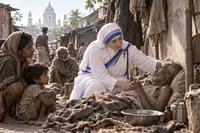
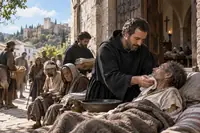
On a stifling summer afternoon in Calcutta, India, a tiny woman in a white sari bordered with blue knelt in a stinking open sewer. With her bare hands she brushed away the maggots crawling over a dying man whose family had thrown him into the street. He opened his clouded eyes, looked at this nun he had never seen before and whispered:
“Why are you doing this for me?”
The woman smiled, laid her wrinkled hand on his forehead and answered gently:
“Because I love you, and Jesus loves you!”
That little woman, who weighed less than forty-five kilograms, was Mother Teresa of Calcutta, before whom the whole modern world bowed in respect. In an age that chased wealth and comfort and worshiped material power, she swam against the tide. She went down to the very bottom of misery to embrace the people society found most repulsive and drove away: lepers covered in sores, AIDS patients in their last days, newborns thrown into garbage bins.
She did not bring them political theories or grand speeches. She brought them a warm hand, a respectful look and a place to die with the dignity of a human being created by God.
Chapter 1 of 6
Gonxha, a young woman of the Balkans
Mother Teresa was born Anjezë Gonxha Bojaxhiu (Gonxha means “rosebud” in Albanian) on August 26, 1910, in Skopje, now the capital of North Macedonia, into a devout Albanian merchant family. Her father, Nikollë Bojaxhiu, was a respected merchant; her mother, Dranafile Bernai, was a devout woman known throughout the area for her generosity to the poor.
When Gonxha was nine, her father died suddenly after a violent illness; many suspected he had been poisoned because of his politics. With the breadwinner gone, her mother worked hard at a sewing and embroidery business to raise three young children. Though the family was now much poorer, Dranafile never forgot the poor. She often told her little daughter:
“Whenever you share a piece of bread with the poor, remember that you are sharing it with Jesus Himself!”
There was always room at the Bojaxhiu table for a wandering beggar.
At eighteen, feeling an urgent call to the missions, Gonxha said goodbye to her mother and her homeland to join the Sisters of Loreto in Ireland, an order devoted to teaching in mission lands. She was sent to India at the beginning of 1929.
After her novitiate in Darjeeling at the foot of the snowy Himalayas, she made her vows and took the religious name Teresa, after Saint Thérèse of the Child Jesus, the saint of the “little way.”
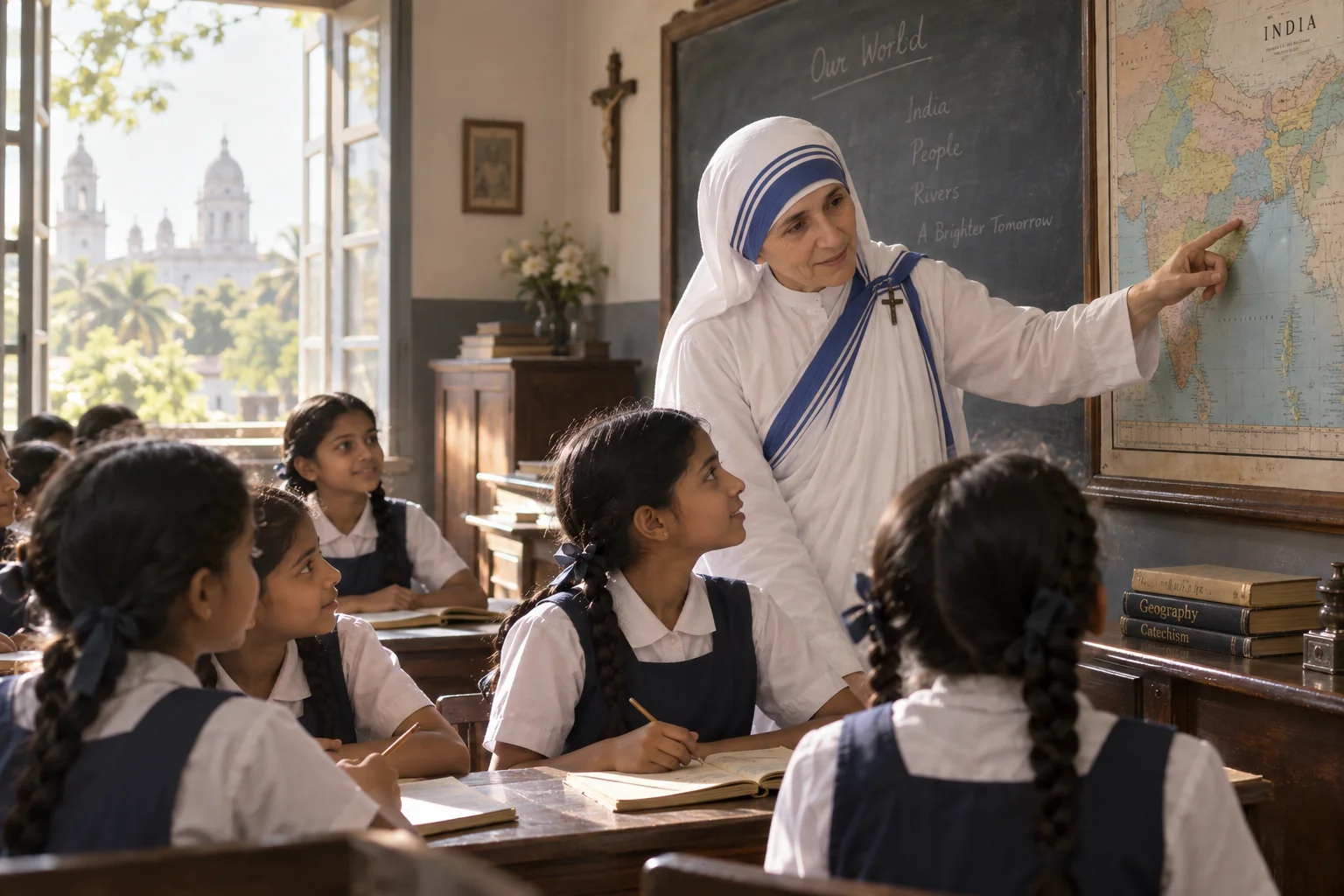
For nearly twenty years Sister Teresa lived peacefully behind the solid walls of St. Mary’s high school on the outskirts of Calcutta. She taught geography and history to girls from well-off families and was later made principal. She was an exemplary nun, dearly loved by students and colleagues. Yet just beyond the school’s brick wall lay the slums of Motijhil, among the poorest, dirtiest and hungriest in the world.
Chapter 2 of 6
“A call within a call”
On September 10, 1946, on a train from Calcutta to Darjeeling for her annual retreat, something happened that turned the thirty-six-year-old nun’s life upside down.
Over the grinding of the wheels on the rails, Sister Teresa suddenly heard a clear, powerful call deep in her heart, which she later called “a call within a call.” The cry of Jesus on the Cross echoed again:
“I thirst!”
Jesus thirsted not only for water but for love, and that thirst had a human face in the poorest of the poor dying on the sidewalks of Calcutta.
The call asked her to give up everything: to leave the safe, comfortable school, take off the Loreto habit and go out to live among the poor, sharing their destitution completely.
After waiting patiently for two years for the approval of the Holy See and the archbishop, on August 17, 1948, Sister Teresa took off her European habit and put on a sari of coarse white cloth with three blue stripes along the border, the simple dress of India’s poorest women street sweepers. She took a short first-aid course in Patna, then, with just five rupees in her pocket, walked alone into the dark slums of Calcutta.
Chapter 3 of 6
First steps, and the house at Kalighat
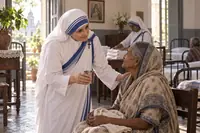
The first days were terribly hard. She had to beg for every bowl of rice and every pill, and she slept in a corner of a poor family’s room. Hands used to holding chalk now washed foul-smelling bodies and bandaged feet that leprosy had robbed of their toes. Some evenings, exhausted and faint with hunger, she was sorely tempted to go back to the comfortable life of her old order. But she bit her lip, knelt to pray and kept going.
In 1949 a former student, Subashini Das, became the first to join her. On October 7, 1950, the Holy See officially recognized the founding of the Missionaries of Charity.
Besides the three vows of poverty, chastity and obedience, her sisters took a special fourth vow:
“wholehearted and free service to the poorest of the poor”
.
In 1952 Mother Teresa opened her first home for the dying at Kalighat, in an abandoned pilgrims’ hostel within the grounds of the Hindu temple most sacred to the goddess Kali, and named it Nirmal Hriday, “Pure Heart.”
At first, angry Hindu extremists surrounded the place, demanding that she be driven out; they suspected she was using charity to lure people into Christianity. She calmly came out and told the police officer:
“If you want to kill me, kill me; but let these poor people have a place to die in peace!”
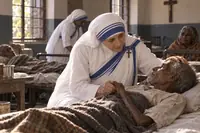
Then one day she found a young Hindu priest with cholera, abandoned by his own people and lying in the street waiting to die. Mother carried him in herself, washed him lovingly and nursed him back to health. Seeing a love that made no distinction of religion, the people knelt to apologize and began to call her a living saint. Over the decades, Nirmal Hriday took in more than fifty-four thousand dying people from the streets of Calcutta, and more than twenty-three thousand of them died there in loving arms instead of alone in the gutters.
Mother said:
“They lived like animals in the street; but we want them to die like angels — loved and respected!”
Chapter 4 of 6
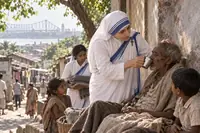
“It is not how much we do...”
From that first house at Kalighat, the Missionaries of Charity soon spread around the world: Shanti Nagar, the Town of Peace, for lepers; Shishu Bhavan, the Children’s Home, sheltering thousands of orphans; homes for AIDS patients in New York; centers for the homeless in London, Rome and Africa.
Wherever people suffered abandoned, Mother and her sisters went: to storms, earthquakes and wars. During the siege of Beirut in 1982, she crossed the lines under bombardment herself to rescue thirty-seven disabled children left behind in a psychiatric hospital.
In 1979, Mother Teresa was awarded the Nobel Peace Prize. At the ceremony in Oslo, Norway, she declined the lavish banquet, worth hundreds of thousands of dollars, and asked that the money be used to buy food for the hungry.
Before heads of state and world-famous scholars, the woman in the faded sari spoke up for innocent unborn children:
“The greatest destroyer of peace today is abortion... If a mother can kill her own child in her womb, what is left to stop you and me from killing each other?”
Her whole outlook on life fits into a few simple words:
“God does not ask us to be successful; He asks us to be faithful... It is not how much we do, but how much love we put into what we do!”
Chapter 5 of 6
The night of faith and silent tears
Yet behind the radiant smile she always wore, Mother Teresa went through a terrible “night of faith” that lasted nearly fifty years.
Her letters to her spiritual directors, published after her death, stunned the world. From 1948 until the day she died, she hardly ever felt the comfort of God’s presence. Her soul was sunk in dryness, coldness and emptiness. She felt completely abandoned by God.
That was her deepest sharing in the thirst of Jesus on the Cross:
“My God, my God, why have You forsaken me?”
She did not give up. The more absent God seemed, the more tightly she clung to faith; the emptier she felt inside, the more love she poured out on the suffering. Her holiness was not a string of sweet, fervent days. It was a heroic act of the will, daring to love until it hurts.
Chapter 6 of 6
A star goes out over Calcutta
In her last years, after several heart attacks and endless journeys, her heart grew very weak.
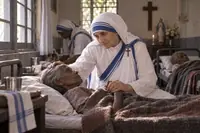
On the evening of September 5, 1997, at the motherhouse in Calcutta, Mother Teresa died peacefully and went home to God, at the age of eighty-seven.
The government of India, a mostly Hindu nation, gave her a state funeral with the highest honors, normally reserved for heads of state. Her coffin was carried on the same gun carriage that had once borne the body of Mahatma Gandhi. Millions of people of every religion, color and caste poured into the streets, weeping, to say goodbye to their beloved Mother.
On October 19, 2003, Pope John Paul II beatified her. On September 4, 2016, Pope Francis canonized Mother Teresa of Calcutta in Saint Peter’s Square. The Church celebrates her on September 5 each year.
Saint Teresa of Calcutta has a very practical message for each of us: we do not need to go all the way to India to find the poor.
The poor are right in our own homes:
- the tired spouse who needs a word of praise;
- the struggling child who needs eyes that listen;
- the elderly father or mother sitting lonely in a corner of the room.
She reminds us:
“Find the poor right in your own home, and begin to love right there!”
The end of the story
You have walked with Saint Teresa of Calcutta to the end of the story.
Three times you stop to read more slowly:
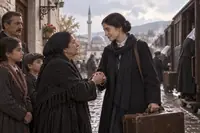
Kneeling in an open sewer, brushing maggots off a dying man, she answered him: "Because I love you, and Jesus loves you!"
The house of Nirmal Hriday took in more than fifty-four thousand dying people, more than twenty-three thousand of whom died in caring arms instead of alone in the gutters.
At the Nobel Peace Prize ceremony, she asked that all the banquet money be used to buy bread for the hungry.
Stay in silence
One thing keeps echoing in you: for nearly fifty years she lived in a "night of faith" without feeling God, and she never stopped pouring out her love for others.
It is not how much we do, but how much love we put into what we do.
Let us pray
Saint Teresa of Calcutta,
you knelt by a sewer to care for a dying man and told him: "Because I love you, and Jesus loves you." Through long years without feeling God’s presence, you never stopped loving.
Teach me to see Jesus in the poorest and most abandoned people around me.
And when my heart is dry and I feel nothing in prayer, help me keep on loving, as you did.
Amen.
Sources
- Feast dayAuthor’s edited profile
- Patron ofPatronages and symbols, version 1.1
- Often depicted withPatronages and symbols, version 1.1
- Reflectionvatican.va
- Reflectioncausesanti.va
Meet the next one
 Journey 4