

Journey 4 · Hands That Stayed with the Suffering
Saint Louise de Marillac
A mother’s heart in the poor streets of Paris
Feast day May 9
Tap to step inside
Saint Louise de Marillac
A mother’s heart in the poor streets of Paris
Map of a life
This life told in 6 chapters
Begin the journey OpeningOpening1 min
 Chapter 1 of 6A childhood in the shadow of rejection1 min
 Chapter 2 of 6The light of Pentecost1 min
 Chapter 3 of 6An apostle on the roads1 min
 Chapter 4 of 6The birth of the Daughters of Charity1 min
 Chapter 5 of 6Overcoming inner turmoil1 min
 Chapter 6 of 6Her last breath, and the legacy she left2 min
Feast day
Saint Louise de Marillac
Some places may celebrate on a slightly different day.
May 9
Patron of
- Social workers (declared by John XXIII in 1960)
- Widows
- The Daughters of Charity
Often depicted with
- A black habit
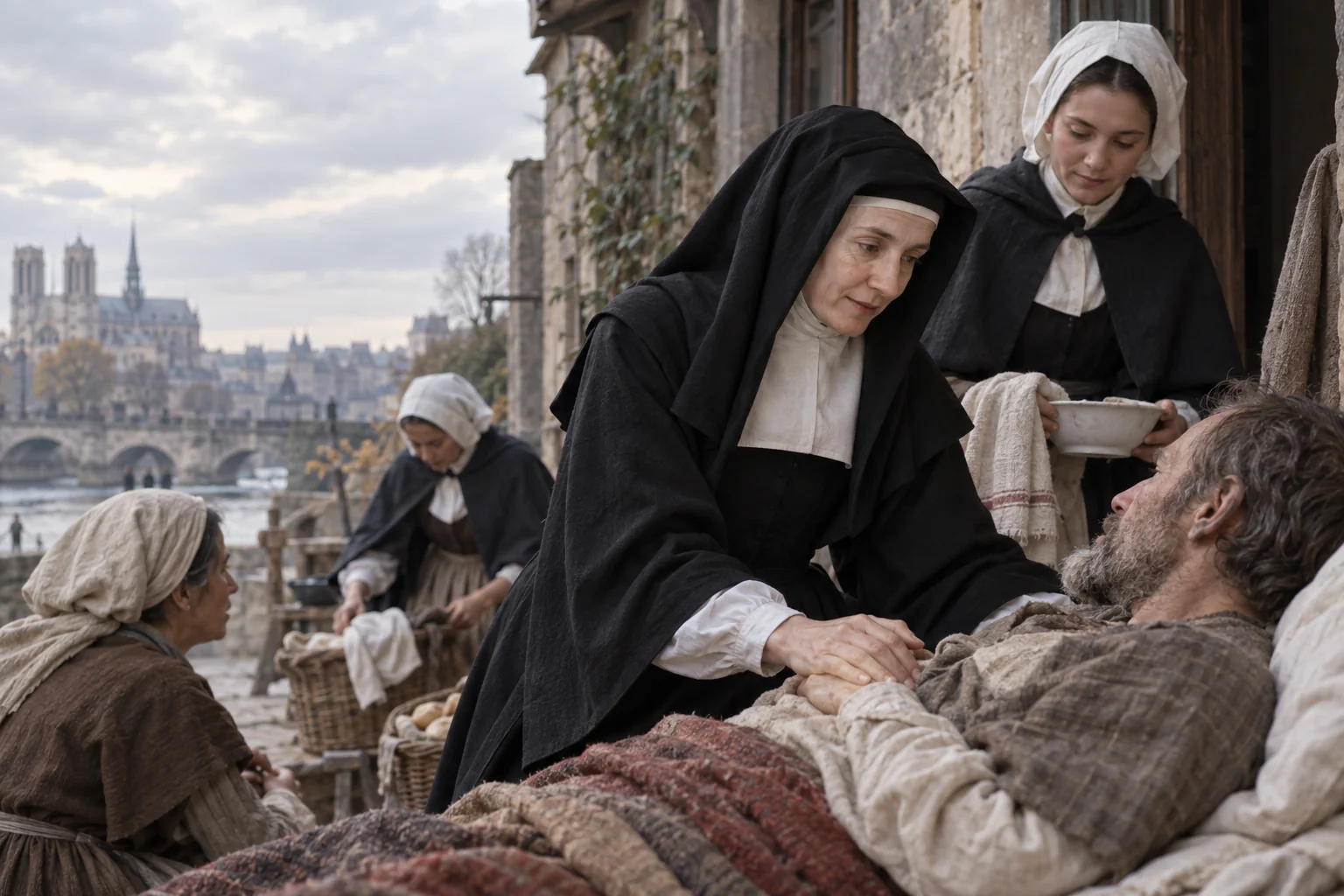
- At the bedside of the sick
Opening
Opening
Many women who live through broken relationships, loss and long illness close their hearts in loneliness and bitterness. But in Louise de Marillac, the deep wounds of a child who never knew her mother, a wife widowed young and a mother always anxious for her only son became the soil in which a great mother’s love grew.
She was more than Saint Vincent de Paul’s capable co-worker. She was the mother, the teacher and the heart of the Daughters of Charity, the first sisters in the history of the Church who dared to leave the cloister to carry love into muddy streets, foul-smelling hospitals and tumbledown huts.
God’s grace turned an anxious noblewoman in fragile health into an outstanding organizer of charity who stood firm in troubled times.
Chapter 1 of 6
A childhood in the shadow of rejection
Louise de Marillac was born on August 12, 1591, in Paris, France. Her father was Louis I de Marillac, a distinguished nobleman of the illustrious Marillac family at the French court. But her life was marked by sorrow from the day she was born: Louise was born outside marriage, and no one has ever known who her mother was. Her kind father acknowledged her and provided for her, but growing up without a mother’s love left a deep wound in the girl’s heart.
As she grew up, Louise was sent as a boarder to the Royal Monastery of Saint-Louis at Poissy, run by Dominican nuns. There she received a thorough education in philosophy, literature, painting and theology. The years spent within the sound of the nuns’ chant planted in her the wish to give her whole life to God as a Capuchin nun, among the sisters known as the Daughters of the Passion.
But when she asked to enter, the superior turned her down: her health was too frail. Her spiritual director told her that God had other plans for her life, though at the time she could not see what they might be.
In 1604 her father died; Louise was only thirteen. Left without her one support, she was moved to a modest boarding house in Paris, where she learned thrift and housekeeping and got a taste of how uncertain life can be.
In 1613, in a marriage arranged by her family, Louise married Antoine Le Gras, a hardworking secretary at the royal court. They had one son, Michel. Louise devoted herself to her husband and child and to the duties of a noblewoman, but she was still torn by anxiety and guilt over the call to religious life she had once felt.
Chapter 2 of 6
The light of Pentecost
More trials followed: Antoine fell seriously ill for many years and became irritable and difficult. Louise nursed him devotedly day and night, while also worrying endlessly about her son Michel, who was slow to develop and moody. She fell into a severe spiritual crisis, convinced that her family’s sufferings were punishment for not following her early wish to become a nun.
On the feast of Pentecost 1623, while she knelt in prayer in the church of Saint-Nicolas-du-Chardonnet in Paris, Louise received a grace that swept away all her anxieties. She later called it the
“Light of Pentecost”
.
God made three things clear to her:
- she would stay to care for her husband until the day he died;
- afterwards, she would make vows of poverty, chastity and obedience;
- and she would be in a small community devoted to serving others, a place with no convent walls, going about freely to care for the poorest of the poor.
She wrote down what she had experienced on a small piece of paper, folded it, and carried it with her for the rest of her life, like a compass.
In 1625 Antoine died peacefully, nursed to the end by his wife. Widowed at thirty-four, Louise placed her life under the guidance of a priest who looked plain and countrified but burned with the fire of charity: Father Vincent de Paul.
Chapter 3 of 6
An apostle on the roads
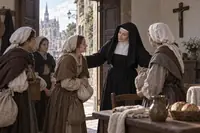
Father Vincent, a wise man, saw in this widow a hidden fire that needed to be freed from her many small anxieties. Instead of letting her sit at home brooding on her sorrow, in 1629 he gave her a bold mission: to travel around visiting, organizing and linking together the
“Confraternities of Charity”
scattered in country parishes throughout France.
Despite her poor health, Louise de Marillac climbed into jolting carriages and made her way to one remote village after another. She met with the members, taught them how to care for the sick and keep accounts, checked the stores of medicine, and made peace where there were quarrels.
These journeys drew her out of the shell of her own insecurity. She saw with her own eyes the extreme poverty of the peasants and the lack of schooling for girls, and she saw a great gap: the noble ladies of the Confraternities, generous as they were, could not themselves do the heavy, dirty work of changing bandages and washing the sick who were covered in sores.
There had to be people who would freely give their whole lives to doing those humble tasks directly, with all their love.
Chapter 4 of 6
The birth of the Daughters of Charity
On November 29, 1633, in her small house near the church of Saint-Nicolas-du-Chardonnet in Paris, Louise de Marillac opened her door to the first four poor country girls who came to live with her, among them the simple Marguerite Naseau.
That was the birthday of the Daughters of Charity, the Filles de la Charité.
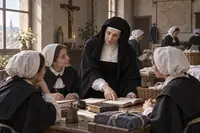
Louise de Marillac was the mother and teacher who trained and formed these country girls herself. She taught them to read, to prepare medicines and bandage wounds, and above all to see Christ Himself in the poor.
Under the spiritual guidance of Father Vincent de Paul and the gifted organizing hand of Mother Louise, the Daughters of Charity brought about a revolution in religious life. They were not shut behind convent grilles; they wore a coarse gray habit and the plain white winged headdress of French country girls of the day. They went everywhere: to the great hospitals of Angers and Nantes, to leper houses, to battlefields to nurse the wounded, and to the dungeons where convicts waited to be sent to the galleys.
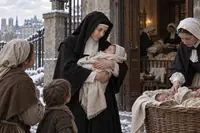
Above all, Louise’s mother’s heart ached for the hundreds of newborns abandoned in the streets of Paris every year. With Father Vincent she founded a home for abandoned infants. With her own hands she bathed, warmed and held the babies left out on snowy winter nights, found trustworthy wet nurses, and saw to their schooling as they grew.
Chapter 5 of 6
Overcoming inner turmoil
Though busy running a congregation that was spreading rapidly across France and Poland, Louise de Marillac never stopped being a mother, with a mother’s very human worries.
Her only son Michel was an open wound in her heart: he left his studies unfinished, dropped out of the seminary and drifted, and she wept silently through many sleepless nights. Father Vincent de Paul wrote to her again and again, urging her to entrust her son to God and not to let family worries paralyze her faith.
Only in 1650, when Michel married and gave her a granddaughter, did Louise find peace. The pain of raising a difficult child made her endlessly understanding toward the poor mothers and broken families she met every day.
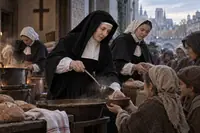
During the years of the Fronde, the civil war that ravaged France, when Paris sank into hunger and chaos, Mother Louise’s house became the center of relief work. Though her body was broken by illness and constant fevers, she worked day and night to find flour and soup for thousands of refugees.
Chapter 6 of 6
Her last breath, and the legacy she left
In early 1660, gangrene and infection broke Mother Louise’s health completely. Lying in her sickbed in Paris, she knew she would soon go home to the Father. Father Vincent de Paul was also gravely ill at the nearby house of Saint-Lazare and could not come to see her one last time. Two great souls who had worked together for thirty-five years and done wonders of charity said goodbye in silence, united in faith and prayer.
Before she closed her eyes, Mother Louise de Marillac left these last words to the Daughters of Charity kneeling around her bed:
“Always be united and love one another with all your hearts... Be faithful to your calling to serve the poor... Always pray to Our Lady, the only Mother of the Company!”
On March 15, 1660, Mother Louise died peacefully at the age of sixty-nine, six months before Father Vincent.
Pope Benedict XV beatified her in 1920, and on March 11, 1934, Pope Pius XI canonized Louise de Marillac. In 1960 Pope John XXIII proclaimed her patron of all Christian social workers. The Church celebrates her on May 9 each year, formerly on March 15. Her remains rest today inside a wax figure in the Chapel of Our Lady of the Miraculous Medal on the Rue du Bac in Paris. The same chapel keeps the heart of Saint Vincent de Paul and the incorrupt body of Saint Catherine Labouré, to whom Our Lady appeared there in 1830; it is one of the most visited places of pilgrimage in Paris, with more than two million visitors a year.
In Vietnam, the winged headdress and simple blue habit of the Daughters of Charity of Saint Vincent de Paul are a familiar sight in leper villages, orphanages, centers for people with disabilities and hospitals.
Saint Louise de Marillac shows us that no painful past or difficult family situation can keep a person from becoming an instrument of God’s peace. When a woman dares to turn the tears of her own suffering into sweet milk that soothes the pain of others, the Kingdom of God is there in the midst of the world.
The end of the story
You have walked with Saint Louise de Marillac to the end of the story.
Some things you will not easily forget:
A girl who never knew who her mother was, and carried that wound all her life like an emptiness never filled.
In the church of Saint-Nicolas, a vision she called the "Light of Pentecost" dispelled all her turmoil, and she wrote it on a scrap of paper she always carried like a compass.
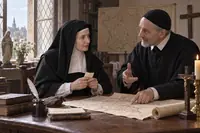
On winter nights in Paris, she bathed and warmed with her own hands newborns abandoned in the streets.
Stay in silence
And you ask yourself: what turned a frail, anxious woman into a steadfast organizer of charity in troubled times?
No painful past can keep a person from becoming an instrument of peace, if they dare to turn their own tears into sweet milk for others.
Let us pray
Saint Louise de Marillac,
you never knew your mother’s face, and carried that sorrow all your life. Yet you yourself bathed and warmed so many newborns abandoned in the streets of Paris.
Pray for abandoned and orphaned children, and for those who care for them.
May those who are anxious, as you once were, find peace in God, and learn to turn their own pain into love for others.
Amen.
Sources
- Feast dayAuthor’s edited profile
- Patron ofPatronages and symbols, version 1.1
- Often depicted withPatronages and symbols, version 1.1
- Reflectionfilles-de-la-charite.org
- Reflectionvaticanstate.va
Meet the next one
 Journey 4