

Journey 4 · Hands That Stayed with the Suffering
Saint Vincent de Paul
An organizer of charity in troubled times
Feast day September 27
Tap to step inside
Saint Vincent de Paul
An organizer of charity in troubled times
Map of a life
This life told in 5 chapters
Begin the journey
Feast day
Saint Vincent de Paul
Some places may celebrate on a slightly different day.
September 27
Patron of
- All Catholic charitable organizations (declared by Leo XIII in 1885)
- The poor
- The Saint Vincent de Paul Society
Often depicted with
- Holding an abandoned infant
- A priest’s black cassock
Opening
Opening
There are times in history when poverty and suffering rise like a devastating flood: brutal wars leave villages in ruins, the starved lie dead by the roadside, thousands of newborns are abandoned in the corners of winter markets, and the rusty chains of galley convicts eat deep into their flesh.
Faced with that vast sea of suffering, compassion that is only a passing feeling soon runs dry. It takes a heart on fire with the love of the Gospel, joined to a practical, methodical mind for organizing and an iron will.
Saint Vincent de Paul was the man God sent to France and to the Church of the seventeenth century.
He did more than kneel beside each poor person himself. He brought about a revolution, gathering people of every class, from noble ladies in splendid palaces to simple country girls, and turning charity into an organized, skilled and lasting network of service. He has always been honored as the “Apostle of the Poor” and as patron of all Catholic charitable organizations throughout the world.
Chapter 1 of 5
A young priest looking for an easy life
Vincent de Paul was born on April 24, 1581, in the small village of Pouy, in Gascony in southwestern France, into a poor farming family of six children. As a boy, Vincent herded sheep and pigs in muddy fields. Seeing that his third son was bright and quick, his poor father gritted his teeth and sold the plow oxen — the family’s most precious possession — so the boy could go to school.
In 1600, at just nineteen, Vincent was ordained a priest. But by his own honest admission later, what first drew the poor young man to the altar was not a lofty ideal of sacrifice, but the wish to escape rural poverty, to find a comfortable benefice or an easy position so he could retire early and support his aging parents.
A letter he wrote in 1607 tells of his being captured by Barbary pirates on the Mediterranean, sold as a slave in Tunis, North Africa, and later converting his Muslim master so they could escape back to Europe together. Though the historical accuracy of this slavery story is still debated by scholars, those insecure years of youth, debt and failure slowly shaped his soul.
In 1610 he came to Paris and became chaplain to Queen Marguerite de Valois. There he went through a terrible crisis of faith lasting three years: his soul sank into a darkness of doubt so dry and cold he could hardly breathe.
In that spiritual anguish, he fell on his knees and made a promise to God: he would give the rest of his life entirely to serving the poorest of the poor, if God would mercifully lift this darkness of doubt from him. At once, sweet peace returned to his soul; and from that moment, his life changed course completely.
Chapter 2 of 5
Two events that awakened a mission
In 1613, introduced by his learned spiritual director, Bérulle, Father Vincent became tutor and chaplain to the famous noble family of Gondi — one of the most powerful families in France at that time. Life in their elegant châteaux led to two decisive events in 1617:
The first took place in January 1617 at the castle of Folleville, in Picardy in northern France: Father Vincent was called to the bedside of an old dying peasant, whom the whole village had always considered a model of piety. Put at ease by Vincent’s kindness, the peasant tearfully confessed grave sins he had hidden all his life and had never dared to admit to the country priests.
The sick man exclaimed:
“Without this confession, I would have been damned!”
Shaken by the spiritual ignorance of millions of poor peasants left to themselves in the countryside, on January 25, 1617, Father Vincent preached a sermon on general confession in the church at Folleville that would make history. Thousands flocked to the confessional, and he saw an urgent call: to bring the Gospel to the poor in the countryside. The Congregation of the Mission that he later founded came to regard that day as its official birthday.
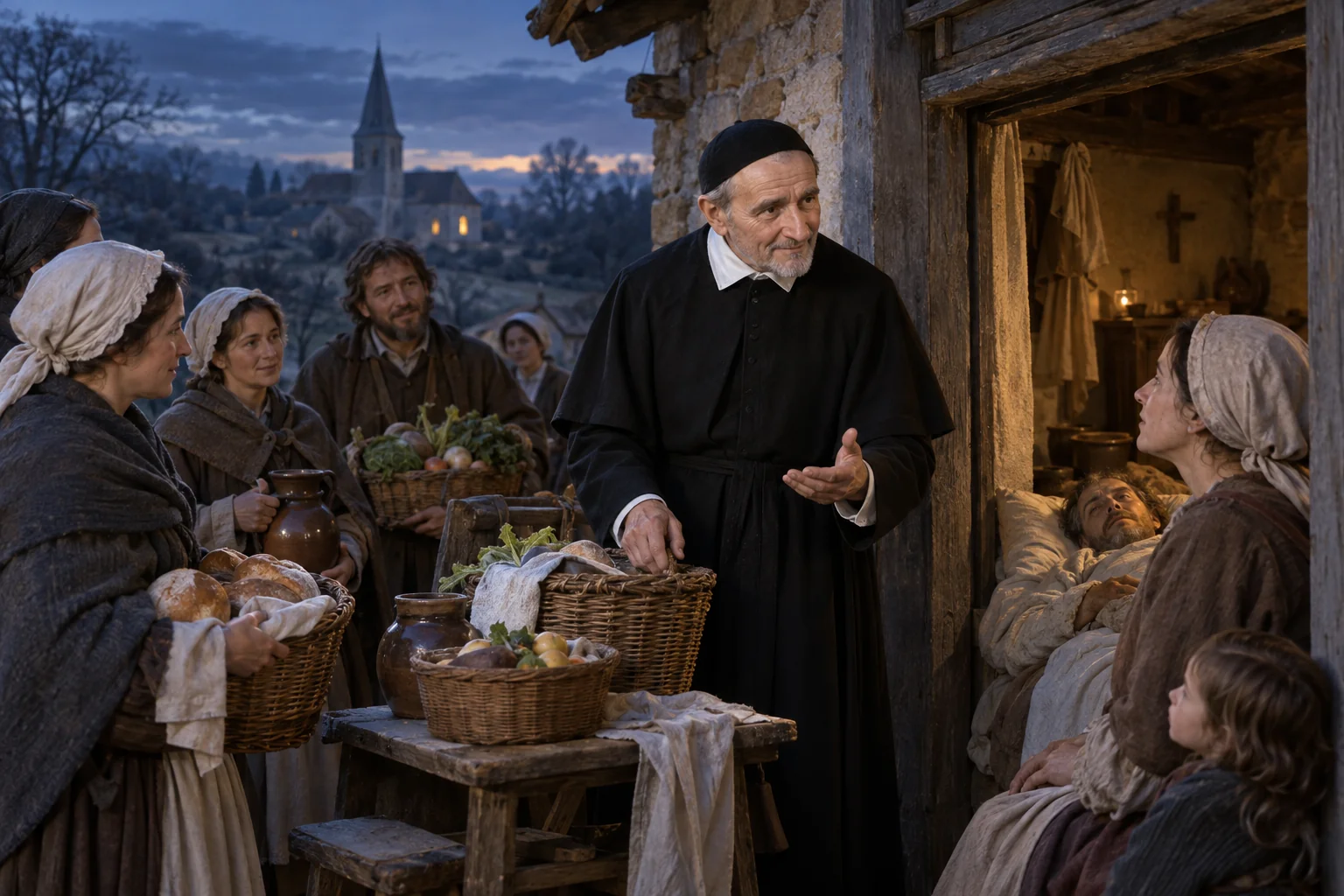
The second took place in August of that year in the parish of Châtillon-les-Dombes: before Sunday Mass, he was told that a poor farming family in the parish was stricken with a dangerous illness, the whole household bedridden with no one to care for them and about to starve. From the pulpit, he earnestly urged the parishioners to help generously.
That afternoon, when he walked out to visit the family, he was astonished to see streams of people bringing food and clothing to help. There was so much food piled up that what could not be eaten would spoil, while in a few days the family would be hungry again just as before.
He suddenly saw something important: there is plenty of goodwill in people, but without wise organization it is wasted and does no lasting good. The very next day, he gathered the devout women together and founded the “Confraternity of Charity”, forerunner of today’s Saint Vincent de Paul societies, with a clear rule: taking turns, one each day, to go in person to care for, cook for and support the sick family.
Chapter 3 of 5
Great works of love
From those two turning points of 1617, Father Vincent de Paul devoted the more than forty years left to him to building great works of charity that changed the face of French society.
First came the Congregation of the Mission, also called the Lazarists or Vincentians, founded in 1625 with the support of the Gondi family. Its priests pledged to give up honors and positions in the cities and to devote themselves to going to the most remote villages to preach missions and to form the clergy. Seeing how poorly priests were prepared at the time, he started retreats for candidates for ordination, organized Tuesday conferences for the clergy, and became a pioneer in establishing seminaries to train priests in the spirit of the Council of Trent.
Next came the Daughters of Charity of Saint Vincent de Paul, founded in 1633 with Saint Louise de Marillac. At that time, all sisters were required to live behind enclosure walls. Father Vincent and Mother Louise did something unheard of: they gathered poor country girls who wore no elaborate habit and lived behind no convent grille.
- Their convent was the sickroom;
- their cell a shabby rented room;
- their chapel the parish church;
- and their enclosure the fear of God!
They went through every alley and street caring for the poor, serving in hospitals, and looking after orphans and war wounded.
Appointed Chaplain General of the Royal Galleys in 1619, he went down himself into the dark holds of the ships, where thousands of convicts were chained by the ankle to the rowing benches, savagely beaten and living amid scabies and stench. He bandaged their wounds, demanded that they be treated as human beings, and brought God’s love to soften hardened hearts. Seeing that every year hundreds of infants were abandoned in the streets of Paris in winter, to be bitten by dogs or freeze to death, he founded the Work of the Foundlings, carrying the newborns in his own arms to entrust them to the Daughters of Charity to raise.
Chapter 4 of 5
Bowing before the poor
Amid countless pressing tasks, Father Vincent held fast to one principle: the poor are our true teachers and masters.
He taught his priests and sisters:
“We must serve the poor with deep reverence and sincere gratitude, for through them we serve Christ Himself. When you have to leave your prayer to go and cook a bowl of soup for a sick person, do not be troubled, for that is leaving God for God!”
During the civil war of the Fronde that ravaged France from 1648 to 1653, terrible famine struck Lorraine and Paris. Father Vincent organized a relief network on a scale never seen before: raising millions of livres from the nobility and setting up soup kitchens that saved tens of thousands of lives every day.
He even went boldly into the royal palace to confront the powerful Cardinal Mazarin and urge him, for the sake of the poor, to end the war.
Chapter 5 of 5
The apostle at rest
In his last years, Father Vincent’s legs were badly swollen and ulcerated, and he could no longer walk. He had to sit in an old wooden chair at the house of Saint-Lazare in Paris, but his mind and pen never stopped directing his works of charity far and wide.
Early on the morning of September 27, 1660, seated in his familiar armchair, Father Vincent de Paul died peacefully, at the age of seventy-nine. His last words were a profession of faith:
“Lord, I trust in You!”
Pope Benedict XIII beatified him in 1729, and on June 16, 1737, Pope Clement XII canonized him. In 1885, Pope Leo XIII solemnly proclaimed Saint Vincent de Paul patron of all Catholic charitable organizations throughout the world. The Church celebrates him on September 27 each year. During the French Revolution, when religious houses were dissolved and plundered, his remains were hidden at great risk by the Daughters of Charity in their own chapel on the Rue du Bac to protect them from desecration; only in 1830 were they solemnly brought to the new church built specially in his honor, where his relics still rest today in a silver reliquary above the main altar.
In Vietnam, the spirit of Saint Vincent de Paul is deeply present through the priests of the Congregation of the Mission, the Daughters of Charity, and above all the Saint Vincent de Paul Society, found in almost every parish.
Saint Vincent de Paul has a lesson for everyone who works in charity: charity is not condescension; true charity must go hand in hand with respect for human dignity, must be wisely organized, and must be nourished by a deep life of prayer.
He saw Jesus hidden beneath the rags of a beggar. And with his whole life, he taught us how to love the poor with our own hands and our own concrete work.
The end of the story
You have walked with Saint Vincent de Paul to the end of the story.
A few scenes keep coming to mind:

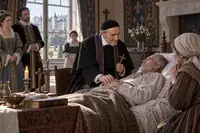
The dying old peasant tearfully confessing a sin hidden all his life, then crying out: "Without this confession, I would have been damned!"
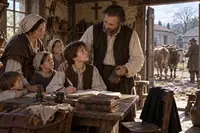
One afternoon in Châtillon, the food people brought piled up so high it would spoil — while in a few days the family would be hungry again.
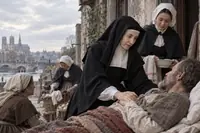
He went down into the holds of the galleys, bandaging the wounds of convicts chained to the rowing benches.
Stay in silence
What makes you stop is this: spontaneous compassion dries up easily, but when it is organized with both mind and heart, it can feed a whole nation.
When you have to leave your prayer to go and cook a bowl of soup for a sick person, that is leaving God for God.
Let us pray
Saint Vincent de Paul,
you went down into the holds of the galleys to bandage chained convicts, and organized mercy so that it reached the poor steadily, leaving no one out.
Pray for those doing works of charity in my parish. May they work with both their minds and their hearts.
Teach me to give up my rest to help someone who is sick, and to believe that when I do, I meet God Himself.
Amen.
Sources
- Feast dayAuthor’s edited profile
- Patron ofPatronages and symbols, version 1.1
- Often depicted withPatronages and symbols, version 1.1
- Reflectionfilles-de-la-charite.org
- Reflectionvincentian.org
Meet the next one
 Journey 4