

Journey 4 · Hands That Stayed with the Suffering
Saint Martin de Porres
A broom that swept away dividing walls
Feast day November 3
Tap to step inside
Saint Martin de Porres
A broom that swept away dividing walls
Map of a life
This life told in 5 chapters
Begin the journey OpeningOpening1 min
 Chapter 1 of 5A rejected child in the city of Lima1 min
 Chapter 2 of 5A willing servant at the Holy Rosary friary1 min
 Chapter 3 of 5An infirmary of mercy and a kingdom of animals1 min
 Chapter 4 of 5A lamp burning all night, and a peaceful death1 min
- Chapter 5 of 5A saint of reconciliation and social justice1 min
Feast day
Saint Martin de Porres
Some places may celebrate on a slightly different day.
November 3
Patron of
- Racial reconciliation
- Social justice
- Health workers
- Peru
Often depicted with
- A broom
- A dog, a cat and a mouse eating from one dish
Opening
Opening
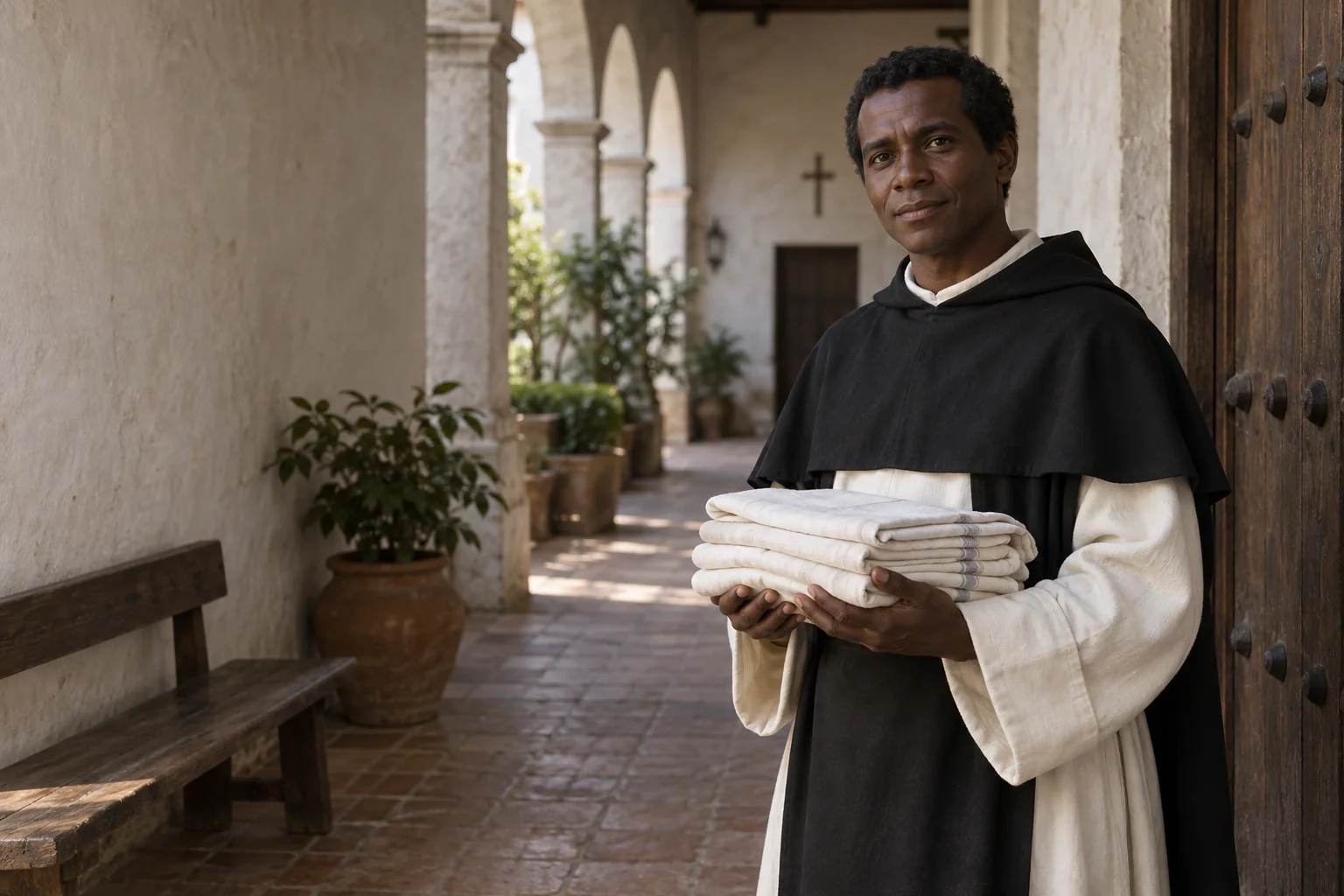
At the friary of the Holy Rosary in seventeenth-century Lima, people were used to seeing a dark-skinned brother quietly sweeping the long corridors with a broom. His white Dominican habit and black cloak were worn thin at the shoulders, his hands were stained from washing the festering wounds of the sick, and night after night he knelt before the crucifix in a corner of the empty chapel.
That brother was Martin de Porres, rejected at birth by his own father for being of mixed race, and despised by colonial society as one of the lowest of the low.
Yet this man from the bottom of society became the great healer of Lima, a father to countless suffering people, and a living sign of a Christian love that breaks down every wall of color, race and class.
Chapter 1 of 5
A rejected child in the city of Lima
Martin was born on December 9, 1579, in the city of Lima, capital of Peru, then a colony of the Spanish Empire. His father, Juan de Porres, was a distinguished Spanish nobleman and knight; his mother, Ana Velázquez, was a free Black woman of Panamanian origin.
When he saw that his firstborn had his mother’s dark skin, the nobleman felt his family’s honor had been insulted and refused to acknowledge the child. The baptismal record says simply: “Martin, father unknown”. His mother worked alone as a washerwoman to raise Martin and his younger sister Juana in grinding poverty.
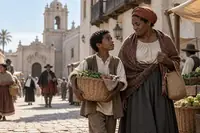
Though he grew up poor and despised in an unjust colonial society, young Martin showed a remarkably kind heart from early on. Whenever his mother gave him money to buy food at the market, he would give most of it away to starving beggars on the way, and then get a beating from his mother when he got home.
When Martin was eight, his father, after a long absence, came back and took the two children to Guayaquil, Ecuador, to raise them. But only a few years later, his father sent Martin back to Lima to his poor mother.
At twelve, Martin asked to be apprenticed in the shop of a barber-surgeon in the city. There he worked hard, learning to prepare herbal remedies, bandage wounds, pull teeth and practice basic medicine. With his skillful hands and compassionate heart he became a devoted assistant, who always put poor patients who could not pay first.
Chapter 2 of 5
A willing servant at the Holy Rosary friary
At fifteen, sensing God’s call, Martin knocked at the door of the Dominican friary of Santo Domingo, the friary of the Holy Rosary, in Lima. It was a vast complex in the center of the city, whose cloisters were lined with tiles brought from Seville in the early seventeenth century.
Under the laws of the Spanish Empire and the rules of religious orders at that time, Black people and people of mixed race could not become priests or professed brothers. Well aware of his place, Martin asked for no privilege. He humbly asked to enter as a donado, a lay helper who did the heaviest menial work and lived poorly in the friary.
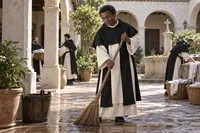
For nine long years, Martin did the lowliest jobs: sweeping the friary, scrubbing the latrines, washing the friars’ dirty clothes, working in the kitchen, and shaving his brothers and cutting their hair. The broom became his constant companion.
He did those humble tasks with joy and reverence, seeing Christ Himself in each of his brothers. When some hot-tempered young friars hurled insults at him, calling him a “mulatto dog”, Martin only smiled and bowed his head, considering himself fully deserving of those insults.
Seeing his holiness and deep humility, in 1603 the superiors set custom aside and allowed Martin to make his solemn vows as a Dominican brother. Once, when he learned that the friary was deep in debt, Brother Martin ran and fell at the prior’s feet with a request that stops the heart:
“Father, I am only a poor, useless Black man; sell me as a slave to pay the friary’s debts!”
Chapter 3 of 5
An infirmary of mercy and a kingdom of animals
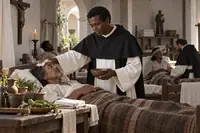
Brother Martin was put in charge of the friary’s infirmary. With his medical knowledge, his experience with herbs, and above all a gift of healing from God, he cared for thousands of patients.
His charity did not stop at the friars; it spilled out into the streets of Lima. Every day he gave out food to hundreds of poor people, to Black slaves mistreated by their masters, and to Indigenous people worked to the bone. He turned his little cell into an emergency room for the sick.
When the superior, fearing contagion, strictly forbade him to bring sick people with sores from the street into the sleeping quarters of the friary, Martin obeyed and took them to his sister Juana’s house. But once he came upon a beggar with a contagious disease lying by the roadside, close to dying of cold. Martin risked everything, carried him in on his back and laid him in his own bed.
When the superior sternly rebuked him for disobeying, Brother Martin humbly replied with words straight from the Gospel:
“Forgive me, Father, for obedience is precious indeed, but charity toward those in need is far greater!”
The superior was moved, and from then on let him follow the promptings of charity freely.
Brother Martin’s kindness reached even the animals. He set up a place to care for injured stray dogs and cats, and fed old, worn-out donkeys turned out by their owners. Even the mice that chewed the books and altar breads were gently scolded and led to a corner of the garden of their own, where he fed them every day. The picture of Brother Martin feeding a dog, a cat and a mouse from the same dish has become a lovely image of the peace of God’s Kingdom.
He also founded the first orphanage and free school in Lima, named Santa Cruz, where hundreds of homeless, abandoned children were fed, taught and given an honest trade.
Chapter 4 of 5
A lamp burning all night, and a peaceful death
Behind those ever-busy hands was a life of prayer deeply united with Jesus crucified. By day he served others; at night Brother Martin usually slept only a few hours on a plank at the foot of the altar and spent most of the night kneeling before the tabernacle or beneath the great crucifix in the chapter room.
Many witnesses spoke of extraordinary gifts God gave him: being lifted into the air in ecstasy at prayer, reading souls, and bilocation, appearing in two places at once to comfort prisoners in North Africa or the dying thousands of miles away. Yet Brother Martin always thought of himself as the most useless sinner on earth.
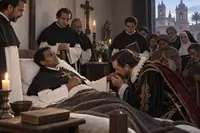
In the autumn of 1639, at the age of sixty, Brother Martin fell gravely ill with fever and knew his time had come to go home to the Father. The whole city of Lima was shaken. Bishops, nobles and officials, slaves and ragged beggars, all streamed to the friary of the Holy Rosary to see their beloved father and brother one last time. The Viceroy of Peru himself came and knelt at his bedside, kissing the humble brother’s dark hand to ask for his blessing.
On the evening of November 3, 1639, as his brothers recited the Creed together, at the words
“and became man”
, Brother Martin de Porres smiled peacefully, held the crucifix to his chest and died. He was buried in a chapel off the second cloister of the friary of Santo Domingo, where the remains of two other Peruvian saints of his time, Saint Rose of Lima and Saint John Macías, are also kept today. It is one of the holiest places of pilgrimage in Latin America.
Chapter 5 of 5
A saint of reconciliation and social justice
Brother Martin’s funeral was unlike anything Peru had seen. The coffin of the brother once scorned as a “bastard child of color” was carried, in turns, on the shoulders of the Viceroy himself, the Archbishop of Lima and the most distinguished knights, through a sea of weeping people.
Pope Gregory XVI beatified him in 1837, and on May 6, 1962, Pope John XXIII canonized Martin de Porres. He was made patron of racial reconciliation, of social justice and of health workers. The Church celebrates him on November 3 each year.
In Vietnam, the image of “Saint Martin, the dark-skinned saint”, broom in hand, is found in almost every church. Poor working people find in him a friend who understands their hard lives.
Saint Martin de Porres reminds us that a person’s worth does not lie in skin color, noble birth or social status. It is measured by the humble love that bends down to wash the feet of others. Saint Martin’s broom swept away the walls of prejudice and made room for real brotherhood among the children of one Father in heaven.
The end of the story
You have walked with Saint Martin de Porres to the end of the story.
Long after the story ends, you still see:
A boy rejected by his own father because of his skin, still sharing all his market money with beggars and then taking a beating at home.
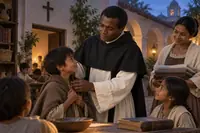
The brother falling at his superior’s feet, asking: "Sell me as a slave to pay the friary’s debts!"
The picture of him feeding a dog, a cat and even the troublesome mice from a single dish.
Stay in silence
A question you ask yourself: when his brothers in the order hurled the insult "mulatto dog" at him, what made him only smile and bow his head, without a word of resentment?
Obedience is precious, but charity toward those in need is far greater.
Let us pray
Saint Martin de Porres,
you were rejected by your own father because of your skin, insulted by your brothers in the order, and yet you only smiled and bowed your head. You swept floors, cared for the sick, and loved even the smallest animals.
Pray for those looked down on because of their skin, their origins or their circumstances. Let them know how precious they are before God.
Teach me to do humble work gladly, and to treat every person and every creature with kindness.
Amen.
Sources
- Feast dayAuthor’s edited profile
- Patron ofPatronages and symbols, version 1.1
- Often depicted withPatronages and symbols, version 1.1
- Reflectionvaticannews.va
- Reflectionop.org
Meet the next one
 Journey 4