

Journey 4 · Hands That Stayed with the Suffering
Saint Anthony of Padua
A voice for the poor and the fire of God’s word
Feast day June 13
Tap to step inside
Saint Anthony of Padua
A voice for the poor and the fire of God’s word
Map of a life
This life told in 6 chapters
Begin the journey OpeningOpening1 min
 Chapter 1 of 6A young nobleman of Lisbon1 min
 Chapter 2 of 6The fire of martyrdom and a coarse habit1 min
 Chapter 3 of 6A hidden jewel discovered1 min
 Chapter 4 of 6The hammer of heresy and a voice for the poor1 min
 Chapter 5 of 6The last hours at Camposampiero1 min
 Chapter 6 of 6A saint for the whole world1 min
Feast day
Saint Anthony of Padua
Some places may celebrate on a slightly different day.
June 13
Patron of
- Finding lost things
- The poor (Saint Anthony’s Bread)
- Portugal and the city of Padua
Often depicted with
- The Child Jesus standing on a book
- A lily
- A loaf of bread
Opening
Opening
Most people know Saint Anthony of Padua as the young friar holding the Child Jesus in his arms, or as the saint you pray to when something is lost. Yet behind that simple devotion lies a fiery life. He was a famous preacher who shook the cities of the Middle Ages, a learned Doctor of the Church, and above all a man who dared to use his voice and his standing to confront tyrants, defend the poor against moneylenders and demand justice for those who had no voice.
Born to silks in a noble family, he freely chose the coarse habit of a mendicant friar. He wanted to shed his blood as a martyr in faraway lands, but God kept him in the crowded streets of Europe to heal wounded souls.
Chapter 1 of 6
A young nobleman of Lisbon
Anthony was born around 1195 in Lisbon, Portugal, and baptized Fernando Martins de Bulhões. His family was of distinguished noble stock and lived near the city’s cathedral. He could easily have made his name in the world or in the army, but young Fernando’s heart turned early to the things of God.
At fifteen, despite his family’s objections, he gave up his privileged life to join the Canons Regular of Saint Augustine at the monastery of São Vicente de Fora outside Lisbon. Soon afterwards, tired of the noisy visits of friends and relatives that kept him from prayer, he asked to be transferred to the monastery of Santa Cruz in Coimbra, then the great center of learning and culture in Portugal.
In Coimbra he spent nearly ten years studying Scripture and the theology of the Church Fathers. With his extraordinary memory and deep love for God’s word, Fernando built up a vast knowledge of the Bible, the solid ground for all his later preaching.
Chapter 2 of 6
The fire of martyrdom and a coarse habit
In 1220, one event turned his life around. The bodies of the first five Franciscan friars martyred in Morocco were brought back and solemnly buried at the monastery of Santa Cruz in Coimbra. As Fernando looked on these poor friars who had given their lives for the Gospel, a fire blazed up in his heart.
He asked permission to move from the Augustinian Canons to the newly founded Order of Friars Minor, the Franciscans. When he put on the new order’s coarse brown habit tied with a rope, he took the name Anthony, after the hermit Saint Anthony the Great, as a sign that he was leaving his old self behind for good.
Anthony’s only wish then was to be sent to Morocco to preach the Gospel and to die a martyr like the five friars before him. But God had other plans. As soon as he set foot in Morocco he fell gravely ill, and he stayed ill for months. His broken health forced him to take a ship home.
On the way home, a violent storm drove his ship to Sicily, in southern Italy. From there his road took a completely different turn. He walked north into central Italy and attended the General Chapter of the Franciscans in Assisi in 1221, where he saw the founder, Saint Francis of Assisi, with his own eyes for the first time.
Chapter 3 of 6
A hidden jewel discovered
Anthony was so humble and quiet that after the chapter no one knew how learned he was. He was sent to the remote hermitage of Montepaolo near Forlì. There he lived quietly in a small cave, doing the lowliest kitchen jobs, sweeping the house and spending long hours in prayer.
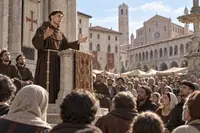
One day, at an ordination in Forlì attended by both Dominicans and Franciscans, the priest appointed to preach was unexpectedly absent. The superior asked the friars present to stand up and say a few words, but each one shyly declined because he had not prepared. Finally the superior told Brother Anthony to say whatever the Spirit gave him.
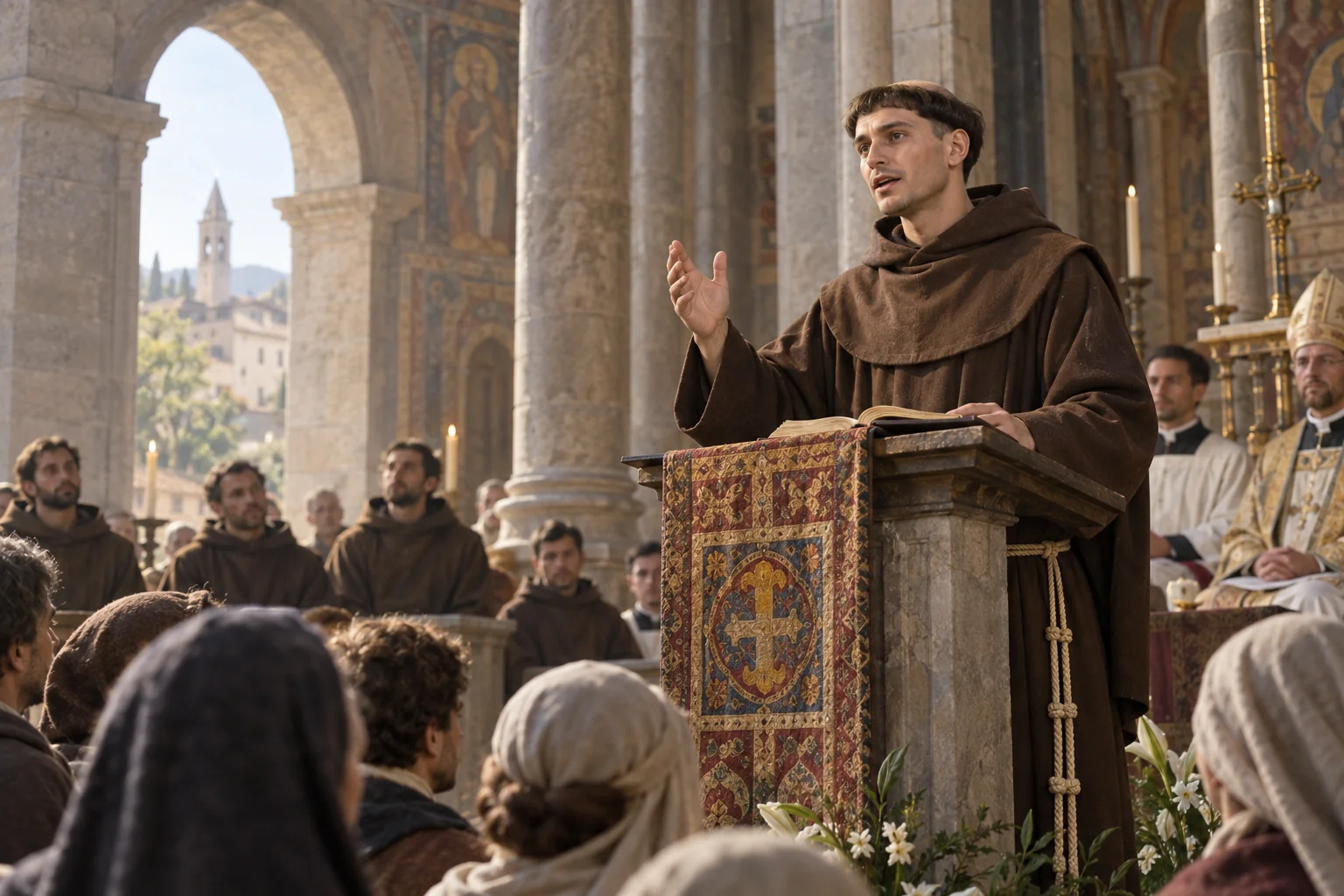
Anthony obeyed and stepped up to preach. At first he spoke hesitantly and humbly, but the longer he spoke, the more God’s word poured out of him like a torrent. His astonishing knowledge of Scripture, the depth of his thought and his ringing voice, burning with love, left the whole congregation stunned.
The jewel hidden so long in a cave suddenly shone out. From then on Saint Francis entrusted him with preaching throughout Italy and southern France, and he became the order’s first teacher of theology.
Chapter 4 of 6
The hammer of heresy and a voice for the poor
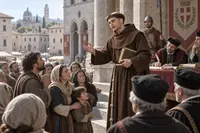
For the next ten years, Anthony traveled through cities large and small: from Bologna, Montpellier and Toulouse to Padua. He preached in churches, in public squares and in open fields, drawing tens of thousands to listen. His preaching was so effective against the heresies of the day, such as that of the Albigensians or Cathars, that people called him “the Hammer of Heretics”.
Yet what made ordinary people love him most was his tireless defense of the weak. In the Middle Ages, cruel moneylending was everywhere, and it drove many poor farming and craftsman families into prison and stripped them of their homes and fields. Anthony did not hesitate to stand in the pulpit and openly condemn the bottomless greed of the rich who crushed the poor.
He went in person to the authorities of Padua and persuaded them in 1231 to pass a landmark law: debtors who had handed over all their property could no longer be thrown into prison. He even traveled all the way to the stronghold of the notoriously cruel tyrant Ezzelino da Romano to demand the release of innocent political prisoners. The voice of a poor friar became a shield for the downtrodden.
Tradition also tells lovely stories: how he preached to the fish in the sea, who listened when the people of Rimini would not, or how a mule left hungry for three days knelt before the Eucharist instead of rushing to a bundle of fresh hay, witnessing to the Lord’s real presence before the eyes of a heretic. Such stories show the wonderful harmony between a holy man and God’s creatures.
Chapter 5 of 6
The last hours at Camposampiero
Constant preaching journeys and a hard life wore Anthony out. In Lent 1231 in Padua he preached every day to more than thirty thousand people, then sat in the confessional for hours on end without stopping to eat.
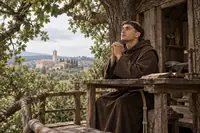
As his health quickly failed, he withdrew to rest at a small friary at Camposampiero. There he asked for a little cell to be built for him in a large walnut tree in the woods, so that he could be alone with God day and night. It was here, tradition says, that the local lord saw the Child Jesus appear in radiant light, put His arms around Anthony’s neck and speak tenderly with him.
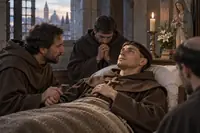
At the beginning of June 1231, sensing he would soon go to God, Anthony asked his brothers to carry him in an ox cart back to Padua. But when they reached the convent of Arcella on the outskirts of the city, his strength was spent.
On the afternoon of June 13, 1231, after receiving the last sacraments and singing a hymn to Mary, “O glorious Queen...”, Anthony fixed his eyes on heaven. When a brother asked what he saw, he smiled and whispered,
“I see my Lord!”
Then he died peacefully, only thirty-six years old.
Chapter 6 of 6
A saint for the whole world
As soon as word of his death spread, children all over Padua ran into the streets crying:
“The saint is dead! Our dear father is dead!”
Less than a year after his death, on May 30, 1232, Pope Gregory IX canonized Anthony, one of the fastest canonizations in the history of the Church. In 1263, when the great basilica in his honor in Padua was ready to receive his remains, Saint Bonaventure, then Minister General of the Franciscans, opened the coffin himself to move the relics. The body had returned to dust and only some bones remained, but the tongue was still intact and soft, as in life. Deeply moved, Saint Bonaventure lifted it up and exclaimed:
“This is truly a miracle! God wants us to know that Anthony was truly a messenger of God’s love.”
His tongue and jawbone are still kept in finely worked golden reliquaries in the basilica in Padua, and millions of pilgrims come each year to see the tongue that preached so many fiery sermons.
In 1946, Pope Pius XII declared him a Doctor of the Church with the title “Evangelical Doctor”, Doctor Evangelicus.
The Church celebrates Saint Anthony of Padua on June 13 each year.
In Vietnamese parishes and Catholic homes, Saint Anthony of Padua is a much-loved, familiar saint, closely tied to “Saint Anthony’s Bread,” the custom of collecting bread and rice for the poor. People turn to him to find lost things, and more importantly to rekindle a faith grown cold, to find peace at home and to find their way back to an honest life.
Saint Anthony’s life reminds us that God’s word is not theory to be kept in a glass case. It has to become courageous action: defending justice, standing up for the needy and bringing warmth and love to the most wretched people in this world.
The end of the story
You have walked with Saint Anthony of Padua to the end of the story.
You will often recall:
The quiet friar who swept the kitchen at Montepaolo was suddenly called on to preach, and God’s word poured out of him like a torrent, leaving the whole congregation stunned.
He traveled all the way to the stronghold of the tyrant Ezzelino da Romano to demand freedom for innocent prisoners.
In the walnut tree in the woods of Camposampiero, the Child Jesus appeared and put His arms around his neck.
Stay in silence
You carry away one thought: long after his body had turned to dust, his tongue was still intact, as if to remind us that preaching born of love never decays.
"I see my Lord!" — the last words of a man who spent his whole life speaking only of God.
Let us pray
Saint Anthony,
people still turn to you whenever they lose something. Today I ask you to help me find what is more precious: the peace I have lost somewhere, the faith I have neglected, a loved one I have drifted away from.
You once dared to go to the powerful to ask freedom for the innocent. Help me too to speak up for the weak, and to share some of what I have with the poor.
Amen.
Sources
- Feast dayAuthor’s edited profile
- Patron ofPatronages and symbols, version 1.1
- Often depicted withPatronages and symbols, version 1.1
- Reflectionsantantonio.org
- Reflectionstanthony.org
Meet the next one
 Journey 4