

Journey 4 · Hands That Stayed with the Suffering
Saint John of God
A fool for the love of the Cross
Feast day March 8
Tap to step inside
Saint John of God
A fool for the love of the Cross
Map of a life
This life told in 7 chapters
Begin the journey OpeningOpening1 min
 Chapter 1 of 7The wandering years of youth1 min
 Chapter 2 of 7The thunderbolt of Granada and a holy “madness”1 min
 Chapter 3 of 7Where a mission of mercy was born1 min
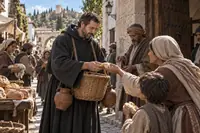 Chapter 4 of 7“Brothers, do good to yourselves!”1 min
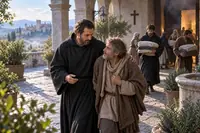 Chapter 5 of 7A fire of love stronger than death1 min
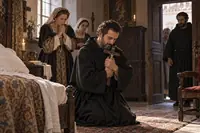 Chapter 6 of 7Dying on his knees1 min
- Chapter 7 of 7What the Hospitallers carry on1 min
Feast day
Saint John of God
Some places may celebrate on a slightly different day.
March 8
Patron of
- The sick and hospitals (declared by Leo XIII in 1886)
- Doctors and nurses (declared by Pius XI in 1930)
- Booksellers
- The city of Granada (Spain)
Often depicted with
- A pomegranate topped with a cross
- Carrying a sick person
Opening
Opening
For much of human history, people with mental illness were thought to be possessed by demons. They were cast out by society, chained to cold stone walls in the dark, and beaten without mercy every day to “drive out the madness”.
In the middle of that cruelty, a man whom people had once taken for a lunatic stood up. He made himself the lowliest of servants and spent the rest of his life caring for these suffering people with gentleness, respect and boundless compassion.
That man was John of God (Juan de Dios), founder of the Hospitaller Order of Saint John of God, the Brothers who care for the sick.
His life is an extraordinary story of conversion. He was a runaway child, a hardened mercenary and a traveling bookseller, until at last he was “captured” by the love of Christ crucified and became a pioneer of humane care for the mentally ill.
Chapter 1 of 7
The wandering years of youth
He was born on March 8, 1495, in the town of Montemor-o-Novo, in the Kingdom of Portugal, and baptized João Cidade. His parents, André Cidade and Teresa Duarte, were poor, ordinary, devout people.
At eight, spellbound by the stories of a traveling cleric who stopped at their house, young João slipped away from home to follow him. His mother died not long afterwards, grieving for her son, and his heartbroken father entered a Franciscan friary.
The boy drifted all the way to Spain, where a farm manager at Oropesa kindly took him in as a shepherd. He grew up in the countryside, simple and strong.
As a young man, hungry for adventure, João joined the Spanish royal army and fought as a mercenary in fierce wars against the French and the Turks.
The rough life of a soldier drew him into carousing and gambling, and he drifted away from the faith. Once he was nearly hanged, unjustly, for losing a chest of army supplies; another time he was thrown from his horse and nearly killed in battle. João began to sense how fragile life is and how God’s providence had kept him alive.
After leaving the army, he kept on wandering: herding sheep in Seville, laboring on the roads at Gibraltar, and going as far as North Africa to work as a builder to earn money to help a noble family that had fallen on hard times.
Finally, around 1538, at forty-three, João settled in the city of Granada in southern Spain and opened a small bookstall selling prayer books and holy pictures. The man who had tasted so much of life’s bitterness seemed to have found a safe harbor.
Chapter 2 of 7
The thunderbolt of Granada and a holy “madness”
On January 20, 1539, in the church of Saint Sebastian in Granada, something happened that turned his life upside down. João went to hear a sermon by Saint John of Avila, the famous preacher of Spain.
The sermon on repentance and the self-giving love of Christ struck straight to the bookseller’s heart.
As if by a flash of lightning in the night, João saw the misery and sin of his life and the boundless mercy of God. Overwhelmed with anguish, he ran out of the church, beating his breast and crying aloud for God’s forgiveness. He ran back to his bookshop, gave away his books and pictures to the poor, and smashed everything else in it.
He took off his fine clothes, rolled in the mud, and went through the alleys begging people to curse him and spit in his face as a penance.
The people of Granada were astonished and concluded that the bookseller had gone completely mad. They seized him, tied him up and threw him into the Royal Hospital of Granada, where the insane were locked up in those days.
Chapter 3 of 7
Where a mission of mercy was born
His days in the madhouse of Granada were a nightmare, yet that was exactly where God was preparing him for his great mission.
At that time the only “treatment” for the mentally ill was to tie them to stone pillars, starve them and whip their bare flesh mercilessly to “punish the madness”. Locked up with these poor people, bleeding from the whip himself, João came to know the pain of people stripped of their humanity.
From the depths of that prison he prayed:
“Lord, have mercy on these poor people! Grant that one day I may open a hospital where the mentally ill and the poor are cared for with love and respect, not with brutal beatings!”
When Saint John of Avila heard the news, he hurried to the hospital to see him. He saw that this was not madness but a deep conversion, and he gently urged João to master his feelings and give up his strange public penances, and to turn that fire into practical service.
João obeyed, and at once grew calm. The astonished doctors found him completely lucid and set him free.
Chapter 4 of 7
“Brothers, do good to yourselves!”
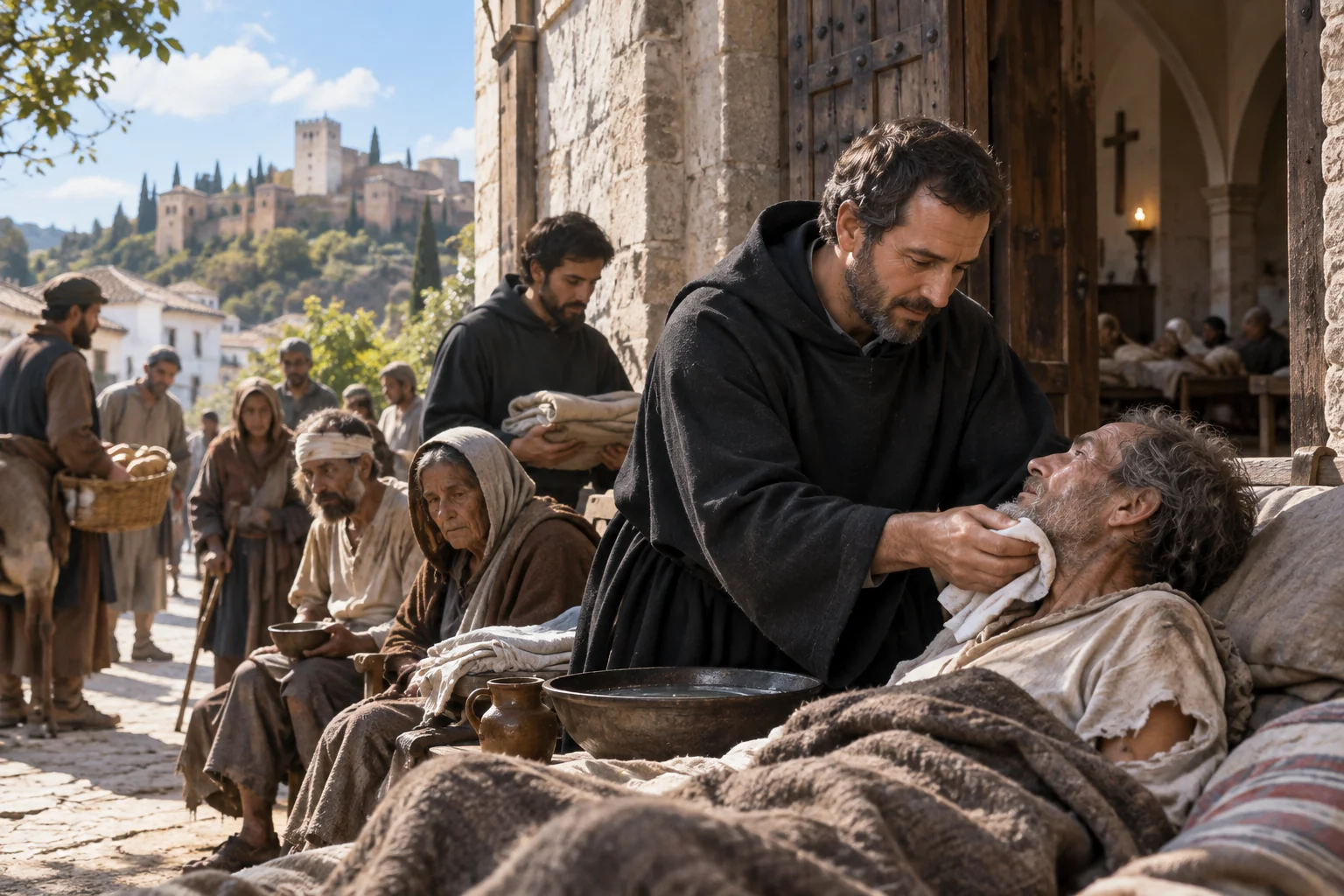
João walked out of the madhouse a new man. In the autumn of 1539, he rented a small, rickety house in Granada and began taking in poor sick people, the disabled and those with venereal disease whom other hospitals turned away.
Every day people saw him in an old gray cloak, with a large basket and two clay pots hung around his neck, going through the streets of Granada and calling out words that touched their hearts:
“Brothers, do good to yourselves! For the love of God, do good!”
There is deep theology in that cry: doing good to the poor is not doing them a favor; it is the giver who stores up treasure in heaven.
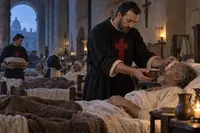
He gathered every leftover crust and every spare coin to bring home and feed the sick. By day he begged; at night he washed the sick himself, did their laundry, changed their bandages and sat with each one to comfort them.
For his time, what he did was revolutionary. He separated patients by illness to prevent contagion, and gave each one a bed of his own with a warm mattress and blankets, instead of throwing three or four together on a heap of filthy straw as had long been the custom. That house later grew into the official Hospital of San Juan de Dios, opened in 1544, near the very neighborhood where he had collapsed in his conversion years before, and it went on serving the sick without interruption until the twentieth century.
The Bishop of Granada, moved by his goodness, gave him a gray habit and a new name: “John of God”, Juan de Dios.
Chapter 5 of 7
A fire of love stronger than death
Saint John of God’s courage shone in the terrible fire at the Royal Hospital of Granada in 1549.
As the flames swallowed the building and thick black smoke sent everyone fleeing, John of God rushed straight into the fire. One by one, he carried paralyzed patients out on his back.
When everyone was out, he went back in to save blankets and beds for the patients. The fire raged so fiercely that the roof fell in. People thought he had burned to death, and then, to their amazement, he walked out of the flames unharmed.
In the winter of 1550, the river Genil rose in a raging flood. Seeing a poor young man gathering firewood fall into the swift current and about to drown, John of God plunged into the icy water without a second thought.
The young man was saved, but the fifty-five-year-old caught a deep chill that turned into acute pneumonia.
Chapter 6 of 7
Dying on his knees
Knowing he would not recover, he went over all the hospital’s accounts and debts, and urged his companions to go on loving and caring for the poor.
A devout noblewoman took him into her home so that he could be nursed more easily. Early on the morning of March 8, 1550, his fifty-fifth birthday, sensing that the hour of his death had come, John of God struggled out of his sickbed.
He knelt on the floor, holding the crucifix to his chest with both hands, and spoke his last words:
“Lord Jesus, into Your hands I commend my spirit!”
Then he died peacefully, still on his knees.
When people came into the room, he had died, but his body was still kneeling upright, his hands still clasping the crucifix and his face shining with peace.
Chapter 7 of 7
What the Hospitallers carry on
After his death, his closest companions came together and founded the Hospitaller Order of Saint John of God, devoted to running hospitals and caring for the sick. In 1759 a splendid basilica bearing his name was completed in Granada to receive his relics. Today, in its gilded interior, a solid silver urn holds small fragments of his bones and the plain wooden crucifix he clasped as he died, venerated by believers from all over the world.
Pope Urban VIII beatified him in 1630, and on October 16, 1690, Pope Alexander VIII canonized John of God. In 1886, Pope Leo XIII proclaimed him patron of the sick and of hospitals. In 1930, Pope Pius XI declared him patron of doctors and nurses. The Church celebrates him on March 8 each year.
In Vietnam, the Brothers of the Hospitaller Order of Saint John of God are a beloved presence through the Thánh Mẫu General Hospital and centers caring for people with disabilities and mental illness in Đồng Nai and many other places.
Saint John of God shows us that what the world calls foolishness can be the highest wisdom of the Gospel.
He saw the sacred dignity of the human person even in the broken bodies and minds the world despised most. And by serving without conditions, he taught the world to bend down and kiss the wounds of Christ in their most suffering brothers and sisters.
The end of the story
You have walked with Saint John of God to the end of the story.
Some passages you will want to read again:
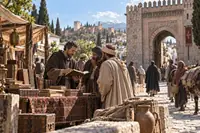
After a sermon, he ran out of the church beating his breast and weeping, and gave away all his precious books to the poor.
Locked in a madhouse, his body bleeding from the whip, he still prayed: "Grant that one day I may open a hospital where the sick are cared for with love, not with brutal beatings!"
In the fire, he rushed straight into the flames, carrying paralyzed patients out on his back one by one.
Stay in silence
What stays with you is this: what the world calls foolishness is sometimes the highest wisdom of a heart that loves without counting the cost.
Brothers, do good to yourselves!
Let us pray
Saint John of God,
people once locked you in a madhouse. But you went on to open a hospital to care for the sick with love, and you rushed into the fire to carry patients out one by one.
You are the patron of the sick and of hospitals. Pray for those in hospital, especially the poor with no one to visit them.
Pray for doctors and nurses, that they may care for patients with both skill and compassion.
Amen.
Sources
- Feast dayAuthor’s edited profile
- Patron ofPatronages and symbols, version 1.1
- Often depicted withPatronages and symbols, version 1.1
- Reflectionsjogbrothers.eu
- Reflectionsjd.es
Meet the next one
 Journey 4