

Journey 1 · Those Who Met the Lord
Saint Raphael the Archangel
The companion no one recognized
Feast day September 29
Tap to step inside
Saint Raphael the Archangel
The companion no one recognized
Map of a life
This life told in 10 chapters
Begin the journey OpeningOpening1 min
 Chapter 1 of 10God heals1 min
 Chapter 2 of 10The old man who buried the dead1 min
 Chapter 3 of 10The girl widowed seven times1 min
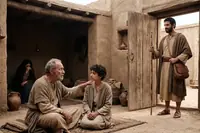 Chapter 4 of 10A guide for a drachma a day2 min
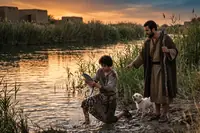 Chapter 5 of 10The fish by the Tigris1 min
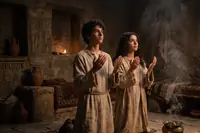 Chapter 6 of 10A prayer on the wedding night1 min
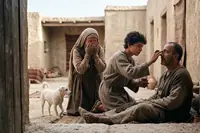 Chapter 7 of 10Eyes that saw again1 min
 Chapter 8 of 10"I am Raphael"1 min
 Chapter 9 of 10A pool in Jerusalem and a city in Spain1 min
 Chapter 10 of 10The companion on the road1 min
Feast day
Saint Raphael the Archangel
Some places may celebrate on a slightly different day.
September 29
Patron of
- Travelers
- The sick and health workers
- Those looking for a spouse
- The blind
Often depicted with
- A fish
- A traveler’s staff
- Walking beside young Tobias
Opening
Opening
There is a story in Scripture that many Catholics have never read in full, though it has everything a novel needs: an old man blinded in the most senseless accident, a girl married seven times and widowed seven times on her wedding night, a young man leaving home for the first time, a huge fish leaping out of a river, a little dog trotting along behind, and a kind guide whom no one, the whole way, recognized for who he really was.
That guide is the Archangel Raphael. And the whole story is found in a small book of fourteen chapters: the book of Tobit.
Unlike Michael with his sword or Gabriel with his message, Raphael appears in the most ordinary guise: a young man looking for work, hired as a guide for a drachma a day. He walks hundreds of kilometers with his companions, eats with them, rests with them, shows them how to cook a fish, how to ask for a bride, how to heal a father’s eyes. Only when everything is done does he reveal who he is. Perhaps that is why, of the three archangels, Raphael is the closest to everyday life: he is the angel of journeys, of illnesses, of marriages, of families going through hard times.
Chapter 1 of 10
God heals
In Hebrew, Raphael means "God heals." His whole story is a chain of wounds being healed: blind eyes made to see again, a woman freed from harm, a poor family given back its wealth, and above all, souls that had wanted to die brought back to hope.
The book of Tobit has had a strange fate. The Jewish people did not include it in the Hebrew Bible, and later our Protestant brothers and sisters did not accept it as Scripture either. But the Catholic and Orthodox Churches, following the tradition of the first Christians, have kept it as part of the word of God. For many centuries the book was known only in Greek and Latin, and many scholars thought it had originally been written in Greek. Then in 1952, in Cave 4 at Qumran by the Dead Sea, fragments of Tobit were found, copied by hand more than two thousand years ago: four in Aramaic and one in Hebrew. That means the story of Raphael was being read and copied by Jews before the time of Jesus, some of it in Aramaic, the language Jesus spoke every day.
The story is set during the Assyrian exile, in the eighth century before Christ, when the northern tribes of Israel were carried off to Nineveh. It is not a chronicle; commentators see it as a teaching story, told to show people how to live their faith in a foreign land. But what it teaches is very real: living uprightly when no one is making you, showing mercy when you yourself are suffering, and trusting that God still walks beside you, even when you do not recognize Him.
Chapter 2 of 10
The old man who buried the dead
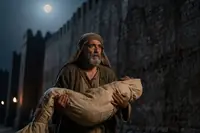
The first character is Tobit, a devout Jew living in exile in Nineveh, the capital of Assyria. In a foreign city where his own people were killed and their bodies thrown outside the walls, he did what no one else dared: he secretly gathered their bodies and buried them. The king of Assyria found out, hunted him down and seized all his property. When he was pardoned and came home, he went straight back to doing it.
One day, on the feast of Pentecost, when dinner had been set out, he sent his son to invite a poor man to come and eat with them. The son came back with news: one of their own people had been murdered and his body dumped in the marketplace. Tobit left his meal, went and carried the body home, and waited for nightfall to bury it. That night, unclean under the Law from touching a corpse, he did not go into the house but slept out in the courtyard, by the wall. He did not know there were sparrows nesting in the wall. Their droppings fell, still warm, into his eyes and left white films over them. The physicians treated him again and again, but it did no good. He went completely blind (Tob 2:9–10).
A man who had done good all his life ends up blind just because he slept in the wrong place, under a bird’s nest. The story does not explain why, just as real life so often does not explain why. Tobit fell on hard times, was reproached by his own wife, and one day begged God to let him die.
On that very same day, in a city far away, a young woman was also begging to die.
Chapter 3 of 10
The girl widowed seven times
In Ecbatana, in Media, lived a young woman named Sarah, the only daughter of Raguel. Sarah had been given in marriage to seven husbands, and all seven had died on the wedding night, before they could be with her. The book of Tobit says a demon named Asmodeus had killed them.
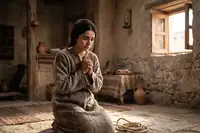
People in the household began to whisper. One maidservant even told Sarah to her face that she herself had killed her husbands. The girl was so hurt that she went up to the upper room of her father’s house, meaning to hang herself. But then she stopped, thinking of her father: she was his only child, and if she died like that, people would heap shame on him for the rest of his life. She knelt by the window, and instead of dying, she prayed (Tob 3:7–15).
The book of Tobit says that at the same moment, the prayer of the blind old man in Nineveh and the prayer of the girl widowed seven times in Ecbatana were heard before the glory of God. And Raphael was sent to heal them both.
Two people in two cities hundreds of kilometers apart, strangers to each other, despairing on the same day. They did not know that the answer to one would pass through the life of the other.
Chapter 4 of 10
A guide for a drachma a day
Tobit suddenly remembered: many years before, he had left a large sum of silver, ten talents, in the keeping of a kinsman named Gabael in the city of Rages, in Media. He called his son Tobias, gave him instructions as if they were his last words, and sent him to fetch the silver to provide for the family.
The advice he gave his son before the journey is one of the most beautiful passages in the book. He told his son to bury his mother when she died, and never to cause her sorrow. He told him to give alms according to his means: if you have much, give much; if you have little, do not be afraid to give even a little. He told him to pay hired workers the same day and not keep their wages overnight. And there is one sentence few people expect to find in the Old Testament: "Do to no one what you yourself dislike" (Tob 4:15). Hundreds of years before Jesus taught "Do to others whatever you would have them do to you," a blind old man told his son much the same thing in the simplest terms.
Tobias had never traveled far and did not know the way. He went to the marketplace to look for a guide, and met a young man who introduced himself as Azariah, son of Hananiah, a kinsman. He knew the road to Media and had stayed at Gabael’s house. Tobit questioned him carefully, then hired him for a drachma a day, promising something extra if he brought his son back safe.
That young man was Raphael. The blind old man had hired an archangel for a drachma a day without knowing it.
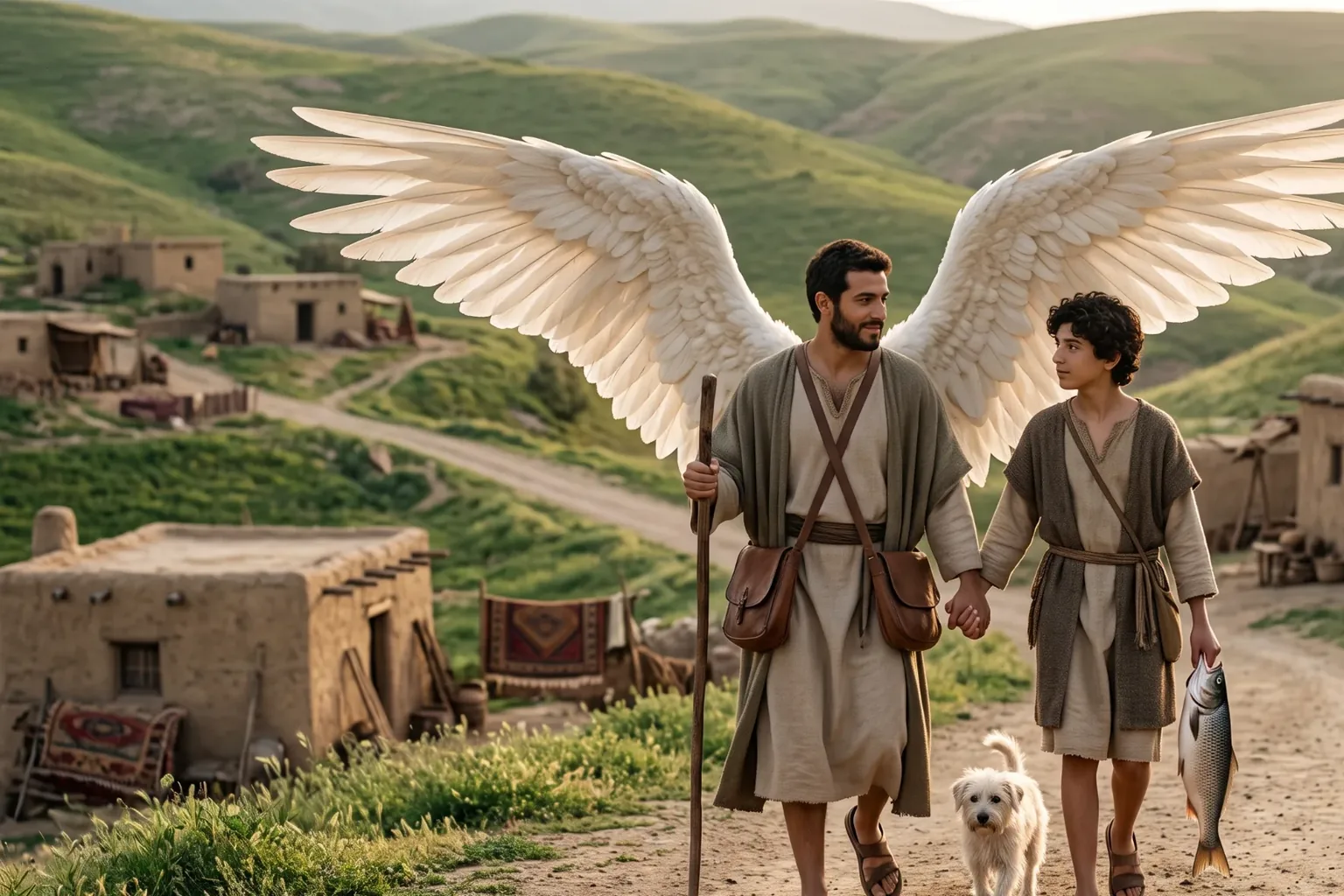
As the two set off, the book of Tobit records a small detail: "The dog went along with him" (Tob 6:2). Elsewhere in the Bible, dogs are usually wild, unclean animals. This is one of the very few places where a dog appears as a beloved household pet, trotting after its master on a long journey. That detail later delighted Renaissance painters. The painting "Tobias and the Angel" from Verrocchio’s workshop in Florence, now in the National Gallery in London, has a small white dog running at their feet and a fish with scales gleaming like silver. Researchers believe it was the young apprentice in that workshop, Leonardo da Vinci, who painted the dog and the fish.
Chapter 5 of 10
The fish by the Tigris
On the first evening, the two stopped by the Tigris River. Tobias went down to wash his feet, and a large fish leapt up as if to swallow his foot. He cried out. The guide told him: "Grab it, don’t let it get away!" He caught the fish and hauled it onto the bank.
Then Raphael told him to do something strange: cut the fish open, keep the gall, the heart and the liver, and roast the flesh to eat on the way. Tobias asked what they were for. The guide replied that the heart and liver would drive away an evil spirit, and the gall, rubbed on eyes clouded by white films, would make them see again (Tob 6:1–9).
Because of this detail, the fish became Saint Raphael’s symbol in Christian art. In almost every painting, he is shown as a young man in traveling clothes, staff in hand, sometimes holding a fish, leading a boy by the hand.
As they drew near Ecbatana, Raphael told Tobias that they would stay that night at Raguel’s house, and that he had the right to ask for Raguel’s daughter Sarah in marriage, as her closest kinsman. Tobias was afraid: he had heard about the seven husbands who died. He was an only son; if he died, his elderly parents would die of grief. Raphael reassured him, and told him what to do on the wedding night.
Chapter 6 of 10
A prayer on the wedding night
Raguel welcomed the two strangers, recognized Tobias as the son of his kinsman, and embraced him, weeping with joy. When Tobias asked to marry Sarah, Raguel told him the whole truth, but agreed. That very evening the marriage contract was written. And here is a touching detail: while the newlyweds went into their room, Raguel quietly went out and dug a grave, in case the eighth son-in-law died like the seven before him.
In the bridal chamber, Tobias did as Raphael had told him and burned the fish’s heart and liver, and the demon fled. Then he said to his wife: "Sister, get up! Let us pray and ask the Lord to have mercy on us and save us." And before anything else, the young couple got up together and prayed (Tob 8:4–8).
That prayer, which recalls how God created Adam and gave him Eve as his helper and asks that the couple "find mercy and grow old together," is still one of the readings most often chosen for weddings. Many Catholic couples have heard it on their wedding day without knowing it comes from a wedding night full of fear, and from an angel’s advice.
The next morning, Raguel sent a maid into the room to look. She came out and reported: both were sound asleep. Raguel hurriedly had the grave filled in before daybreak, then held a wedding feast that lasted fourteen days.
Chapter 7 of 10
Eyes that saw again
While Tobias stayed for the wedding feast, Raphael went on alone to Rages to collect the silver for the family. Meanwhile in Nineveh, Tobias’s mother went out to the road every day to watch for her son, counting the days and sure he was dead. Blind Tobit, anxious himself, had to comfort his wife.
Then one day, sitting by the road, the mother saw her son in the distance. The book of Tobit says the dog ran on ahead. She ran in to tell her husband. The blind old man groped his way to the door and stumbled. Tobias ran to hold his father up, then did as Raphael had told him: he rubbed the fish gall on his father’s eyes, blew into them, and peeled away the white films. Tobit saw his son, threw his arms around him and wept: "My child, I see you again, you are the light of my eyes!" (Tob 11:13–14).
Then Sarah arrived too. Tobit went out to the gate of Nineveh to meet his daughter-in-law, praising God as he walked. The townspeople were amazed to see him striding along with no one leading him.
Chapter 8 of 10
"I am Raphael"
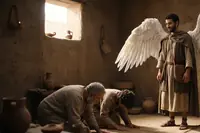
When all was done, Tobit called his son and told him to pay the guide generously: half of all the wealth they had brought home. And only then did the young man reveal who he was.
"I am Raphael, one of the seven angels who stand before the Lord" (Tob 12:15). He told father and son that each time Tobit left his meal to go and bury the dead, it was he who brought Tobit’s prayer before God. He had come not because they had earned it, but because God willed it. And one sentence left them stunned: "All those days, you saw me eating, but in fact I ate nothing; what you saw was a vision" (Tob 12:19).
Father and son fell to the ground in fear. When they stood up, the young man was gone.
There is something worth pondering here: in all that long journey, no one recognized Raphael as an angel. He ate with them, slept under the same roof, talked over the road with them, and showed them very ordinary things. Tobias called him "brother Azariah." Tobit called him "my young friend." Only looking back did they understand who had been walking beside them.
Chapter 9 of 10
A pool in Jerusalem and a city in Spain
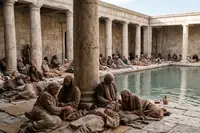
John’s Gospel tells of a pool in Jerusalem called Bethesda, where crowds of sick people lay waiting. According to some ancient manuscripts, from time to time an angel of the Lord came down to stir the water, and whoever went into the pool first was healed (John 5:1–4). The Gospel does not say what that angel was called. But because Raphael means "God heals," the Church’s tradition has long linked the angel of the pool with him, and in the old liturgy this Gospel passage was read at the Mass of Saint Raphael.
In Spain, the city of Córdoba honors Raphael as its "Guardian of the City." In 1578, when plague was raging in the city, a priest named Andrés de las Roelas said that an angel had appeared to him several times, promising to save the city. Afraid of being deceived, he consulted the Jesuits, who advised him to ask the figure outright who he was the next time. At dawn on May 7, 1578, by his account, the angel answered: "I swear to you, by Jesus Christ crucified, that I am Raphael, whom God has placed as guardian of this city." The people of Córdoba built a church on the spot, called the Church of the Oath. Walking around the city today, you can still see about ten tall columns called "Triumphs," each topped with Saint Raphael holding a pilgrim’s staff, looking down over the old streets.
Also in Spain, in the sixteenth century, there was a man who had been a mercenary soldier and a traveling bookseller, then was converted and spent the rest of his life caring for the sick poor in Granada: Saint John of God, whose story you can read elsewhere in this app. He often carried those who could not walk on his back to his hospital. The old biographies say that at times, when he was worn out, Saint Raphael came to lend him a hand. That is why the Hospitaller Brothers he founded still honor Saint Raphael as one of their patrons.
Chapter 10 of 10
The companion on the road
In 1921, Pope Benedict XV placed the feast of Saint Raphael in the calendar of the whole Church, on October 24. In 1969, this feast was moved to September 29, celebrated together with Michael and Gabriel.
Saint Raphael is honored as patron of travelers, of the sick, of physicians and pharmacists, of the blind, and of those looking for a spouse. In many places young people still ask him for a good meeting, like that of Tobias and Sarah.
In Vietnam many people bear Raphael’s name, and many Catholic hospitals and clinics around the world are named for him. But perhaps what he reminds us of most is not the miracles, but the way he came: unannounced, without a halo, in the guise of a hired man earning a drachma a day.
Perhaps everyone’s life has a "brother Azariah" or two. A friend who walks with us through a hard stretch of road. A devoted doctor on a night shift. A stranger who points the way just when we are lost. We do not recognize them at the time. Only looking back do we understand that God did not let us walk alone.
Blind Tobit had begged to die. Sarah had meant to hang herself. A little while later, both were sitting under one roof at a wedding feast, with eyes that could see and hearts at peace. Raphael’s story ends with Tobit praising God, who "strikes and then shows mercy." Not because every suffering has an explanation. But because in the middle of suffering, there is One still walking with us.
The end of the story
You have walked with Saint Raphael the Archangel to the end of the story.
Images that will stay with you:
An old man leaving his feast-day meal untouched to carry home the body of one of his people for burial.
On the wedding night, the young couple getting up to pray before anything else, while out in the garden, the father quietly digs a grave.
The dog running home ahead, and a blind old man groping his way to the door to meet his son.
Stay in silence
As the story closes, you realize that in all that long journey, no one knew the guide was an angel. Only looking back did they understand who had walked beside them.
Today, look back over the road you have just traveled, and thank the people who have quietly walked with you.
Let us pray
Saint Raphael the Archangel,
you walked with young Tobias along a long road, and he never knew who was beside him.
Walk with me on my journeys, when I go far away to work, when my children are far from home. Heal my loved ones who are sick, and give the doctors and nurses beside them clear minds and devoted hearts.
Help the young people in my family meet a good spouse. And open my eyes, so that I may see the Lord walking with me through the very ordinary people around me.
Amen.
Sources
- Feast dayArticle, version 1.1
- Patron ofPatronages and symbols, version 1.1
- Often depicted withPatronages and symbols, version 1.1
Meet the next one
 Journey 1