

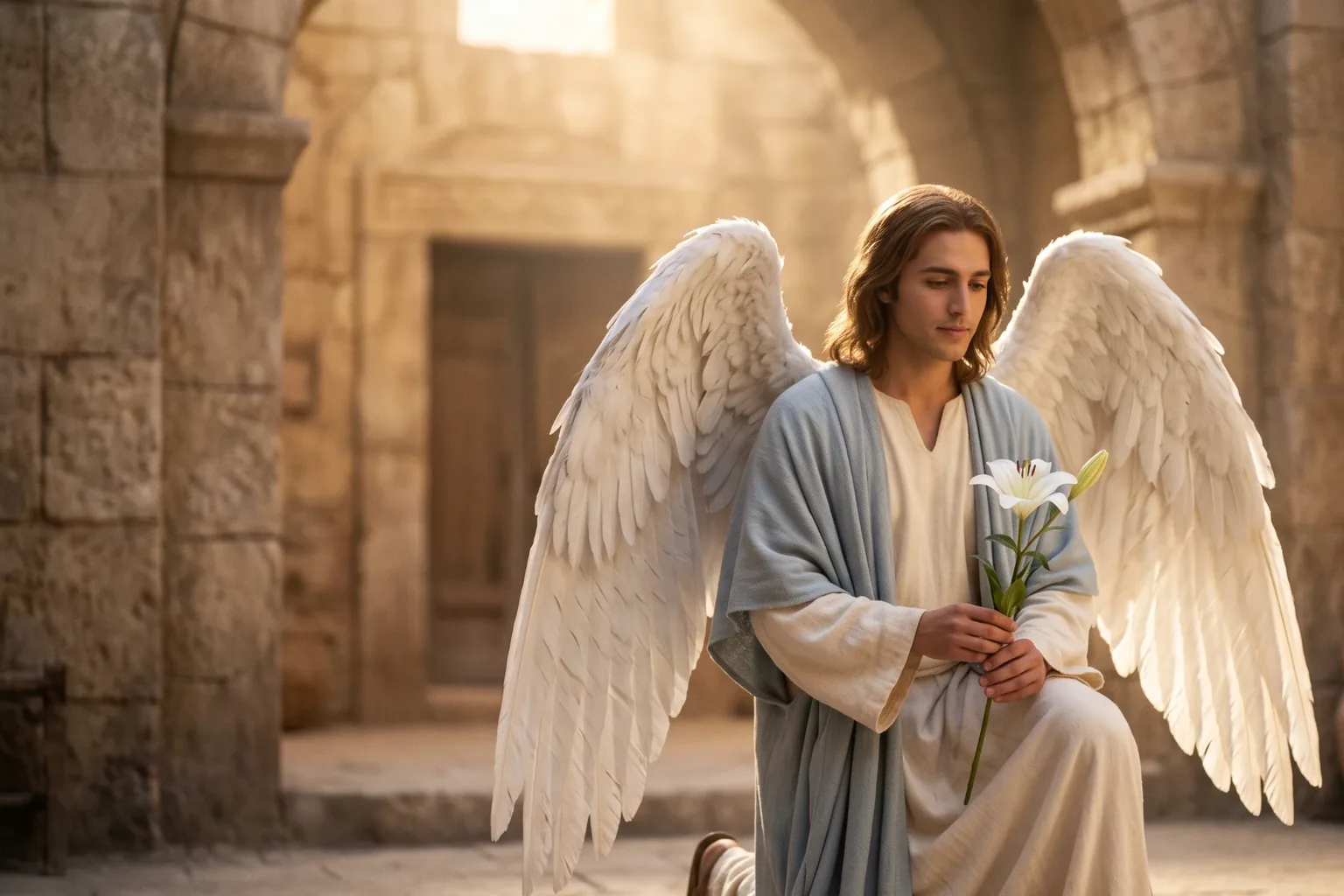
Journey 1 · Those Who Met the Lord
Saint Gabriel the Archangel
The bearer of a greeting that changed history
Feast day September 29
Tap to step inside
Saint Gabriel the Archangel
The bearer of a greeting that changed history
Map of a life
This life told in 9 chapters
Begin the journey OpeningOpening1 min
 Chapter 1 of 9God’s hero1 min
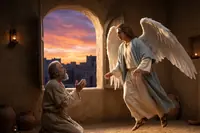 Chapter 2 of 9The hour of the evening sacrifice1 min
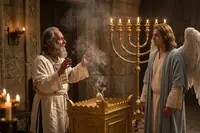 Chapter 3 of 9The priest who was struck mute2 min
 Chapter 4 of 9A village no one mentioned2 min
 Chapter 5 of 9A greeting that became a prayer1 min
 Chapter 6 of 9The bell that rings three times a day1 min
 Chapter 7 of 9Wings in the paintings1 min
 Chapter 8 of 9Patron of those who bring news1 min
 Chapter 9 of 9The bearer of good news1 min
Feast day
Saint Gabriel the Archangel
Some places may celebrate on a slightly different day.
September 29
Patron of
- Postal, telecommunications and media workers (declared by Pius XII in 1951)
- Diplomats
Often depicted with
- A lily
- A trumpet
- A banner reading "Ave Maria"
Opening
Opening
Every day, all over the earth, hundreds of millions of people repeat the words of an angel, often without noticing. "Hail Mary, full of grace, the Lord is with thee." The opening line of the Hail Mary was not composed by any saint or pope. Vietnamese Catholics know this prayer by heart before they can read; they pray it bead by bead through night vigils, at the bedside of the sick, on long bus journeys. It is the greeting of the Archangel Gabriel, spoken to a young girl in a small village of Galilee, more than two thousand years ago.
Gabriel does not carry a sword like Michael, nor travel a long road like Raphael. Every time he appears in Scripture, he does just one thing: he brings a word. A word of explanation to someone bewildered, a word of news to someone who has lost hope, a word of invitation to someone who will change the whole of history. Some believe, some doubt, some ask to know more. But no one hears his word and keeps their life just as it was.
Chapter 1 of 9
God’s hero
In Hebrew, Gabriel means "God is strength," or it can be understood as "God’s hero." It sounds like a name made for a warrior, yet it belongs to the gentlest of the three angels Scripture names. Gabriel’s strength is not in his arm. It is in the word he brings: the word of God, the kind of word that, once spoken, comes to pass.
Scripture mentions Gabriel four times, twice in the Old Testament and twice in the New. Each time he appears at a turning point, when God’s people are waiting for something they themselves are not sure will come.
Few people notice the one sentence in which Gabriel introduces himself. When the priest Zechariah doubted his word, Gabriel replied: "I am Gabriel, who stands in the presence of God" (Luke 1:19). In the courts of ancient Eastern kings, only the most trusted courtiers were allowed to stand before the king, and to be sent out with his most important decrees. Gabriel was telling the old man: what you have just heard is no small matter; it comes straight from the presence of God.
Chapter 2 of 9
The hour of the evening sacrifice
Gabriel first appears in the book of Daniel, during the Babylonian exile. Daniel sees a puzzling vision of a ram and a he-goat butting each other, horns sprouting and then breaking off. He sits there, bewildered, trying to understand. Then he hears a man’s voice calling from over the river: "Gabriel, make this man understand the vision" (Dan 8:16).
So the first thing Gabriel does in Scripture is not to announce good news, but to explain. He comes to a man at a loss and helps him grasp what is beyond him. Daniel says that when the angel came near, he fell face down in fear, and Gabriel touched him and set him on his feet.
The second time, in chapter 9, there is a very moving detail. Daniel is praying, confessing his people’s sins, and Gabriel comes "in swift flight" to him "at the time of the evening sacrifice" (Dan 9:21). That was the hour when the priests offered the daily evening sacrifice at the Temple in Jerusalem. But by then the Temple had been burned by the Babylonians nearly seventy years earlier. No altar, no priests, no sacrifice. Yet Daniel still kept that hour for prayer, as if the Temple were still standing. And God sent Gabriel at that very hour.
Gabriel brought him the prophecy of the "seventy weeks," a mysterious promise that one day sin would be blotted out, everlasting righteousness brought in, and an anointed one would come. The Church Fathers later read this passage as foretelling Christ. Daniel did not live to see that day. But he died with a promise in his hands.
Chapter 3 of 9
The priest who was struck mute
Nearly five hundred years later, Gabriel appeared again, this time in the Temple of Jerusalem itself, by then splendidly rebuilt under King Herod.
There was an old priest there named Zechariah. His wife, Elizabeth, was childless, and both were advanced in years. In those days, having no child was a great sorrow, and to many people a disgrace too, as if one had been forgotten by God.
Luke’s Gospel says that Zechariah was "chosen by lot" to enter the sanctuary and offer incense. That small detail means a great deal: there were thousands of priests then, divided into twenty-four divisions, each serving a week twice a year. Offering incense in the sanctuary was assigned by lot, and according to ancient Jewish sources, each priest could do it at most once in his life; many waited a lifetime and never had their turn. On the greatest day of his life, as he stood alone at the altar of incense in the fragrant smoke, Zechariah saw an angel standing at the right side of the altar.
Gabriel told him: your wife will bear a son, and you will name him John, who will prepare the way for the Messiah. And the old man, who had perhaps prayed for this for decades, could not believe it when he finally heard the answer: "How can I be sure of this? For I am an old man, and my wife is getting on in years" (Luke 1:18).
Gabriel was not angry. He simply gave him a sign: he would be mute, unable to speak until the day these things happened. Outside, the people waited, wondering why he was taking so long. When he came out, he could say nothing, only make signs. For nine months afterwards, the old priest lived in silence, watching his wife carry their child, and perhaps learned what a whole life of offering incense had not taught him: some words of God do not need to be fully understood to be received.
Only on the day the boy was born, when the relatives wanted to name him after his father, did Zechariah ask for a tablet and write: "His name is John." At that moment his mouth was opened, and the first words he spoke after nine months were words of blessing to God.
Chapter 4 of 9
A village no one mentioned
Six months later, Gabriel was sent somewhere quite different. Not to a magnificent Temple in the capital, Jerusalem, but to Nazareth, a small village in Galilee that is not mentioned even once in the whole Old Testament. Not to an old priest, but to a young girl, perhaps only in her teens, betrothed to a builder named Joseph.
Gabriel’s greeting, in the original Greek, is "Chaire, kecharitōmenē." The first word, "Chaire," literally means "Rejoice!" It was an everyday Greek greeting, but it also echoes the ancient prophets calling on the "daughter of Zion" to rejoice because God is coming. The second word, "kecharitōmenē," is a very rare word, appearing exactly once in the whole Bible to address a person: "one who has been filled with grace." The Vietnamese prayer renders it "đầy ơn phúc", just as English says "full of grace."
It is worth comparing this meeting with Zechariah’s. Both asked the angel a question. Zechariah asked: "How can I be sure?" Mary asked: "How will this be, since I have not known a man?" (Luke 1:34). One asked in order to demand proof; the other asked to know what she was to do. Zechariah was struck mute; Mary was given an explanation. And Gabriel’s answer to the young girl ends with a sentence countless people have clung to ever since, when there seemed to be no way out: "For nothing is impossible with God" (Luke 1:37).
The Gospel does not say where in the village Gabriel met Mary. A very early Christian text from the second century, the "Protoevangelium of James" (which is not part of Scripture), says that Mary first heard the greeting while she was going to draw water at the well. So in Nazareth today two places remember this event. The Orthodox have the Church of Saint Gabriel, built right over the village’s old spring; in the crypt, the water still flows. And Catholics have the Basilica of the Annunciation, built over an ancient cave believed to be part of Mary’s house. On the altar in the cave is carved a Latin sentence: "Verbum caro hic factum est," the Word was made flesh here. The words come from John’s Gospel, with one small word added, "hic," here, so that pilgrims know where they are standing.
Chapter 5 of 9
A greeting that became a prayer
When Gabriel left, his greeting was not yet a prayer. It became a prayer gradually, over many centuries.
The first Christians joined Gabriel’s greeting to the words Elizabeth cried out when Mary came to visit: "Blessed are you among women, and blessed is the fruit of your womb." By around the eleventh or twelfth century, lay people in Europe were praying the two greetings together as a prayer of its own. The second part, "Holy Mary, Mother of God, pray for us sinners, now and at the hour of our death," was added much later, around the fifteenth or sixteenth century, when Europe had just come through terrible plagues and people longed for the grace of a good death. In 1568, Pope Saint Pius V placed the full prayer in the Roman Breviary, and from then on it took the form we pray today.
So each time we pray a Hail Mary, we are repeating the words of three: Gabriel’s greeting, Elizabeth’s blessing, and the plea of the Church through the generations. A five-decade Rosary repeats fifty times the words the angel spoke at Nazareth.
Chapter 6 of 9
The bell that rings three times a day
Anyone who grew up in a Vietnamese Catholic village remembers the church bell ringing three times a day: early morning, midday and evening. At the sound of the bell, people working in the fields stopped, people at home stood still, and the whole neighborhood prayed the Angelus: "The Angel of the Lord declared unto Mary, and she conceived of the Holy Spirit."
The custom of praying at the sound of the bell began in Europe in the thirteenth century, when Franciscan friars encouraged people to pray three Hail Marys at the evening bell. The midday bell has a story of its own. In 1456, Ottoman forces besieged the city of Belgrade, a key fortress guarding the way into Europe. Pope Callixtus III ordered every church to ring its bells at noon so that people would stop to pray for those defending the city. Belgrade held. The noon bell has never fallen silent since; it merged with the Angelus bell that many churches around the world still ring today.
So three times a day, in villages tens of thousands of kilometers from Nazareth, people recall the meeting between Gabriel and the young girl of Galilee, out in the fields, over the noon meal, as the lamps are lit.
Chapter 7 of 9
Wings in the paintings
Perhaps no scene in the Gospels has been painted as often as the Annunciation. And in almost all those paintings, Gabriel holds a white lily, symbol of purity, or kneels before Mary, as if the messenger from heaven must also bow before the one God has chosen.
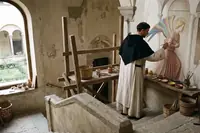
At the friary of San Marco in Florence, the friar-painter Fra Angelico painted the Annunciation on a wall around the 1440s. Gabriel’s wings in that painting are colored in rainbow bands of red, gold and blue, as if to say that the messenger brings all the beauty of heaven down to earth. The painting was placed right at the top of the stairs leading to the friars’ cells, so that each time they went up or down, they would remember to stop and pray a Hail Mary.
And the young Leonardo da Vinci’s "Annunciation" in the Uffizi has a little-known detail: Leonardo originally painted Gabriel’s wings short, modeled on the real birds’ wings he loved to study. Later another painter lengthened the wings to look like the angel wings familiar at the time, and researchers can still see traces of the added paint.
People also often paint Gabriel blowing a trumpet at the end of the world, and "Gabriel’s horn" has become an expression in many languages. But Scripture never says Gabriel blows the trumpet. The First Letter to the Thessalonians speaks only of "the trumpet of God" and "the voice of an archangel," naming no one. The image of Gabriel with a trumpet was added later by devotion and art, perhaps because people were so used to thinking of him as the one who announces.
Chapter 8 of 9
Patron of those who bring news
For many centuries, Saint Gabriel had a feast of his own only in some places. In 1921, Pope Benedict XV placed the feast of Saint Gabriel in the calendar of the whole Church, on March 24, just before the Annunciation on March 25, as if the messenger were going ahead to announce it. In 1969, this feast was moved to September 29, celebrated together with Michael and Raphael. In the Orthodox Church, Gabriel is still celebrated on March 26, the day after the Annunciation, and on July 13.
In 1951, Pope Pius XII issued a letter naming Saint Gabriel patron of telecommunications. In it he listed very concretely things that were then still marvels: sending telegrams to those far away with astonishing speed, telephoning across great distances, sending messages by radio waves, and seeing events taking place very far away. Today, when everyone carries a phone that sends messages around the world in a second, that 1951 letter reads as both naive and moving. And the angel who once flew to Daniel "at the time of the evening sacrifice" is now regarded as patron of postal workers, telegraph operators, radio and television broadcasters, and all whose work is bringing news to others.
Chapter 9 of 9
The bearer of good news
In Vietnam, quite a few people, both men and women, bear Gabriel’s name. But even those who do not bear his name meet him every day, each time they pray a Hail Mary, each time they hear the church bell ring at noon.
Looking back at Gabriel’s four appearances, we see one thing in common: each time he came to people who were waiting. An old exile waiting for the day his people would be freed. An old priest waiting for a child. A people waiting for the Savior for centuries. And each time he came when people least expected it: in the middle of a puzzling vision, in the middle of offering incense, in the middle of an ordinary day in a village no one mentioned.
Perhaps that is why Gabriel is closer to us than we think. Everyone in life has things they are waiting for: a child, good news, a way out of a debt, someone coming home. Gabriel does not promise that everything we wait for will come the way we want. But he reminds us that God does not forget. Daniel’s prayer was heard. Zechariah’s plea was granted, though he did not dare believe it. And a young girl in Nazareth was chosen, not because she was rich or famous, but because she dared to answer: "Here I am, the servant of the Lord."
"For nothing is impossible with God." That is the sentence Gabriel left us. And every time the church bell rings, we are reminded of it again.
The end of the story
You have walked with Saint Gabriel the Archangel to the end of the story.
Images that will stay with you:
An old exile still keeping the hour of the evening sacrifice to pray, though the Temple had long been burned.
An old priest coming out of the sanctuary unable to say a word, waiting nine months before his mouth opened in praise.

A young girl in a village no one had heard of, hearing the greeting "Rejoice!", then answering "Yes".
Stay in silence
As the story closes, you realize that Gabriel always came to people who were waiting, at the moment they least expected.
Next time you hear the church bell ring, stop for a moment, and remember: nothing is impossible with God.
Let us pray
Saint Gabriel the Archangel,
you brought the greeting "Rejoice" to a small village, and every day I still repeat it in the Hail Mary.
I bring you the things I am waiting for and have not yet dared to say. Let me not, like Zechariah, demand proof, but, like Our Lady, dare to ask and dare to say "yes".
Teach me to bring good news to others: an encouraging word at the right moment, a message just to ask how they are, a sentence that lightens someone’s heart.
Amen.
Sources
- Feast dayArticle, version 1.1
- Patron ofPatronages and symbols, version 1.1
- Often depicted withPatronages and symbols, version 1.1
Meet the next one
 Journey 1