

Journey 1 · Those Who Met the Lord
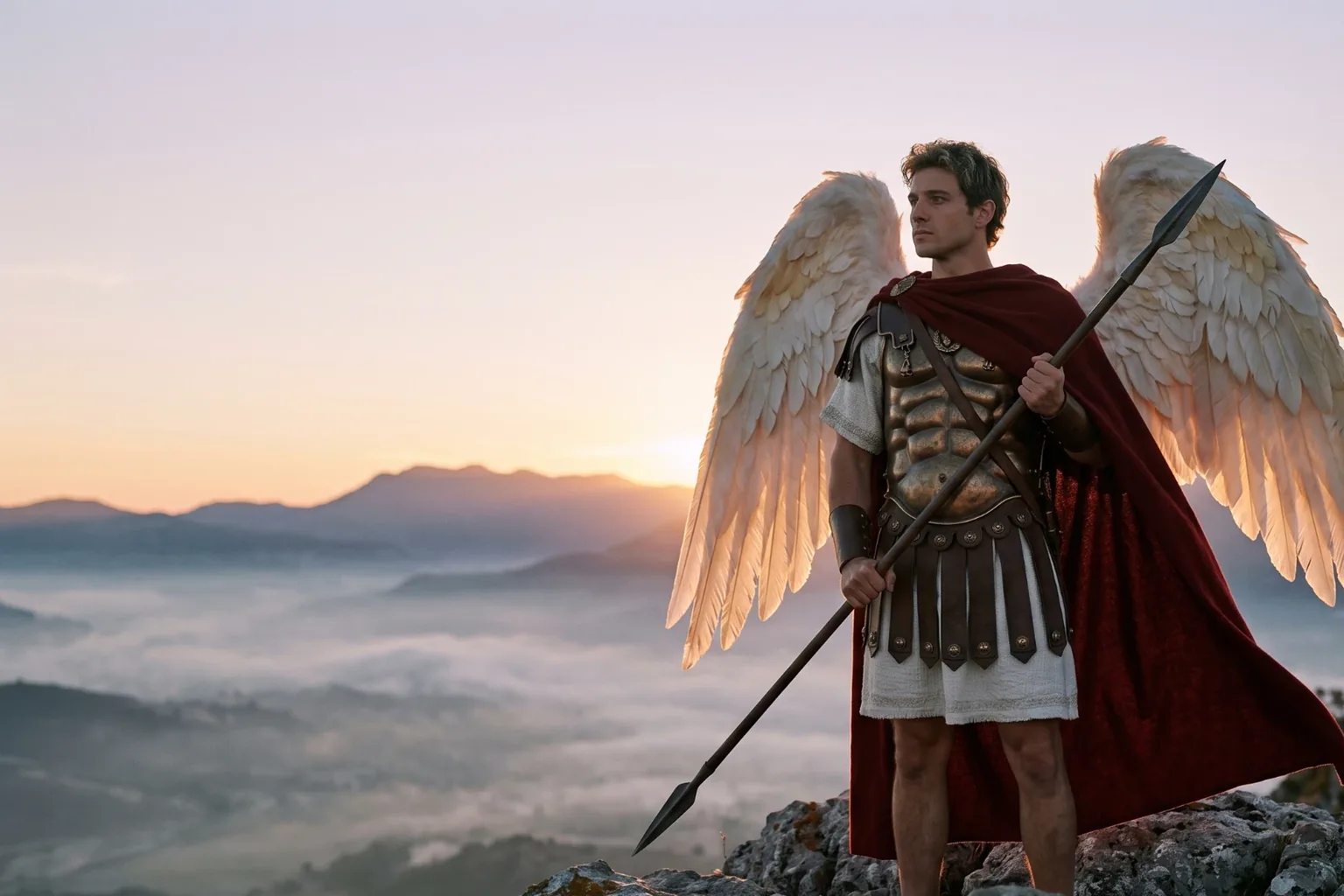
Saint Michael the Archangel
Who is like God?
Feast day September 29
Tap to step inside
Saint Michael the Archangel
Who is like God?
Map of a life
This life told in 11 chapters
Begin the journey OpeningOpening1 min
 Chapter 1 of 11A question for a name1 min
 Chapter 2 of 11Standing beside a people in exile1 min
 Chapter 3 of 11A word that dared not condemn1 min
 Chapter 4 of 11War in heaven2 min
 Chapter 5 of 11The river that changed course at Chonae1 min
 Chapter 6 of 11A cave consecrated by no human hand2 min
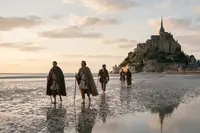 Chapter 7 of 11A mountain in the sea and a hole in a skull2 min
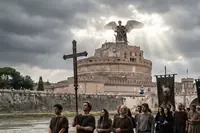 Chapter 8 of 11The angel who sheathed his sword1 min
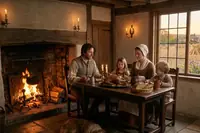 Chapter 9 of 11September 29 and the geese1 min
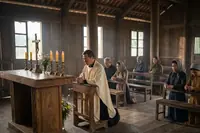 Chapter 10 of 11A prayer after Mass1 min
 Chapter 11 of 11Who is like God?1 min
Feast day
Saint Michael the Archangel
Some places may celebrate on a slightly different day.
September 29
Patron of
- Police officers (Pius XII)
- Soldiers
- The dying
- Protection against evil
Often depicted with
- A sword
- A pair of scales
- Treading on the dragon
- Armor
Opening
Opening
In Scripture, his name was not chosen for its sound. It is a question. "Mi-ka-El" in Hebrew means: "Who is like God?"
One can hear those words as a challenge flung in the face of the proud, or as the cry of someone who suddenly sees how small they are before the One on high. Both are true. For two thousand years, Christians have called on Michael when afraid, when sick, when evil seemed stronger than they were. And each time they called on him, they reminded themselves of the answer: no one. No illness, no power, no darkness is like God.
Scripture mentions Michael only five times. He has no childhood, no hometown, no date of death, for he is not a human being. He is an angel, a spiritual creature made to serve God. Yet from those five brief appearances, the Church has come to know him clearly: he is the one who stands with God’s people in their darkest hours. From that have grown shrines on mountaintops, prayers learned by heart, names given to children, and folk customs that many places still keep, though they no longer remember where they began.
Chapter 1 of 11
A question for a name
In the whole Catholic Bible, only three angels are called by name: Michael, Gabriel and Raphael. Tens of thousands of other angels appear in its pages without names, called only "the angel of the Lord," "the man clothed in linen," "the heavenly host." That Scripture names these three at all is significant, for to the ancient Jews, knowing someone’s name meant knowing the person and their mission.
Michael’s name, though, says nothing about himself. It points to God. Gabriel means "God is strength," Raphael means "God heals." But Michael states nothing; it only asks, as if the name wanted the listener to answer.
Long before the time of Jesus, Jewish tradition knew the name Michael well. In 1947, when Bedouin goatherds happened upon ancient scrolls in the caves of Qumran by the Dead Sea, scholars read in one of them, called the "War Scroll," a picture of the final battle between "the sons of light" and "the sons of darkness." In it, God sends eternal help "by the might of the majestic angel," so that "the dominion of Michael" is raised up among the heavenly beings. In other words, even before the Gospels were written, God’s people already thought of Michael as the one charged with leading the battle between good and evil.
But to understand why they thought so, we have to go back to an old man weeping by a river, six centuries before Christ.
Chapter 2 of 11
Standing beside a people in exile
The name Michael is first heard in the book of Daniel. The setting is the Exile. The Babylonian army had razed Jerusalem and burned the Temple, and the strongest of the young had been carried off to a foreign land. Israel lived in exile by the rivers of Babylon, without a country, without a Temple, and at times feeling they had lost God too.
The book of Daniel says that in the third year of Cyrus, king of Persia, around 536 BC, Daniel, by then an old man, mourned for three whole weeks, eating no rich food, touching no meat or wine, and using no fragrant oil. He prayed for his people, who had just been allowed to return home but were meeting every kind of obstacle in rebuilding their homeland.
Then a messenger from heaven came to him on the bank of the Tigris and said something very strange: his prayer had been heard from the very first day, but the messenger had been held back by "the prince of the kingdom of Persia" for twenty-one days. Only when Michael, "one of the chief princes," came to help was the way opened (Dan 10:13).
Twenty-one days. Exactly the three weeks Daniel had fasted and wept. That ancient passage lifts a veil on something ordinary eyes cannot see. There are times when prayer seems to fall into empty space, but in truth it was heard from the first day, and somewhere out of sight, someone is fighting for us.
Near the end of the book, the promise is made even clearer: "At that time Michael, the great prince who protects your people, shall arise. There shall be a time of distress such as has never been… But at that time your people shall be delivered" (Dan 12:1).
"Who protects your people." From that one verse, the first Christians came to call Michael the Protector of God’s people. Then, when God’s people widened into the whole Church, he came to be honored as the Protector of the Church, a title still used today.
Chapter 3 of 11
A word that dared not condemn
Michael appears next in the very short Letter of Saint Jude, just one chapter long and tucked away near the end of the New Testament, so that many people read the Bible all their lives without noticing it.
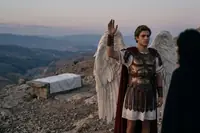
Saint Jude recalls an old Jewish tradition: when Moses died on Mount Nebo, Michael disputed with the devil over his body. The book of Deuteronomy says that God himself buried Moses in a valley, and "to this day no one knows where his grave is" (Deut 34:6). Perhaps out of that mysterious silence grew the story of Michael guarding the body of Israel’s greatest prophet, not letting the enemy seize it. The full story was told in an ancient book now lost; we know it only through the few lines Saint Jude quotes.
What is striking is not the dispute, but the way Michael spoke. Saint Jude writes that even then, Michael "did not dare to bring a slanderous judgment," but said only: "The Lord rebuke you!" (Jude 9).
The great prince of the heavenly armies, standing before God’s very enemy, did not claim for himself the right to insult or judge. He left that to God. Saint Jude tells this story as a warning to believers who were hotly criticizing and abusing others in the community: if even an archangel would not use insulting words, how much less should we.
That is quite different from the image of a sword-swinging warrior we are used to seeing in paintings. Michael’s strength does not lie in speaking loudest or having the last word. It lies in knowing who he is, and knowing who the true Judge is.
Chapter 4 of 11
War in heaven
The most familiar image of Michael comes from the book of Revelation, the last book of the Bible, written at the end of the first century, when Christians in Asia Minor were being pressed to worship the Roman emperor as a god and were suffering for refusing.
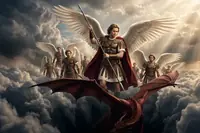
Saint John saw a vision: a Woman clothed with the sun, the moon under her feet, about to give birth; and a great red Dragon with seven heads, standing ready to devour the child the moment it was born. Then "war broke out in heaven: Michael and his angels fought against the Dragon. The Dragon and his angels fought back, but they were defeated, and there was no longer any place for them in heaven" (Rev 12:7–8). The Dragon, "that ancient serpent, who is called the devil and Satan," was thrown down to the earth.
The book of Revelation is written in images. It does not describe a battle on a particular date. It tells persecuted people what they most needed to hear: evil may still snarl on the earth, but in heaven it has already lost. The outcome has been decided, even if today we still have to suffer.
From this page, for many centuries, painters have shown Michael in armor, holding a sword or spear, his foot on the dragon. Some paintings also give him a pair of scales, because medieval Christians believed he was the one who brought the souls of the dead before God’s judgment seat.
In 1518, the great painter Raphael painted "Saint Michael Vanquishing Satan" as a gift for the king of France; the painting still hangs in the Louvre. More than a hundred years later, the painter Guido Reni painted a Saint Michael for the Capuchin church in Rome. People still repeat a story that is hard to verify: Reni secretly painted the face of the demon under Saint Michael’s feet to look exactly like a cardinal who had spoken ill of him. No one knows whether it is true, but the story shows how close people felt to the painting: the demon is not somewhere far away; it can wear the face of our everyday grudges.
There is something striking in almost all the old paintings of Michael: his face is usually calm. There is no spite in it, as in someone in a brawl, and no triumphant grin. Only the steadiness of one who knows God has already won, and that he is simply doing the part he was given.
Chapter 5 of 11
The river that changed course at Chonae
Long before the West built great shrines to Saint Michael, Eastern Christians were already honoring him. And one of the first places lay near a city familiar to readers of the New Testament: Colossae, to which Saint Paul wrote the letter to the "Colossians."
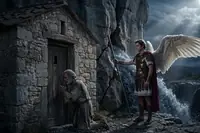
In the last lines of that letter, Saint Paul sends a personal word to a man named Archippus: "See that you complete the ministry you have received in the Lord" (Col 4:17). Orthodox tradition tells that later, Archippus himself looked after a small chapel in honor of the Archangel Michael near Colossae, beside a spring where the sick came to ask for healing. Jealous pagans of the region joined forces to dig channels and divert two rivers so that the water would crash straight into the chapel. That night, as tradition tells it, Michael appeared and struck the mountain rock with his staff. The rock split wide open, and the flood poured down into a deep cleft and flowed away underground, leaving the chapel untouched.
From then on the place was called Chonae, Greek for "the place where the water plunged." To this day, the Eastern Churches celebrate the "Miracle of the Archangel Michael at Chonae" on September 6. They give him a beautiful title: Archistrategos, "the Supreme Commander," and keep his main feast on November 8 rather than September 29 as in the Roman Catholic Church.
The story of Chonae is tradition, and no historical record can confirm its details. But it shows how the first Christians pictured Michael: not as a warrior out to conquer anyone, but as one who stepped in to shield a small chapel, a healing spring, a vulnerable community.
Chapter 6 of 11
A cave consecrated by no human hand
In southern Italy, on Mount Gargano jutting into the Adriatic like the spur of a boot, there is a cave the Italians call the "Celestial Basilica," because, according to tradition, it is the only holy place not consecrated by human hands.
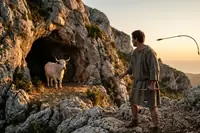
The story, recorded in an old book from around the eighth century, begins in a very ordinary way: in 490, a wealthy landowner of the Siponto area named Garganus lost the finest bull in his herd. Searching everywhere, he found it standing right at the mouth of a cave on the mountaintop. Angry at the stubborn animal, he drew his bow and shot a poisoned arrow. But the arrow turned back in midair and struck the man who shot it.
When he heard of this strange event, Bishop Lawrence of Siponto told the people to fast and pray for three days. And according to tradition, the Archangel Michael appeared to him, saying that the cave was a place he had chosen and would guard himself. In 493, when the bishop meant to go and consecrate the cave, he was told again that there was no need: Michael himself had already consecrated it. It is said that when the procession entered, they found an altar already standing in the cave, covered with a red cloth.
For more than a thousand years afterwards, the cave on Mount Gargano was one of the greatest pilgrimage sites in Europe. The Lombards, a people who swept down from the north to rule Italy in the sixth century and who loved the image of the warrior angel, made it their national shrine. In 2011, UNESCO recognized the shrine as a World Heritage site.
Among the millions of pilgrims over the centuries was one who walked all the way down from distant Umbria: Saint Francis of Assisi, who was deeply devoted to Saint Michael and fasted forty days every year to prepare for his feast. Tradition tells that when he reached the mouth of the cave, Francis stopped and did not dare go in, feeling himself unworthy. He only knelt at the threshold to pray, then carved into the rock a small T-shaped cross, the Tau he used in place of a signature.
Chapter 7 of 11
A mountain in the sea and a hole in a skull
On the coast of Normandy in France, amid vast tidal flats, there is a rocky island called Mont-Saint-Michel, Saint Michael’s Mount. Its story is so strange it sounds like a fairy tale, yet it comes with a piece of evidence that is still kept today.
Tradition tells that in 708, Bishop Aubert of Avranches dreamed that the Archangel Michael told him to build a chapel on the rocky island offshore, then called Mont Tombe. He took it for an ordinary dream and did nothing. Michael appeared a second time; still he hesitated. The third time, so the story goes, the angel pressed his finger into the bishop’s head, and when he woke, he felt a hole in his skull. This time he did not dare to argue.
The small chapel was dedicated on October 16, 709. From then on, over thirteen centuries, it grew into a massive abbey rising from the sea. Every day when the tide comes in, the path joining the island to the mainland disappears under water; pilgrims of old had to wait for low tide to walk across the sand, and more than a few were lost to the tide or the quicksand.
Saint Aubert’s skull, with a round hole in the forehead, is still displayed today in a glass case in the church of Saint-Gervais in Avranches, across the bay. Skeptical researchers say it is the mark of an ancient trepanation, a hole cut to treat an illness. Pilgrims still come to look, and smile at the story of a stubborn bishop.
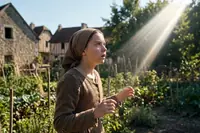
During the Hundred Years’ War between England and France, English forces besieged Mont-Saint-Michel for years but never took it. The mount that held out became a sign of hope for all of France. At that very time, in the village of Domrémy, a thirteen-year-old peasant girl was standing in her family’s garden one summer noon when she heard a voice from her right, amid a great light. Later, before a court, she testified that this first voice was Saint Michael’s, and that he told her only one very simple thing: be good, and go to church often. That girl was Joan of Arc.
Chapter 8 of 11
The angel who sheathed his sword
In Rome, on the bank of the Tiber, stands a huge round fortress. It was built in the second century as a mausoleum for the emperor Hadrian, and later served in turn as a stronghold, a prison and a refuge for the Popes whenever Rome was attacked. On top of the fortress stands the statue of an angel sheathing his sword.
Tradition tells that in 590, plague was ravaging Rome, and Pope Pelagius II himself died of it. The new Pope, Saint Gregory the Great, led the whole city in a penitential procession for three days, singing the litany as they walked. It is said that some people in the procession collapsed and died right in the street. As the procession approached Hadrian’s tomb, people saw on its summit the Archangel Michael sheathing a sword still dripping with blood. Soon afterwards the plague ended. From then on the fortress has been called Castel Sant'Angelo, the Castle of the Angel.
The statue on top has been replaced many times. The marble statue carved by the sculptor Raffaello da Montelupo in 1536 now stands in an inner courtyard of the castle; the bronze statue on the summit today is by Peter Anton von Verschaffelt, cast in 1753. Music lovers know the castle from a very different scene: the final act of Puccini’s opera Tosca, when the heroine throws herself from the battlements, right beneath the angel sheathing his sword.
Chapter 9 of 11
September 29 and the geese
Many people think September 29 marks a day when Michael appeared somewhere. In fact, the date comes from something quite ordinary: the dedication of a church. The oldest Roman sacramentaries, from the sixth century, already record the anniversary of the dedication of a basilica in honor of Saint Michael on the Via Salaria, about six miles north of Rome. That church no longer exists, but its feast has spread throughout the world.
In medieval England, the feast of Saint Michael, called Michaelmas, became one of the four "quarter days" of the year: the end of the harvest, the day farmers paid their rent, the day new laborers were hired, the day judges began their sessions. To this day, the autumn term at the ancient universities of Oxford and Cambridge is still called "Michaelmas term." There was also a custom of eating a fat goose that day, and an old saying went: "Eat a goose on Michaelmas Day, and you won’t want for money all the year." The purple asters that bloom at the end of September are still called "Michaelmas daisies" by country people.
In 1969, when the Church revised the liturgical calendar after the Second Vatican Council, September 29 became the shared feast of the three Archangels named in Scripture. Three angels, three names, three ways God comes to us: Michael protects, Gabriel announces, Raphael heals and accompanies.
Chapter 10 of 11
A prayer after Mass
In 1886, Pope Leo XIII added a short prayer asking Saint Michael’s protection to the prayers said after Low Mass throughout the world. A story has long been told that he composed the prayer after a terrifying vision just after Mass, but it appears in writing only decades later and has no reliable documentation. What is certain is that the prayer entered the life of the whole Church.
Generations of Catholics, including in Vietnam, learned that prayer by heart as children, saying it on their knees at the foot of the altar as soon as the priest finished Mass: Saint Michael the Archangel, defend us in battle, be our protection against the wickedness and snares of the devil.
In 1964, when the Mass was renewed after the Council, the prayers after Mass were no longer required. But the prayer to Saint Michael never disappeared. On April 24, 1994, Pope Saint John Paul II told the faithful: although this prayer is no longer said at the end of Mass, please do not forget it; keep praying it for help in the battle against the forces of darkness.
On July 5, 2013, in the Vatican Gardens, Pope Francis, sitting beside Pope Emeritus Benedict XVI, blessed a new statue of Saint Michael, and then entrusted Vatican City to the protection of Saint Joseph and Saint Michael. Five years later, on September 29, 2018, he asked the faithful throughout the world to pray the Rosary every day during October, ending with the ancient prayer "We fly to your patronage" and the prayer to Saint Michael, at a time when the Church was going through stormy waters.
Long before that, Pius XII had made Saint Michael the patron of police officers, who stand every day between ordinary people and danger. In many Vietnamese parishes, Saint Michael is the patron of the parish council and of youth groups.
Chapter 11 of 11
Who is like God?
In Vietnam, Michael is one of the saints’ names most often given to boys. Among the saints in this app is one who bears that name: Saint Michael Hồ Đình Hy, an official of the Nguyễn court beheaded in 1857. Perhaps no one names a child Michael without a simple wish in their heart: may my child be protected in a life full of snares, and may my child know how to stand on the side of good, even when it costs something.
Looking back, what we know for certain about Michael is very little: five verses of Scripture. The rest is tradition: dreams, caves, rivers turned aside, mountains in the sea. Not every story can be checked like an official record. But all of them show something real: when people were most afraid, of plague, war, floods or just a puzzling dream, they looked up and called on Michael.
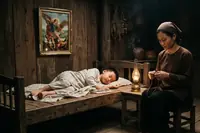
And perhaps the closest thing he leaves us is not his sword, but the question carried in his name. Whenever we fear something beyond our strength (an illness, a debt, someone who has power over us, a bad habit we cannot shake), that question keeps all its force: Who is like God?
Michael does not win because he is strong. He wins because he stands in the right place, at God’s side. And that is something a child, a country mother, the frailest old man can also do.
The end of the story
You have walked with Saint Michael the Archangel to the end of the story.
Images that will stay with you:
An old exile fasting and weeping for three weeks, not knowing his prayer had been heard from the first day, and that someone was fighting for him.
Standing before God’s enemy, the great prince said only, "The Lord rebuke you!" and not a single insult.
In plague-stricken Rome, on top of an ancient tomb, an angel sheathing his sword.
Stay in silence
At the end of his story, you realize that Michael’s strength does not lie in his sword. It lies in always standing on God’s side, and letting God be the Judge.
When fear grows bigger than you, ask again the question in his name: Who is like God?
Let us pray
Saint Michael the Archangel,
your name is a question: "Who is like God?" Remind me of that question whenever I am afraid, when illness, debt or a bad habit makes me think I cannot get up again.
Protect my family on the nights I cannot sleep for worry. Guard my children when they are far away, amid snares I cannot see.
And teach me to live as you do: strong without being aggressive, standing on the side of good, but letting God be the Judge.
Amen.
Sources
- Feast dayArticle, version 1.1
- Patron ofPatronages and symbols, version 1.1
- Often depicted withPatronages and symbols, version 1.1
Meet the next one
 Journey 1