

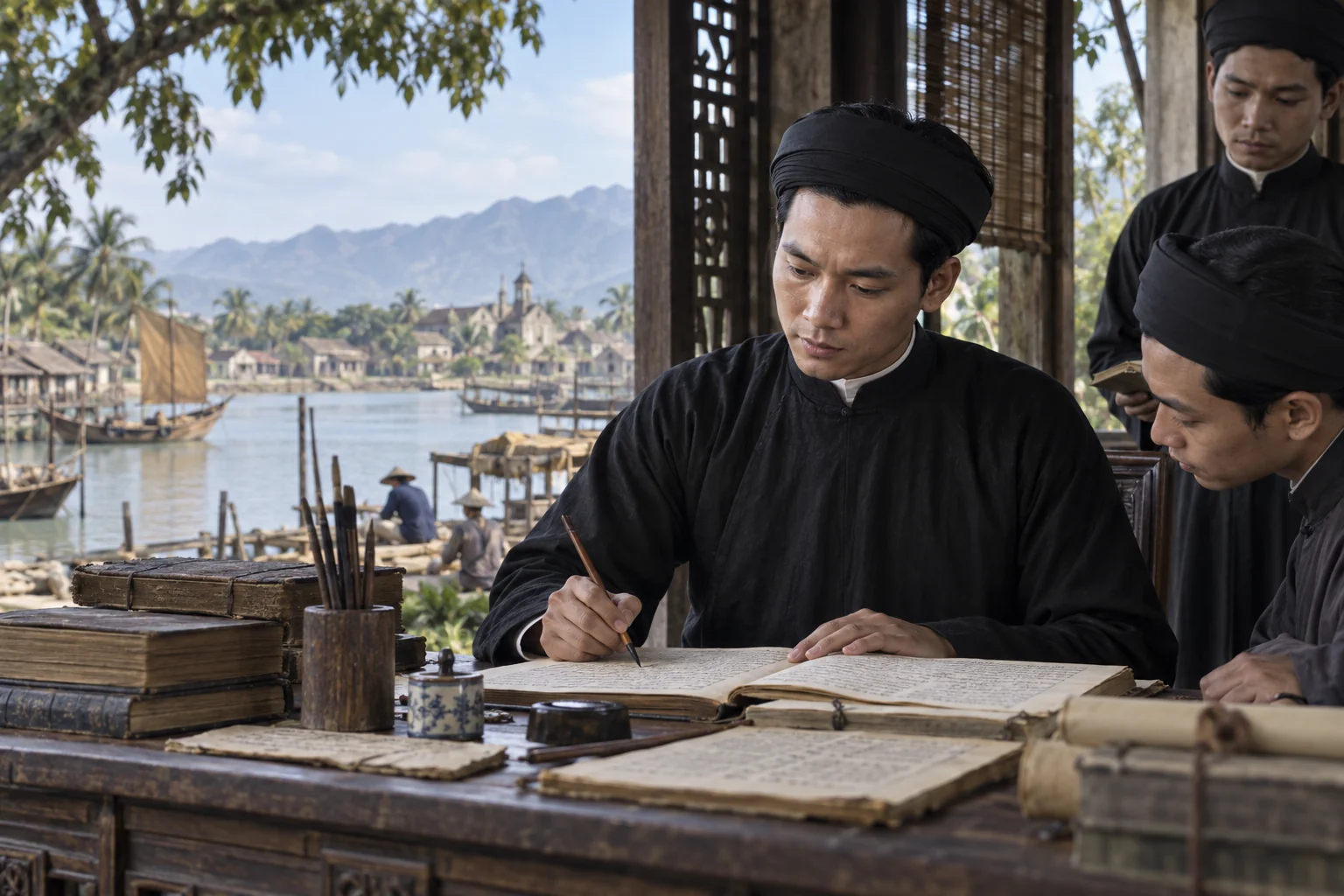
Journey 8 · Faith with a Vietnamese Face
Saint Philip Phan Văn Minh
A loyal pen and blood shed at the Ba Răng landing
Feast day July 3
Tap to step inside
Saint Philip Phan Văn Minh
A loyal pen and blood shed at the Ba Răng landing
Map of a life
This life told in 6 chapters
Begin the journey OpeningOpening1 min
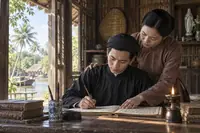 Chapter 1 of 6A son of the rich land of Cái Mơn1 min
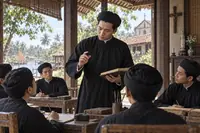 Chapter 2 of 6A seminary professor in a time of strict persecution1 min
 Chapter 3 of 6A shepherd of the canals and of the people’s Nôm script1 min
 Chapter 4 of 6The raid at the Ba Răng landing1 min
 Chapter 5 of 6Torn by the lash and a noble spirit in the courtroom1 min
 Chapter 6 of 6The day of triumph at the Đình Khao landing2 min
Feast day
Saint Philip Phan Văn Minh
Some places may celebrate on a slightly different day.
July 3
Often depicted with
- A palm branch
- A pen and a book
Opening
Opening
At the beginning of July 1853, under Emperor Tự Đức, at the execution ground of Đình Khao on the bank of the Cổ Chiên River, in Vĩnh Long province, a thirty-eight-year-old man knelt on a patterned mat. He had a scholar’s look, and his face had the calm of someone more at home with books than with execution grounds. He wore a spotless white tunic and a heavy cangue around his neck, and his fingers moved over his rosary without pause.
Thousands of people, Christians and non-Christians alike, from all over Vĩnh Long, Cái Mơn and Ba Tri, lined both sides of the road to the execution ground, weeping as they said goodbye to the shepherd they fondly called “holy Father Minh.”
Before giving the order, the mandarin in charge came up to him one last time. “Master, you are a man of high learning, versed in both Chinese and Western letters,” he said, with genuine regret in his voice.
“I truly cannot bring myself to do this. Just say one word renouncing the religion of Jesus, and I will at once petition the emperor to pardon you and give you an important post.”
The priest smiled and looked at the mandarin with a strange calm. “I thank you with all my heart for your kindness, sir,” he answered.
“But from childhood until now I have worshiped only God, the common Father of all creatures, and I am wholeheartedly loyal and devoted to my homeland. I would rather lose this life than ever betray my faith. Please go ahead and carry out your duty, sir.”
He was Father Philip Phan Văn Minh, one of the most brilliant Catholic scholars of the South in the nineteenth century. He used both Western learning and the Vietnamese Nôm script to sow the faith in the poor Catholic hamlets of the river country, and in the end he gave his life.
Chapter 1 of 6
A son of the rich land of Cái Mơn
Philip Phan Văn Minh was born in 1815 in the Cái Mơn Catholic community, then in Minh Ngãi canton, Tân Minh district, Vĩnh Long province — now Vĩnh Thành commune, Chợ Lách district, Bến Tre province. Missionaries came to Cái Mơn very early, with records going back to about 1700. It lies in one of the richest orchard regions of the Mekong Delta, where a tangle of canals keeps the fruit trees green all year round, an area later known as Bến Tre’s “kingdom of fruit.” His father, James Phan Văn Chánh, and his mother, Maria Nguyễn Thị Tròn, raised a large family in the faith.
From childhood Minh was unusually bright: he learned Chinese characters from the village teachers, grasped things at once, loved poetry, and wrote such a beautiful hand that the grown-ups in the parish often remarked on it. At thirteen, after his father died, young Minh boldly went to Bishop Jean Taberd (known to the Vietnamese as Đức cha Từ), who was visiting Cái Mơn, and asked to enter the Latin school. Seeing in the boy rare gifts and a devout soul, Bishop Taberd took him in and brought him to be raised at the seminary of Lái Thiêu.
But soon afterward the court’s troops surrounded the Latin school of Lái Thiêu in a sweep against the faith. Bishop Taberd had to send the seminarians by ship to the major seminary of Penang in Malaya, where many generations of Vietnamese seminarians studied, including several future martyr saints.
Chapter 2 of 6
A seminary professor in a time of strict persecution
For twelve years, from 1828 to 1840, the seminarian Philip Minh studied hard in a foreign land. He mastered Latin, French and Greek, without ever letting go of the Sino-Vietnamese and Nôm learning of his childhood in Cái Mơn. That rare blend of Western learning and Vietnamese roots would become the most striking feature of his whole ministry.
In 1838 Bishop Taberd summoned the seminarian Minh and a fellow student all the way to Calcutta, India, to help him compile and revise his Latin–Vietnamese dictionary, published as the Dictionarium Latino-Annamiticum. It was one of the most important bilingual dictionaries of its time and did much to shape the early Romanized Vietnamese script. For a young man from a small orchard village in the Mekong Delta, taking part in a scholarly work of that scope was something hardly anyone back home could have imagined.
In 1840 the seminarian Philip Minh returned to his homeland, just as Emperor Minh Mạng was enforcing the harshest edicts against the faith in the history of the Nguyễn dynasty. He was made a professor at the seminary of Cái Nhum, which later moved to Bãi San, and formed generations of seminarians who were firm in faith and widely read, the very qualities he had worked so hard to gain in more than a decade abroad.
In 1846, in Chợ Quán church in Saigon, Philip Phan Văn Minh was ordained a priest by Bishop Lefèbvre, at the age of thirty-one.
Chapter 3 of 6
A shepherd of the canals and of the people’s Nôm script
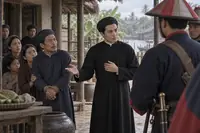
After his ordination, Father Minh was sent to care for large parishes in the Mekong Delta: Ba Tri, Mặc Bắc, and finally Bến Ba Răng, in present-day Vĩnh Long. There the tangle of rivers was both the people’s livelihood and the only way a priest could slip unseen from one Catholic hamlet to another.
Father Minh lived a very frugal life: rice with dried fish and vegetables from the garden, a coarse cloth tunic worn through at both shoulders. Night after night he paddled a small three-plank boat himself through narrow creeks, some barely wide enough for one boat between dense walls of nipa palms, to say Mass, hear confessions and anoint the dying in remote Catholic communities.
What set Father Minh apart from many priests of his time was the way he used his learning to serve the least educated. He taught himself the local medicinal herbs and treated the poor for free, Christian or not; in the epidemics that so often swept the river country, those hands saved many lives. He also wrote poems, catechism verses and lives of the saints in Nôm, simple rhymes that even people who could not read the Romanized script or the difficult Chinese characters could learn by heart and pass on by the fire in the evening. In this way a scholar who had helped compile a Latin dictionary brought the catechism to country people who had never learned their letters.
Chapter 4 of 6
The raid at the Ba Răng landing
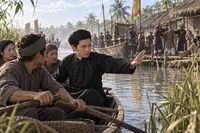
At the beginning of 1853, under Tự Đức, the hunt for priests grew ever fiercer. A man in the parish, greedy for the reward the authorities offered, went secretly to the provincial town of Vĩnh Long and reported that Father Minh was hiding in the house of the community leader Lựu, at the Ba Răng landing.
Early on the morning of February 26, 1853, soldiers in war boats suddenly descended and surrounded the house. The faithful hurriedly put Father Minh in a small boat to paddle him away into the dense reeds along the river. But when he saw the soldiers savagely beating the community leader Lựu and threatening to burn the whole Catholic hamlet if the priest was not found, Father Minh told the boatman to turn back.
He stepped ashore and stood upright before the soldiers. “I am the priest Phan Văn Minh,” he said.
“Take only me; please do not harm the community leader and the innocent faithful.”
The soldiers tied him up, put him in a cangue, chained his legs, and took him with the community leader Lựu to the provincial prison of Vĩnh Long.
Chapter 5 of 6
Torn by the lash and a noble spirit in the courtroom
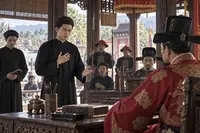
Knowing that Father Minh was a famous scholar, versed in both Western and Chinese learning, the governor of Vĩnh Long tried to persuade him himself before resorting to force. “Master Minh, you have the talents to govern and serve the country; the court greatly needs men like you to deal with the West,” the governor said.
“Why should you die for that foreign religion? Just say one word renouncing the faith, or let the soldiers carry you over the Cross once, and I will at once petition the emperor to spare your life and grant you a high post.”
Father Minh answered with the same calm, clear reasoning he used when teaching the catechism to the poor:
“Your Excellency, the Catholic religion teaches people to honor the Creator who made them, teaches children to be devoted to their parents, teaches subjects to be loyal to the king and his officials, and teaches everyone to love and help one another. How could I give up a religion that teaches nothing but what is just and good? The Cross is where my Lord died to redeem me; I have venerated and kissed it all my life. How could I dare trample on Him in exchange for a little earthly fame?”
Unable to persuade him, the judge flew into a rage and had him stripped, tied to a post and flogged again and again with rattan canes. Blood poured from the scholar priest’s torn flesh, but he clenched his teeth and endured it in silent prayer, without a word of complaint.
Through five months in the dark prison of Vĩnh Long, Father Minh remained remarkably serene. He wrote letters urging the faithful of Cái Mơn to hold fast to the faith, shared his meager rice with prisoners poorer than himself, and by the way he lived slowly won the admiration even of the jailers.
Chapter 6 of 6
The day of triumph at the Đình Khao landing
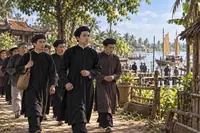
On July 3, 1853, the court’s death sentence reached Vĩnh Long. That morning Father Philip Phan Văn Minh was led out to the execution ground of Đình Khao on the bank of the Cổ Chiên River, a large branch of the Tiền River busy with boats plying between the provinces of the Delta. He walked between two rows of soldiers with swords and spears, while thousands of the faithful lined the road, sobbing as they said goodbye to the shepherd they loved.
Father Minh walked serenely in his white tunic, praying the Rosary. At the place of execution, after professing his faith and forgiving the very man about to carry out the sentence, he knelt on a patterned mat and lifted his eyes in prayer one last time. The gong sounded three times, the sword came down, and the thirty-eight-year-old shepherd’s life of self-giving was complete.
The faithful of Cái Mơn bravely carried his body home and buried him inside the church of Cái Mơn, in the place where he was born, where a fatherless boy of thirteen had once shyly gone to Bishop Taberd and asked to study. Today his relics are still venerated at the Đình Khao Pilgrimage Center in Vĩnh Long, and at the church of Cái Mơn itself in Bến Tre.
On May 27, 1900, Pope Leo XIII beatified Father Philip Phan Văn Minh. On June 19, 1988, Pope Saint John Paul II canonized him, together with one hundred sixteen other Vietnamese Martyrs, in Rome. The Church celebrates him on July 3 each year.
Among the many Vietnamese martyrs who were farmers, merchants, soldiers or ordinary catechists, Father Philip Phan Văn Minh holds a place of his own: a scholar thoroughly trained abroad, who had helped with a lasting work of learning and could easily have chosen a far safer and more prestigious path. Instead he brought all that learning, Latin and Nôm, medicine and poetry, home to serve the least educated country people in a corner of the Mekong Delta, and in the end gave it all on one morning at the Đình Khao landing. Perhaps that is why the people of Cái Mơn, more than a century and a half later, still call him by that simple, loving name: holy Father Minh.
The end of the story
You have walked with Saint Philip Phan Văn Minh to the end of the story.
A few moments in his life stay with you:
Left fatherless at thirteen, the boy from the orchards of Cái Mơn boldly went to Bishop Taberd to ask to study, beginning more than a decade of study in foreign lands.
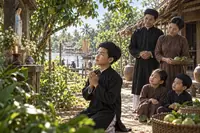
He was invited all the way to Calcutta to help compile the Latin–Annamite dictionary, contributing to the shaping of the Vietnamese Romanized script in its early days.
Back home, that learned man used his knowledge to give medicine to the poor and write catechism verses in Nôm for country people who had never learned their letters.
Stay in silence
You understand why the villagers call him "holy Father Minh": an intellectual who could easily have chosen a safe and prestigious path chose instead to bring all his learning home to serve the least educated.
How could I give up a religion that teaches nothing but what is just and good?
Let us pray
Saint Philip Phan Văn Minh,
you lost your father as a child, then studied and became learned, helping to make a dictionary of the Vietnamese script. Back home, you gave medicine to the poor and wrote catechism verses for those who could not read.
Pray for those who succeed in their studies, that they may not forget their homeland and the less educated.
Help me to use what I have learned to serve the poorest.
Amen.
Light a candle for Saint Philip Phan Văn Minh
Sources
- Feast dayAuthor’s edited profile
- Often depicted withPatronages and symbols, version 1.1
- Reflectionhdgmvietnam.com
- Reflectiontonggiaophanhanoi.org
Meet the next one
 Journey 8