

Journey 8 · Faith with a Vietnamese Face
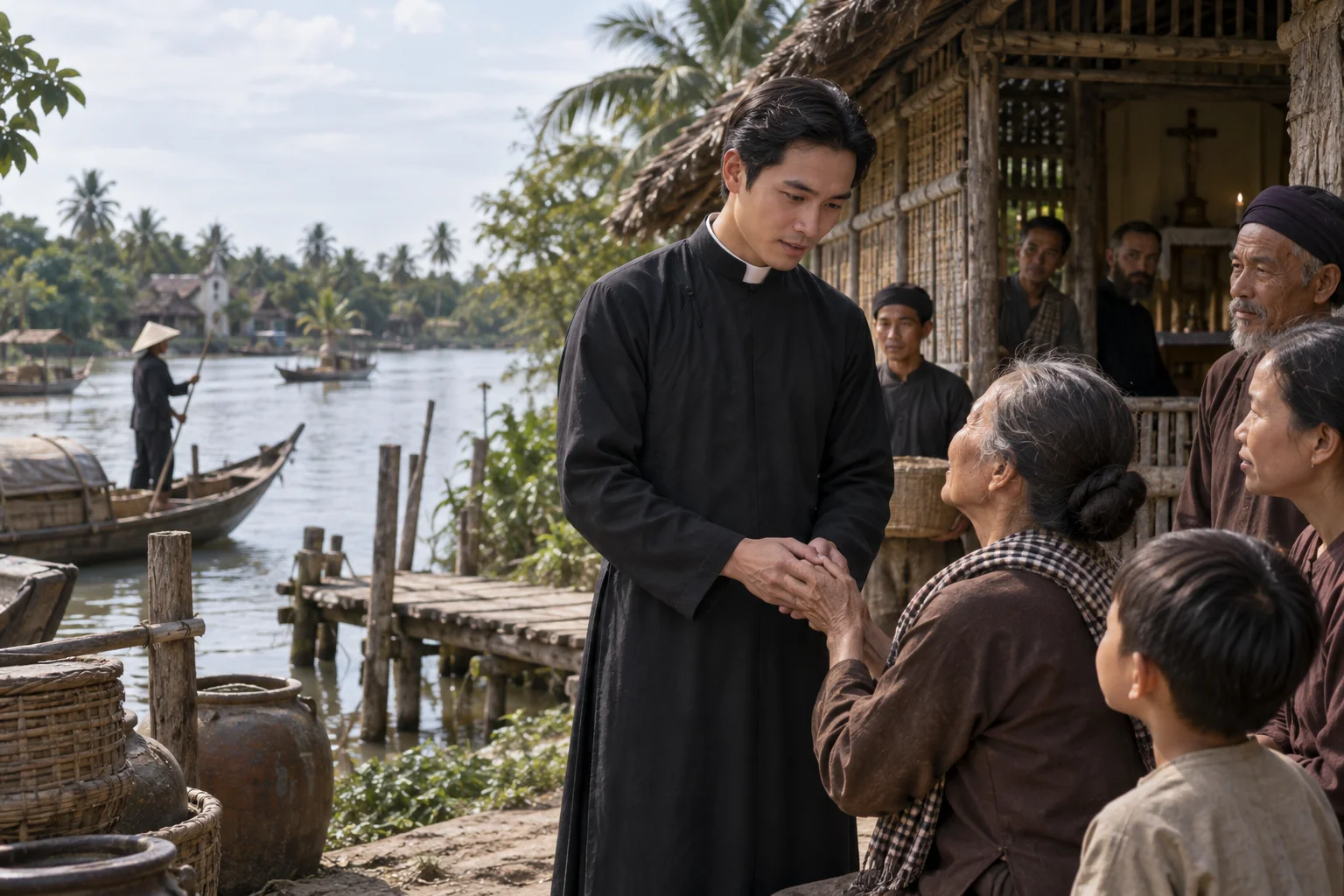
Saint Peter Đoàn Công Quý
A young priest and a serene smile at the place of execution
Feast day July 31
Tap to step inside
Saint Peter Đoàn Công Quý
A young priest and a serene smile at the place of execution
Map of a life
This life told in 4 chapters
Begin the journey
Feast day
Saint Peter Đoàn Công Quý
Some places may celebrate on a slightly different day.
July 31
Often depicted with
- A palm branch
- A priest’s vestment
Opening
Opening
That same morning, on the same sandbank beside the Châu Đốc River, standing beside old Ông Câu Emmanuel Phụng, was a man only thirty-one years old. While Ông Câu Phụng had the weathered look of a lifetime of labor, the man beside him had a face that was still very young: refined, even rather scholarly, quite out of place at an execution ground.
He wore a plain black tunic, threadbare in places, a bamboo cangue around his neck, his hands moving over an old rosary. But what the onlookers that day never forgot was not the cangue or the prisoner’s clothes, but his face: not a trace of fear, even a hint of a smile.
Looking at the crowd weeping around him, he spoke, clearly and warmly:
“Dear friends and neighbors, I am going on ahead... Please hold fast to the faith, live kindly, and pray for me.”
People called him Father Peter Đoàn Công Quý. He was one of the youngest priests in the whole list of the Vietnamese martyr saints; his life as a priest lasted less than a full year, from the day of his ordination to the day of his execution.
That year was so short that, looking only at the numbers, one might think he had not had time to do much. But in that brief time he did something that not every priest has the chance, or the courage, to do: he stepped out of his safe hiding place and faced the enemy, simply to save the life of the layman who had sheltered him.
Chapter 1 of 4
A childhood by the river at Hưng Nhơn
Peter Đoàn Công Quý was born in 1828 in the Búng Catholic community, in the village of Hưng Nhơn, Bình Chánh canton, Thủ Dầu Một province — an area now part of An Thạnh ward, Thuận An city, Bình Dương province. It lies along the Saigon River, where orchards and rice fields mingle, not far from river landings busy with boats carrying goods up to the eastern provinces and down to the Mekong Delta.
His father, Anthony Đoàn Công Miêng, was a lay officer who looked after the community’s common affairs, much like the Ông Câu for whom his own youngest son would one day give his life. His mother, Maria Nguyễn Thị Trường, will appear again later in this story, through a letter written from a dark prison. Quý was the youngest of six children and grew up in a devout home, where faith ran through every family meal and every evening prayer.
From childhood, little Quý differed from other children his age in one way: he preferred to sit quietly listening to the adults pray rather than run about in the fields. He was intelligent and quick, but also somewhat quiet and gentle, and especially kind-hearted; the cakes and treats the grown-ups gave him often ended up with poorer children in the neighborhood. He loved serving at Mass so much that some mornings his family had to go looking for him, only to find him already sitting in the church before it was fully light.
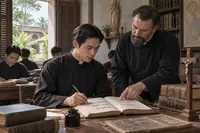
In 1847, at nineteen — no longer too young to enter the seminary by the standards of the time — he was recommended by his parish priest to the major seminary of Saint Joseph at Thị Nghè, Saigon. It was one of the first and most important places for forming native priests in the southern Church at the time, where the seminarians were trained both in letters and in the religious way of life before beginning formal theological studies.
Seeing in the seminarian Quý gifts and virtue far beyond his classmates, his superiors decided to send him farther — to study at the major seminary of the Paris Foreign Missions Society on the island of Pulau Tikus, Penang, in Malaya. This school, usually called the Collège Général, had been founded in 1665 at Ayutthaya, in Siam, to form clergy for the whole of East Asia, and after many moves because of war and political upheaval had settled in Penang in 1806. Later generations gave it a telling name, the Seminary of the Martyrs, because so many of the teachers and seminarians who studied there later shed their blood in Vietnam and Korea.
For seven long years, from 1848 to 1855, the seminarian Peter Quý worked hard at philosophy, theology, letters and the foreign languages needed for his later ministry. Far from his family and homeland, he kept a simple, diligent way of life, and was known throughout the seminary for his devotion to the Eucharist and a rare gentleness in the way he treated everyone, a trait that those who later met him in prison still remembered.
On April 11, 1855, he returned to his homeland. But his homeland was no longer the peaceful land he had left seven years before. Emperor Tự Đức’s edicts against the faith were being enforced more harshly than ever, and he had to step straight into a life of service in the shadows — moving between hidden Catholic communities, avoiding every prying eye, waiting for the day he would receive holy orders. Only in September 1858, at thirty, was he ordained a priest by Bishop Lefèbvre in the church of Thị Nghè. The ceremony must surely have been held in great secrecy, with the whole region on edge as priests were hunted down.
Chapter 2 of 4
Eight months of ministry and a life freely offered
After his ordination, Father Peter Quý was appointed assistant priest in the parish of Lái Thiêu for a short time. Then at the beginning of 1859, his superiors gave him a mission everyone understood to be full of danger: to take charge of the Đầu Nước community on Cù Lao Giêng, a remote, isolated area where the royal troops were tightening control more than ever.
Father Quý reached the island in the first days of the year and was taken in by Ông Câu Emmanuel Lê Văn Phụng, who hid him in his own house — the place that had already sheltered so many missionaries and priests before him. For someone who had just left seven years of study in a quiet seminary, a life of hiding amid dark nights and secret journeys must have been a test quite unlike anything his books had prepared him for.
But Father Quý did not choose to lie low and keep himself safe. Night after night, when the darkness was thick enough to hide a small boat, he paddled through the tangle of creeks on the island to reach each Catholic family — hearing confessions, saying Mass, giving the sacraments to people who had not seen a priest for months, sometimes years. By day he stayed in Ông Câu Phụng’s house, teaching catechism to the young people, or sitting beside the frail old people, listening to them and comforting them with a calm rare in a man of thirty-one.
At dawn on January 7, 1859, when soldiers suddenly burst in and surrounded Ông Câu Phụng’s house, Father Quý was hiding behind a thin wooden partition — the place that had always been a safe refuge whenever there was trouble. But this time everything happened too fast. He heard clearly every blow of the rods falling on Ông Câu Phụng’s body in the yard, and heard the soldiers roaring their threats to tie up the whole family and take them to be beheaded if they did not reveal who was harboring the priest.
In that moment, perhaps he remembered the Gospel verse he had learned by heart through seven years of seminary: the good shepherd lays down his life for his sheep. But knowing a verse by heart is one thing; living it when your own life is on the line is something else entirely.
He pushed aside the wooden partition and stepped out.
“I am the Catholic priest,” he told the soldiers, without a moment’s hesitation. “Please do not harm Ông Câu Phụng and the villagers; they have done nothing wrong — I came here of my own free will.”
The soldiers and villagers standing around were all stunned. A man who could easily have stayed hidden and waited for nightfall to escape had chosen instead to step out openly and declare himself the very man they were hunting. No one had time to react before the soldiers tied him up tightly, together with Ông Câu Phụng, and took them down to the boats to be brought to the prison of Châu Đốc.
Chapter 3 of 4
A smile in the prison of Châu Đốc
For six months, from January to July 1859, Father Peter Quý was held in the dark prison of Châu Đốc, enduring many interrogations and tortures. He was flogged many times with thorny rattan whips, rods with sharp spikes whittled into them to make the pain worse, a common torture in Nguyễn prisons for prisoners considered stubborn. He was also pressed many times to step over the cross, and each time he refused.
“The Cross is the altar on which my Lord gave His life to redeem me,” he answered the threats. “I honor and worship Him all my life; I would rather die a thousand times than ever offend Him.”
What stands out about this young priest, beyond his firmness under torture, is the way he lived during those days in prison. Many witnesses later recounted that he always kept a remarkable cheerfulness: not the carefree air of someone who does not understand the danger awaiting him, but the peace of a man who has fully accepted the road he is walking. He turned the cramped, damp prison into a small parish: comforting his fellow prisoners in the same plight, sharing every meager portion of rice that was brought to him with those hungrier than himself, and teaching them simple prayers to get through the long nights in the dark.
Some jailers, who at first only carried out their orders to guard him, were gradually moved by the way he lived. They quietly loosened his chains, and even made it possible for him to meet the faithful who came to visit. They were small gestures, but full of risk for the jailers themselves if they were discovered.
It was from that dark prison that Father Quý wrote a letter home to his mother, Maria Nguyễn Thị Trường, in their home village of Búng. That letter, handed down through many generations, is hard to read without being moved. These are not the words of a son afraid of death; here it is the son who comforts his mother:
“My dear Mother! Please do not weep or grieve because I must wear chains for the name of God... To suffer prison and die for Christ is a great blessing that God in His love has given to me and to our whole family! Rejoice and thank God, and keep praying that I may stay faithful to my last breath... I will see you again in our blessed heavenly Homeland!”
No one knows exactly in what circumstances Mrs. Trường read that letter — perhaps sitting alone in the house in Búng where she had raised her youngest son from the days when he loved serving at Mass more than running about in the fields. But the letter was kept and handed down through many generations, as one of the most moving testimonies to the bond between a mother and a son taking his last steps on the road of martyrdom.
Chapter 4 of 4
The martyr’s crown on the bank of the Châu Đốc River
On July 31, 1859, the sentence was carried out. Father Peter Đoàn Công Quý walked out onto the sandbank beside the Châu Đốc River with the bearing of an undefeated man: the bamboo cangue around his neck, the rosary in his hand, and on his face the serenity that those who saw it never forgot.
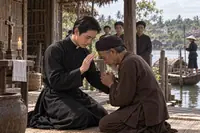
Before the execution, he knelt beside Ông Câu Phụng one last time, heard the confession of the old man who had sheltered him through those months, and then the two exchanged an embrace of farewell. It was a moment when a priest and a layman — a shepherd and the sheep he had vowed to protect — exchanged roles one last time: Ông Câu Phụng, who should have been the one protected, now stood there and watched his young priest go first.
He knelt on a patterned mat, lifted his eyes to heaven, his lips moving softly in a last prayer. Three strokes of the gong rang out. The executioner’s sword came down. The thirty-one-year-old priest, with less than a year as a shepherd, had completed his mission to the last drop of his blood.
The faithful of the Chợ Quán community and his relatives bravely took his body and brought it for burial in the very community of Búng — where he had been born thirty-one years before, where his old mother still kept her son’s last letter. Today his relics are still venerated in the parish church of Búng, in Bình Dương province. The circle closed, from birthplace to homecoming, though between the two lay a whole journey across the sea to Penang and back in the harshest years of persecution.
On May 2, 1909, Pope Pius X beatified Father Peter Đoàn Công Quý. And on June 19, 1988, Pope Saint John Paul II canonized him, together with one hundred sixteen other Vietnamese Martyrs, in Rome. The Church celebrates him on July 31 each year, the same day as the old man who walked his last steps with him on the sands of Châu Đốc.
There is something strange about the short life of Father Peter Quý, if one stops to think about it: seven years of study at a distant seminary across the sea, only to serve as a priest for less than a year. By ordinary reckoning, it looks almost like a waste: so many years of study, so much effort in formation, for a ministry almost unbelievably short. But in that brevity lies something that many long priestly lives may never reach: the moment of stepping out from behind the wooden partition, freely handing himself over to the enemy so that another family could live. Perhaps it is that moment, and not the number of years of service, that is the true measure of a priest’s life fully lived.
The end of the story
You have walked with Saint Peter Đoàn Công Quý to the end of the story.
A few moments in the young priest’s life bring a lump to your throat:
Hearing the lash falling on Ông Câu Phụng in the yard, he stepped out of his hiding place and said: "I am the Catholic priest... they have done nothing wrong — I came here of my own free will."
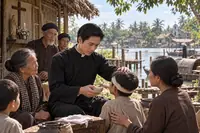
From his dark prison he wrote to comfort his own mother: "To suffer prison and die for Christ is a great blessing that God in His love has given to me and to our whole family!"
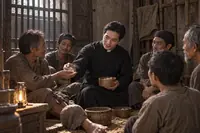
Before the execution, he knelt to hear one last confession from Ông Câu Phụng — the man who had sheltered him — and then the two embraced in farewell.
Stay in silence
You understand the true measure of a shepherd’s life: not the number of years of service, but the moment of daring to step out of safety so that another family may live.
I am the Catholic priest; please do not harm Ông Câu Phụng and the villagers — they have done nothing wrong; I came here of my own free will.
Let us pray
Saint Peter Đoàn Công Quý,
hearing the lash falling on the man who had sheltered you, you stepped out of your hiding place: "I am the priest; they have done nothing wrong."
Pray for young priests, that they may be as brave and generous as you.
Teach me not to let others suffer in my place, and to comfort my parents even in the hardest times.
Amen.
Light a candle for Saint Peter Đoàn Công Quý
Sources
- Feast dayAuthor’s edited profile
- Often depicted withPatronages and symbols, version 1.1
- Reflectiontonggiaophanhanoi.org
- Reflectionvntaiwan.catholic.org.tw
Meet the next one
 Journey 8