

Journey 8 · Faith with a Vietnamese Face
Saint Emmanuel Lê Văn Phụng
An exemplary family man at the gateway of Châu Đốc
Feast day July 31
Tap to step inside
Saint Emmanuel Lê Văn Phụng
An exemplary family man at the gateway of Châu Đốc
Map of a life
This life told in 5 chapters
Begin the journey OpeningOpening1 min
 Chapter 1 of 5A devout carpenter on the island of Cù Lao Giêng2 min
 Chapter 2 of 5A house sheltering shepherds in a time of storms2 min
 Chapter 3 of 5The fateful day in the Đầu Nước community2 min
 Chapter 4 of 5Six months in prison and a refused ransom2 min
 Chapter 5 of 5A hero’s death where the rivers meet at Châu Đốc2 min
Feast day
Saint Emmanuel Lê Văn Phụng
Proper memorial in the Diocese of Long Xuyên; common feast on November 24
July 31
Often depicted with
- A palm branch
- A rope
Opening
Opening
Early on the morning of July 31, 1859, two wooden stakes were driven at first light into a sandbank beside the Châu Đốc River, where a branch of the Hậu River flows close to the Cambodian border, a few miles by water from the town of Châu Đốc. The mist had not yet lifted from the river when people began streaming in and packing the bank, some even wading into the mud to get a little closer.
The first to be led out between two rows of soldiers with spears was an old man of sixty-three. He wore a long black gauze tunic and a turban, the dress of a respected village elder, not prison clothes. He stood upright and walked steadily, without a stagger, despite six months in a dark prison. Beside him was a much younger man, only thirty-one, a bamboo cangue around his neck, his hands fingering a worn rosary.
The old man turned to the younger one, his voice strong enough for those nearby to hear:
“Father, you and I have lived side by side serving God, and now we may die side by side for God’s name on this land of our birth — what a boundless blessing.”
People called him Ông Câu Phụng — Emmanuel Lê Văn Phụng, head of the Catholic community of Cù Lao Giêng. The young man beside him was Father Peter Đoàn Công Quý, the priest he had hidden in his home through the most dangerous months.
Ông Câu Phụng had no army behind him and no title beside his name in the court’s registers. He was simply a man who made tables and chairs, built houses and plowed fields to feed nine children, known all over the island by a very ordinary name: the Christian carpenter. Yet that carpenter, standing between life and death, did not desert his post: a father in his home, an elder brother in his community, a man who had promised to shelter others and sheltered them to the end.
Chapter 1 of 5
A devout carpenter on the island of Cù Lao Giêng
Cù Lao Giêng lies in the middle of the Tiền River, in today’s Chợ Mới district, a strip of alluvial land about twelve kilometers long and seven wide, surrounded by water on every side. You reach it by ferry, slipping between the nipa palms and Alexandrian laurels that grow at the water’s edge. The soil is rich, renewed by the river all year round. Its isolation, with no road to the mainland and every coming and going by boat, helped make it one of the oldest cradles of the Catholic faith in the Mekong Delta. From the eighteenth century, waves of Catholic settlers came to clear the land, build villages and quietly found Christian communities in that still-wild country of rivers.
Emmanuel Lê Văn Phụng was born in 1796 in the hamlet of Đầu Nước on that island. His father, Emmanuel Lê Văn Kế, and his mother, Maria Nguyễn Thị Nhơn, came from Catholic peasant families who had worked the fields and orchards there for generations. Young Phụng grew up to the sound of flowing water, boats putting in to shore, and the church bell echoing across the canals every morning. He was baptized as a child with the name Emmanuel, “God with us,” a name that, looking back on his life, people later felt suited him strangely well.
He had little schooling and owned no books to speak of apart from a few prayer books. His trade was carpentry: sawing timber, planing boards, making tables and chairs, building houses, work that demands steady hands and a sharp eye but never makes anyone rich. He married a devout woman of the same parish, and they had nine children. The house he built with his own hands from island timber, with a thatched roof and a packed earth floor, was no different from hundreds of others along the riverbank, except that it was always tidy, evening prayers always rose from it, and its door was always open to needy neighbors, whether or not they shared his faith.
People said Phụng was so blunt that he sometimes gave offense, but no one ever heard him tell a lie for his own advantage. When he made a set of tables and chairs, he charged exactly the agreed price, no more and no less. When neighbors ran short of rice before the harvest, he lent it to them without interest. And so, year after year, his standing grew: not the kind that comes from wealth, but the kind people give only to those who have lived uprightly so long that no one doubts them anymore.
Eventually the Catholics of Cù Lao Giêng, with the approval of the clergy, chose him as Ông Câu, the head of the parish lay council. It was not an ordained office but a lay responsibility: looking after the parish’s common affairs, keeping contact between the people and the priests, and seeing to order and common property. But at a time when all religious activity was outlawed, being Ông Câu meant being the first to answer for any disaster that struck the community.
Chapter 2 of 5
A house sheltering shepherds in a time of storms
In the 1850s, under Emperor Tự Đức, edicts against the faith were issued one after another, each harsher than the last. The authorities set up guard posts at the great river mouths and offered rewards to anyone who denounced a priest or missionary in hiding; communities caught harboring priests could have all their property confiscated, and the whole village could be punished.
But Cù Lao Giêng, cut off by water on every side, became one of the safest hiding places for missionaries and Vietnamese priests. Every boat coming or going had to pass through small creeks with winding bends that only the locals knew by heart; to strangers, especially officials and soldiers from the mainland, it was a watery maze.
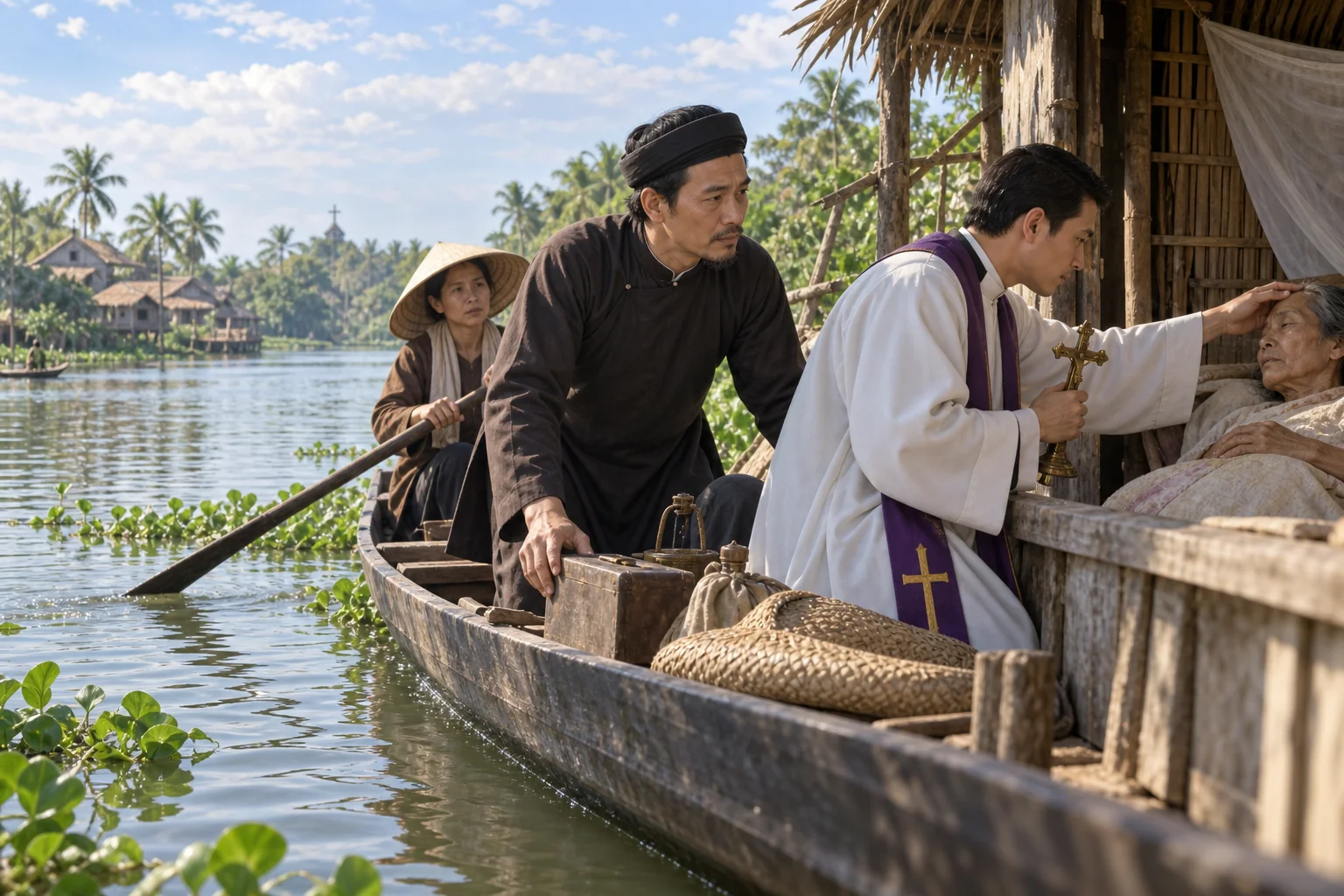
Ông Câu Phụng turned his own house into a hiding place. With his own hands he dug secret cellars under the floor, covered by piles of half-sawn timber, an ordinary sight in a carpenter’s workshop that no one would suspect, and even under the rain gutters around the house. When a priest or missionary needed shelter, he took them down into the cellar, covered it with planks and went on with his everyday work as if nothing were happening.
He did more than hide people. He also looked after a community of Lovers of the Holy Cross sisters working quietly on the island, providing their lodging and food and keeping watch whenever there were rumors of a patrol. On moonless nights he arranged secret Masses in his own house or in trusted homes nearby, so that the faithful could receive the sacraments they would otherwise have gone without.
He did all this not in a single night but over many years, so quietly that even his non-Christian neighbors had no idea that beneath the old carpenter’s floor a whole hiding network was at work.
At the beginning of 1859, a young priest was sent to care for the Catholics of Đầu Nước: Father Peter Đoàn Công Quý, ordained less than six months before. Ông Câu Phụng took him in and hid him in his own house, as he had hidden so many others. But he cared for this young priest with special tenderness, as one cares for a youngest son just grown up and not yet used to the dangers lurking everywhere. Night after night, when Father Quý paddled out to visit Catholic families in the area, Ông Câu Phụng kept watch, alert to every strange movement on the river, until he saw the priest return safely.
Chapter 3 of 5
The fateful day in the Đầu Nước community
Every secret, however carefully kept, comes out one day, usually through someone very close.
Someone in the area, greedy for the reward offered for denouncing a priest, secretly rowed all the way to the town of Châu Đốc to inform. No one knows exactly who he was. Later records speak only of “a betrayal,” without a name, perhaps because those who wrote down the story did not want to leave a name for later generations to curse, or simply because no one remembered anymore.
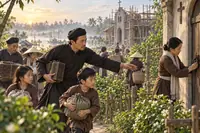
At dawn on January 7, 1859, while the mist still lay thick on the river, hundreds of soldiers in many war boats suddenly closed in on the island and surrounded Ông Câu Phụng’s house before anyone inside could react. There was no time to get Father Quý down into the secret cellar as usual; the soldiers were already at the door.
They burst in and searched every corner of the house, tied up Ông Câu Phụng in the middle of the yard, and began questioning him with the lash. Father Quý, pressed behind a thin wooden partition, could hear every stroke, and the soldiers roaring that they would tie up the whole family and take them away to be beheaded if Ông Câu Phụng did not reveal who was hiding the priest.
In that moment the thirty-one-year-old priest faced a choice no sermon had ever fully prepared him for: stay hidden and save his own life, or step out and save the family of the man who had sheltered him so long.
He pushed aside the wooden partition and stepped out into the yard.
“I am the Christian priest,” he said, his voice not trembling at all. “Spare Ông Câu Phụng and his family; they have done nothing wrong.”
The soldiers froze for a moment, then shouted for joy: the biggest catch had given himself up. They tied up both men at once, seized the prayer books and sacred objects, and marched them down to the boats bound for the prison in Châu Đốc. When the parishioners heard, they rushed to the riverbank and stood in a long line, weeping, as their priest and the man they had trusted for so many years disappeared around the bend of the river, their hands still tied behind their backs.
Chapter 4 of 5
Six months in prison and a refused ransom
The prison of Châu Đốc then stood not far from the provincial market, where the Hậu River and the Châu Đốc River meet, a strategic spot the court used as a garrison guarding the Cambodian border and as a place to hold prisoners considered dangerous to public order.
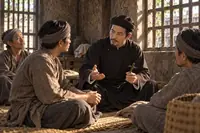
When the governor learned that Ông Câu Phụng was a well-known landowner of some means and great standing in the region, he changed his tone. Instead of simply torturing him, he tried persuasion and even offered a way out:
“Phụng, you are an honest man who has dealt fairly all your life. Harboring a priest is a serious matter, but I respect you. All I need is for you to declare that you did not know this man was a priest, that you just happened to give a passing traveler lodging, and I will set you free at once to go home to your wife and children.”
It was a door left ajar: one untrue sentence, harmless enough on the face of it, and he could go home to the nine children waiting for him.
Ông Câu Phụng refused.
“Your Excellency, I am a Catholic; I have been taught always to tell the truth and never to lie. I know very well that he is a priest of God, and I myself freely took him into my home to care for him and serve him. I will never tell a falsehood to save myself.”
The governor grew angry and ordered him to step over a cross laid in front of the courtroom, the usual way the mandarins forced Christians to deny their faith in public. Instead of stepping over it, Ông Câu Phụng fell to his knees, embraced the cross and kissed it reverently in front of everyone.
The rattan came down at once, dozens of strokes in a row, tearing the old man’s back. Blood spread over the earthen floor of the courtroom. He did not cry out, only clenched his teeth, his lips moving in silent prayers.
News of the torture reached Cù Lao Giêng. His family and the parishioners gathered a large sum of money, probably most of their savings, and took it to Châu Đốc, hoping to buy his release. It often happened at the time: many well-off families saved their relatives in just this way.
But when he heard about it, Ông Câu Phụng called his children and spoke to them with unusual sternness:
“Why bring money to ransom me? I am old now; what use would a few more years of life be? To suffer prison and die for God is the highest honor God has given me. Take that money home and share it with the poor and use it for works of devotion. Let no one try to ransom me again.”
Through the remaining months in that dark prison, Ông Câu Phụng and Father Quý stayed close, like a real father and son. They prayed together every evening and shared their meager rice with prisoners worse off than themselves, and in this way they slowly won over even the hardened jailers.
Chapter 5 of 5
A hero’s death where the rivers meet at Châu Đốc
At the beginning of July 1859, the sentence from the capital, Huế, arrived in Châu Đốc. Father Peter Quý, as the priest who spread the religion, was sentenced to trảm, beheading. Ông Câu Emmanuel Phụng, who had harbored him, was sentenced to giảo, strangulation. The same crime, but the law graded the punishment: the religious leader received the sentence regarded as heavier, and the accomplice a death considered “lighter” in the legal thinking of the time, though in reality being strangled by a rope pulled from both ends was no gentle death.
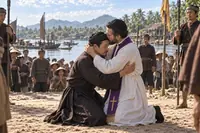
On the morning of July 31, 1859, the two men were led out to the sandbank beside the Châu Đốc River, where the crowd had gathered since early morning. Before the execution the two knelt side by side one last time. Father Quý heard Ông Câu Phụng’s confession, and then they embraced and gave each other the kiss of peace, a gesture familiar from the liturgy that now meant something quite different: the farewell of a spiritual father and son who knew that in a few minutes both would cross the final threshold together.
Father Quý was executed first. After the sword came down, it was Ông Câu Phụng’s turn.
He knelt on a mat the faithful had spread for him, a small, loving gesture to keep a last bit of dignity for the one about to die. His hands were joined at his chest. Two executioners put a rope around his neck, one at each end, and pulled hard in opposite directions. There was no single stroke as with Father Quý; this was a longer, slower death, and perhaps that is why those who saw it never forgot the old father of the family keeping his posture of prayer until his last breath.
After the soldiers withdrew, the parishioners carried his body home for burial on Cù Lao Giêng, the land where he was born and grew up, where he built his house and his trade, and where in the end he gave his life to keep the flame of faith from going out. Sixteen years later, in 1875, work began on that same island on a Romanesque stone church. Completed in 1887, it is one of the oldest churches in the Mekong Delta and still stands today, a quiet sign that the blood shed on that island was not shed in vain.
On May 2, 1909, Pope Pius X beatified Ông Câu Emmanuel Lê Văn Phụng. And on June 19, 1988, Pope John Paul II canonized him, together with one hundred sixteen other Vietnamese Martyrs, in Saint Peter’s Square in Rome. The Church celebrates him on July 31 each year.
On Cù Lao Giêng today, people still tell the story of Ông Câu Phụng not as the story of a distant saint on an altar, but as the story of a grandfather or father in their own family: a man who made tables and chairs, plowed fields, scraped together rice for nine children, and then one day had to choose between keeping his life and keeping the truth. Few of us will ever face so great a choice. But perhaps precisely because he was such an ordinary man, with no power and no office, only calloused hands and a small house by the river, his story has stayed so long in the hearts of people who are also trying to live uprightly in a life that is far from easy.
The end of the story
You have walked with Saint Emmanuel Lê Văn Phụng to the end of the story.
Some scenes leave you silent:
For years the old carpenter dug secret cellars right beneath the floor of his house, hiding countless priests and missionaries among piles of half-sawn timber.
When his children gathered money to ransom him from prison, he waved it away: "To suffer prison and die for God is the highest honor God has given me... Let no one try to ransom me again."
He was sentenced to strangulation, two executioners pulling a rope around his neck in opposite directions; it was a slower death, yet he kept his posture of prayer until his last breath.
Stay in silence
You understand what a sheltering roof can cost: a simple carpenter, with no power and no office, can become the pillar that keeps a whole community’s faith alive.
To suffer prison and die for God is the highest honor God has given me.
Let us pray
Saint Emmanuel Lê Văn Phụng,
you were a simple carpenter who dug a cellar beneath your floor to hide the priests. When your children wanted to ransom you, you told them not to, because dying for God was an honor.
Pray for fathers of families, that they may be a sheltering roof for their wives and children and for the faith.
Help my family keep the faith in the very simple things of every day.
Amen.
Light a candle for Saint Emmanuel Lê Văn Phụng
Sources
- Feast dayCatholic Bishops’ Conference of Vietnam / Diocese of Long Xuyên
- Often depicted withPatronages and symbols, version 1.1
- Reflectiongiaoxunuisap.com
- Reflectiontonggiaophanhanoi.org
Meet the next one
 Journey 8