


Journey 8 · Faith with a Vietnamese Face
Saint Thomas Trần Văn Thiện
An eighteen-year-old seminarian and the brocade robe he refused
Feast day September 21
Tap to step inside
Saint Thomas Trần Văn Thiện
An eighteen-year-old seminarian and the brocade robe he refused
Map of a life
This life told in 5 chapters
Begin the journey OpeningOpening1 min
 Chapter 1 of 5A boy from the village of Trung Quán1 min
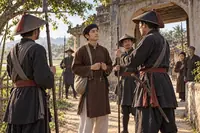 Chapter 2 of 5Arrested at the gate of Di Loan1 min
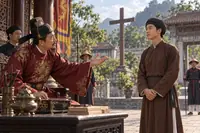 Chapter 3 of 5The temptation of a brocade robe and a heroic refusal2 min
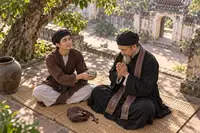 Chapter 4 of 5Meeting Father Jaccard in prison1 min
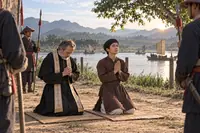 Chapter 5 of 5A hero’s death at the execution ground of Nhan Biều2 min
Feast day
Saint Thomas Trần Văn Thiện
Some places may celebrate on a slightly different day.
September 21
Often depicted with
- A palm branch
- A seminarian’s cassock
Opening
Opening
At noon on September 21, 1838, on the bank of the Thạch Hãn River, just outside the old citadel of Quảng Trị, lay a stretch of ground called Nhan Biều, where the court executed those condemned for grave crimes. The sun of central Vietnam was harsh that noon, throwing a dazzling glare off the river, and in that light they tied a young man of only eighteen to a wooden stake. He was still slender, with the face of a student not yet weathered by life.
Standing around the execution ground were not only soldiers with swords and spears. There was also the governor, the man who had come down to the prison himself to work on the young man, not with the lash but with promises that would make any eighteen-year-old waver: an official post, a beautiful daughter for a wife, an income for life, if only he would step over a piece of wood in the shape of a cross laid in front of him.
The young man smiled, so gently that it took people by surprise, and shook his head.
“I seek only titles in heaven, and care nothing for titles on earth,” he said. “I would rather die in poverty for the name of Christ than ever put on the brocade robe of glory that comes with betrayal.”
That young man was Thomas Trần Văn Thiện, a seminarian who had not finished even his first year, who had never taught anyone the catechism or been ordained to any order. Yet the Church later chose him as patron of Vietnamese youth and seminarians, perhaps precisely because he had no time to do anything great. He had time for only one thing: to hold firm to a single “no” before the greatest temptation of his life, at the very age when people are most easily swayed.
Chapter 1 of 5
A boy from the village of Trung Quán
Thomas Trần Văn Thiện was born in 1820 in the village of Trung Quán, Quảng Ninh district, Quảng Bình province, a land between the coastal dunes of central Vietnam and the low hills to the west, where people live by growing rice and fishing the small rivers that run to the sea. His family had been Catholic for generations, and his parents were devout people who prayed faithfully morning and evening.
From childhood Thiện was unlike the other village children, not because he was aloof or cold, but because he had a calm rarely seen at that age. He learned Chinese characters and the Vietnamese script quickly, knew his catechism by heart long before the others, and was so obedient and well-behaved that all the adults in the village loved him.
In 1838, just turned eighteen, Thiện decided to leave the village of Trung Quán to pursue his vocation to the priesthood. He set his heart on the seminary of Di Loan in Quảng Trị province, founded less than a year before, at the end of 1837, by a French missionary, Father Jean Jacques Candalh, whom the Vietnamese called Cố Kim. It was a brand-new seminary with only a handful of students, set up after Cố Kim arranged with the parish priest of An Ninh to buy land and build a house in the riverside village of Di Loan.
But Thiện arrived one step too late.
Chapter 2 of 5
Arrested at the gate of Di Loan
The summer of 1838 saw one of the fiercest waves of persecution under Emperor Minh Mạng, especially in the provinces of Quảng Trị and Quảng Bình. The emperor issued an edict ordering a relentless hunt for foreign missionaries, naming among them Cố Kim, the man running the little seminary at Di Loan. Troops surrounded the whole village, Cố Kim fled deep into the forest, and the new seminary had to close.
Just then young Thomas Thiện, knowing nothing of all this, was walking down from Quảng Bình with a small bundle holding a few clothes and a prayer book, his rosary in his fingers, heading for Di Loan in the hope of being admitted.
The soldiers lying in wait around the village found him suspicious, a young stranger, soberly dressed, carrying a rosary, and stopped him at once. Was he a Catholic? Was he looking for the priests?
Thiện could have denied everything and passed himself off as a traveler. Instead he raised his head and answered plainly:
“Yes, I am a Catholic, and I have come here to ask to study for the priesthood.”
For soldiers hunting for any trace of the Catholic faith, that answer was as good as giving himself up. They cheered as if they had won a great prize, locked a cangue around the eighteen-year-old’s neck and chains on his legs, and marched him off to the provincial prison of Quảng Trị.
Chapter 3 of 5
The temptation of a brocade robe and a heroic refusal
At the provincial court, the governor looked at the young prisoner before him (handsome, well-spoken, far more dignified than the simple peasants he was used to judging) and felt genuine pity. Instead of ordering the usual flogging, he set out to persuade him himself.
“My son, you are so young, with a bright future opening before you,” the governor said, almost like a worried father speaking to his son. “Why foolishly follow a false religion and bring on yourself a death that will leave your bones to rot in this prison? Listen to me: just step over that cross once, and I will set you free at once. I will adopt you as my son, give you my own beloved daughter in marriage, and arrange a high post for you at court so that you can bring glory to your family.”
It was not a threat. It was a door opening onto a completely different life (fame, wealth, a beautiful wife, a place at court), all in exchange for one step over a piece of wood in the shape of a cross.
For an eighteen-year-old son of poor peasants, it was perhaps the greatest temptation of his life, beyond anything he could have imagined back in Trung Quán.
Thiện knelt with his back straight, looked the governor in the eye, and answered in a voice calm beyond belief for his age:
“Your Excellency, I thank you with all my heart for your kindness... But I long only to be united with Christ in eternity, and care nothing for an earthly marriage. I seek only the glorious titles of heaven, and care nothing for the passing titles of earth. The Cross is where my Lord died to redeem me; I worship and adore Him — how could I dare trample on the One who is the source of my life?”
At that answer the governor dropped his gentle manner. He had the young man’s shirt stripped off, tied him tightly to a wooden post in the middle of the courtroom, and ordered forty strokes of the rattan. Each stroke tore the young flesh, and blood spread over the earthen floor. Thiện bit his lip. He did not complain or beg; he only called softly on the name of Jesus for strength to endure.
Chapter 4 of 5
Meeting Father Jaccard in prison
After that flogging, Thiện was thrown into the same cell as a French missionary, Father François Jaccard, whom the Vietnamese called Cha Phan. Father Jaccard had been a missionary in Vietnam for many years, spoke Vietnamese fluently, and had been arrested in that same harsh sweep of the summer of 1838.
For Thiện, sharing a cell with a missionary priest was a blessing he had never dared to dream of. In that damp, cramped, dark prison, Father Jaccard became his last teacher: not in the classroom he had hoped for at Di Loan, but among chains and floggings. The priest taught him to pray more deeply, explained the meaning of suffering for the faith, and prayed with him every night, when the only light in the cell was the faint glow of the moon through a crack in the wooden door.
Thiện cared for Father Jaccard as a son cares for his father, giving him his meager share of rice and cleaning the wounds the lash had left on the aging missionary’s body. The two of them, one old and one young, one a foreigner and the other a boy from Trung Quán, turned the little time they had left into a retreat deeper perhaps than anything Thiện would have known had he been admitted to Di Loan as he first intended.
From that dark prison, Thomas Thiện wrote a short letter home to his mother in the village of Trung Quán:
“My dear Mother! Do not grieve that I must wear chains for the name of God... To die for Christ is a great and everlasting blessing! Thank God and trust firmly in Him... I will see you again in our blessed heavenly Homeland!”
Chapter 5 of 5
A hero’s death at the execution ground of Nhan Biều
On September 17, 1838, Emperor Minh Mạng approved the death sentence for both the seminarian Thiện and the missionary Jaccard. Four days later, on the feast of Saint Matthew the Apostle, the sentence was carried out.
On the morning of September 21, the two of them, a foreign priest who had given many years to the mission and a Vietnamese seminarian who had not finished even one year of study, were led out together to the ground of Nhan Biều on the bank of the Thạch Hãn River. Before the execution, Thiện asked Father Jaccard to hear his confession one last time, and then both knelt on the two mats spread out for them and prayed in silence.
Because Father Jaccard, as a missionary, was regarded as a leader while Thiện was merely a follower, the court, as was its custom, gave them different forms of execution. The soldiers took the chains off Thiện’s legs and put a long rope around his neck. Two executioners took the ends and pulled hard in opposite directions until the eighteen-year-old stopped breathing and slumped onto the mat, already soaked with the sweat and blood of the flogging a few days before.
His body was buried right at the execution ground of Nhan Biều. In 1847, his remains, together with those of many other martyrs, were reburied in the chapel of the Paris Foreign Missions Society. Today his relics are still venerated in many places in the archdiocese of Huế and in the religious communities that have him as their patron.
On May 27, 1900, Pope Leo XIII beatified him. And on June 19, 1988, Pope John Paul II canonized Thomas Trần Văn Thiện, together with one hundred sixteen other Vietnamese Martyrs, in Rome. The Church celebrates him on September 21 each year.
Among the Vietnamese Martyrs, some spent a whole lifetime as priests or bishops and left behind a great body of pastoral work. Thomas Trần Văn Thiện was different. He had not finished even one year of seminary, had never worn a religious habit, had never stood before a community to teach. But perhaps it is in that very unfinished life that his story comes closest to young people today, who also face countless glittering offers and must decide for themselves which of all the things they are promised is truly worth holding on to.
The end of the story
You have walked with Saint Thomas Trần Văn Thiện to the end of the story.
Three scenes that make you marvel at an eighteen-year-old:
Stopped by soldiers at the gate of Di Loan, he could have denied everything, but he answered honestly: "Yes, I am a Catholic, and I have come here to ask to study for the priesthood."

Offered a daughter in marriage, an official post and a whole bright future, he simply smiled and shook his head: "I seek only titles in heaven, and care nothing for titles on earth."
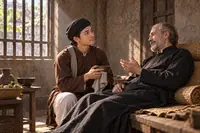
In prison he cared for Father Jaccard as a son cares for his father, giving him his meager rice and cleaning the wounds the lash had left on the missionary’s body.
Stay in silence
You understand the price of a single “no”: sometimes a whole life has time for only one thing: holding firm before the greatest temptation, at the age when people are most easily swayed.
I seek only titles in heaven, and care nothing for titles on earth.
Let us pray
Saint Thomas Trần Văn Thiện,
at only eighteen, offered a daughter in marriage and an official post, you simply smiled and shook your head: "I seek only titles in heaven." In prison you cared for Father Jaccard as a son cares for his father.
Pray for seminarians and for young people searching for their vocation.
Help me to say honestly that I am a Catholic, and to stand firm and say no to the great temptations of life.
Amen.
Light a candle for Saint Thomas Trần Văn Thiện
Sources
- Feast dayAuthor’s edited profile
- Often depicted withPatronages and symbols, version 1.1
- Reflectionhdgmvietnam.com
- Reflectiontonggiaophanhanoi.org
Meet the next one
 Journey 8