

Journey 2 · Holiness Under One Roof
Saint Louis Martin
A father who kept a home together
Feast day July 12
Tap to step inside
Saint Louis Martin
A father who kept a home together
Map of a life
This life told in 5 chapters
Begin the journey


Feast day
Saint Louis Martin
Some places may celebrate on a slightly different day.
July 12
Patron of
- Fathers and married couples (with Saint Zélie, the first married couple canonized together, 2015)
Often depicted with
- A clock (his watchmaking trade)
- A fishing rod
Opening
Opening
A watchmaker spends his whole life bent patiently over tiny gears. To make a timepiece run smoothly again, he must find each place where it catches, set each spindle in its place, and listen for each faint tick that people in a hurry easily miss.
Louis Martin lived many peaceful years at that humble work, before the whole world came to know him as the holy father of Saint Thérèse of the Child Jesus.
Yet that father’s life would meet turns that the watchmaker’s skilled hands could never repair:
- a gentle wife taken far too soon by a cruel illness;
- one beloved daughter after another leaving home for the four walls of an enclosed convent;
- and finally, a harsh stroke that struck at his very memory and body.
Through all those stormy seasons, Louis Martin’s fatherly love kept shining. Sometimes it showed in the steady protection he gave as head of the family; sometimes in the humility with which he accepted the care of others, when his body had broken down.
Chapter 1 of 5
A road that did not pass through the monastery
Louis Martin was born on August 22, 1823, in Bordeaux, France, into a disciplined military family. Because of his father’s work, the family moved through several cities before settling in Alençon, a small town in northwestern France that since the seventeenth century had been famous throughout Europe for its exquisite lace called “Point d’Alençon”, known as the queen of laces. Young Louis grew up under strict discipline, studied diligently, loved books, and was deeply moved by the beauty of nature.
In 1842, Louis began learning watchmaking in Rennes, then went on to Strasbourg to improve his skills. On a journey through the majestic snowy Alps, the pure beauty of the monastery of the Great Saint Bernard awakened in the young man the wish to give himself to God in religious life. Louis asked to enter, but he was turned away because he did not yet know enough Latin, as was required at the time.
He tried to study more Latin, but his health would not allow it, and that door closed. Louis went back to his old trade, went to Paris to complete his training, and in 1850 opened a watchmaking and jewelry shop on the rue du Pont-Neuf in the town of Alençon.
Some doors in life slam shut, and at the time we feel only emptiness and sadness. It takes many more years before we see the fertile ground God has quietly prepared behind that door.
Louis did not become a monk on a snowy mountaintop, but his longing for holiness did not dry up. It soaked into every careful hour of work, into absolute honesty in business, into firmly closing his shop on Sundays even though he lost quite a few customers, into his morning and evening prayers, his solitary fishing trips in the countryside, and a generous heart open to the poor. His shop prospered. He was the kind of man who could grow wealthy honestly and stay free inside, never letting money take hold of his heart.
Chapter 2 of 5
A meeting in ordinary life
In the spring of 1858, crossing the Saint-Léonard bridge in Alençon, Louis happened to pass a young woman with a graceful, gentle bearing. She was Zélie Guérin, a gifted lacemaker in the town, specializing in the very Alençon lace the whole city was proud of. Strangely enough, Zélie too had once applied to enter a religious order devoted to the sick and been turned down.
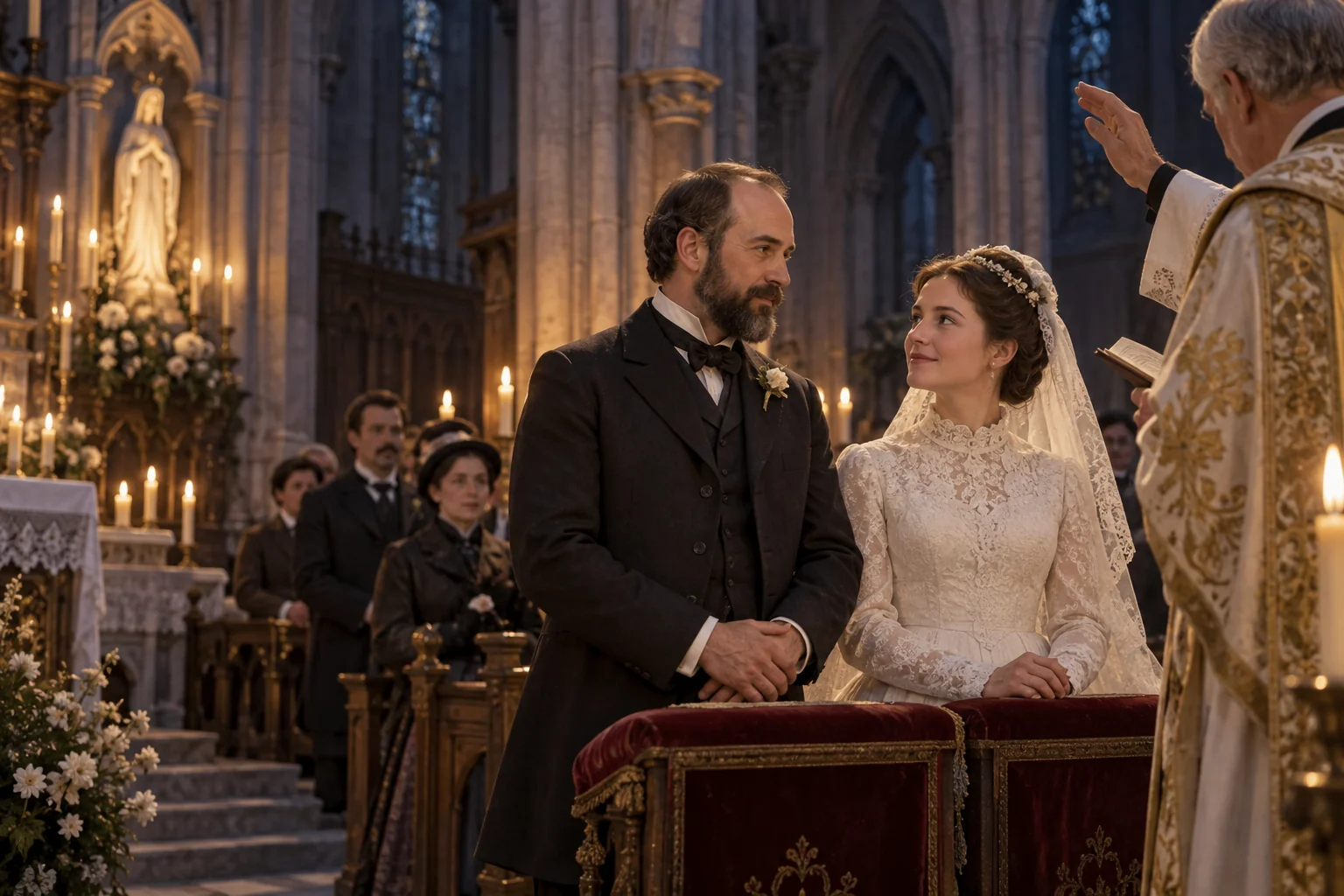
Two people whose dream of religious life seemed to have come to nothing now met at a new crossroads. Their love blossomed quickly and grew in deep mutual respect. They were married in the church of Notre-Dame in Alençon at midnight, as the day turned to July 13, 1858, just three months after their first meeting on that bridge.
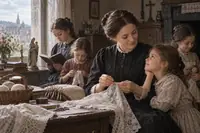
Louis was calm, composed and fond of silence; Zélie was quick, resourceful and given to worry. Their differences did not drive them apart; they complemented each other beautifully. Seeing his wife’s lace business growing strongly, in 1870 Louis generously sold his own watchmaking shop to take charge of the accounts, the dealings and the management of his wife’s lace workshop. It was no small decision for a man of that time, when being the family’s breadwinner was usually seen as a husband’s particular honor. Their home had the heartbeat of a real working family: talk of orders, paying the workers, everyday budgeting, woven together with fervent family prayer.
Nine children were born one after another. But four of them — two boys and two girls — died very young. The five daughters who lived to adulthood were Marie, Pauline, Léonie, Céline and the youngest, Thérèse.
Each time a little child was lost, the father’s heart broke. Louis and Zélie brought that grief to God in prayer and surrendered it to Him, and went on pouring all their love into caring for the children who remained.
The Martin family had serious discipline, but the house was always full of laughter, songs, fishing outings and games the father made up for his children. Louis called his daughters by loving nicknames: Marie was his “diamond”, Pauline his “precious pearl”, Céline “the brave one”, and Thérèse his “little queen”. Behind the dignified head of the household was a deeply tender, warm father’s heart, where his children could always lay their heads when they were sad.
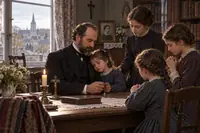
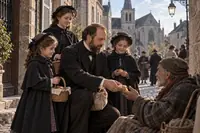
That love spilled out beyond the gate. Louis often took his children to visit lonely old people, and helped the beggars they met in the street with his own hands. He taught his children to pray with hands that knew how to open and share a crust of bread with the poor, not only with prayers learned by heart.
Chapter 3 of 5
When his wife was gone
On August 28, 1877, Zélie died of breast cancer after years of suffering, at only forty-five. Louis lost the companion he loved most after nineteen years of faithful marriage. Their youngest daughter, Thérèse, was just four and a half, too small to understand all that had just happened to her family.
The house suddenly became empty and cold. The gentle wife who had shared every joy and hardship was gone. To give his motherless daughters a better home, Louis bravely moved the whole family from Alençon to the town of Lisieux, renting a peaceful house called Les Buissonnets on a small hill, near the family of his brother-in-law Isidore Guérin, so that the girls would have the support of their uncle and aunt.
That was the wisdom and humility of a father who knew his own limits. He did not strain to prove he could carry everything alone, but opened his heart to the help of his relatives so that his children could grow up whole.
At Les Buissonnets, the older daughters took their mother’s place caring for the younger ones, while Louis remained the steady support of the whole household. He kept a devout rhythm of life, walked with little Thérèse every day, and taught her to gaze at the beauty of creation. Evenings by the lake and fields of wildflowers became her first lessons in a loving God, through the very beauty He had made.
Then the holy partings came.
- Pauline entered the Carmelite convent in 1882;
- Marie followed in 1886;
- and then the youngest, Thérèse, pleaded to enter in 1888 when she was only fifteen — an age at which, under the usual rule of the order, she was not yet eligible.
Each time a daughter stepped through the convent door, a chair at the family table was left empty, and the father’s heart bled again. Yet Louis did not selfishly keep his daughters back to comfort his lonely old age. He saw giving his daughters to God as the highest honor. He personally took Thérèse all the way to Rome, to an audience with Pope Leo XIII, to ask that she be allowed to enter earlier than the required age.
Léonie had many emotional difficulties, a troubled temperament and several failed attempts at religious life, yet Louis never scolded or belittled her. Each time she failed and came home, he opened his arms wide to welcome her back, without a word of reproach. His children’s weaknesses never lessened his love.
Chapter 4 of 5
Trembling hands and a final cross
From 1887, Louis Martin’s health began to decline seriously. A series of strokes, along with hardening of the arteries, damaged his nervous system, leaving him confused, losing his memory and suffering bouts of panic.
In February 1889, his condition forced the family to have him treated at the Bon-Sauveur mental hospital in the city of Caen.
The man who had once been courteous and refined, master of a whole business and respected by the whole town, now had to stay in a psychiatric ward for more than three long years. It was a painful and humiliating cross for the family. His daughters had to endure cruel gossip and looks of pity or mockery, in an age when mental illness was still seen as a shame to be hidden, not yet understood as an illness needing treatment.
Yet illness could never strip him of his dignity as a child of God and as a father. Between bouts of delirium, whenever he was lucid, Louis kept thanking God and surrendering himself completely. The father’s failing body became the most vivid lesson to his daughters on the mystery of the “Holy Face” of Christ in his humiliation. To love someone is not only to be proud of them when they are healthy and successful, but to cherish and care for them even when they have lost their memory and become a helpless child in a sickbed.
In May 1892, he was brought back to Lisieux. Céline and Léonie, with their relatives, cared devotedly for their father, at every meal and through every night. His legs were completely paralyzed, and he depended on others for everything. The very man who had once spread his arms to shelter a whole household now had to learn to let others spread their arms to shelter him.
On July 29, 1894, Louis Martin died peacefully at the Château de la Musse near Évreux, at the age of seventy, with his daughter Céline lovingly beside him. After her father’s death, Céline too entered the Carmel. His earthly journey was complete, and he left the Church a lasting example of faith.
Chapter 5 of 5
A father for every home
On October 19, 2008, Louis Martin and Zélie Guérin were beatified in Lisieux. On October 18, 2015, Pope Francis canonized them, the first married couple in the history of the Church to be canonized together. Their shared feast was set for July 12 each year, the anniversary of their wedding more than a century and a half earlier.
For fathers and husbands in Vietnamese families today, Saint Louis Martin is a companion close at hand. He teaches us
- to respect and support our wives’ work;
- to play with and be friends to our children;
- to open our doors wide to help those in need;
- and to accept hardships, illness and old age in peaceful surrender.
Louis Martin stood on both sides of love: he was once the steady pillar sheltering a whole household; and at the end of his life, he humbly let others shelter him and care for him.
The fire that warms a family home never goes out, as long as fathers still know how to love, sacrifice and take their children by the hand along the road of God, just as the watchmaker of long ago patiently took little Thérèse by the hand for walks under the sky of Lisieux.
The end of the story
You have walked with Saint Louis Martin to the end of the story.
You will not forget:

When his dream of the monastery closed, he went back to being a watchmaker, careful with every tiny gear, just as he lived his faith.

When his wife died young, he moved the whole family on his own, and taught his youngest daughter to gaze at the beauty of creation every evening.
His memory gone, his legs paralyzed, the man who had once sheltered a whole household now had to learn to let others care for him.
Stay in silence
You understand now: he stood on both sides of love, as a steady support and as one who had to humbly accept the care of others.
To love fully is to give while you still have strength, and to receive when you are spent — both need the same humility.
Let us pray
Saint Louis Martin,
you were a watchmaker, careful with every tiny gear, just as you lived your faith. When your wife died young, you raised your daughters alone. And at the end of your life, you humbly let your daughters care for you.
Pray for fathers who are raising their children alone. Give them enough strength, and enough tenderness.
Pray for the elderly and those losing their memory in my family, and help those caring for them to love with patience.
Amen.
Sources
- Feast dayAuthor’s edited profile
- Patron ofPatronages and symbols, version 1.1
- Often depicted withPatronages and symbols, version 1.1
- Reflectionvatican.va
- Reflectionvatican.va
Meet the next one
 Journey 2