

Journey 2 · Holiness Under One Roof
Saint Zélie Martin
The threads of love
Feast day July 12
Tap to step inside
Saint Zélie Martin
The threads of love
Map of a life
This life told in 6 chapters
Begin the journey OpeningOpening1 min
 Chapter 1 of 6A young woman looking for her way2 min
 Chapter 2 of 6A blessed meeting on a bridge1 min
 Chapter 3 of 6Nine children welcomed, four farewells1 min
 Chapter 4 of 6A home open to the people around it1 min
 Chapter 5 of 6The tumor, and a motherhood left unfinished1 min
- Chapter 6 of 6A lace that still shimmers1 min
Feast day
Saint Zélie Martin
Some places may celebrate on a slightly different day.
July 12
Patron of
- Mothers and married couples (with Saint Louis)
- Women who are both mothers and in business
- Mothers who have lost a child
Often depicted with
- A needle and a strip of Alençon lace
Opening
Opening
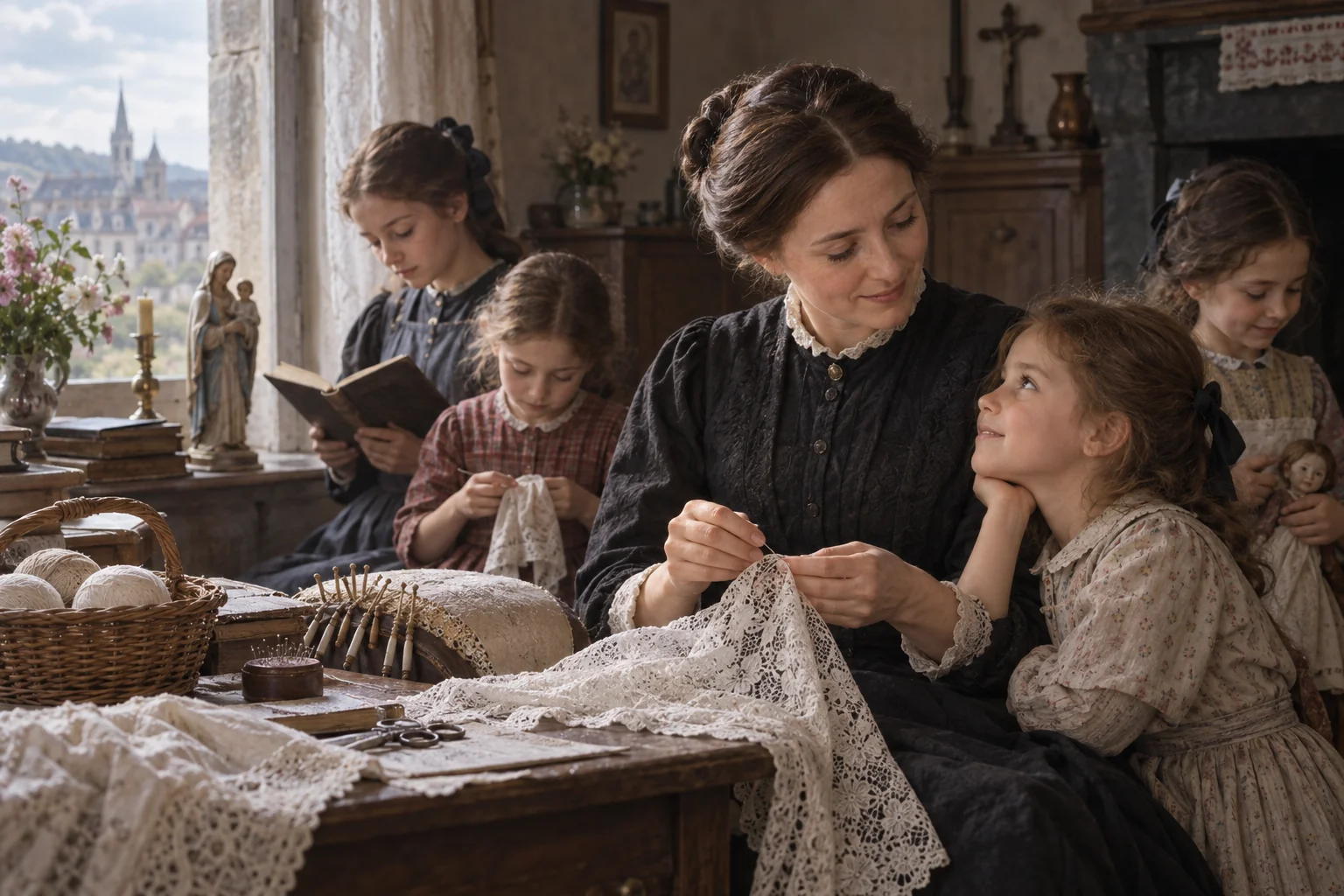
A fine piece of lace is made of so many tiny tasks that anyone admiring the finished work can hardly imagine how much patience, sweat and even tears went into it. Thread after fragile thread slips between calloused fingers, slowly forming the flowers, the open spaces, the joins.
Zélie Martin knew that work down to every stitch. She made lace to earn a living, to support her family, and to save every coin for the future of her young children.
The family letters that survive paint a vivid, honest portrait: a woman utterly devoted to her husband and children, capable and gifted in business, with a sharp eye for detail, but also prone to gnawing worry, sometimes worn out by the work of providing for them, and then wiping her brow and getting back to work. Her holiness was woven into the daily life of a home that threw its doors open to the sunlight every morning.
Chapter 1 of 6
A young woman looking for her way
Marie-Azélie Guérin — known affectionately as Zélie — was born on December 23, 1831, in Gandelain, near Saint-Denis-sur-Sarthon, France. In that household she had an older sister, Marie-Louise, and a younger brother, Isidore. Her parents took their faith seriously and were very strict at home; that strictness left a sadness in her that Zélie still recalled with a pang, long after she had grown up, in her letters to her daughters.
Her childhood was not entirely happy. As a sensitive girl she longed for the gentle affection that the adults of her day did not know how to show. Yet, wonderfully, that lack did not make her heart closed or hard. Later, as a mother, she looked for every way to let her children feel how much their parents loved them, as if she were determined that none of them would ever know the loneliness she had known.
The family moved to the town of Alençon. Zélie went to the school of the Sisters of the Sacred Heart and began learning the traditional needle lace, the “Point d’Alençon” famous throughout Europe, a craft that demands such a sharp eye and patient hands that a single centimeter can take hours of painstaking work. Her devotion led her to apply to the Daughters of Charity of Saint Vincent de Paul, hoping to give her whole life to caring for the sick and the poor. But after considering her fragile health, the superior told her plainly that she could not be accepted.
Her dream of religious life seemed to have collapsed. She went quietly home to an uncertain future.
Wanting something good does not automatically open every door. She had to find another way for herself, with her own hands and her own hard work.
In 1853, at just twenty-two, Zélie boldly started a small business making Alençon lace. From one cramped room she learned to organize a network of lacemakers working from home, take orders and hand out patterns, while she herself mended every faulty stitch and joined the small pieces into finished lace. She worked patiently with large merchants in Paris and gradually built up a solid, independent business.
Behind the delicate needlework lay the remarkable determination of a self-reliant woman. She did not sit bemoaning her lot and waiting for someone to take pity on her. She learned, did her sums, worked tirelessly, and dared to carry the responsibility on her own shoulders.
Chapter 2 of 6
A blessed meeting on a bridge
In 1858, crossing the Saint-Léonard bridge in Alençon, Zélie passed a man of calm, dignified bearing. A voice whispered deep in her heart:
“This is the one I have prepared for you.”
That man was Louis Martin, the respected watchmaker.
Two people who had each once hoped to enter religious life now found their true calling in marriage. Their wedding was celebrated at midnight, as the day turned to July 13, 1858, in the church of Notre-Dame in Alençon. Married love did not cool their love of God; it gave their faith real faces to love and care for, and holy duties to carry out every day.
Louis later sold his watch shop to help his wife run the lace business and keep the accounts. Zélie brought to the family her resourcefulness, quickness and overflowing affection. They had different temperaments but backed each other completely. Their letters show how warm and tender their love was. They talked over money and orders; there were business trips away from home, full of longing for the day of return. Holiness did not make their love the least bit dry or cold.
Chapter 3 of 6
Nine children welcomed, four farewells
In nineteen years of marriage, Zélie gave birth to nine children. But four of them, two boys and two girls, died one after another while still very young. Marie, Pauline, Léonie, Céline and Thérèse were the five daughters who remained. Little Thérèse was born on January 2, 1873, and the whole Church would later honor her as Saint Thérèse of the Child Jesus.
For Zélie, each child was a precious, sacred life to be protected with all her heart. Births that brought her close to death, sleepless nights with a feverish child, the worry of finding a trustworthy wet nurse, concerns about her children’s characters and schooling crowded into her days. That holy home had its days of more tears than smiles.
Of all the children, the third daughter, Léonie, caused her parents the most heartache. Léonie developed slowly, was in poor health, stubborn and hard to manage, and struggled terribly with her lessons. On top of that, the little girl was being bullied and threatened by a domineering maidservant, without her parents knowing.
Zélie had to try patiently to understand her, guide her gently, and pray through her tears every day for her daughter. She had no perfect method for raising children; her motherhood was a long, patient search, patient to the point of pain, never giving up on a clumsy child who was hard to understand.
She wanted her children to grow up good and devout, but her home was not gloomy or stifling at all. It was full of laughter, outings and surprise presents. Faith grew there in a life brimming with warmth.
And the four little ones who had died always kept a sacred place in their mother’s heart. No mother can see a child born later as a replacement for the child she has lost. Zélie went on living, holding close both the children in her arms and the children resting in eternity.
Chapter 4 of 6
A home open to the people around it
Lacemaking took a great deal of time and effort. Yet the women who worked for Zélie were never treated as money-making machines. She checked on them kindly when they were sick, helped with their family troubles, and found ways to help their children when she could.
Husband and wife rose very early to go to Mass every day, then came home to start work. They gave generously to beggars and cared for the destitute they met along the road. Their faith showed itself in hands that shared food and clothing.
A busy working mother can easily fall into thinking that she must wait until everything is done and the house is perfectly quiet before she can pray and live her faith. But in the Martin family, prayer did not wait for an impossible perfection. Prayer held up people who were toiling away amid piles of unfinished work.
That is what makes Saint Zélie so close to Vietnamese women today, who struggle to earn a living while also seeing to every meal and every nap of their young children. They know what it is like to have a day torn into a hundred pieces: work at the factory or the market, an urgent call from school, medicine for a sick relative... Real love is often given in just such hard-won scraps of time.
Chapter 5 of 6
The tumor, and a motherhood left unfinished
Zélie had noticed a lump in her breast many years earlier, but said nothing and kept caring for her family. In the final stage, the spreading cancer brought her agonizing pain. Even so, she went on putting the household’s affairs in order as far as her failing strength allowed.
In June 1877 she made a grueling pilgrimage to Lourdes, more than seven hundred kilometers from Alençon, at a time when pilgrimages to the site of Our Lady’s apparitions were booming, with hundreds of thousands of people arriving every year. For a woman with a terminal illness, the long journey by train and carriage was itself an act of great faith. She begged Our Lady for healing so that she could live to raise her children. But she came home no better. The miracle she had hoped for did not come. That summer, the forty-five-year-old mother’s strength slowly ebbed away.
For Zélie, surrender meant something bitter: leaving behind five young daughters, little Thérèse only just over four. She trusted in God, but that trust did not make a mother’s heart ache any less at the hour of parting.
On August 28, 1877, Zélie Martin died peacefully in Alençon.
She did not see her children grow up. She did not see Thérèse’s beautiful road in the Carmel, never read the pages her daughter would write, never saw millions of people from every continent come to honor her family. Her life ended with so many plans unfinished. Yet the love and the seeds of faith she had sown were never left unfinished. They kept sprouting and bearing rich fruit in the children she left behind.
Chapter 6 of 6
A lace that still shimmers
On October 19, 2008, Louis and Zélie were beatified in Lisieux. On October 18, 2015, Pope Francis solemnly canonized them. Their shared feast is July 12 each year.
Saint Zélie is honored for the life she actually lived: a faithful wife, a devoted mother, a hardworking craftswoman, an honest businesswoman who knew how to love through countless trials. She walked her own road to holiness, long before anyone knew her as the mother of a great saint.
In many homes, people sometimes see only the children’s success and forget the long nights their mother stayed awake, the coins saved on every bunch of vegetables and every fish, the tears she held back so the children would not worry.
To remember Saint Zélie is to look again at each fragile thread of that motherly love. Some threads pass through pain, but woven with love for God, they make a lace of rare beauty that time cannot fade.
The end of the story
You have walked with Saint Zélie Martin to the end of the story.
A few things stay with you:
Turned away from religious life because of her health, she opened a small lace workshop and built a livelihood with her own two hands.
Having lost four little children, she still kept a home full of laughter for the others, never a gloomy one.
In her last painful days of cancer, she still made the long pilgrimage to Lourdes, begging to live so she could raise her children.
Stay in silence
What remains with you is this: she never saw her children grow up, never read Thérèse’s writings, yet the seeds she sowed were never left unfinished.
Some threads pass through pain — but woven with love, they make a lace that does not fade with the years.
Let us pray
Saint Zélie Martin,
you built your lace workshop with your own hands, lost four little children and still kept your home full of laughter. And when you were gravely ill, you asked only to live so you could raise your children.
Pray for mothers who work and care for their families at the same time. Pray for parents who have lost a child, that God may comfort them.
May the seeds of faith I sow in my family, even when I cannot yet see them grow, never be left unfinished.
Amen.
Sources
- Feast dayAuthor’s edited profile
- Patron ofPatronages and symbols, version 1.1
- Often depicted withPatronages and symbols, version 1.1
- Reflectionvatican.va
- Reflectionvatican.va
Meet the next one
 Journey 2