

Journey 2 · Holiness Under One Roof
Saint Monica
A mother who learned to open her hands
Feast day August 27
Tap to step inside
Saint Monica
A mother who learned to open her hands
Map of a life
This life told in 5 chapters
Begin the journey


Feast day
Saint Monica
Some places may celebrate on a slightly different day.
August 27
Patron of
- Mothers and wives
- Associations of Catholic mothers
- Parents whose children have drifted from God
Often depicted with
- The black habit of the Augustinians
- Tears
Opening
Opening
One bitterly cold autumn morning in 383, on the coast of North Africa, Monica realized with a shock that her son was gone. The night before, the young Augustine had sweet-talked his mother, saying he was only going down to the harbor to see off a friend. His mother believed him, and spent the night in prayer at a small shrine of Saint Cyprian nearby, trusting that her son would be back before dawn.
But as soon as a favorable wind rose in the dark of night, the ship hoisted its sails and sped out to sea, carrying her son toward faraway Rome, and leaving his aging mother alone on the sand with a prayer that God seemed not to have answered the way she had hoped.
That was one of the most painful wounds of Monica’s life. For years she had wept until she had no tears left, and still could not reach the heart of her wayward son. Later, when he had become a great bishop, Augustine himself, still deeply moved, told in his Confessions how he had deceived his mother.
In every page of her son’s book, Monica appears both strong and utterly fragile: she loved her son deeply, worried for him until her heart ached, and at times wanted to hold on to him with every last bit of her strength; and then, over a whole lifetime, she had to learn a lesson a thousand times harder than holding on: how to open her hands, and entrusting the child she loved most entirely to the mercy of God.
Chapter 1 of 5
From a home in North Africa
Monica was born around 331 or 332 into a devout Christian family in Thagaste, in North Africa — present-day Algeria. It was a town nearly six hundred meters above sea level, in the middle of one of the most fertile plains of North Africa, surrounded by hills and thick woods, rich with wheat and olives. Her exact date of birth is not known. The loveliest memories of Monica’s childhood come from family stories that Augustine himself carefully recorded many years after his mother’s death.
In that household there was an old nurse who had cared for Monica’s father when he was a small child. This old woman, whose name we do not know, firmly taught the children self-control, moderation and uprightness in the smallest things. Faith was handed on in simple ways like these, through a devoted servant’s care and everyday reminders, which people carry in their hearts like a family heirloom when they are grown, even if they no longer remember the face of the one who taught them.
As a child, Monica too had faults to correct. When her parents sent her down to the cellar to draw wine, the little girl would sometimes sneak a small sip, and little by little she was drinking whole cupfuls. One day, in the middle of a quarrel, a maidservant in the house angrily called her a “little drunkard.” That stinging rebuke woke Monica up. The girl realized with a start that she was sliding downhill, and gave up that bad habit at once and for good. Her holiness was not some flawless inborn perfection; it began with a child who humbly admitted her fault and bravely got up to correct herself while there was still time.
When she grew up, Monica obeyed her parents and married Patricius, a local official who did not yet share the Christian faith. They had three children: Augustine, Navigius and a daughter. Augustine was born in 354, and the older he grew, the more he showed a brilliant intelligence that made his parents both proud and anxious.
Monica’s marriage was no bed of roses. Patricius was a man with a fiery temper, and unfaithful as well. Her mother-in-law, egged on by the servants, turned bitter toward her. Monica had to live patiently with deep differences of temperament and belief, right in her own home.
She kept a wise rule: when her husband was in a rage, she held her tongue and did not answer back a single word; once his anger had cooled, she would gently choose her words and explain. With her mother-in-law, she used kindness, patience and respect to melt away one suspicion after another. Behind that forbearance lay the endless hardship of a woman who wanted to keep her home together without letting hatred breed more hatred.
We admire her patience, and still grieve for the humiliations she bore. A family needs both people to share the effort and the responsibility; a woman’s endurance is never a debt she simply owes in order to be praised as virtuous.
Thanks to her steadfast example, Patricius opened his heart and received baptism near the end of his life, and died in peace around the year 371. Monica became a widow at about forty. But the stormiest days of her life, with her eldest son, were only just beginning.
Chapter 2 of 5
A son far away, even under the same roof
Augustine studied hard in Carthage, chasing worldly fame and sinking into loose love affairs. Around 373, the brilliant young man joined the Manichaeans, a sect at odds with the Catholic faith.
Monica’s pain then was not simply seeing her son give up the habit of prayer; she was in anguish because the child of her own flesh was searching for happiness in illusions that in the end would leave only emptiness and ruin.
She was so hurt that at one point she firmly refused to let her son eat at the family table, because of the blasphemies he defended. Then God comforted her through a dream: she saw herself standing weeping on a wooden measuring rule, and a radiant angel came and told her that where she stood, her son would stand too. With that hope, she opened her door again, went on cooking meals, and went on waiting for her son amid painful disagreements.
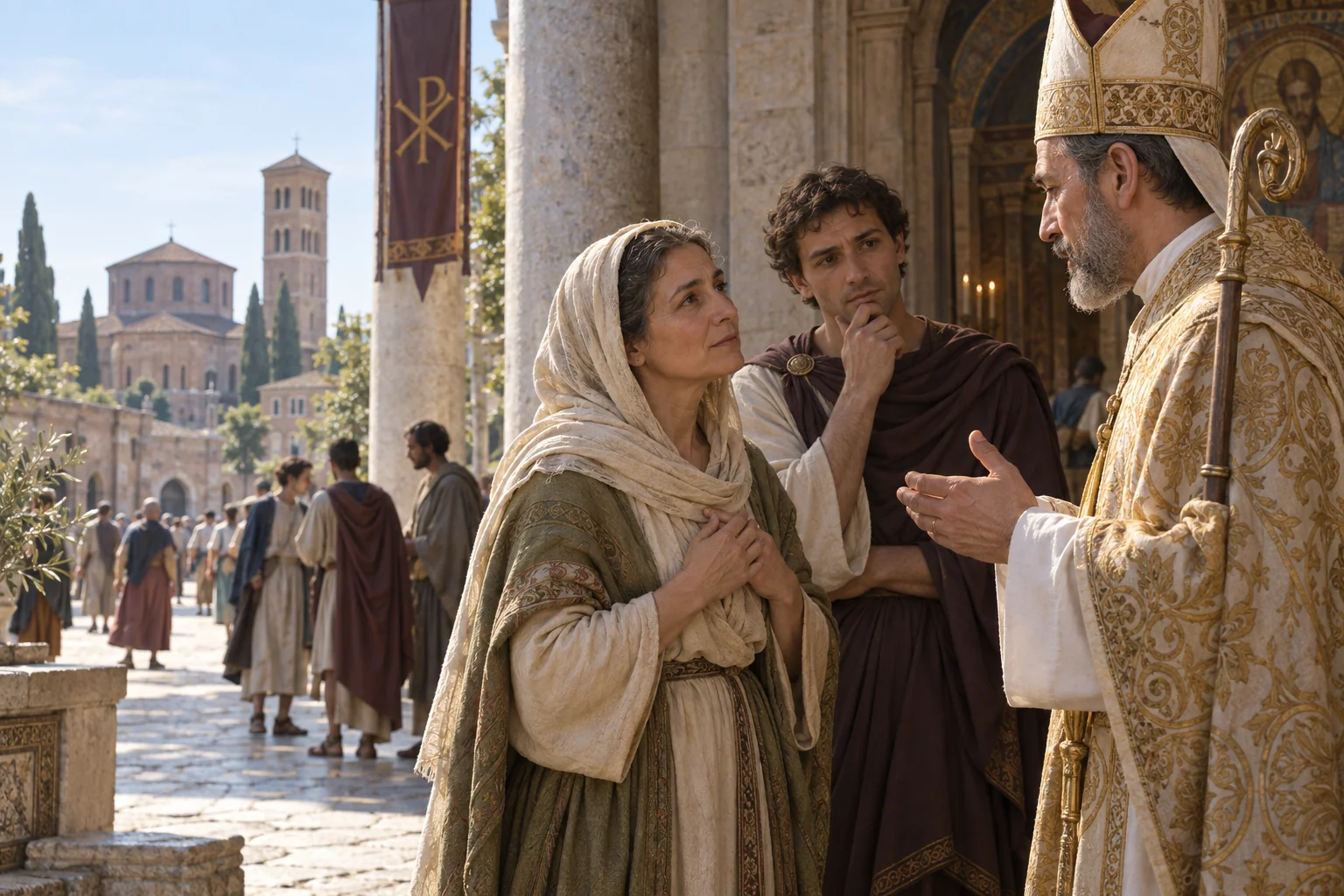
Waiting did not mean sitting calmly by. Her heart felt raw, as if rubbed with salt. Monica went to a holy bishop and begged him in tears to talk to Augustine and persuade him. Seeing that the young man was still too proud of all his book learning and not ready to listen, the bishop declined, and advised her to keep praying with perseverance.
When he saw her still kneeling at his feet, pleading with tears streaming down her face, the bishop was moved and said the words that became famous:
“Go in peace! The son of so many tears will never be lost!”
Monica clung to those words like a lifebuoy. Yet many long years still lay between that word of comfort and the day her son came back. There were long stretches with no outward sign at all that her son was changing his heart. She still had to get up each morning, light the fire, cook, go to market and live among others, carrying a bleeding wound in her heart that no one knew about.
Vietnamese mothers who have stayed up night after night praying the Rosary for a child who has strayed into gambling or addiction, or left the faith, understand Monica’s heart completely. They know the feeling of wanting to say one more word but fearing the child will storm off even farther, wanting to give advice but in the end only swallowing their tears and setting aside a bowl of rice, waiting for the child to come home.
Monica does not give us a magic formula to solve every difficulty at once. She sits beside mothers in something deeply human: loving someone to the very end, yet being utterly unable to make that person’s choices for them.
Chapter 3 of 5
Across the sea to Milan
After the night her son deceived her and left her on the shore of North Africa, Monica did not give up in bitterness. Love and faith drove the widow to board a ship, cross the stormy Mediterranean to Italy, and make her way to the city of Milan where her son was teaching.
In Milan she met the renowned bishop Ambrose. Augustine too was going to hear Saint Ambrose preach, at first only for his brilliant eloquence, but little by little he was moved by the spiritual depth of the word of God that he had once looked down on. Monica found in this bishop a firm support.
Even in her fifties, Monica never stopped learning and was always ready to bend. When she learned that Saint Ambrose did not allow the custom of bringing food and wine to eat and drink at the martyrs’ tombs, as had been the practice back home in North Africa, she obeyed at once and gave up the habit without a word of protest. The old mother who had prayed for so many years did not presume she knew everything; her faith had the suppleness of a soul that knew how to listen to the Church.
Among the faithful she was a presence of prayer and peacemaking. Augustine always remembered a beautiful virtue of his mother’s: when she heard two angry people speaking ill of each other, she never carried the bitter words of one into the ears of the other. She only chose good words, things that could draw them closer, to pass on. It is a small, hidden kind of charity, and how many homes and parishes today long for it.
In 386, Augustine’s tormenting inner struggle reached a decisive turning point. Under a fig tree in a garden, hearing a child’s voice singing faintly,
“Take up and read!”
, he opened the Scriptures and was flooded with the light of God’s grace. He decided to give up fame and the passions of the flesh to give his whole life to God.
At the Easter Vigil of 387 in the cathedral of Milan, Saint Ambrose baptized Augustine, together with his son Adeodatus and his friend Alypius.
More than thirty years of Monica’s tears and prayers had not been wasted. They were like timbers quietly holding up a great house. She did not bring about her son’s conversion with her own hands, but her love, steadfast to the last tear, was the channel through which God’s grace poured into her son’s soul.
Chapter 4 of 5
The window over the garden at Ostia
After that blessed day, mother and son set out with their family to return home to Africa. They stopped to rest at the port of Ostia near Rome to wait for a ship.
At the lodging there was a small window looking down on a quiet garden. Monica and Augustine stood leaning side by side at the window, talking together about the eternal life of the saints in heaven. Augustine tells how, in that conversation, mother and son seemed lifted above every beauty of this world to touch the Most High himself — the source of all good.
It is one of the gentlest and most moving images of a mother and her child: mother and son no longer arguing, no longer pulling against each other over who was right and who was wrong. The two stood side by side, at peace, looking in the same direction — something that, in all the decades before, had perhaps never once happened between them.
Monica said softly to her son:
“My son, as for me, nothing in this life holds me any longer. I had only one wish, to see you become a Christian before I closed my eyes, and God has granted it to me beyond anything I hoped for...”
The heart once wrung with anguish for her son was now completely free and at peace. She could love her son without needing to hold on to him for herself any longer.
Only a few days later, she came down with a high fever. She grew steadily worse over nine days. Monica died at Ostia in the autumn of 387, at the age of fifty-six; Augustine was then thirty-three.
She had once wished to be taken home after her death and buried beside her husband. But at the hour of her death, she smiled and told her sons:
“Bury my body anywhere, do not trouble yourselves about it. I ask only one thing of you: wherever you may be, always remember me at the altar of the Lord.”
She never finished the voyage home to Africa, but she came home for good, into the arms of God.
Chapter 5 of 5
A mother in the prayers of countless homes
The Church celebrates Saint Monica on August 27 each year, right before the feast of Saint Augustine (August 28), as if to remind us that the son’s glory cannot be separated from the mother’s tears. Associations of Catholic mothers in Vietnam and around the world have chosen her as their patron, as if she were a mother or grandmother in their own family.
Monica wept, felt helpless, grew impatient and wanted to hold her son tight. But she learned to correct herself, learned to listen, and learned to trust that her son belonged to God more deeply than he belonged to her.
Parents who picture Saint Monica at the window at Ostia can take great comfort. Loving our children does not mean smothering control. True love dares to walk patiently alongside, dares to weep for the child, and in the end knows how to open its hands and entrust the child to God. When a mother’s hands open, love is not lost, but filled to overflowing in eternal life.
The end of the story
You have walked with Saint Monica to the end of the story.
Those moments are still there:
A night when her son deceived her and left her alone on the shore, the ship carrying him already vanished out at sea.

For more than thirty years, she never stopped praying and weeping for a son who had lost his way, though there was no sign he would ever come back.

At the window in Ostia, mother and son finally standing together, no longer arguing, simply looking in the same direction.
Stay in silence
You see more clearly than ever: Monica does not teach us a formula to fix everything at once. She shows us how to love someone to the very end, and still respect their freedom.
When a mother’s hands open, love is not lost — it is simply placed into a greater hand.
Let us pray
Saint Monica,
for more than thirty years you wept and prayed for a son who had lost his way, before you saw any sign that he would come back.
I bring to you the loved ones I am worried about: those far away, those grown cold, those still struggling to find their way.
Teach me to love without binding, to wait without bitterness, to speak less and pray more.
And when I am weary, remind me that no tear shed before God is ever wasted.
Amen.
Sources
- Feast dayAuthor’s edited profile
- Patron ofPatronages and symbols, version 1.1
- Often depicted withPatronages and symbols, version 1.1
- Reflectionnewadvent.org
- Reflectionnewadvent.org
Meet the next one
 Journey 2