

Journey 7 · Going Far, Standing Firm
Saint Juan Diego
The poor native man and the roses of Tepeyac
Feast day December 9
Tap to step inside
Saint Juan Diego
The poor native man and the roses of Tepeyac
Map of a life
This life told in 6 chapters
Begin the journey OpeningOpening1 min
 Chapter 1 of 6A son of the fallen Aztec empire1 min
 Chapter 2 of 6The request of Our Lady of Guadalupe2 min
 Chapter 3 of 6Castilian roses in the depth of winter2 min
 Chapter 4 of 6The miracle of the image on the cloak2 min
 Chapter 5 of 6The quiet keeper of the shrine beside Our Lady1 min
- Chapter 6 of 6A saint of humility and reconciliation1 min
Feast day
Saint Juan Diego
Some places may celebrate on a slightly different day.
December 9
Patron of
- Indigenous peoples
Often depicted with
- A tilma bearing the image of Our Lady
- Roses
Opening
Opening
Early on a cold winter morning, December 9, 1531, on the stony path winding around the barren hill of Tepeyac near Mexico City, a poor fifty-seven-year-old native man was hurrying along. He wore a tilma, a rough cloak woven from maguey cactus fiber, and walked barefoot, on his way to the church of Tlatelolco for Mass and catechism.
Suddenly, from the top of the deserted hill, he heard birds singing as sweetly as a heavenly choir. Then a gentle voice called in the Nahuatl language:
“Juantzin, Juan Diegotzin!”
— My little Juan! Climbing to the top of the hill, he was stunned to see a beautiful Lady standing in a dazzling light. What moved him most deeply was this: the Lady did not look like the proud white colonizers who ruled his homeland; she had the same dark skin as the native people, wore a jade-blue mantle sprinkled with golden stars like the royal princesses of the Aztecs, and was speaking in his own mother tongue.
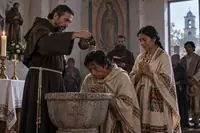
That humble man was Saint Juan Diego — Cuauhtlatoatzin — the first indigenous saint of the Americas. The mysterious meeting between him and Our Lady of Guadalupe set off the greatest wave of conversions in human history: in less than a decade, more than nine million native people freely entered the waters of Baptism, reconciling two hostile cultures and opening a new chapter for the Americas.
Chapter 1 of 6
A son of the fallen Aztec empire
Cuauhtlatoatzin — which in the Nahuatl language means “Talking Eagle” — was born around 1474 in Cuautitlán, a small village about twenty kilometers from the capital Tenochtitlan, today Mexico City. He belonged to the class of poor commoners — the macehualtin — of the Aztec empire.
In 1521, the bloody conquest by Hernán Cortés and the army of Spanish colonizers flattened the mighty Aztec empire. The pagan temples were destroyed, the native civilization collapsed, and millions of native people were thrown into misery, slavery and despair, full of hatred for the white foreigners. In 1524, when the first twelve Franciscan friars arrived in Mexico as missionaries, Cuauhtlatoatzin and his wife Malintzin opened their hearts to the Gospel.
The couple received Baptism, taking the Christian names Juan Diego and María Lucía. They lived a holy married life, practicing chastity and devoting themselves to works of charity. In 1529 his wife died, and Juan Diego moved to live with his elderly uncle Juan Bernardino in Tolpetlac, walking dozens of kilometers every day to go to Mass and serve the poor.
Chapter 2 of 6
The request of Our Lady of Guadalupe
On the morning of December 9, 1531, on the hill of Tepeyac — where there had once been a temple of the Aztec mother goddess Tonantzin — Our Lady appeared to Juan Diego. She spoke to him with a mother’s tenderness:
“My little Juan, my youngest and dearest son... I am the perfect and ever-Virgin Holy Mary, Mother of the true God, the Giver of life! I greatly desire that a temple be built here, so that I may show all my love, compassion, help and protection to you, to all the people of this land, and to all who love me and call on me in their troubles and hardships!”
Our Lady told him to go to the residence of the Bishop of Mexico — Bishop Juan de Zumárraga — and deliver this request.
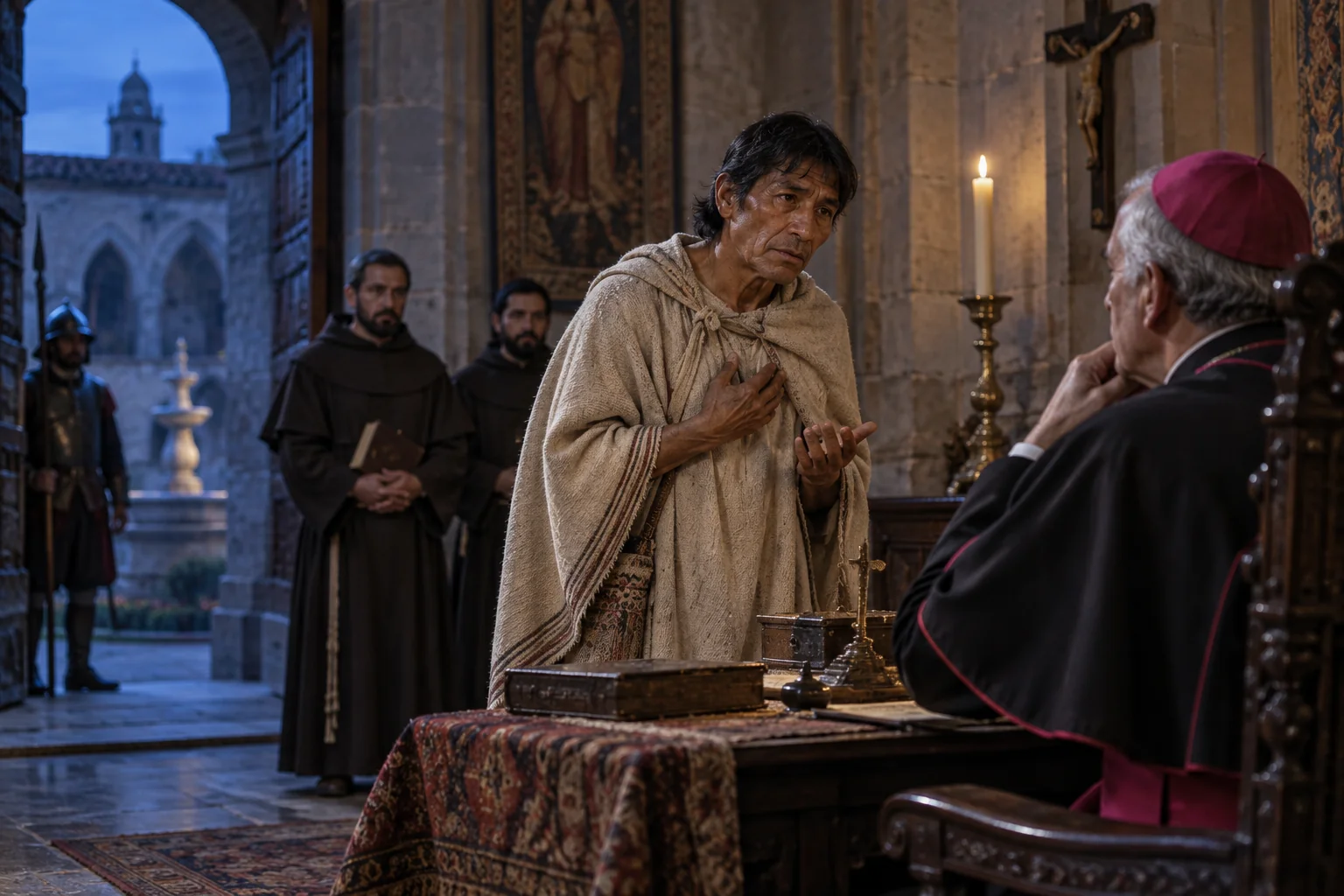
Juan Diego obeyed at once and ran to the bishop’s residence. But the Spanish bishop and the clergy of his household looked at the ragged native man with suspicion. The bishop listened half-heartedly, then advised him to go home and rest, promising to consider the matter later. That afternoon, back on the hill of Tepeyac and seeing Our Lady still waiting, Juan Diego fell to his knees in anguish and pleaded: “My Lady, my gentle Mother... I am only a poor peasant, a dry leaf, a frayed rope of no value at all... No one will believe what I say! Please send some nobleman whose word carries weight, and then people will listen to you!” But Our Lady smiled at him lovingly and answered:
“My dear son, I have many great people I could send; yet it is God’s holy will and mine that you yourself — in your littleness and humility — should be the one to carry out this mission!”
The next day, Sunday, December 10, Juan Diego patiently went to the bishop’s residence a second time. This time, after questioning him closely, Bishop Zumárraga told him to ask the Lady for a clear sign from heaven as proof. That afternoon, Our Lady promised to give him the sign the following morning.
Chapter 3 of 6
Castilian roses in the depth of winter
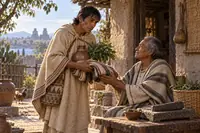
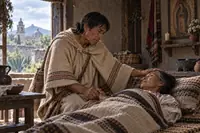
But on Monday, December 11, Juan Diego could not go to Tepeyac, because his uncle Juan Bernardino suddenly came down with the epidemic fever and was close to death. He had to stay by his uncle’s bedside caring for him all day. At dawn on Tuesday, December 12, his dying uncle asked Juan Diego to hurry to the city to find a priest to give him the Anointing and Viaticum. Afraid that meeting Our Lady again on Tepeyac would delay saving his uncle’s soul, Juan Diego took a roundabout path around the east side of the hill.
But a mother’s love never lets her child go astray. Our Lady suddenly came down the hillside and stopped him on his way. Juan Diego, flustered, fell to his knees and stammered out an explanation about his uncle’s illness. Our Lady looked at him with great tenderness and spoke words of comfort that the faithful have treasured ever since:
“Let nothing trouble or frighten your heart, my little son! Do not fear this illness or any other pain! Am I not here, I who am your Mother? Are you not in the shadow of my mantle? Are you not held in the crook of my arms? What else do you need? Do not worry about your uncle; at this very moment he is completely well!”
At that same hour, Our Lady appeared at the home of his uncle Juan Bernardino, healed him and revealed her title: Our Lady of Guadalupe.
Our Lady told Juan Diego to climb to the top of the hill of Tepeyac and pick the flowers blooming there to bring to her. The top of Tepeyac was a barren limestone outcrop, full of thorns, and it was the middle of a freezing, frosty December. But when he reached the top, Juan Diego was stunned to see a whole garden of fresh, exquisite Castilian roses in bloom, fragrant with the morning dew — noble roses found only in faraway Spain, which could never grow on Mexican soil in the middle of winter. He picked those roses and carefully wrapped them in the fold of his tilma to carry down. Our Lady arranged each flower in his cloak with her own hands, tied the two corners of the cloak together and said:
“Take this bundle of flowers and place it in the Bishop’s own hands; this is my sign!”
Chapter 4 of 6
The miracle of the image on the cloak
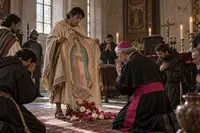
Juan Diego ran straight to the bishop’s residence. After hours of waiting and being teased by the guards, he was led into the reception room before Bishop Zumárraga and the officials. The peasant knelt and repeated every word of Our Lady. Then he let go of the corners of his tilma. The fresh Castilian roses tumbled onto the marble floor.
But that was not all. As the roses tumbled out, everyone in the room dropped to their knees in tears. For there on the rough cactus-fiber cloth, a beautiful image of Our Lady of Guadalupe had appeared, radiant before everyone’s eyes: Our Lady with a gentle native face, a blue mantle sprinkled with stars, standing on a crescent moon, in a rose-colored gown bearing symbolic patterns of the Aztec empire. The bishop knelt and asked forgiveness for his long doubt. He carried the image to his chapel and at once began building the church on the hill of Tepeyac, just as Our Lady had asked.
That tilma — an ordinary piece of rough plant-fiber cloth that would normally rot away within twenty years at most — has miraculously survived intact for nearly five hundred years, without fading or decaying, despite the damp climate and the smoke of millions of pilgrims’ candles over the centuries. On November 14, 1921, an employee of the Mexican President’s office named Luciano Pérez Carpio hid a bomb in a vase of flowers right beneath the image, plotting to destroy the whole basilica. The blast was heard a kilometer away, shattering the windows, destroying the marble altar rail, and twisting a bronze crucifix nearby — still preserved today under the name “the Christ of the Bomb”. But the glass protecting the image of Our Lady, right above the bomb, was not even scratched.
The most advanced scientific and ophthalmological studies of the twentieth century all confirmed with astonishment that the surface of the image bears no trace of any human brushstroke or chemical pigment at all; and that the pupils of Our Lady’s eyes reflect tiny, precise images of Juan Diego, Bishop Zumárraga and the witnesses present in the room that day.
Chapter 5 of 6
The quiet keeper of the shrine beside Our Lady
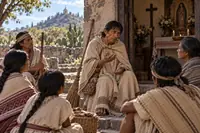
After that day, Juan Diego asked permission to leave his old home and move into a small hut of earth right next to the first chapel on the hill of Tepeyac. For the remaining seventeen years of his life, from 1531 to 1548, he lived as the shrine’s humble keeper: sweeping the chapel, welcoming the millions of native people from distant tribes who poured in to gaze on Our Lady, and patiently retelling the story of Our Lady’s love in his own native tongue. He fasted, prayed and offered his whole life in silence.
On May 30, 1548, Saint Juan Diego died peacefully at the age of seventy-four. He was buried right at the foot of his beloved hill of Tepeyac.
Chapter 6 of 6
A saint of humility and reconciliation
On May 6, 1990, in the Basilica of Our Lady of Guadalupe in Mexico, Pope Saint John Paul II beatified Juan Diego. On July 31, 2002, he returned to Mexico to canonize him — the first indigenous saint of all the Americas. The Church celebrates him on December 9 each year.
Saint Juan Diego reminds us that God does not choose the smug and proud; He chooses what the world regards as the lowliest, smallest and poorest to accomplish His great works of salvation. Never be ashamed of being poor and lowly. Take shelter under Mary’s mantle and listen to what she whispered on the hill of Tepeyac long ago:
“Am I not here, I who am your Mother? What else are you afraid of?”
Then you can walk firmly and bear witness to the Gospel in the midst of daily life.
The end of the story
You have walked with Saint Juan Diego to the end of the story.
A few moments you want to read slowly:
On the hill of Tepeyac, Our Lady appeared not looking like the white colonizers, but with the very skin and voice of the poor native people.
When he humbly said he was only "a dry leaf, a frayed rope of no value at all", Our Lady still chose him as her messenger.
When he opened the cloak holding the Castilian roses picked in the dead of winter, an image of Our Lady appeared, radiant before the whole room.
Stay in silence
You sense a mother’s love, close at hand: God does not choose the smug and proud, but the poorest and humblest to accomplish great things.
Am I not here, I who am your Mother? Are you not in the shadow of my mantle?
Let us pray
Saint Juan Diego,
you called yourself only "a dry leaf, a frayed rope", yet Our Lady chose you as her messenger and printed her image on your cloak.
Help me not to feel ashamed of being poor and lowly, for God loves to choose the little ones.
Pray for ethnic minorities and for the poor in remote places, and may Our Lady of Guadalupe protect every unborn child.
Amen.
Sources
- Feast dayAuthor’s edited profile
- Patron ofPatronages and symbols, version 1.1
- Often depicted withPatronages and symbols, version 1.1
- Reflectionvatican.va
- Reflectionvatican.va
Meet the next one
 Journey 7