

Journey 1 · Those Who Met the Lord
Saint Joachim
A father at the threshold of the promise
Feast day July 26
Tap to step inside
Saint Joachim
A father at the threshold of the promise
Map of a life
This life told in 5 chapters
Begin the journey

Feast day
Saint Joachim
Some places may celebrate on a slightly different day.
July 26
Patron of
- Fathers
- Grandparents (World Day for Grandparents and the Elderly, near July 26)
Often depicted with
- A dove or lamb as an offering
- A staff
Opening
Opening
Before Mary received the message of salvation, she too was once a little child. Before she held the infant Jesus in her arms, she was held and cherished by her own parents, taught and raised at home like any other child. Since ancient times the Church has honored those parents by two beloved names: Joachim and Anne.
The four canonical Gospels never record the couple’s names. We know Saint Joachim through an ancient Christian tradition, and we remember him with gratitude as the father who stood behind Our Lady, respecting the silences history has left.
Chapter 1 of 5
A story kept by every generation
Around the second century, an ancient text usually called the Protoevangelium of James told the story of Mary’s family and childhood. It is not part of the Bible the Church recognizes. Yet many of its simple images have found their way into Christian art, liturgy and devotion over the centuries, so much so that almost all of us have heard the story, sometimes without knowing where it came from.
In that ancient story, Joachim is a devout, fairly well-off and generous man who regularly gave double offerings to the Temple and was open-handed with the poor. He and his wife Anne lived together for many years without a single child.
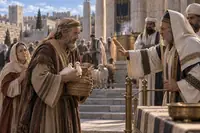
On a great feast day, as he came forward with his offering, a man named Reuben blocked his way and rebuked him: a man with no child to carry on his line, he said, was not worthy to stand among those bringing gifts to God, as if childlessness were a public sign of God’s disapproval.
That is how popular tradition tells it; it is not a careful historical record. But the pain in the story rings piercingly true: a man judged and despised for something beyond his control, then pushed aside in the very place where he most wanted to draw close to God.
Childlessness never makes a family worth less before God. Reuben’s insult is the wound in the story; it cannot, and should never, be understood as God’s own verdict on couples who have no children.
Chapter 2 of 5
Into the wilderness to pray in silence
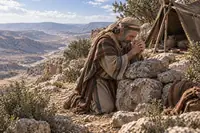
The ancient text goes on to say that Joachim was deeply grieved by that insult. He remembered the patriarch Abraham, who was given a son in old age when all hope seemed long gone. Rather than go home to face cruel tongues, he quietly went alone into the barren wilderness. There he pitched a small tent, fasted forty days and nights and prayed earnestly to God, with no one beside him.
The forty days and nights echo the great trials of salvation history: Moses on Mount Sinai, Israel wandering in the desert, Jesus himself fasting in the wilderness before he began to preach. Joachim is shown as a man who laid all his humiliation and helplessness before the Lord and waited patiently there, before any ray of hope had appeared.
At home, Anne carried the same pain and prayed earnestly, though her husband was not there to bear it with her. Far apart, husband and wife ached and prayed for the same thing. The longing for a child was not only a woman’s private grief; the man carried that burden too, only more quietly: not weeping aloud, but going far away to face his pain alone.
Picturing Joachim in the wilderness, we may think of so many fathers and husbands around us. They seldom speak of their pain or helplessness. People tend to see only how well they earn a living and carry the family’s burdens, while deep down they too face dead ends where there is nothing to do but wait.
Joachim in the ancient story brought that very helplessness into his prayer. He did not hold every outcome in his hands; he simply stood before God with the very real emptiness in his life.
Chapter 3 of 5
Coming home into his wife’s arms
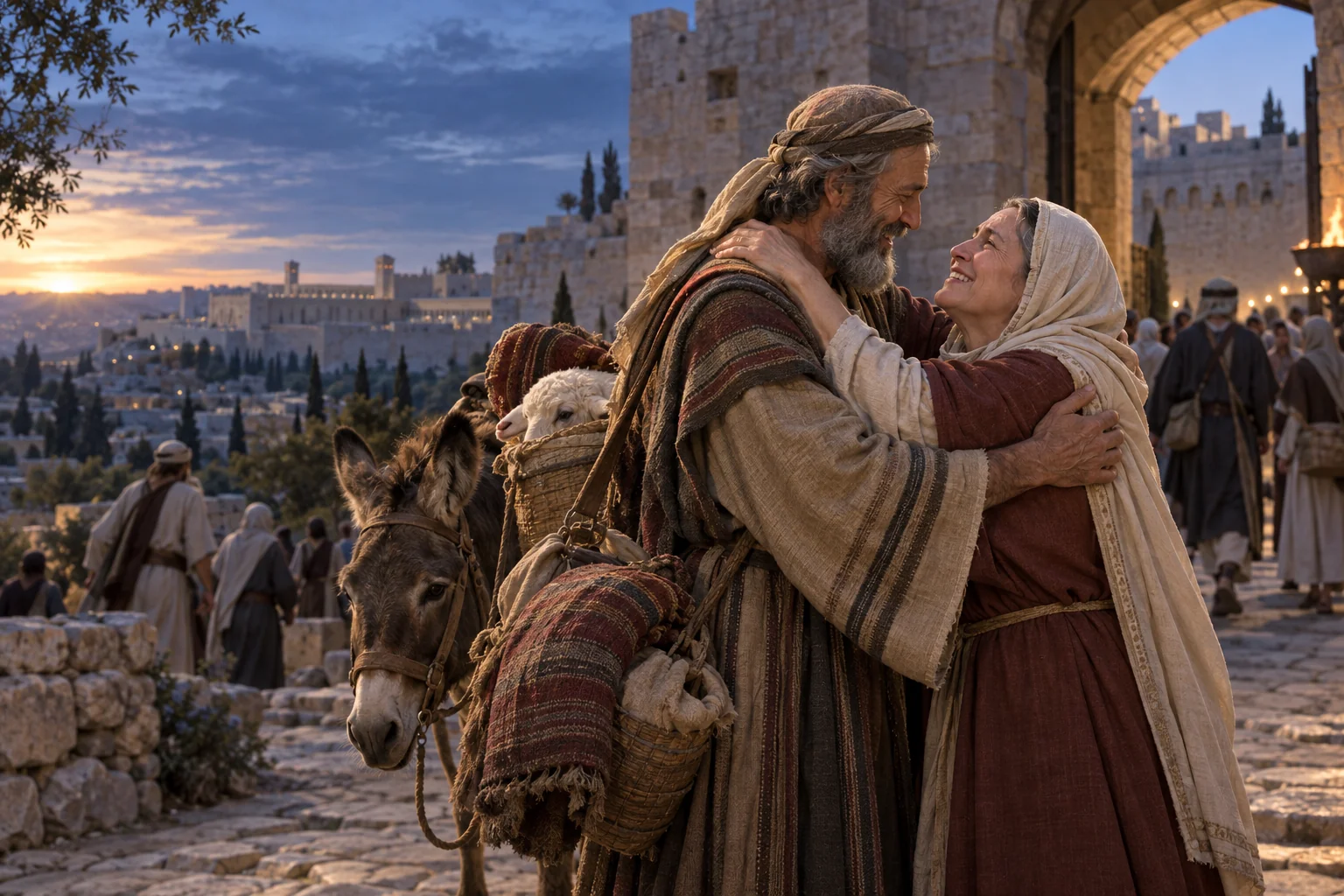
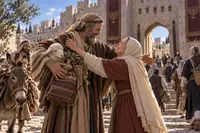
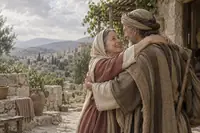
Tradition says that an angel of God appeared to each of them, in different places, with the news that their prayer had been heard. Overjoyed, Joachim prepared offerings of thanksgiving and hurried home. Seeing her husband in the distance, Anne ran out to meet him and threw her arms around him, weeping for joy.
Painters of old, from Giotto’s frescoes in the Scrovegni Chapel to Dürer’s woodcuts centuries later, often set this tender meeting before an ancient gate of Jerusalem that the Jews called the “Gate of Mercy.” The name is only a coincidence of history, yet it suits the story strangely well: a meeting born of the very mercy the couple had prayed for through so many weary years.
Over the centuries that image has become part of Christian liturgy and art: two people who had come through bitter, humiliating days together, now walking hand in hand into a new season of hope.
Before they had a child to hold, they had each other to come home to. The story keeps a beautiful moment of married love: a tight embrace after many days apart, with no reproach for staying away so long, only joy.
Some time later, Anne gave birth to a baby girl, and the couple named her Mary. Tradition sees the simple joy of that small home as the quiet preparation for the greatest calling any human being has ever received.
Chapter 4 of 5
A child given, not kept
The Protoevangelium of James also tells of a happy feast when Mary turned one, of the priests’ blessing, and of the couple’s quiet resolve to offer their child to God. When she was two, Joachim wanted to keep that promise at once; but Anne asked to wait one more year, so that the little girl would not be frightened by leaving home too soon.
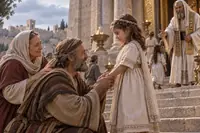
When Mary was three, the couple brought her up to the Temple in Jerusalem to present her. The story paints a small child’s unsteady steps, the flickering lamps of the Temple, and the parents’ joy mixed with heartache as they watched her walk away into other hands. It is the language of popular devotion, but it carries a deep truth: children are gifts from God. Parents must love and raise them, but they must also learn to open their hands so their children can follow the calling God has prepared for them, even when it breaks the parents’ hearts.
After that, tradition says nothing more about Saint Joachim. The father quietly stepped back and left the stage to his daughter. Mary would have her own road; his part can be summed up in two words: receiving, and entrusting.
Chapter 5 of 5
The grandfather in Vietnamese family memory
We do not know when he was born, how old he was when he died, or whether he lived to see his grandson Jesus, and that open question leaves a pang of regret. Paintings of him holding the Christ Child are works of love and prayer that go far beyond anything history can establish.
The Church celebrates Saint Joachim together with Saint Anne on July 26 each year. Keeping the feast together, rather than separating the father’s part from the mother’s, keeps whole the picture of a holy family in which devout parents nurture a child’s calling.
For Vietnamese Catholics, devotion to Saint Joachim is closely bound up with filial piety and gratitude toward grandparents and elders: people who spent their lives faithfully keeping the family’s ways, taking their grandchildren to Mass every Sunday morning, and quietly sacrificing everything so that those who came after them might have a brighter future.
Some fathers never live to see how their children’s lives turn out. Some grandfathers are remembered only for a short piece of advice, an upright way of living, the habit of praying the Rosary before the family altar every night before bed. That quiet presence goes on sheltering later generations, even when they no longer clearly remember his face.
Saint Joachim stands at the threshold of the history of salvation as a steadfast father. Joseph the carpenter may have learned silence and trust from the example of his father-in-law, though the two perhaps never met. The hands that opened to offer his daughter at the Temple long ago remain a beautiful prayer for every parent today: may my love for my child be strong enough to care and shelter with all my heart, and generous enough to set my child on the road the Lord has prepared for them.
The end of the story
You have walked with Saint Joachim to the end of the story.
You will carry with you:
Reproached in the middle of the Temple for having no child, he went quietly into the wilderness and fasted forty days to pray alone.
Coming home, seeing his wife in the distance, he ran to embrace her — with no reproach for having gone away so long.
Bringing his little daughter to the Temple to offer her, then quietly stepping back, leaving the whole stage to his child.
Stay in silence
You fall silent a moment, then understand: his whole part can be summed up in two words, receiving and entrusting.
To love a child enough to hold on, and generously enough to let go at the right moment: that too is love made complete.
Let us pray
Saint Joachim,
reproached for having no child, you went quietly into the wilderness to pray. Then, when your daughter Mary was born, you brought her to the Temple, offered her to God, and stepped back.
Pray for fathers who are anxious for their families. Teach them to love their children enough to care for them, and generously enough to give them to God.
Grant the grandparents in my family a peaceful old age, and the joy of seeing their grandchildren live their faith.
Amen.
Sources
- Feast dayAuthor’s edited profile
- Patron ofPatronages and symbols, version 1.1
- Often depicted withPatronages and symbols, version 1.1
- Reflectiongutenberg.org
- Reflectionnewadvent.org
Meet the next one
 Journey 1