

Journey 1 · Those Who Met the Lord
Saint Elizabeth
Joy that came in a season of waiting
Feast day August 23
Tap to step inside
Saint Elizabeth
Joy that came in a season of waiting
Map of a life
This life told in 6 chapters
Begin the journey OpeningOpening1 min
 Chapter 1 of 6Years without the laughter of children1 min
 Chapter 2 of 6A husband who came home in silence1 min
 Chapter 3 of 6A visit in the sixth month1 min
 Chapter 4 of 6A song in the house, and family love1 min
 Chapter 5 of 6The mother who kept her son’s name1 min
- Chapter 6 of 6A mother who stepped back into the shadows1 min
Feast day
Saints Zechariah and Elizabeth
According to the Vatican News calendar of saints
August 23
Patron of
- Pregnant women
- Those unable to have children
Often depicted with
- Holding the infant John
- The scene of Mary’s visit
Opening
Opening
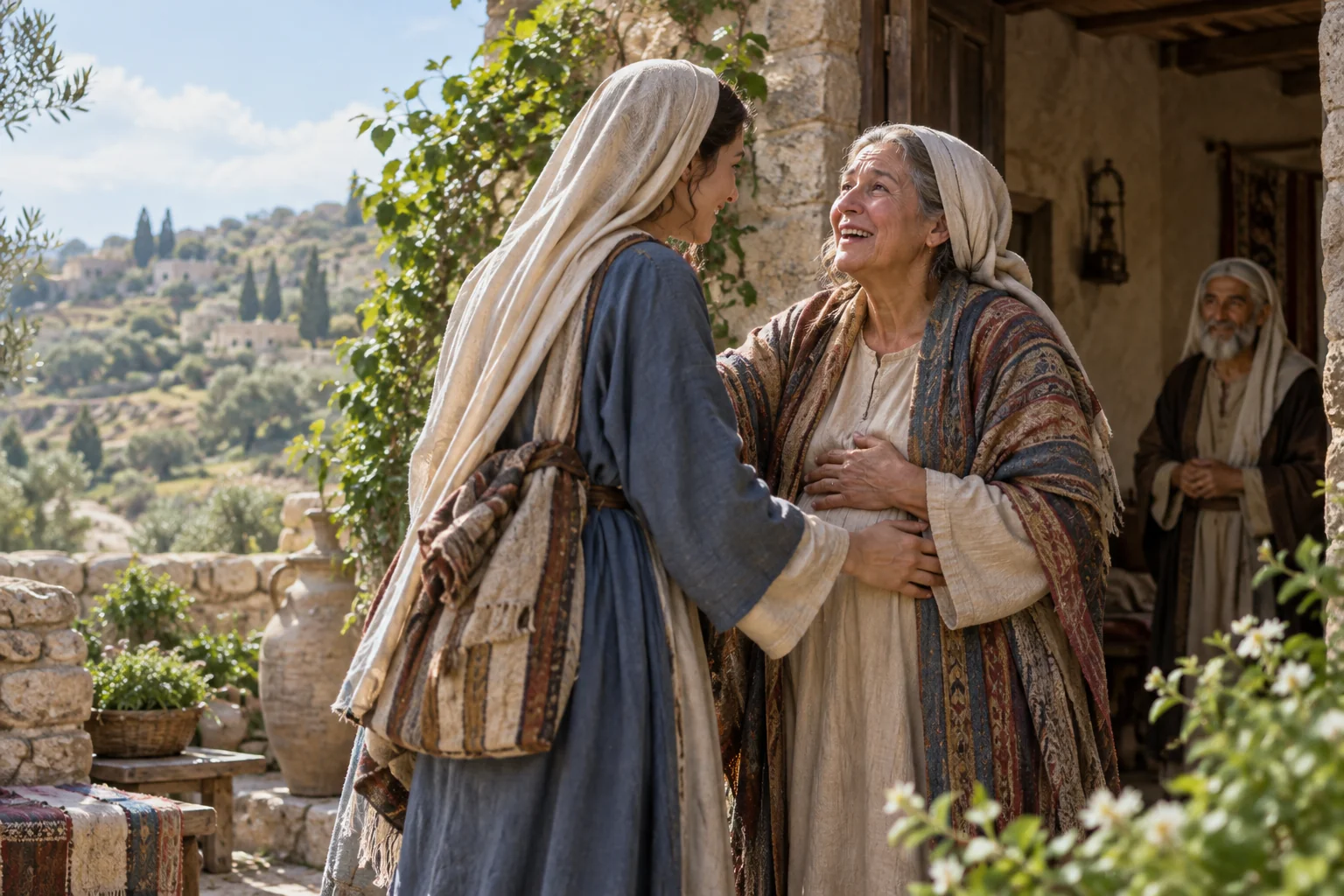
When the Virgin Mary stepped over her threshold, Elizabeth was not simply welcoming a young relative who had come a long way. The child in her womb leapt for joy, and in that moment the older woman recognized what no eye in that house could see: the Mother of the Lord had come to visit her.
Her greeting traveled far beyond that small house in the hill country of Judea. Down the centuries, countless believers have repeated her blessing every day in the Hail Mary:
“Blessed are you among women, and blessed is the fruit of your womb!”
Yet before that joyful moment, Elizabeth had lived through long years of silent waiting, waiting for something no human strength could bring about.
Chapter 1 of 6
Years without the laughter of children
Saint Luke sets the story in the time when King Herod ruled Judea, before Christ. Elizabeth was descended from Aaron, of the priestly line, married to Zechariah, a priest of the division of Abijah. Tradition from the sixth century places the couple’s house at Ain Karem — a small village nestled among the green hills of Judea, about seven kilometers southwest of Jerusalem. If this was the place, Mary’s journey from Nazareth covered as much as a hundred and twenty kilometers of hill roads: a long, hard trip, not an afternoon stroll.
Scripture describes the couple as righteous before God, walking blamelessly in all His commandments and ordinances. Yet the great sorrow of that home was that they had no children. By the time the story is told, both were advanced in years. The text does not say exactly how many years they had been married, or how old each of them was.
In ancient Jewish society, children were considered a great blessing from God and the continuation of a whole family’s life; childlessness often brought not just loneliness but curious looks, gossip and whispered judgments. Later Elizabeth herself said that the Lord had taken away her reproach among men. It is a short sentence, but it reveals years of living with unkind words.
Yet from the very first lines, Saint Luke makes it plain that the couple were righteous. The absence of a child was never proof that God had turned His face away from them, even if people of that time often thought so.
Scripture sums up those long, bitter years in a few short lines. We do not know how the couple shared their tears and hidden sorrow through so many nights. We only know that they persevered together, faithful to the Lord. Their faithfulness stood firm long before their prayer received an answer anyone could see.
Chapter 2 of 6
A husband who came home in silence
During his division’s turn of service at the Temple in Jerusalem, Zechariah was chosen by lot to enter the sanctuary and offer incense, an honor that might come to a priest only once in a lifetime. The angel Gabriel appeared beside the altar, announcing that Elizabeth would bear a son, and that he must name the child John. The child would go before the Lord to prepare His way.
Because he and his wife were both old, Zechariah doubted and asked how he could know this was true. Because he did not believe, he was struck mute, unable to speak until the day the promise was fulfilled. When his service ended, he went home in silence, unable to tell anyone a word of what had happened.
The Gospel tells of the announcement to the husband; Scripture does not place Elizabeth at the Temple that day, nor record any conversation between her and the angel. We meet her again only once she has conceived and has quietly kept herself hidden for five months.
Elizabeth received the life growing in her womb as a gift of boundless mercy: the Lord had looked on her with favor. That joy did not need to be announced to the world. It grew day by day, hidden in the mother’s body and the warmth of the home, while the husband beside her could not say a single word to share it with her.
There are homes where the deepest things are shared without any words at all. Here Scripture lets us stand before the mystery of waiting, and adds nothing more.
Chapter 3 of 6
A visit in the sixth month
When Elizabeth was six months pregnant, the angel spoke of her at the Annunciation to Mary, as a sign that nothing is impossible with God. Hearing this, Mary set out in haste over the hills to the hill country of Judea, entered the house of Zechariah and greeted Elizabeth.
The two women were kin. An older woman who had been childless and a young virgin met, each with a very different calling, yet both callings went far beyond any human plan.
As soon as she heard Mary’s greeting, Elizabeth felt the child within her leap for joy. Filled with the Holy Spirit, she blessed Mary and the Son Mary was carrying, and then cried out in wonder:
“Why am I so favored that the mother of my Lord should come to me?”
She also praised Mary as blessed for having believed that what the Lord had spoken would be fulfilled. Overflowing with joy as she was, Elizabeth did not make herself the center of the meeting. She recognized her young relative’s great faith, spoke words that encouraged her, and honored what God was doing in someone else.
That is the beauty of charity: not keeping all the attention on the miracle in your own life, but opening your heart to bless the grace given to another.
Chapter 4 of 6
A song in the house, and family love
In answer to that greeting, Mary sang the Magnificat, praising God who had looked upon His lowly servant and done great things for her. The song speaks of the hungry filled with good things, the rich sent away empty, and the promise to our father Abraham fulfilled. Two humble lives in a simple house were woven into the great story of salvation of a whole people.
Mary stayed with Elizabeth about three months, and then returned to Nazareth. The text does not say whether she stayed until John was born. But those three months were real companionship, not a hurried visit on the way somewhere else.
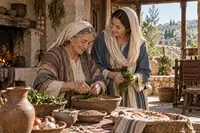
In Vietnamese families, many people know this kind of love well, the love of patiently staying: coming to help a relative about to give birth, sitting beside an elderly person who is ill, sharing the unnoticed chores in the kitchen. True charity often comes into a house as a visit and then stays on in everyday tasks, rather than stopping at a passing word of concern.
Chapter 5 of 6
The mother who kept her son’s name
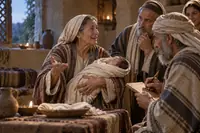
When her time came, Elizabeth gave birth to a son. Her relatives and neighbors heard that the Lord had shown her great mercy, and they rejoiced with her. The loneliness that had weighed on her for so long gave way to a joy the whole village shared.
On the eighth day, at the circumcision, everyone meant to name the child after his father, Zechariah, as custom required. But Elizabeth spoke up firmly, without hesitating:
“No, he is to be called John!”
Everyone was surprised, since no one in the family had that name, and they made signs to the father to ask him. Zechariah asked for a tablet and wrote, with a trembling hand:
“His name is John.”
At once his mouth was opened and his tongue loosed, and after so many months of silence he began to bless God.
Elizabeth spoke decisively and bravely. She did not wait for her husband to speak first, though naming a child was normally the father’s right. Together with him she accepted a name given by the Lord, and with it a future that was not just a continuation of the family’s own plans. Zechariah sang a hymn of praise to the Lord who had visited and redeemed His people. The child grew and became strong in spirit, and lived in the wilderness until the day he appeared before Israel.
Chapter 6 of 6
A mother who stepped back into the shadows
After the story of John’s childhood, the New Testament says nothing more about Elizabeth’s last years. We do not know how long she lived, whether she saw her son go out to preach by the Jordan, or how she died. Her dates and age are left in silence.
In the Church’s liturgical year, the feast of the Visitation on May 31 brings that meeting in a house among the hills of Judea back to the hearts of believers every year.
Saint Elizabeth, mother of John the Baptist, is not the same person as Saint Elizabeth of Hungary or other saints of that name in later centuries. What makes her beautiful is a righteous life of quiet waiting, a joy that knows how to bless others, and the steadiness with which she accepted her son’s calling, without hesitation or calculation.
She left behind no books and no fortune. What she left has melted into the Church’s daily prayer. Each time Vietnamese Catholics pray the Hail Mary, the voice of that elderly mother sounds again in countless homes, though few think of her name as they pray.
Elizabeth’s life shows that old age, childlessness, or the years that seem most hopeless can still be where God is quietly preparing new life for the whole world, if we persevere in hope to the end.
The end of the story
You have walked with Saint Elizabeth to the end of the story.
Perhaps you will always remember:
At the sound of Mary’s greeting, the child in her womb leapt for joy, before she could understand why.
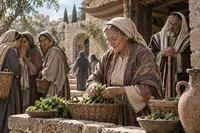
Overflowing with joy, she kept no attention for herself, but honored the Lord’s grace at work in her young relative.
On the naming day, she was firm: "No, he is to be called John!" No one in the family had ever borne that name.
Stay in silence
You pause, and see: she left no writings and no famous sayings. All she left was a quiet faith, strong enough to stand upright when the whole family still doubted.
Some of the most beautiful joys are the ones we celebrate for others, not for ourselves.
Let us pray
Saint Elizabeth,
after many childless years, you received a son in your old age. When Mary came to visit, you did not speak of your own joy, but praised the Lord’s grace in your young relative.
Pray for couples longing for a child. Let them not despair, but keep trusting in the Lord.
Teach me to rejoice in the joy of others, and to have the courage to hold to what the Lord wants, even when my whole family does not yet understand.
Amen.
Sources
- Feast dayVatican News — Saints of the Day
- Patron ofPatronages and symbols, version 1.1
- Often depicted withPatronages and symbols, version 1.1
- Reflectiongutenberg.org
Meet the next one
 Journey 1