

Journey 1 · Those Who Met the Lord
Saint Anne
The mother of the Mother
Feast day July 26
Tap to step inside
Saint Anne
The mother of the Mother
Map of a life
This life told in 6 chapters
Begin the journey OpeningOpening1 min
 Chapter 1 of 6A name from ancient tradition1 min
 Chapter 2 of 6Sorrow beneath a tree in the garden1 min
 Chapter 3 of 6A promise given, and the joy of motherhood1 min
 Chapter 4 of 6Waiting for her child to grow stronger1 min
 Chapter 5 of 6What a mother can give1 min
- Chapter 6 of 6A prayer passing from a grandmother’s lips to a grandchild’s heart1 min
Feast day
Saints Joachim and Anne
General Roman Calendar
July 26
MemorialPatron of
- Mothers and grandmothers
- Pregnant women and those unable to conceive
- Quebec (Canada) and Brittany (France)
Often depicted with
- Teaching the young Mary to read
- A red robe with a green mantle
Opening
Opening
In so many familiar holy pictures, in churches and in family living rooms, Saint Anne sits lovingly beside a little girl bent over a book. That little girl is the young Mary.
The picture comes from no page of the Gospels, yet it has become a living image of faith handed down through the generations: a mother close by, a child learning, and the word of God treasured in the home.
Before Mary taught the infant Jesus his first words, she too had a mother of her own. The Church has always remembered that mother by a tender name: Saint Anne.
Chapter 1 of 6
A name from ancient tradition
The canonical Gospels never record the names of Mary’s parents. (The prophetess Anna who met the infant Jesus in the Temple, as Saint Luke tells it, is a different elderly woman who simply shares her name; she is not Our Lady’s mother.)
The beloved stories of Saint Anne come from the Protoevangelium of James, a second-century text. It is not part of Scripture, but it shows how dearly the early Christians loved the Savior’s family. It is as if they could not bear to leave a blank space behind Mary’s life, and so they told and kept what they believed to be true, passing it down by word of mouth for many generations.
To tell of Saint Anne is to step into an old and devout story that generations have cherished, while remembering that her birth, her age and the dates of her life are recorded nowhere with certainty.
Chapter 2 of 6
Sorrow beneath a tree in the garden
According to the old story, Anne and her husband Joachim endured childlessness for many long years. After being publicly shamed in the Temple, Joachim went off sadly into the wilderness. Alone at home, Anne had to bear both the pain of having no child and the sudden absence of her husband, not knowing where he had gone, when he would come back, or whether he would return at all.
One afternoon, she went down into the garden behind the house, sat in the cool shade of a tree and began to pray. Looking up, she saw a sparrow’s nest full of chirping chicks, and her heart broke. In the story her lament rings out amid a garden teeming with new life, while her own home stood cold and empty.
It is a fragile, very human picture. Tradition does not remember her only at the glorious moment when she gave birth to the Mother of God; it also lovingly remembers her days of sorrow, when something as ordinary as a nest of chicks was enough to touch her deepest wound.
Readers today feel for her, but this story should never be used to judge those who have no children. A woman’s dignity does not depend on whether she can bear a child. Anne’s pain deserves a compassionate hearing; it must never become a burden laid on others in the same situation.
Chapter 3 of 6
A promise given, and the joy of motherhood
The tradition tells that an angel of the Lord appeared to comfort Anne, announcing that God had heard her and that she would bear a child. Overwhelmed, she vowed then and there to offer the child to God. At the same time, in another place, Joachim received a similar vision and hurried home.
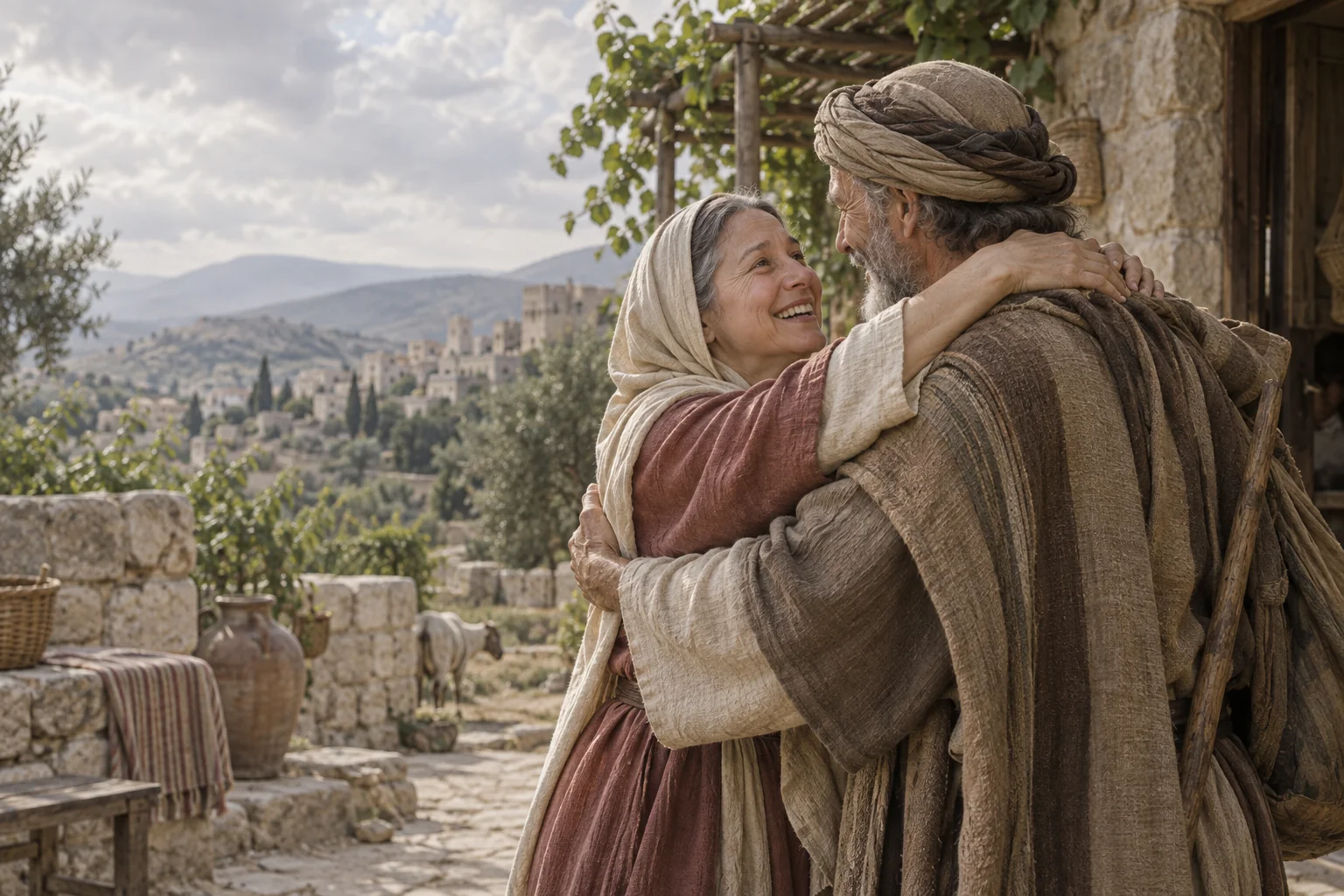
Anne ran out to meet her husband and threw her arms around him, unable to hold back her tears. Two people who had shared the same sorrow were now joined in a new hope, no longer carrying their grief alone.
Then she gave birth to a daughter, and named her Mary. The ancient text keeps songs of thanksgiving, the days of a mother tenderly caring for her infant, and the joyful feast when the child turned one. These touches read more like a hymn of praise for God’s grace than a dry entry in a register.
In that simple world, motherhood appears as something sacred. The woman who once wept looking at a bird’s nest was now bending down to hold her newborn close. Years of patient waiting had blossomed into a song of thanksgiving beyond words.
Chapter 4 of 6
Waiting for her child to grow stronger
The ancient text also keeps a small and moving conversation between husband and wife. When Mary turned two, Joachim urged that they take her to the Temple to fulfill their vow. But Anne gently asked her husband: let us wait just one more year, so that the child will be stronger, fully weaned, and not so frightened at leaving her parents’ arms. Joachim listened and agreed at once; he did not brush his wife’s wish aside.
Set beside the lofty ideal of consecration, Anne’s small request shows a mother’s real tenderness: she was attentive to how her child was growing, not just anxious to fulfill a promise. She did not forget her vow of offering; she only wanted to shelter her child’s tenderness a little longer before she had to let go.
Only when Mary turned three did her parents bring her to the Temple. The feast of the Presentation of Mary in the Temple, on November 21 each year, keeps the sacred meaning of that offering without claiming that every detail of the old story is verified history.
In Anne, we contemplate a very gentle virtue: knowing how to wait. Parents often want to do everything at once for their children’s future, but real love looks at where the child actually is and how strong they are, and steadies each unsteady step at the right moment instead of forcing them to grow up too fast.
Chapter 5 of 6
What a mother can give
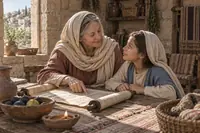
The image of Anne guiding Mary’s hand as she learns to read expresses the Church’s conviction that faith is first handed on in the family. It is not a historical snapshot but an invitation to every family today to stop and think about the priceless things passed on through everyday closeness: a first prayer, a lesson in gratitude, respect for elders, and kindness practiced through small things each day.
Our Lady’s life in the Gospel is a life of listening, remembering and pondering the word of God in her heart. We do not know exactly what lessons Anne taught her child. But devotion to her helps families today to thank the mothers and grandmothers who patiently prepared the soil of their children’s souls, even if they never lived to see the full harvest.
One thing should be said clearly here: the Church’s profession that Mary was preserved from original sin from the moment of her conception (the Immaculate Conception) in no way means that Anne conceived her child in some miraculous virginal way. The Immaculate Conception speaks of God’s special protection of Mary from the very first moment of her life; the virginal conception by the power of the Holy Spirit is a mystery belonging to Jesus alone. Devotion to Saint Anne, then, honors the very human and very holy beauty of ordinary motherhood: Our Lady was born into a real family, carried, delivered and nursed day by day like any other child.
Chapter 6 of 6
A prayer passing from a grandmother’s lips to a grandchild’s heart
No document tells us the date of Saint Anne’s death or her age. She is honored as the grandmother of Jesus in His human nature, and so she holds a very warm place in the hearts of Catholic mothers through the generations.
Among Vietnamese Catholics, the name Anne is heard with affection everywhere. Generations of women have carried her name since baptism, grown up to become mothers and grandmothers, and left their families a devout way of life: wrinkled hands moving bead by bead over the Rosary at night, reminders to the children not to be late for Sunday Mass, and a whole lifetime of patient sacrifice without a word of complaint.
Faith is not handed on only through long sermons. Sometimes a child remembers the ways of the Lord for life just from seeing their grandmother’s trembling hand light a stick of incense before the family altar, from the way their mother quietly shares a bowl of rice with a beggar at the gate, or from the forgiving eyes of an adult pardoning a child’s very small mistake.
Looking at Saint Anne beside her daughter Mary, we find a rare moment of peace. Without grand words, a mother’s patient presence and quiet love are like gentle milk that silently nourishes holy souls, for the Church and for the world.
The end of the story
You have walked with Saint Anne to the end of the story.
A few images that stay with you:
Sitting in the shade of a tree, looking at a sparrow’s nest, her heart aching because her own home was still silent, without a child’s voice.
When Mary was two, her husband wanted to take her to the Temple at once; she asked only to wait one more year, so the child would be strong enough not to be afraid.
Guiding Mary’s hand as she learned each letter, sowing the seed of a life that would change all humanity.
Stay in silence
One thing stays with you: faith is handed on not only through long sermons, but through a grandmother’s trembling hand lighting incense, through a mother who knows how to wait for her child’s own pace of growth.
True love always knows how to wait for the right moment, instead of forcing something to ripen before it is ready.
Let us pray
Saint Anne,
you waited a long time for a child, then patiently guided Mary’s hand as she learned to read each word, sowing the first seeds of faith in her heart.
Pray for the grandmothers and mothers teaching their children to pray, to make the Sign of the Cross, to light incense. May those small acts bear fruit in the hearts of the next generation.
Teach me to wait at the right pace for my children to grow, without haste, without forcing.
Amen.
Sources
- Feast dayVatican News — Saints of the Day
- Patron ofPatronages and symbols, version 1.1
- Often depicted withPatronages and symbols, version 1.1
- Reflectiongutenberg.org
- Reflectionnewadvent.org
Meet the next one
 Journey 1