

Journey 4 · Hands That Stayed with the Suffering
Saint Jeanne Jugan
A bed given up and a beggar’s basket of bread
Feast day August 30
Tap to step inside
Saint Jeanne Jugan
A bed given up and a beggar’s basket of bread
Map of a life
This life told in 4 chapters
Begin the journey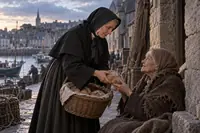
Feast day
Saint Jeanne Jugan
Some places may celebrate on a slightly different day.
August 30
Patron of
- The poor elderly
- The Little Sisters of the Poor
Often depicted with
- A begging basket
Opening
Opening
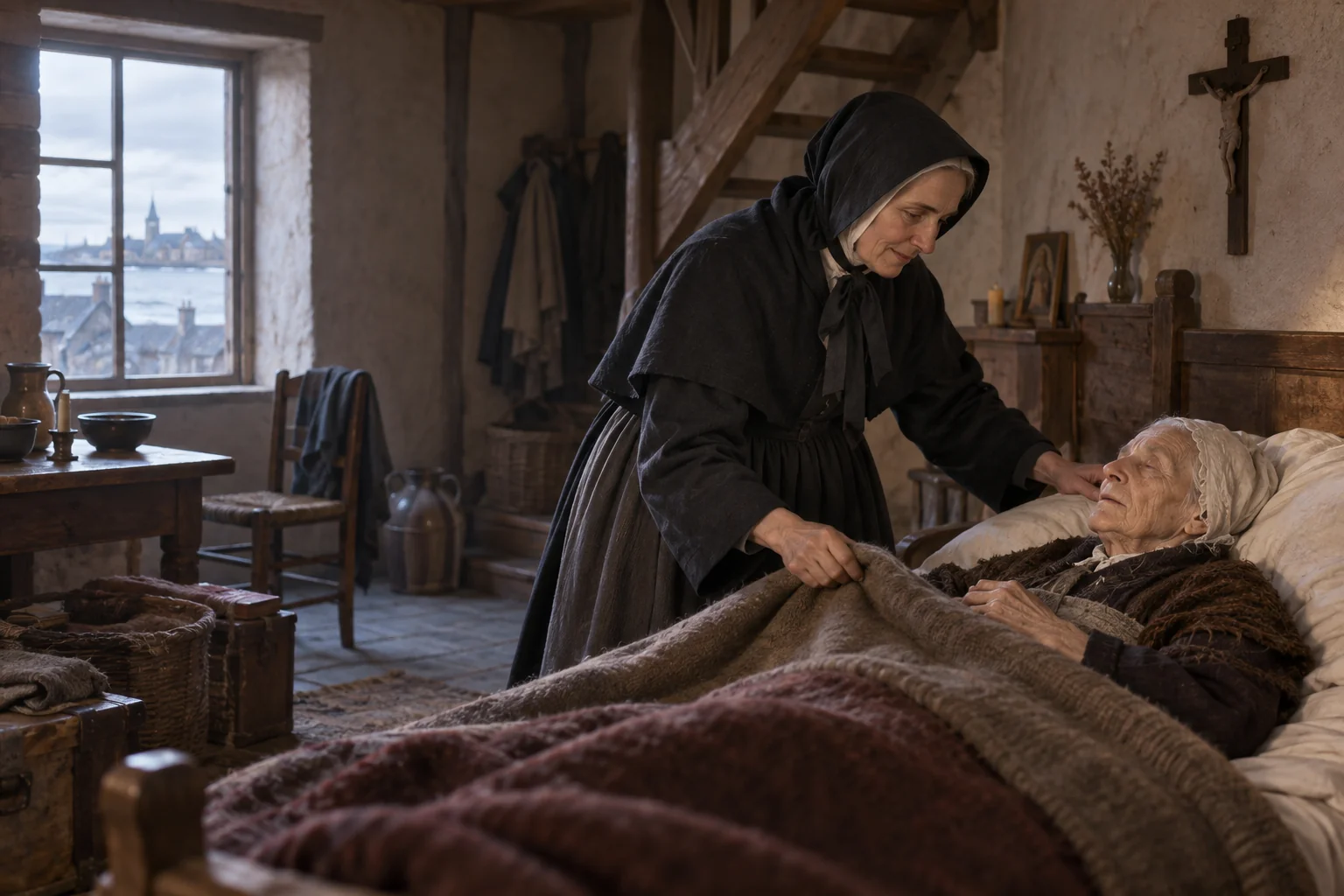
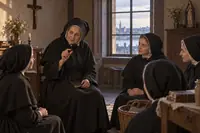
On a freezing winter night in 1839 in the town of Saint-Servan in northern France, snow lay white on the roads. An unmarried woman of forty-seven, a poor domestic servant, was sitting by the small stove in her shabby rented attic.
Someone came to tell her that a blind, paralyzed old woman named Anne Chauvin had just lost her only relative and was lying huddled in a tumbledown shack in the street, about to freeze to death.
Without a moment’s hesitation, the woman threw on her old shawl and ran out into the winter night. She lifted the thin, blind woman in her arms and carried her up the steep stairs, step by step, to her own attic.
She laid the sick woman in her only bed and covered her with a warm blanket, while she herself spread a ragged mat on the cold floor to sleep.
That shared bed was the beginning of a great work of charity: the Little Sisters of the Poor, a congregation devoted to caring for the poorest, loneliest and most abandoned elderly people.
That woman with a heart of gold was Jeanne Jugan, known in religion as Sister Mary of the Cross.
Her life is an extraordinary story of humility: she founded a congregation that spread throughout the world, then was stripped of her role as foundress by a priest and left forgotten for twenty-seven years, in complete silence and without a word of complaint.
Chapter 1 of 4
A childhood on the stormy coast of Cancale
Jeanne Jugan was born on October 25, 1792, in the fishing village of Cancale, in Brittany in northwestern France, a land where the sea feeds people and swallows them without mercy, and where women watching the sea from the cliffs in storm season became an image of the whole Breton coast. She was the sixth of eight children in a poor fishing family.
When Jeanne was only four, her father, Joseph Jugan — the captain of a fishing boat — was lost at sea in a terrible storm. No body, no grave, only the hopeless waiting of a young widow and her small children. Her gentle mother, Marie Forêt, had to rake for clams, gather shellfish and work for hire, struggling alone to feed her children at a time when the French Revolution was fiercely persecuting the Church, when practicing the faith openly could cost your life and priests had to hide and celebrate the sacraments in secret.
From an early age, Jeanne had to herd sheep and help her mother earn their bread. The girl’s faith was nourished by secret Masses said late at night in the holds of fishing boats. Hers was a faith learned not from orderly catechism classes in fine churches, but from the daring, quiet faithfulness of a small community under persecution.
At sixteen, Jeanne went into service as a maid for a devout noblewoman at a nearby manor. The lady saw the young girl’s kindness and often took her along on visits to give medicine to the poor. It was on those visits that the seed of her future mission was quietly sown, though Jeanne was then too young to realize it.
At twenty-five, a handsome, well-off young sailor asked for Jeanne’s hand. Her mother and friends urged her to accept this chance to change her life — for a poor girl of the coast, such a marriage was about the best she could dream of.
But after many nights of prayer, Jeanne firmly refused. She told her mother something that astonished everyone:
“God wants me for Himself... My work has not yet taken shape; I am being kept for a work that no one has yet done!”
No one, not even Jeanne, could imagine at that time what that work “no one has yet done” would be. She only knew to follow a vague, nameless call, trading a secure future for a wholly uncertain road.
In 1817, Jeanne left home and moved to the town of Saint-Servan. She worked at the town hospital for six years, caring for the sick poor until she was worn out. Then she worked as a servant and companion to a devout elderly woman named Mademoiselle Lecoq for twelve years, until the lady died. After nearly thirty years of quiet service, with no recognition and no savings, Jeanne reached middle age empty-handed, but with a heart shaped and ready for a mission greater than anything she had done before.
Chapter 2 of 4
An old mother’s begging basket
In the winter of 1839, taking the blind old woman Anne Chauvin into her attic threw open the door to her mission.
Before long, another frail old woman thrown out by her employer was taken in by Jeanne. Then a third, a fourth... The attic became too cramped. Jeanne and two young women who shared her vision pooled their money to rent a larger house on rue de la Fontaine, and later bought an old abandoned Augustinian convent.
A hard question arose: where would the money come from to feed dozens of frail, paralyzed old people, with no income at all?
Jeanne Jugan made a bold decision: she herself hung a wicker basket on her arm and went knocking at the door of every rich house, every shop, every army barracks and every ship in port to beg.
She did not beg for herself; she begged for the frail old people. She asked for leftover bread, a bowl of soup, an old coat, a few spare coins. Some people hurled insults at her; one man even slapped her face. Jeanne only smiled calmly and said:
“That slap was for me; now, please be kind enough to give something for my poor old people!”
Faced with such patience, the man hung his head in shame and gave her money.
The woman who had once been a country shepherd girl, who had never had any training in management or fundraising, invented a completely new form of charity on her own: she did not wait for the rich to come and give of their own accord; she went out herself, accepting humiliation, to win coin by coin for the very people society had cast aside.
She taught the sisters who worked with her:
“Look on the poor as Jesus Himself... Give the old people the very best! Make them happy; if they are cheerful, that is a sign that our service is pleasing to God!”
In 1842, that little community formally took the name Little Sisters of the Poor. Jeanne Jugan was elected the first superior.
Chapter 3 of 4
Stripped of her name: twenty-seven years in the shadows
Yet precisely as the work of charity was flourishing and had received the prestigious Prize for Virtue from the French Academy in 1845, a terribly painful trial fell upon Jeanne Jugan.
The congregation’s chaplain, Father Auguste Le Pailleur , a man who had given much legal help at the beginning but who was eaten up by pride and ambition, abused his authority.
In 1843, invoking his authority as a priest, Father Le Pailleur single-handedly removed Jeanne Jugan as superior and put a young sister in her place. Crueler still, this priest rewrote the whole history of the congregation, claiming himself to be “the sole Founder”, completely erasing Jeanne Jugan’s name and contribution.
In 1852, Father Le Pailleur ordered Jeanne Jugan to come and live at the motherhouse at La Tour Saint-Joseph, a convent tucked away in the small village of Saint-Pern in the Breton countryside. She was stripped of all authority, forbidden contact with the outside world, forbidden to take part in the congregation’s decisions, and not even allowed to go begging for the poor anymore.
Faced with that painful injustice and betrayal, what did Jeanne Jugan do?
She did not complain, did not write appeals to the bishop, did not try to rally supporters to reclaim her rights. She bowed her head in obedience, in complete silence. She accepted that humiliation as a chance to become like Christ, who emptied Himself on the Cross.
For twenty-seven years after that, from 1852 to 1879, Jeanne Jugan lived quietly as the lowliest servant at the motherhouse.
She did menial jobs: peeling potatoes in the kitchen, mending blankets and sweeping the corridors. The hundreds of young novices who came from everywhere to join the congregation each year saw that white-haired old woman sweeping and thought she was just an ordinary elderly sister, never knowing that she was the Foundress of the congregation whose habit they were wearing.
Try to imagine that feeling: living in the midst of the very work you built with your own hands, passing every day among hundreds of people carrying on your mission, and no one knowing who you are. Not one year, not ten years, but twenty-seven long years — nearly half of a person’s adult life — erased from the story of your own life.
She smiled and taught the young novices:
“Be little, very little... Love the hidden life, and do everything in the silence of love!”
Chapter 4 of 4
The truth comes to light
On August 29, 1879, Sister Mary of the Cross died peacefully, in complete poverty and silence at La Tour Saint-Joseph, at the age of eighty-six, and was buried in the cemetery of the motherhouse at Saint-Pern. By then her congregation had more than two thousand four hundred sisters serving in hundreds of homes for the elderly across Europe and the Americas — a vast work bearing another man’s name, while its true founder lay in a nameless grave.
After her death, God did not let the truth stay buried forever.
In 1890, after a rigorous investigation by the Holy See, Father Le Pailleur’s abuses of power and deceptions were brought to light. The Holy See removed him from his position and required him to withdraw to a religious house to do penance.
The true history was restored: the Church recognized Jeanne Jugan as the one true Foundress of the Little Sisters of the Poor. Today La Tour Saint-Joseph — where she quietly peeled potatoes for twenty-seven years unknown — has become her official shrine, welcoming thousands of pilgrims each year to visit the tomb of the woman once forgotten in the midst of her own work.
On October 3, 1982, Pope Saint John Paul II beatified her. On October 11, 2009, Pope Benedict XVI canonized Jeanne Jugan in Saint Peter’s Square. The Church celebrates her on August 30 each year, formerly on October 15.
Saint Jeanne Jugan leaves a lesson that should stir the conscience of our time: in a world always fighting over power, over credit and ownership, and hungry for others’ praise, her life shows how strong humility can be.
She dared to let her life, like a grain of wheat, fall into the ground and die in silent darkness for twenty-seven years. And from that hidden death, thousands of loving homes for lonely old people have borne abundant fruit across the earth.
The end of the story
You have walked with Saint Jeanne Jugan to the end of the story.
Some scenes stop you in your tracks:

On a winter night in 1839, she carried the blind old woman Anne Chauvin up to her attic, gave up her only bed and lay on a mat on the cold floor herself.
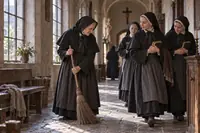
Slapped by a rude man while begging for the elderly, she only answered calmly: "That slap was for me; now, please give something for my poor old people!"
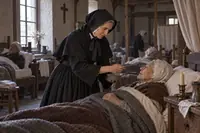
Stripped by Father Le Pailleur of her position and even her role as foundress, she quietly spent twenty-seven years peeling potatoes and sweeping corridors, without a single novice knowing she was the Foundress.
Stay in silence
What makes you think most: some people choose to let the grain of wheat of their life fall into the ground and die in silent darkness, just so that fruit may grow for others.
Love the hidden life, and do everything in the silence of love.
Let us pray
Saint Jeanne Jugan,
that winter night you carried a blind old woman home and gave up your only bed. Slapped while begging for the elderly, you only said: "That slap was for me; now give something for my old people."
Pray for lonely old people forgotten by their families. May they have someone to care for and love them.
Teach me to work humbly and quietly, even when no one remembers my efforts.
Amen.
Sources
- Feast dayAuthor’s edited profile
- Patron ofPatronages and symbols, version 1.1
- Often depicted withPatronages and symbols, version 1.1
- Reflectionpress.vatican.va
- Reflectionlittlesistersofthepoorindia.org
Meet the next one
 Journey 4