

Journey 4 · Hands That Stayed with the Suffering
Saint Frances Xavier Cabrini
A mother’s heart on the immigrant ships
Feast day November 13
Tap to step inside
Saint Frances Xavier Cabrini
A mother’s heart on the immigrant ships
Map of a life
This life told in 5 chapters
Begin the journey OpeningOpening1 min
 Chapter 1 of 5Paper-boat dreams by the Brembiolo1 min
 Chapter 2 of 5“Not to the East, but to the West!”1 min
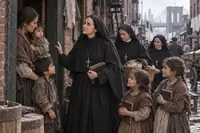 Chapter 3 of 5A mother’s hand in the Five Points slum1 min
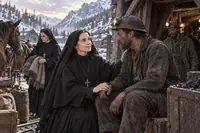 Chapter 4 of 5Tireless journeys on horseback and by train1 min
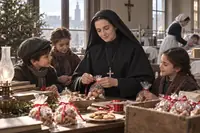 Chapter 5 of 5Her last breath beside the Christmas candy1 min
Feast day
Saint Frances Xavier Cabrini
Some places may celebrate on a slightly different day.
November 13
Patron of
- Immigrants (proclaimed in 1950)
Often depicted with
- A black habit
- The Sacred Heart
Opening
Opening
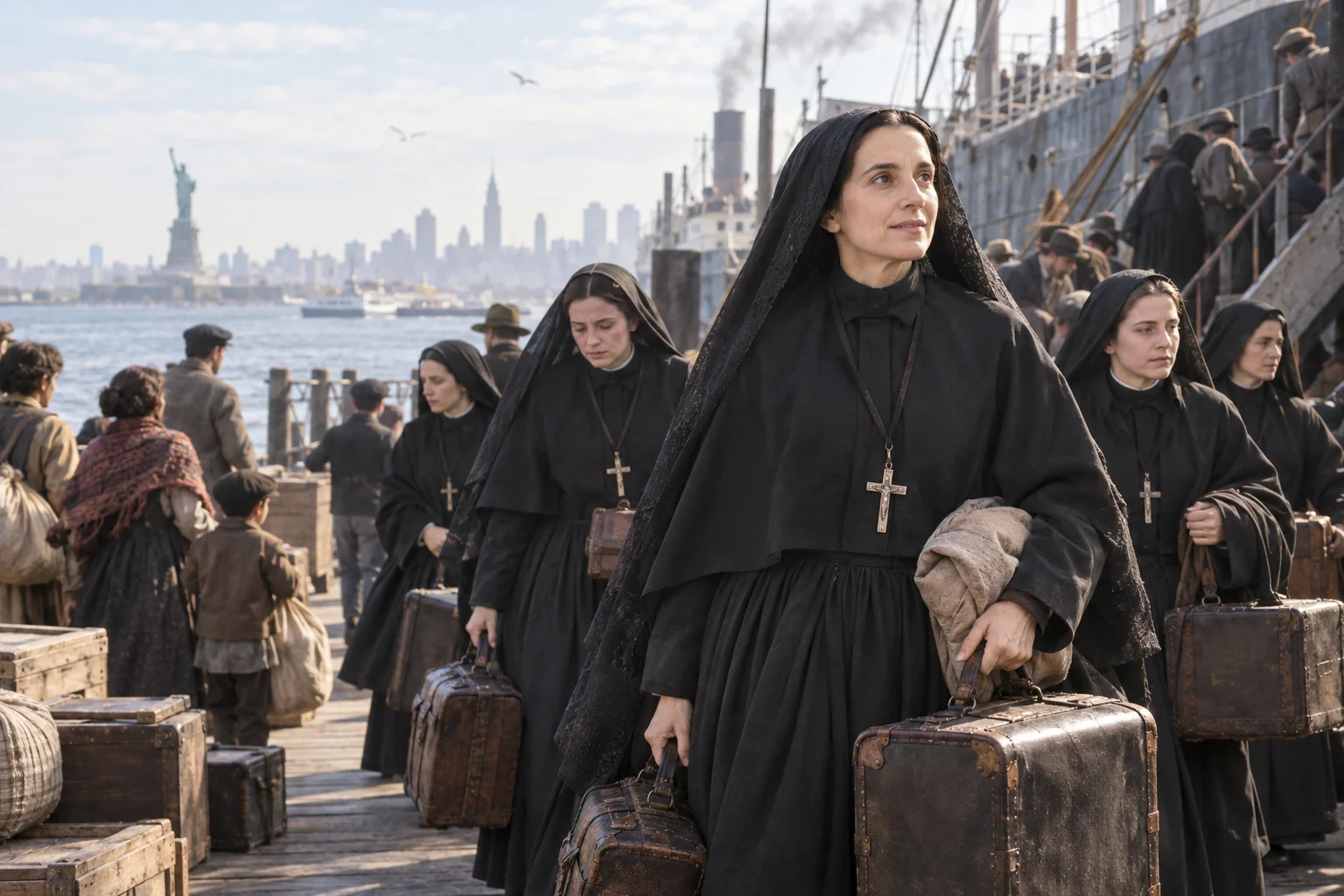
At the bustling docks of New York at the end of the nineteenth century, ocean liners from Europe arrived one after another carrying thousands of ragged, careworn people. They had left their poor homelands on the Mediterranean dreaming of a bright future in the New World. Yet what awaited them was not a life of ease, but the dark, notorious slums of Five Points, brutal exploitation in the mines, and the contempt of the native-born for poor immigrants who spoke no English.
Into that bewildered world came a small Italian woman, in frail health ever since nearly drowning as a child.
She brought no guns or gold. She brought only a heart on fire with love for the Sacred Heart of Jesus and an iron will nothing could break. Mother Frances Xavier Cabrini became the mother, protector and steady support of millions of destitute immigrants.
She crossed the Atlantic nearly thirty times, opened a network of schools, hospitals and orphanages stretching across both Americas, and became the first citizen of the United States to be canonized by the Church.
Chapter 1 of 5
Paper-boat dreams by the Brembiolo
Francesca Saverio Cabrini was born on July 15, 1850, in Sant’Angelo Lodigiano, near Milan, Italy. She was the youngest of thirteen children of Agostino Cabrini and Stella Oldini, a devout farming family. Born prematurely after her mother was startled by a flock of doves suddenly flying past, little Francesca was frail and slight from childhood. That frailty would follow her all her life, as one religious order after another turned her away because of her health.
Yet that little girl dreamed of vast horizons. Sitting by the Brembiolo river, Francesca would fold little paper boats, put wild violets in them to stand for missionaries, and set them floating downstream, dreaming of one day going all the way to faraway China to proclaim the Gospel. It was a child’s game, but also a silent prophecy of a life that would stretch across the oceans.
At eighteen, Francesca earned her primary teaching certificate. Longing to give herself to God, she applied to two orders of sisters devoted to charity, but both flatly refused her because her health was too fragile, believing she would not survive the novitiate. Twice refused, twice told in effect that her weak body was not fit for religious life: for a less determined soul, the dream might have died right there.
Undaunted, in 1874, obeying her parish priest, she went to work at a small orphanage called the House of Providence in Codogno. For six long years she patiently bore the misunderstandings and erratic temper of the woman who ran it, while forming a group of devout young women who shared her vision.
In 1880, when that orphanage had to be dissolved, the Bishop of Lodi called her and said:
“You want to be a missionary sister? I know of no order of missionary sisters that will take you, so found a new missionary institute yourself!”
Chapter 2 of 5
“Not to the East, but to the West!”
Obeying the bishop, Francesca and her first seven companions settled in an abandoned Franciscan convent in Codogno. On November 14, 1880, the Missionary Sisters of the Sacred Heart of Jesus were officially founded. She took the name “Xavier,” after Saint Francis Xavier, as a sign of a mission without borders.
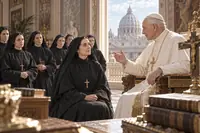
Mother Cabrini still cherished the dream of taking her sisters to China, the dream of the little girl with her paper boats. But at an audience in Rome in 1887, Pope Leo XIII looked intently at the little nun and said words that completely changed the direction of her life:
“Not to the East, Mother Cabrini, but to the West! Go to the United States, where hundreds of thousands of poor Italian immigrants are abandoned and longing for help!”
For her, the word of the Holy Father was God’s command. Mother Cabrini set aside her dream of Asia at once, without hesitation or a word of regret. Her own rejections as a young woman had taught her that one’s own will, however fervent, must give way to God’s will made known through the Church.
On March 31, 1889, she and six sisters stepped onto the docks of New York. A bitter surprise awaited them: because of earlier disagreements over money, the Archbishop of New York coldly advised the sisters to go back to Italy on the first available ship.
But Mother Cabrini answered calmly and firmly:
“Your Excellency, the Holy Father sent us here, and we cannot go back!”
Chapter 3 of 5
A mother’s hand in the Five Points slum
With no money, no English and no patron, Mother Cabrini and her sisters walked straight into the most squalid slums of New York, Five Points and Little Italy, an area that is now part of bustling Chinatown in the heart of Manhattan but was then one of the most notorious places in America for crime, poverty and disease. They rented a cramped, damp room and went door to door among immigrant families every day.
She saw mud-smeared immigrant children who did not go to school, scorned by society as inferior. She gathered them, taught them to read and write, taught them English and catechism, and taught them pride in their roots. When there was no money to feed the children, she and the sisters themselves carried baskets and begged in streets full of cold stares.
Seeing that poor immigrants had no medical care and were turned away by the big hospitals, in 1892 she boldly founded Columbus Hospital in New York.
When engineers and contractors doubted the sisters’ ability to pay, Mother Cabrini herself put on a hard hat, rolled up her sleeves and climbed the high scaffolding to inspect every brick and bargain over the price of every bag of cement. Her faith did not sit and wait for fruit to fall; it was practical, intelligent and astonishingly brave.
She often told her sisters:
“If this work were ours, it would collapse; but if it is the work of the Sacred Heart of Jesus, no power on earth or in hell can stop it!”
Chapter 4 of 5
Tireless journeys on horseback and by train
Mother Cabrini’s heart did not stop at New York. Wherever the cry of poor immigrants was heard, she went.
- She went to Chicago to open schools and hospitals;
- she went to New Orleans to care for the children of Italian workers who had just been unjustly lynched by a racist mob;
- she crossed the rugged Rocky Mountains on horseback to reach the coal mines of Colorado, climbing down into deep, endless underground tunnels to visit and comfort miners working in danger.
She crossed the ocean to Central America, crossed the snow-covered Andes on muleback to reach Argentina, and opened schools in Buenos Aires. She went as far as Brazil, Nicaragua, France, England and Spain. In twenty-eight years of service, the woman once considered “too frail” founded sixty-seven charitable institutions, including hospitals, schools, orphanages and homes for the elderly. The body twice turned away by religious orders as too fragile crossed the Atlantic nearly thirty times on rolling steamships, in an age when a sea voyage could last weeks and was full of danger.
In 1909, to belong fully to the people she served, she became a citizen of the United States.
Chapter 5 of 5
Her last breath beside the Christmas candy
Constant voyages, harsh climates and the burden of leadership wore away the last of her strength.
In the middle of December 1917, at Columbus Hospital in Chicago, Mother Cabrini was sitting at her desk, wrapping little packets of candy with her own hands as Christmas presents for the poor children of the neighborhood. Suddenly she was struck down by a return of malaria, made worse by exhaustion.
On December 22, 1917, Mother Frances Xavier Cabrini died peacefully and alone, sitting in the armchair in her office, at the age of sixty-seven.
In 1933, during the process for her canonization, her body was exhumed. Most of her relics were brought to the chapel of Mother Cabrini High School in New York, now the Shrine of Saint Frances Xavier Cabrini; her head is kept in the chapel of the congregation’s headquarters in Rome. Beneath the altar of the New York shrine, a wax figure modeled on her features lies in a glass case for pilgrims to see, while her actual remains are carefully kept in a bronze urn nearby. Also on display are everyday belongings such as her habit, her glasses and her stockings, reminding pilgrims that this great saint was first of all a human being of flesh and blood.
Pope Pius XI beatified her in 1938, and on July 7, 1946, Pope Pius XII solemnly canonized her. In 1950 she was proclaimed patron of immigrants throughout the world. The Church celebrates her on November 13 each year, formerly on December 22.
For Vietnamese people living far from home, struggling in foreign lands to make a living, Saint Frances Xavier Cabrini is a mother close at hand, someone to lean on in faith.
She teaches us that life far from home may bring countless hardships and humiliations, but if we hold firm to our faith and open our hearts to others in the same situation, we can build homes full of God’s love right there in a foreign land.
The end of the story
You have walked with Saint Frances Xavier Cabrini to the end of the story.
You keep coming back to:
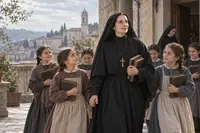
Two religious orders in a row refused her because her body was too fragile, and no one believed she could survive the novitiate.
Pope Leo XIII looking at the little nun and saying: "Not to the East, Mother Cabrini, but to the West! Go to the United States!"
When contractors doubted the sisters could pay, she herself put on a hard hat and climbed the high scaffolding to inspect every brick of Columbus Hospital.
Stay in silence
Looking back over that road, you see: the woman twice told she was too frail to give herself to God later crossed the Atlantic nearly thirty times on rolling ships.
If this work were ours, it would collapse; but if it is the work of the Sacred Heart of Jesus, no power on earth or in hell can stop it!
Let us pray
Saint Frances Cabrini,
you were once told you were too weak for religious life, yet you crossed the Atlantic nearly thirty times to care for poor immigrants.
You are the patron of immigrants. Pray for Vietnamese people working and studying far from home, that they may be safe, keep their faith and not be exploited.
Pray for families who must live apart to make a living.
Amen.
Sources
- Feast dayAuthor’s edited profile
- Patron ofPatronages and symbols, version 1.1
- Often depicted withPatronages and symbols, version 1.1
- Reflectioncabriniworld.org
- Reflectionmothercabrini.org
Meet the next one
 Journey 4