

Journey 4 · Hands That Stayed with the Suffering
Saint Josephine Bakhita
A flower of freedom blooming from chains
Feast day February 8
Tap to step inside
Saint Josephine Bakhita
A flower of freedom blooming from chains
Map of a life
This life told in 6 chapters
Begin the journey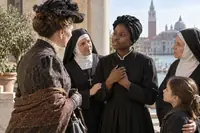 OpeningOpening1 min
 Chapter 1 of 6Terror in the forest of Olgossa1 min
 Chapter 2 of 6Twelve years in hell on earth1 min
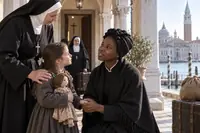 Chapter 3 of 6Italy, and meeting the Most High1 min
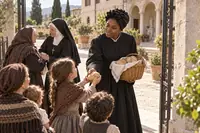 Chapter 4 of 6The “Black Mother” of Schio1 min
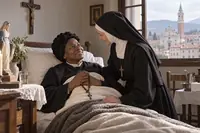 Chapter 5 of 6A last prayer beside the iron chains1 min
- Chapter 6 of 6A patron saint of freedom and forgiveness1 min
Feast day
Saint Josephine Bakhita
Some places may celebrate on a slightly different day.
February 8
Patron of
- Sudan
- Victims of human trafficking (February 8 is the World Day of Prayer against Human Trafficking)
- Those who have been enslaved
Often depicted with
- Broken chains
- The Canossian habit
Opening
Opening
If anyone has tasted the full savagery that human beings can inflict on one another, it is Josephine Bakhita.
She was kidnapped at the age of eight, marched hundreds of kilometers across the desert with a chain around her neck, and sold like merchandise from one master to another, five in all. Her body bore more than one hundred and forty deep scars from beatings and from the cruel custom of cutting and marking slaves’ skin.
Yet what astonishes the world is not the wounds on her body but the complete freedom of her soul.
Once she was asked, “If you met the slave traders who kidnapped and tortured you so savagely, what would you do?” She smiled gently and answered:
“I would kneel down and kiss their hands, because if those sufferings had not happened, I would never have known Christ and never have become a Christian!”
From the darkness of brutal slavery she stepped into the light of true freedom. Today she is honored as a witness to forgiveness and the patron saint of victims of human trafficking throughout the world.
Chapter 1 of 6
Terror in the forest of Olgossa
Bakhita was born around 1869 in the small village of Olgossa, in the Darfur region of western Sudan in Africa. She belonged to the Daju people, and grew up in a warm, happy farming family with her parents, brothers and sisters.
No one knows her real childhood name. One morning in 1877, when she was about eight and playing alone in a field near the village, she was seized by two armed Arab slave traders who gagged her and dragged her deep into the forest.
The terror was so great that the child forgot her own name and the names of her parents. Imagine it: a little girl robbed not only of her family and her freedom but of her very name, the last thread tying her to where she came from. Seeing her weep, the kidnappers mockingly called her “Bakhita,” Arabic for “the lucky one.”
It was a cruel joke from the very men who had taken everything from her, yet in God’s mysterious plan the name would one day come true.
Chapter 2 of 6
Twelve years in hell on earth
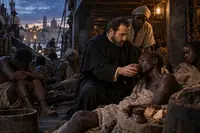
For the next twelve years Bakhita lived the wretched life of a slave. She was sold from master to master in El Obeid and Khartoum, Sudanese cities that were major hubs of the slave trade across the Sahara and the Red Sea, where tens of thousands of Africans were stripped of their dignity every year throughout the nineteenth century.
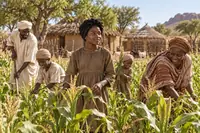
Her fourth master was a Turkish army general notorious for his cruelty. In his household, Bakhita and the other slave women were subjected to a barbaric form of “tattooing”: a razor was used to make hundreds of deep cuts on her chest, belly and arms, and then salt and gunpowder were rubbed into the open wounds so that the scars would stand out forever.
For more than a month Bakhita lay motionless on a ragged mat between life and death, with more than one hundred and forty bleeding wounds. Years later, when she was an old nun, the sisters who helped her wash or dress could not help shuddering at her back and arms, crisscrossed with raised scars, the silent proof of a stolen childhood.
In 1883, when the Turkish general had to return home, he sold Bakhita to Callisto Legnani, the Italian consul in the capital, Khartoum.
For the first time after so many years of torment, Bakhita found herself, trembling, in a household with no whips and no curses. The kind consul and his friend Augusto Michieli treated her with respect and kindness.
Chapter 3 of 6
Italy, and meeting the Most High
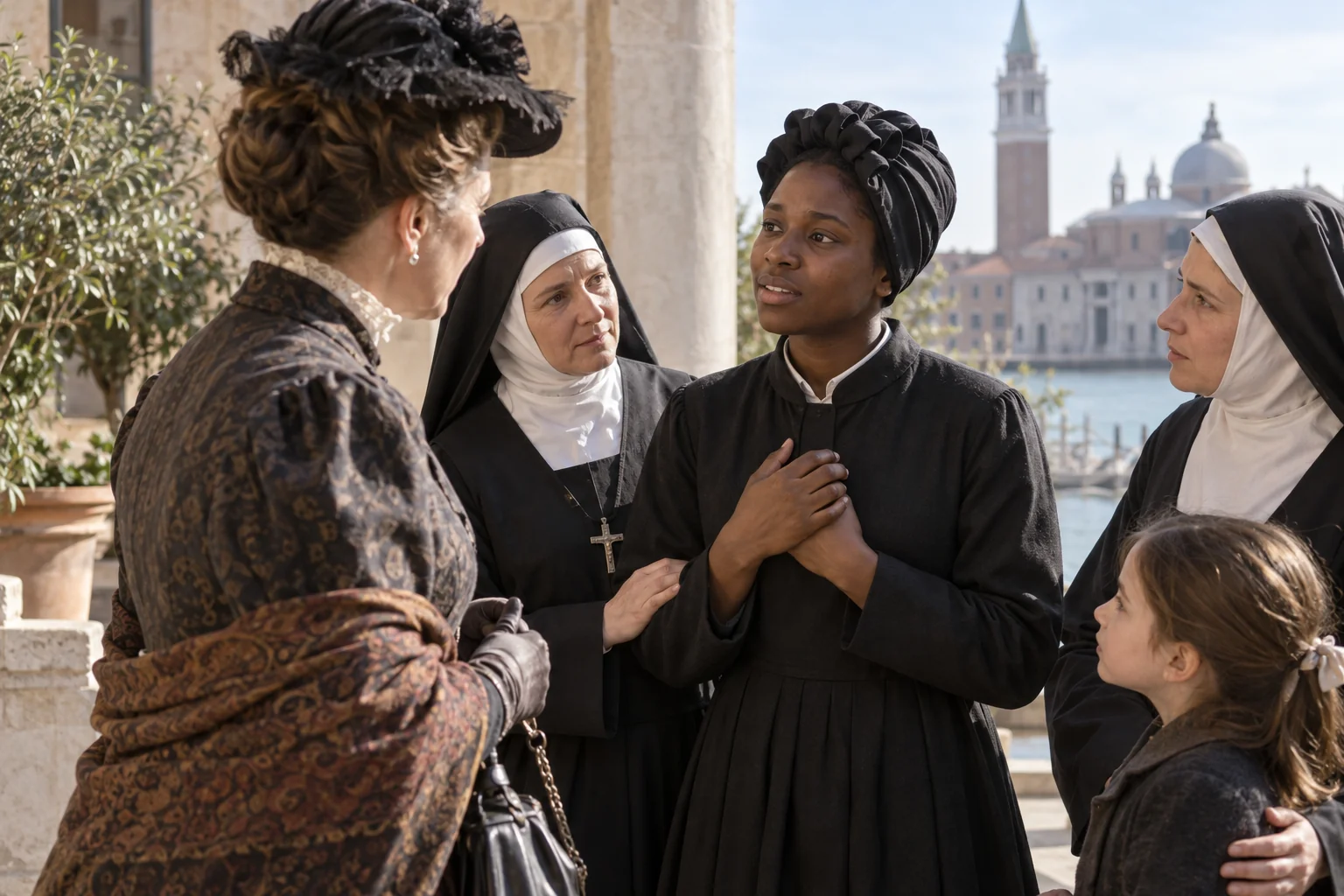
In 1885, because of the uprising in Sudan, Consul Legnani took Bakhita, along with the Michieli family, on a ship back to Italy. In the town of Zianigo near Venice, Bakhita was given the job of nanny to the Michielis’ little daughter, Mimmina.
In 1888, when the Michielis had to go back to Africa to run a large hotel, on the advice of their steward they left Bakhita and little Mimmina as boarders at the convent of the Canossian Daughters of Charity in Venice.
In this convent a whole new world opened up for the young African woman.
For the first time in her life, Bakhita learned the catechism from the sisters and heard about God, the loving Creator. She gazed, moved, at the great crucifix in the chapel as she heard the story of the Son of God who had also been stripped, cruelly scourged and crucified out of love for us. For someone whose own body bore hundreds of scars, that image was no distant theological idea. It touched her to the core.
She exclaimed:
“Since I was a child, looking at the sun, the moon and the stars glittering in the desert sky, I wondered who had made those wonderful beauties... And now I have found Him: He is the Most High!”
When Mrs. Michieli came back from Africa and went to the convent to take Bakhita back as her slave, Bakhita bravely refused. She said she wanted to stay in the convent and serve God.
The case was brought before the royal court of Italy. On November 29, 1889, came a landmark ruling: Italian law did not recognize slavery, and from the day she set foot on Italian soil, Bakhita had been legally free.
Chapter 4 of 6
The “Black Mother” of Schio
On January 9, 1890, Bakhita was joyfully baptized in the cathedral of Venice, taking the baptismal name Josephine Margaret Fortunata, Giuseppina Margherita Fortunata.
In 1893, answering God’s call, she entered the novitiate of the Canossian Daughters of Charity. On December 8, 1896, in Verona, the former slave made her perpetual vows.
In 1902, Sister Josephine Bakhita was sent to the Canossian convent in the small town of Schio, in the province of Vicenza in northern Italy. She spent the remaining forty-five years of her life in this peaceful place.
Sister Bakhita did the humblest jobs: cooking, sewing, and above all keeping the convent door. With her ever-present radiant smile, her warm, deep voice and her kind eyes, she became a loving support to the whole town. People affectionately called her “Madre Moretta,” the dear Black Mother.
After school, children ran chattering to gather around her so she would lay her work-worn hand on their heads in blessing; the poor who came begging received a share of her bread; and families in trouble came to her for comfort.
Through the First and Second World Wars, when bombs devastated northern Italy, Schio was spared, and not a single resident was killed. The townspeople were convinced that the prayers of their “Black Mother” had protected them.
Chapter 5 of 6
A last prayer beside the iron chains
In her last years, arthritis and asthma tormented her so badly that Sister Bakhita had to use a wheelchair.
In her feverish delirium, terrifying memories of her years as a child slave came flooding back. She whispered to the sisters caring for her:
“Please loosen the chains a little... they hurt me so much!”
Seventy years had passed since she was kidnapped, but invisible chains still gripped the memory of a woman who had lived most of her life in freedom and peace.
Yet when a sister gently reminded her: “Mother Bakhita, today is Our Lady’s day!”, she suddenly became lucid again and smiled radiantly:
“Yes, that’s right! I am going to Our Lady!”
On the evening of February 8, 1947, Sister Josephine Bakhita died peacefully at the convent in Schio, at the age of seventy-eight.
Tens of thousands of people from all over the Veneto came to pay their respects. They were astonished to find that her body stayed supple, her joints flexible, and that she looked beautiful and at peace.
Chapter 6 of 6
A patron saint of freedom and forgiveness
Pope John Paul II beatified her on May 17, 1992, and on October 1, 2000, he canonized Josephine Bakhita in Saint Peter’s Square. Today her relics rest in a bronze and crystal urn in the church of the Holy Family beside the Canossian convent in Schio. Next to it, the small room where she lived has been kept as it was, with her simple belongings, and is now a little museum in her name. Thousands of pilgrims from all over Europe come to pray there and learn how she went from slavery to sainthood.
The Church chose her feast day, February 8, as the “World Day of Prayer and Awareness against Human Trafficking,” a fitting choice, since trafficking still thrives in many hidden forms today.
Saint Josephine Bakhita shows us that chains can wound the body but can never imprison a soul turned toward God.
She reminds each of us that true forgiveness is not a cowardly forgetting of wrong. It is the great power that frees us from the prison of hatred, so that we can walk as free people in God’s love.
The end of the story
You have walked with Saint Josephine Bakhita to the end of the story.
Some details you keep coming back to:
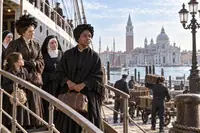
Kidnapped at seven, the little girl was so terrified that she forgot her own name, and her kidnappers mockingly called her "Bakhita," the lucky one.
In the Turkish general’s house she endured the "tattooing": hundreds of deep razor cuts in her chest, belly and arms, with salt and gunpowder rubbed into the wounds.
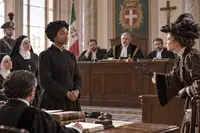
Asked what she would do if she met her kidnappers again, she smiled and said she would kneel and kiss their hands, because through that suffering she had come to know Christ.
Stay in silence
Your heart sinks, and then you realize: chains can leave a hundred scars on the flesh, but they can never imprison a soul that has chosen to forgive.
Without that suffering, I would never have met the One who turned suffering into freedom.
Let us pray
Saint Josephine Bakhita,
you were kidnapped at seven, sold as a slave, and your body was cut hundreds of times. Yet you said that if you met your kidnappers again, you would kneel and kiss their hands, because through all this you came to know God.
Pray for those who are trafficked, exploited and forced into labor. May they be set free and healed.
Teach me to forgive, so that my heart may be free like yours.
Amen.
Sources
- Feast dayAuthor’s edited profile
- Patron ofPatronages and symbols, version 1.1
- Often depicted withPatronages and symbols, version 1.1
- Reflectioncausesanti.va
- Reflectioncanossian.org
Meet the next one
 Journey 4