

Journey 4 · Hands That Stayed with the Suffering
Saint Peter Claver
Forever the slave of the slaves
Feast day September 9
Tap to step inside
Saint Peter Claver
Forever the slave of the slaves
Map of a life
This life told in 5 chapters
Begin the journey OpeningOpening1 min
 Chapter 1 of 5A son of Catalonia and the prophecy of Saint Alphonsus Rodriguez1 min
 Chapter 2 of 5“Speak with your hands before speaking with your lips”1 min
 Chapter 3 of 5Forty years and three hundred thousand souls1 min
 Chapter 4 of 5Loneliness and ingratitude at the end1 min
 Chapter 5 of 5The triumph of a great slave2 min
Feast day
Saint Peter Claver
Some places may celebrate on a slightly different day.
September 9
Patron of
- Missions to Black peoples (proclaimed in 1896)
- Colombia
- Human rights
Often depicted with
- A slave ship
- A cup of water given to the thirsty
Opening
Opening
In the seventeenth century, the port city of Cartagena, in present-day Colombia, was the busiest and most brutal center of the African slave trade in the Caribbean, and one of the cruelest ports in the whole Spanish colonial empire.
Every year, tens of thousands of Black Africans were kidnapped and crammed into stifling ship holds like animals. On a voyage of two or three months across the Atlantic, they lay packed together amid excrement, urine, maggots and the bodies of those who had died of disease. More than a third died before the ships reached port.
When those death ships docked at Cartagena, the survivors were dragged ashore: emaciated bodies of skin and bone, covered in foul sores, their eyes wild with terror.
Right in the middle of that hell on earth, a Spanish Jesuit priest appeared.
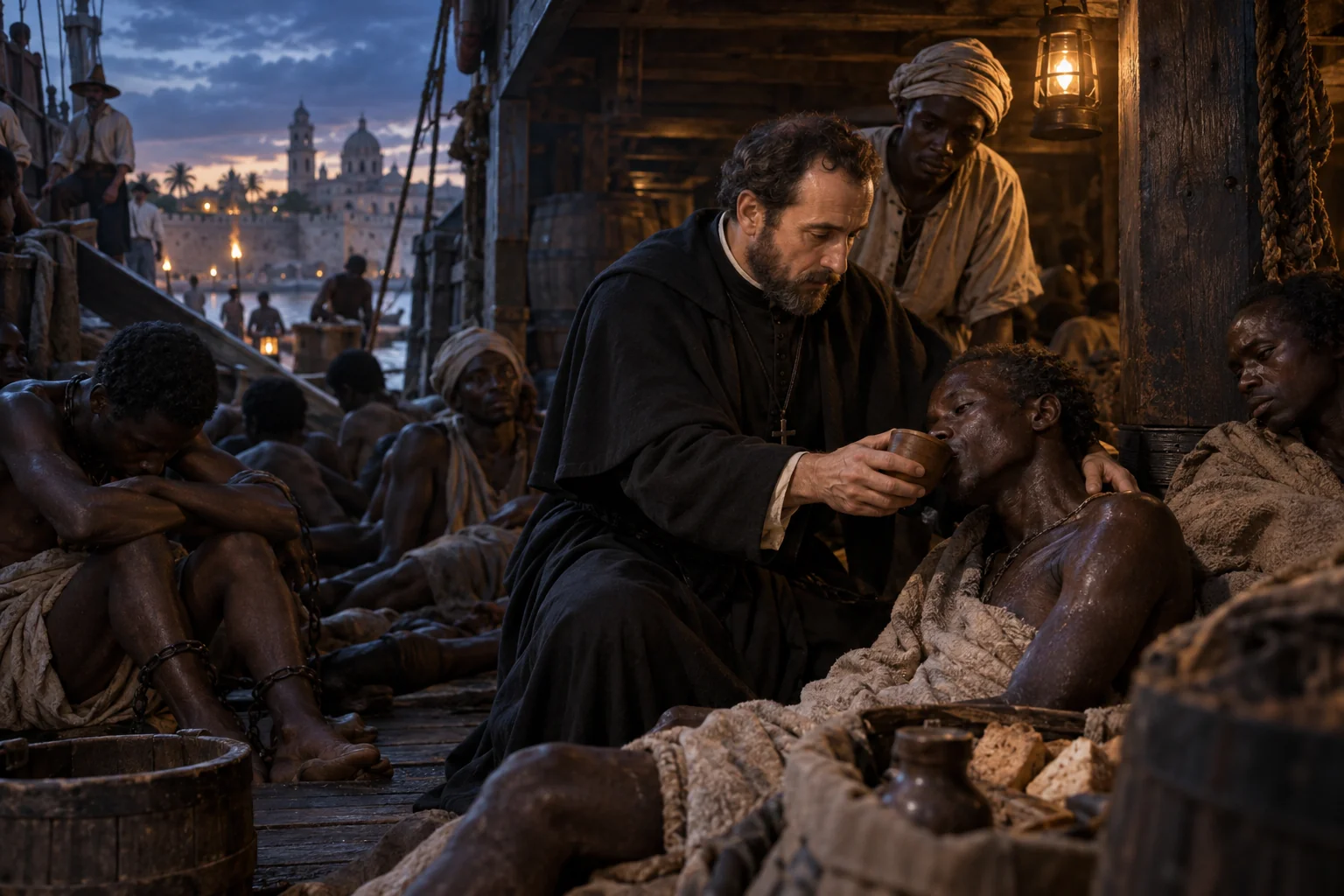
He did not stand on the shore holding his nose in disgust, nor preach empty moral lessons from a distance. He rushed straight down into those holds reeking of death, held the filthy bodies tight in his arms, washed every wound, shared every piece of bread, and made a vow that history remembers:
“Peter Claver, slave of the Black slaves forever!”
Chapter 1 of 5
A son of Catalonia and the prophecy of Saint Alphonsus Rodriguez
Pedro Claver Corberó was born on June 26, 1580, in the town of Verdú, in Catalonia, Spain. His parents, Pedro Claver and Ana Corberó, were prosperous, devout farmers.
As a young man, Peter studied at the renowned University of Barcelona and graduated with distinction in letters and philosophy. At twenty-two, he formally entered the Society of Jesus.
In 1605, Brother Peter Claver was sent to the college of Montesión on the island of Majorca to continue his studies in philosophy. There a meeting changed his life: he became close friends with Brother Alphonsus Rodriguez, an elderly lay brother who kept the door of the college and was full of the wisdom of God.
Recognizing the hidden apostolic fire in the young student, old Brother Alphonsus Rodriguez many times looked deep into Peter Claver’s eyes and spoke words that sounded like a prophecy:
“Brother Peter, why are you here? So many poor souls in the lands of the New World in the Americas are being lost for want of someone to proclaim the Gospel! Go to the Americas, Brother Peter! A rich harvest is waiting for you there!”
Those words set Peter Claver’s heart on fire. He asked his superiors to send him to the missions in the Americas. That elderly doorkeeper, whom the Church would later canonize on the same day as his young student, probably never imagined that his simple encouragement would sow the seed of one of the greatest lives of charity in the history of the Church.
In 1610 he set sail, leaving his Spanish homeland for New Granada, present-day Colombia. He completed his theological studies in Bogotá and was ordained a priest in Cartagena in 1616, at thirty-six.
Chapter 2 of 5
“Speak with your hands before speaking with your lips”
Right after his ordination, Father Peter Claver made the port of Cartagena the one field of his whole apostolate. He saw with his own eyes the tragedy of the African slave trade, a monstrous crime kept alive by the colonizers’ bottomless greed.
Whenever he saw the sails of a slave ship appear on the horizon, Father Peter Claver rowed out at once in a small boat to meet it; he wanted to be the first kind face those wretched people saw in the New World, before they came face to face with the slave traders and plantation owners.
He took along a team of interpreters who spoke many different African languages, slaves he had bought free and trained. He brought baskets of bread, fresh fruit, lemons, wine, medicine and tobacco.
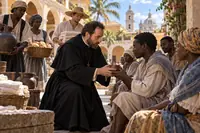
Going down into the dark holds whose stench would make an ordinary person faint, Father Peter Claver did not hesitate to kneel beside the groaning slaves. He fed them soup spoonful by spoonful with his own hands, washed the excrement, pus and blood from their bodies with warm cloths, and bandaged the wounds where iron chains had cut deep into their flesh.
He picked up dying newborns from the breasts of their dead mothers and baptized them in haste.
He told his co-workers:
“We must speak to them with the hands of care before we speak to them with the lips of teaching!”
Through those tender gestures of a father and a gentle mother, the hearts of the slaves, full of hatred and fear, melted. They realized that this man in a black habit was not a cruel white slave trader, but an angel sent by God to help them.
Chapter 3 of 5
Forty years and three hundred thousand souls
After caring for their bodies, Father Peter Claver used large pictures of God, of Jesus on the Cross, of heaven and hell, to patiently teach them the truths of the faith through his interpreters.
He taught them that though their bodies were imprisoned in the chains of human slavery, their souls were free, and they were children infinitely precious in God’s sight.
After they had been carefully prepared, he baptized them. In nearly forty years of tireless service in Cartagena, Father Peter Claver baptized more than three hundred thousand Black slaves with his own hands.
He gave each one a small metal medal to wear around the neck, engraved with the holy names of Jesus and Mary, urging them always to live honestly and keep their human dignity.
Nor did he stop at the port. Every year in the dry season Father Peter Claver walked thousands of kilometers to plantations and gold and silver mines deep in the jungle to visit the slaves he had known.
He slept in their tumbledown huts and ate their meager food with them. He bravely intervened with cruel plantation owners, demanding humane treatment for the enslaved workers.
He also spent time caring for lepers at the San Lázaro leper hospital outside the city, washing and bandaging with his own hands bodies rotting with the disease, their fingers eaten away.
Chapter 4 of 5
Loneliness and ingratitude at the end
Such self-giving met bitter opposition and slander in his own day: the nobility and slave merchants of Cartagena hated him because he dared to defend the rights of Black people; many clergy and religious of the time also criticized him as “eccentric”, claiming he lowered the dignity of the priesthood by spending all day among smelly slaves and defiled the church by letting Black people sit on the same benches as white people.
Yet Father Peter Claver calmly accepted all those insults in silence.
In 1650, on a pastoral journey in the countryside, Father Peter Claver fell gravely ill with the plague. He narrowly escaped death, but was left paralyzed, his hands shaking violently and useless.
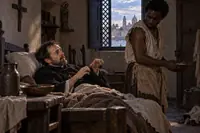
His last four years, from 1650 to 1654, were four years of silent and painful martyrdom in a small, cramped room on an upper floor of the Jesuit house in Cartagena.
The man who had carried thousands of sick people was now forgotten. The community entrusted him to the care of a young Black slave. This servant was rough and heartless, often left him without food all day, let him lie in filth, and even insulted and beat the paralyzed old priest.
It is an irony that chills the heart: the priest who had spent his whole life washing, bandaging and defending hundreds of thousands of slaves lay helpless at the end of his life under the abusive hands of the very kind of person he would once have rescued.
Yet in four years of mistreatment, Father Peter Claver never once complained about or reproached the one caring for him. He accepted all that pain as an offering of reparation to God.
Chapter 5 of 5
The triumph of a great slave
At the beginning of September 1654, when news spread through the city that Father Peter Claver was dying, the city was shaken. People suddenly remembered the greatness of the apostle they had long forgotten.
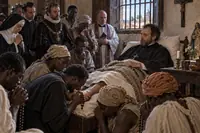
The people of Cartagena poured into the house by the thousands, from officials and clergy to tens of thousands of Black slaves. They crowded into his little room, kneeling to kiss his paralyzed feet and touching their rosaries to his body.
At dawn on September 8, 1654, the feast of the Nativity of Our Lady, Father Peter Claver died peacefully and went home to God, at the age of seventy-four.
Cartagena had never seen a funeral like it: the city council, the very people who had once opposed him, decided to give him a state funeral at public expense. The slaves wept bitterly as they said goodbye to the only father and protector they had ever known.
Pope Pius IX beatified him in 1850, and on January 15, 1888, Pope Leo XIII solemnly canonized Peter Claver, on the same day as Saint John Berchmans and his old friend Saint Alphonsus Rodriguez.
In 1896 he was proclaimed patron of all missions to Black peoples throughout the world. The Church celebrates him on September 9 each year. His body now rests in an illuminated glass case beneath the main altar of the church bearing his name in Cartagena, and the adjoining house has become a museum displaying the history of the slave trade along with African and Indigenous cultural heritage. The very place where he served and endured his last years has become a living memorial, reminding later generations of both the crime and the mercy that once existed side by side there. In May 2022, the Church also dedicated a new, more solemn tomb to honor him, more than three hundred and sixty years after his death.
Saint Peter Claver leaves the world a lasting example of Christian charity: he did not just give the poor what he could spare; he gave his whole self, becoming “the slave of the slaves”.
He showed that before God, no skin color is inferior and no human condition is worthless. Every human being is redeemed by the same priceless blood of Jesus Christ.
The end of the story
You have walked with Saint Peter Claver to the end of the story.
A few images keep returning to your mind:
Whenever he saw the sails of a slave ship on the horizon, he rowed out in a small boat to meet it first, to be the first kind face those wretched people saw in the New World.
He knelt in the stinking hold, feeding soup spoonful by spoonful with his own hands, washing away pus and blood and bandaging wounds where iron chains had cut into the slaves’ flesh.
In his last four paralyzed years, he was starved, insulted and beaten by the very slave assigned to care for him, without a word of complaint.
Stay in silence
The more you read, the more it sinks in: the vow "slave of the slaves" was not a fine phrase, but a whole life spent kneeling to wash bodies treated as worthless.
We must speak to them with the hands of care before we speak to them with the lips of teaching.
Let us pray
Saint Peter Claver,
you rowed out to meet every slave ship, went down into the stinking holds to feed and bandage those in chains. You called yourself "the slave of the slaves".
Pray for those who are treated as objects and not as human beings.
Teach me to bend down and serve those whom society values least, and to bear it without complaint when I myself am treated badly.
Amen.
Sources
- Feast dayAuthor’s edited profile
- Patron ofPatronages and symbols, version 1.1
- Often depicted withPatronages and symbols, version 1.1
- Reflectionjesuits.global
- Reflectionjesuits.org
Meet the next one
 Journey 4