

Journey 4 · Hands That Stayed with the Suffering
Saint Martin of Tours
Half a cloak
Feast day November 11
Tap to step inside
Saint Martin of Tours
Half a cloak
Map of a life
This life told in 10 chapters
Begin the journey OpeningOpening1 min
 Chapter 1 of 10A soldier named after the god of war1 min
 Chapter 2 of 10Half a cloak1 min
 Chapter 3 of 10“I am a soldier of Christ”1 min
 Chapter 4 of 10Hermit and teacher1 min
 Chapter 5 of 10The bishop who hid among the geese1 min
 Chapter 6 of 10The sacred pine and the leper at the gate of Paris2 min
 Chapter 7 of 10The man who would not let anyone be killed for their beliefs1 min
 Chapter 8 of 10Saint Martin’s summer1 min
 Chapter 9 of 10November 111 min
 Chapter 10 of 10Our own half cloak1 min
Feast day
Saint Martin of Tours
Some places may celebrate on a slightly different day.
November 11
Patron of
- Soldiers and cavalrymen
- Beggars and the poor
- France
Often depicted with
- A cloak cut in two
- A horse
- A goose
Opening
Opening
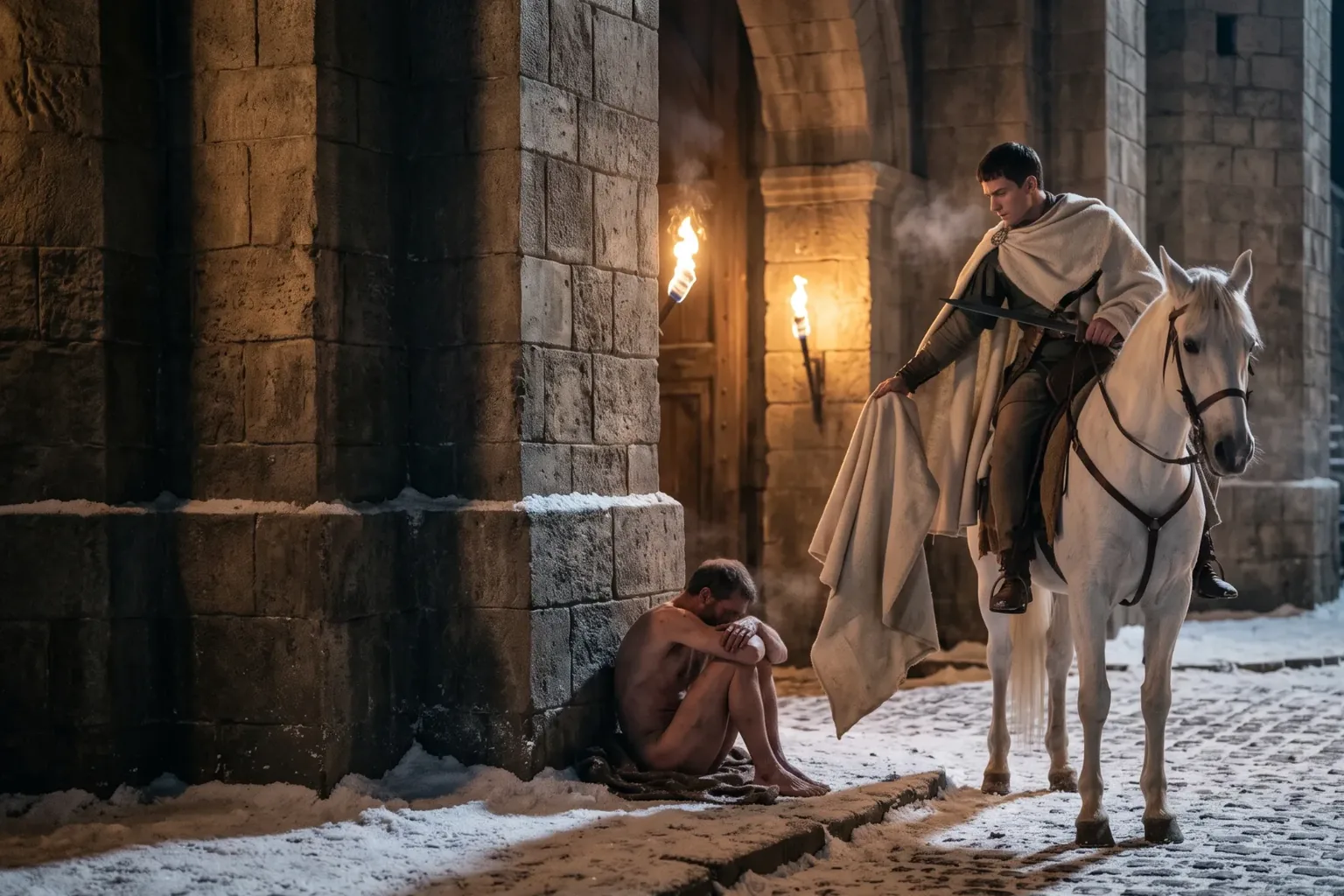
One winter night around the year 337, at the city gate of Amiens in northern Gaul, the wind was so cold that the records of the time say many people froze to death. A beggar, almost naked, sat huddled by the gate, pleading with those who passed by. People stepped past him; no one stopped.
Then a young soldier rode up. He had no money with him, for he had already given it all away. All he had left was his uniform and his cloak. He drew his sword, cut the cloak in two, gave one half to the beggar, threw the other half over his own shoulders and rode on. Some bystanders laughed and mocked the ridiculous sight of a soldier wearing half a cloak.
That night, the soldier dreamed he saw Jesus wearing the very half cloak he had just given away, saying to the angels around Him: “Martin, who is still a catechumen, has clothed Me with this cloak.”
That young soldier was Martin. He had not yet been baptized. And his half cloak would later leave its mark on the language of hundreds of millions of people, in a way no one would have guessed.
Chapter 1 of 10
A soldier named after the god of war
Martin was born around 316 in Savaria, in Pannonia, now the city of Szombathely in western Hungary. His father was a senior officer in the Roman army, a pagan, who named his son after Mars, the Roman god of war. “Martinus” means “belonging to Mars”. The name shows that his father hoped his son would follow him into the army.
The family moved to Pavia, in northern Italy, where his father received land when he left the army. It was there that the boy Martin met Christians. At ten he went to the church of his own accord to ask to learn the faith, against his parents’ wishes. At twelve he dreamed of going into the desert to live like the hermits he had heard about.
But Roman law at the time required the sons of veterans to serve in the army. At fifteen, he was reported by his own father, arrested, put in chains and enrolled in the cavalry. A boy who wanted to be a hermit now wore armor and rode a warhorse.
His biographer, Sulpicius Severus, a Gallic nobleman and lawyer who knew him personally, tells that even in the army Martin lived like a monk. He kept only one servant, and it was usually Martin who pulled off and cleaned his servant’s boots, and the two ate at the same table. He did not get drunk like his comrades, nor bully civilians. His comrades both respected him and found him strange.
Sulpicius’s life was written while Martin was still alive, and is one of the first saints’ lives of the Western Church. Thanks to it, there are few fourth-century saints whose everyday details we know so well.
Chapter 2 of 10
Half a cloak
The story at the gate of Amiens is the most famous story about Martin, painted, carved and told to children all over Europe for sixteen centuries.
Some ask: why didn’t he give the whole cloak? One explanation often mentioned is that under the rules of the time, half of a soldier’s equipment belonged to the army and the other half was his own; Martin gave the poor man the whole of the part that belonged to him. That explanation is not in the ancient life, but it shows how people wanted to understand the gesture as a complete giving of everything he had the right to give.
As for the dream that night, Sulpicius says it did not make Martin proud, but made him understand one thing: the beggar at the city gate was Christ Himself. He remembered the Lord’s words: “Whatever you did for one of these least brothers of Mine, you did for Me.” Not long afterward he asked to be baptized; he was about eighteen that year.
The other half of Martin’s cloak, according to tradition, was kept as a precious relic. The Frankish kings of the Middle Ages took it with them into battle and appointed a priest especially to look after it. A cloak in Latin is “cappa”; since only half remained, people called it “cappella”, the little cloak. The place where that little cloak was kept was also called “cappella”, and the priest who kept it was called “cappellanus”.
From that come the words “chapel” in English and “chapelle” in French, meaning a small place of worship; and the word “chaplain”. Every time someone in the world says “chapel” or “chaplain” in those languages, they are recalling, without knowing it, the half cloak of a young soldier at the gate of Amiens.
Chapter 3 of 10
“I am a soldier of Christ”
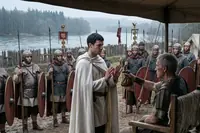
Martin stayed in the army a few more years after his baptism. In 356 the Roman army was preparing to fight the Germanic tribes near Worms, on the Rhine. As was the custom before a battle, the commanding general, Julian — who later became emperor and is famous for wanting to restore the worship of the pagan gods — handed out bonuses to the soldiers.
When his turn came, Martin refused the money. He said to the general: “Until now I have served you. From now on let me serve God. Give the bonus to those who are going into battle. I am a soldier of Christ; I am not allowed to fight.”
Julian grew angry and called him a coward, afraid of death and using religion as an excuse. Martin answered that if people thought he was afraid, then tomorrow he would stand in the front line of the battle, without weapons, without a shield, holding only the sign of the cross, and walk straight into the middle of the enemy. Julian had him locked up to test his words the next day.
But the next morning, according to Sulpicius, the Germanic tribes unexpectedly sent envoys to ask for peace, surrendering themselves and all their goods. The battle never took place. Martin was discharged from the army.
He is one of the first people in Christian history known for refusing to bear arms for reasons of conscience. And, ironically, he later became the patron saint of soldiers.
Chapter 4 of 10
Hermit and teacher
Leaving the army, Martin went to Saint Hilary, bishop of Poitiers, one of the greatest theologians of the time, and asked to become his disciple. Hilary wanted to make him a deacon, but Martin humbly declined, accepting only the order of exorcist, a lower rank of the clergy in ancient times.
He went back to Pannonia to visit his parents, and won his mother over to the faith, though not his father. On the way, he was stopped by robbers in the Alps; one raised an axe to strike him, but Martin talked him round, and according to the story that robber later became a believer. He was beaten and driven out by followers of the Arian heresy. At one time he lived alone on a small island off the coast of Italy, eating roots, and nearly died from eating a poisonous plant.
Around 361, Martin returned to Gaul and founded a community of hermits at Ligugé, near Poitiers. It was the first known monastery in Gaul, today’s France. The Abbey of Ligugé still stands, more than sixteen hundred years later, and Benedictine monks still pray there.
Chapter 5 of 10
The bishop who hid among the geese
In 371 the bishop of Tours died. The people wanted Martin, by then famous throughout the region for his holy life and miracles of healing, to become their bishop. But they knew he would not agree.
So, according to Sulpicius, they used a trick: a man from Tours came to Ligugé, knelt and said that his wife was dying, begging him to come and pray. Martin set out at once. When he reached Tours, he found a whole crowd waiting, and realized he had been tricked.
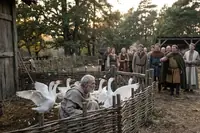
Popular tradition adds a detail that Sulpicius does not record: Martin hid in a goose pen. But the geese honked so loudly that they gave away his hiding place. He had no choice but to become bishop. From that story comes the custom in many European countries of eating roast goose on Saint Martin’s day, November 11, as a way of “punishing” the geese that betrayed the saint.
Once a bishop, Martin still would not live in the bishop’s house. He founded a monastery at Marmoutier, a few kilometers from Tours across the Loire, living in a wooden hut, later in a cave. At one point eighty monks followed him, wearing rough camel-hair garments, seldom leaving their cells except for common prayer.
He traveled all over the countryside of Gaul, where most people still worshiped pagan gods. He founded the first rural parishes. At that time Christianity lived mainly in the cities; Martin was one of the first to bring the Gospel right out to the villages.
Chapter 6 of 10
The sacred pine and the leper at the gate of Paris
Sulpicius Severus, Martin’s biographer, tells many stories of the years when he went preaching in the countryside of Gaul. Some he tells as an eyewitness; others he heard from Martin’s disciples.
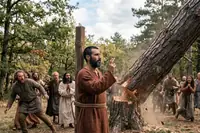
Once, in a village, Martin tore down an old pagan temple. The villagers did not object to that, but when he wanted to cut down the great pine beside the temple, a tree they considered sacred, they flatly refused. One villager challenged him: if you believe in your God so much, we will cut down this tree, and you will stand on the side where it is going to fall. If your God saves you, we will believe.
Martin agreed. They tied him to the spot where the tree would fall. The pine leaned slowly, creaking and cracking, and began to fall straight toward him. His disciples turned pale. According to Sulpicius, Martin simply raised his hand and made the sign of the cross toward the trunk, and the pine, as if pushed back by a gust of wind, swung round and fell toward those standing watching, almost crushing them. Sulpicius writes that on that day almost the whole region asked to learn the faith.
Another story is gentler, and perhaps closer to the man Martin was. Once, as he entered the city of Paris with a large crowd, he met a leper at the city gate, his face so covered in sores that everyone kept away from him. Martin went straight up to him, embraced him, kissed his face and blessed him. Sulpicius says the leper was healed at once. Whether or not that last detail is true, the gesture of embracing and kissing a man shunned by the whole city, under the eyes of the crowd, is very like the young soldier who had once cut his cloak at the gate of Amiens.
Sulpicius also records a time when Martin was invited to a banquet at the court of Emperor Maximus. Following etiquette, the emperor had the cup of wine passed to Martin first, waiting for him to drink and pass it back. But after drinking, Martin passed the cup to the priest who had come with him, because he regarded a priest of God as higher than any king. The whole court was stunned. But the emperor himself, according to the account, respected him all the more.
Chapter 7 of 10
The man who would not let anyone be killed for their beliefs
There is one story about Martin that is seldom told, but which is perhaps one of the bravest things he ever did.
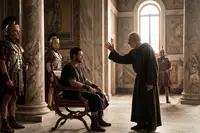
In 385, a Spanish bishop named Priscillian was accused by some other bishops of teaching heresy. They did not only want the Church to condemn him; they also took him before Emperor Maximus at Trier so that the court would sentence him to death.
Martin, though he did not agree with Priscillian’s teaching, went to Trier to protest. He said that letting a secular court judge a question of faith was an unheard-of crime. He begged the emperor not to shed blood. The emperor promised him. But as soon as Martin had left the city, Priscillian and some of his followers were beheaded.
It was the first time in history that someone was executed for heresy at the hands of people who called themselves Christians. Martin was so grieved that, according to Sulpicius, he did not want to sit with the bishops who had accused Priscillian. One could say that as early as the fourth century, a saint raised his voice to warn of something the Church would later take many painful centuries to learn.
Chapter 8 of 10
Saint Martin’s summer
Martin died on November 8, 397, in the village of Candes, where he had gone to settle a dispute among the clergy. He was over eighty. His disciples begged him not to leave them. He prayed: “Lord, if Your people still need me, I do not refuse the labor. Your will be done.”
The people of Poitiers and the people of Tours fought over his body. That night, while the people of Poitiers slept, the people of Tours secretly put the body in a boat and rowed upstream on the Loire back to Tours. Tradition says that along both banks of the river, though it was already the middle of November, the trees suddenly burst into bloom as if it were spring as the boat passed by.
Since then, in France and many European countries, sudden warm sunny days in the middle of November have been called “Saint Martin’s summer”. In England the name was in use until the middle of the twentieth century.
The day of his burial, November 11, became his feast day. Martin was one of the first saints who was not a martyr to be publicly venerated by the Western Church. Before him, “saint” was almost reserved for those who had shed their blood for the faith. Martin showed that a life of complete love is also a way of bearing witness.
Chapter 9 of 10
November 11
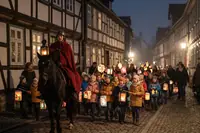
Saint Martin’s tomb at Tours became the greatest place of pilgrimage in medieval France. In France there are thousands of churches and hundreds of villages bearing his name. In Germany and the Netherlands, to this day on the evening of November 11, children still carry homemade lanterns in processions around the neighborhood, singing songs about Saint Martin, sometimes led by a rider in a red cloak playing the saint.
Two historical coincidences are tied to that day.
On November 10, 1483, in the town of Eisleben in Germany, a baby boy was born. The next morning, the feast of Saint Martin, he was baptized, and his parents named him after the saint of the day: Martin. That boy was Martin Luther, who later launched the Protestant Reformation.
And on November 11, 1918, at 11 a.m., the armistice ending the First World War came into force. Many French people of the time noticed at once: peace had come on the very feast of the soldier who had laid down his sword, the man regarded as patron of France and of soldiers.
Chapter 10 of 10
Our own half cloak
In Vietnam, Martin is a fairly common baptismal name. Many who bear it take as their patron Saint Martin de Porres, the mixed-race religious brother of Lima whose story is also in this app. But many others, especially families with older traditions, are named after Saint Martin of Tours, the soldier who cut his cloak. If your name is Martin and you celebrate your patron on November 11, your patron is he.
What Martin leaves us is not a whole cloak, but half a cloak. He did not give the beggar everything, nor keep everything for himself. He gave what he could give, right then, without waiting until he was rich enough, free enough, sure enough.
Perhaps that is what is closest to us. Few people can leave everything to follow the Lord. But everyone has their own “half cloak”: half a meal, half a free afternoon, half the money meant for something they do not need. And Jesus, in Martin’s dream, did not say: “He gave Me only half.” He said: “Martin has clothed Me with this cloak.”
The end of the story
You have walked with Saint Martin of Tours to the end of the story.
Images that will stay with you:
A young soldier, not yet baptized, drawing his sword to cut his cloak in two in the middle of a winter night, amid mocking laughter.
"I am a soldier of Christ; I am not allowed to fight", and the promise to stand in the front line without weapons.
The boat carrying the old bishop’s body upstream on the Loire, and the trees on both banks bursting into bloom in the middle of November.
Stay in silence
As the story ends, you realize that Martin did not give everything, only half a cloak, right then, and the Lord received it whole.
Today, give your "half cloak" to someone who is cold, without waiting until you have plenty.
Let us pray
Saint Martin,
in the middle of a winter night you cut your own cloak in two for a beggar everyone else stepped past. Help me not to step past those who are cold around me: lonely old people, hungry children, a friend who is sad.
Teach me to give what I have today, even if only half, without waiting until I am rich enough.
You were a soldier who chose peace. Pray for places still at war, and help my family make peace with one another.
Amen.
Sources
- Feast dayArticle, version 1.1
- Patron ofPatronages and symbols, version 1.1
- Often depicted withPatronages and symbols, version 1.1