

Journey 4 · Hands That Stayed with the Suffering
Saint Magdalene of Canossa
A marchioness who gave up silk for the poor
Feast day April 10
Tap to step inside
Saint Magdalene of Canossa
A marchioness who gave up silk for the poor
Map of a life
This life told in 5 chapters
Begin the journey

Feast day
Saint Magdalene of Canossa
Some places may celebrate on a slightly different day.
April 10
Patron of
- The Canossians
Opening
Opening
Standing before a great mirror in the splendid Canossa palace in the city of Verona, Italy, a beautiful young noblewoman in a costly silk gown was getting ready for a grand society ball. Yet looking into her own eyes in the mirror, she suddenly felt a dizzying emptiness. The music of the ball could not drown out the heart-rending cries of the thousands of street children scavenging for food by Verona’s bridges.
That young woman was Magdalene Gabriella of Canossa, daughter of one of the most illustrious lines of marquises in Italy.
She could easily have chosen a comfortable, privileged life, waited on by servants. But she turned her back on that silken throne, walked out of the palace gate empty-handed, and became the mother and servant of children of the streets.
She is the founder of the Canossian Daughters of Charity and the Canossian Sons of Charity, who bear witness to “the love of the Cross, greater than every other love”.
Chapter 1 of 5
A stormy childhood in the Canossa palace
Magdalene was born on March 1, 1774, in the Canossa palace in Verona, northern Italy, a magnificent Mannerist palace with a massive colonnade, designed by the famous architect Michele Sanmicheli in 1527, where Napoleon Bonaparte, Tsar Alexander I of Russia and Emperor Francis I of Austria would later stay as guests. Her father was Marquis Ottavio Canossa, her mother Countess Teresa Szluha. She was the third child of an immensely wealthy noble family.
Yet silk could not shield her from tragedy: when Magdalene was only five, her father died suddenly on a holiday trip. Two years later, her mother married another nobleman, leaving her five young children at the Canossa palace to be raised by tutors.
Being abandoned by her own mother left a wound that bled throughout Magdalene’s childhood. On top of that, the French governess hired to care for her was a domineering, harsh woman who often mistreated, humiliated and slandered the girl.
At fifteen, Magdalene caught a dangerous case of smallpox along with a respiratory infection, which caused her great pain and left her in fragile health for the rest of her life.
It was in those lonely, painful years that Magdalene found the only Mother who would never abandon her: Mary at the foot of the Cross. She knelt for hours before the crucifix in the palace chapel, learning to unite her tears of hurt with the Passion of Jesus.
Later, when she had become mother to thousands of abandoned children, Magdalene would often remind her sisters that no one understands the pain of a child without a mother better than someone who has known it herself. The wound of her childhood, instead of becoming a prison for her soul, became the door through which she reached the hearts of the very orphans she would spend the rest of her life loving.
At seventeen, longing to give herself to God, Magdalene twice tried to enter Carmel. But both times she realized this was not the place God wanted: the four walls of an enclosed convent could not hold a heart aching for the poor in the streets. She returned to the palace and managed the vast estate of the Canossa family for many years.
Chapter 2 of 5
Pain in the poor quarters of Verona
The upheavals of the French Revolution and Napoleon Bonaparte’s wars of conquest turned Italy into a bloody battlefield. Verona was devastated: famine and disease raged, and the wounded lay everywhere. In every alley, thousands of orphans roamed and scavenged in the garbage, and young women were driven into prostitution to get enough to eat.
Every time she rode in her carriage through San Zeno, the poorest quarter of the city, it cut Magdalene to the heart. It was an ancient district that had grown up around an early Christian cemetery from Roman times, where the remains of Saint Zeno, the first bishop of Verona, had been buried since the beginning of the ninth century. She began secretly taking money, food and clothing from the palace to give away. In 1799 she took in her first two homeless orphan girls.
Yet handouts could not cure the problem at its roots: the poor needed schooling, a trade to stand on their own feet, and above all, to know that God loves them with all His heart.
Magdalene realized that alms, however generous, were only a temporary painkiller for a much deeper social disease. She began taking time to sit and talk with each child, asking about their family circumstances, and gradually a larger plan took shape in her mind: not only to feed them, but to teach them, so that when they grew up these children could stand on their own two feet, no longer living on others’ pity.
The Canossa family fiercely opposed what she was doing. They thought it a stain on the family’s honor for a marchioness of her rank to mix with the filthy lower classes. Some even thought she had lost her mind.
But Magdalene answered with a decisive choice.
Chapter 3 of 5
Leaving the palace for the slums
On May 8, 1808, Magdalene Gabriella of Canossa took the decisive step: she formally gave up her ancestors’ magnificent palace, her title of marchioness and her life of luxury.
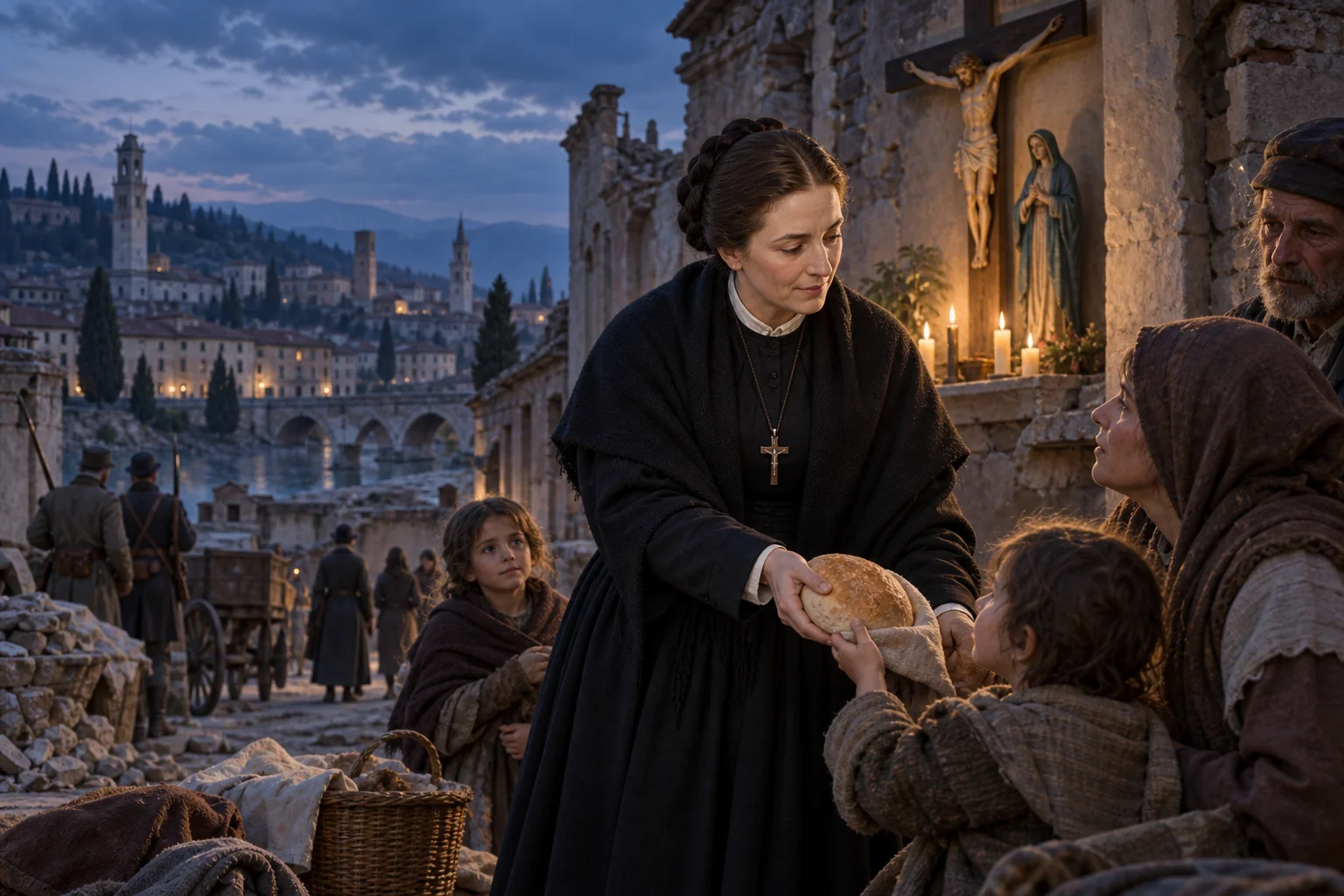
Empty-handed, she walked out of the palace gate and went on foot to the most squalid slum of Verona, San Zeno. There she rented an old abandoned convent named for Saint Joseph and, with a few poor young women, began a consecrated life.
That was the beginning of the Canossian Daughters of Charity.
The former marchioness put on a coarse dark brown habit, with a small metal cross around her neck. Every day she herself swept the house, begged for food, cooked soup for the orphans, washed sick people covered in sores and taught poor girls their letters with her own hands.
She opened free schools and workshops teaching sewing and embroidery, and set up groups of traveling catechists to go to remote rural areas.
In 1810, when Emperor Napoleon Bonaparte came to inspect the city of Verona and heard of the holiness of the Marchioness of Canossa, he personally came to visit her charitable house. Impressed by what he saw, Napoleon signed a decree giving the whole convent of Saint Joseph to her community for its work.
Chapter 4 of 5
“Make Jesus known and loved”
Mother Magdalene of Canossa’s spirituality sprang from contemplating Jesus Crucified, who stripped Himself of all glory and became the poorest of all out of love for us.
She gave her sisters a motto for life:
“Make Jesus known and loved!”
She also told them: “The love of Jesus is a fire that cannot be contained; it must blaze up and spread to the very ends of the earth!”
Her work of charity quickly spread throughout northern Italy: Canossian convents and schools sprang up in Venice, Milan, Bergamo and Trent. She was always present in the hardest places, traveling in rattling carriages in the snowy winter and eating the plainest food of the poor.
In 1831, seeing the urgent needs of boys and young men, she also founded the Canossian Sons of Charity in Venice.
However busy she was, she kept a deep inner silence. Night after night she was seen kneeling for hours before the Eucharist, taking refuge in the heart of Our Lady of Sorrows to draw strength. She taught her sisters:
“Serve the poor with boundless tenderness, and never make them feel they owe you anything!”
Chapter 5 of 5
The triumph of love
Years of ceaseless toil, on top of the serious illness of her youth, wore down her strength.
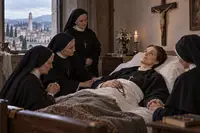
In Lent 1835, Mother Magdalene of Canossa fell gravely ill in Verona. Lying on a simple wooden bed in her poor convent, not far from the splendid palace where she had been born and which she had given up, she calmly accepted approaching death.
On the afternoon of April 10, 1835, Good Friday, as the Church was commemorating the Passion of Jesus, Mother Magdalene of Canossa smiled up at the crucifix and died in deep peace, at the age of sixty-one.
Pope Pius XII beatified her in 1941, and on October 2, 1988, Pope John Paul II solemnly canonized Magdalene of Canossa. The Church celebrates her on April 10 each year; the Canossians celebrate on May 8.
In Vietnam and throughout the mission lands of Asia, the Canossian Sisters are much loved for their kindergartens, hostels for poor female students, charity classes and care of the sick poor.
Saint Magdalene of Canossa leaves us a clear example: all the world’s fame and wealth will pass like a dream; only love given to others is a treasure that lasts forever.
She dared to step down from an earthly throne to become a servant. And through that self-emptying, she stepped straight into the glorious, eternal life of the Kingdom of God.
The end of the story
You have walked with Saint Magdalene of Canossa to the end of the story.
At the end of the story, what stays with you:

Fatherless at five, and two years later left at the palace by her own mother, who remarried and left her to be raised by tutors.

On May 8, 1808, the marchioness walked out of the gate of the Canossa palace empty-handed, to live for good in an abandoned convent in San Zeno, the poorest slum of Verona.
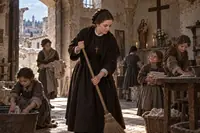
Admiring her work of charity, Emperor Napoleon himself came to visit and signed a decree giving the whole convent of Saint Joseph to her community.
Stay in silence
You realize one more thing: the wound of being abandoned by her mother as a child, instead of becoming a prison, became the door through which she understood and embraced thousands of other abandoned children.
Make Jesus known and loved!
Let us pray
Saint Magdalene of Canossa,
as a child you were left behind by your own mother. As a woman, you left the palace empty-handed to live in the poorest slum and care for abandoned children.
Pray for those who carry wounds from being abandoned in their families. May that wound become a door through which they learn to love others.
Teach me to give up my comforts to go out to the poor.
Amen.
Sources
- Feast dayAuthor’s edited profile
- Patron ofPatronages and symbols, version 1.1
- Reflectionvatican.va
- Reflectioncanossiani.org
Meet the next one
 Journey 4