

Journey 4 · Hands That Stayed with the Suffering
Saint Angela Merici
A spiritual mother in a changing world
Feast day January 27
Tap to step inside
Saint Angela Merici
A spiritual mother in a changing world
Map of a life
This life told in 4 chapters
Begin the journey
Feast day
Saint Angela Merici
Some places may celebrate on a slightly different day.
January 27
Patron of
- The Ursulines
- The sick, people with disabilities, orphans
Often depicted with
- A ladder to heaven (her vision)
- A cloak
Opening
Opening
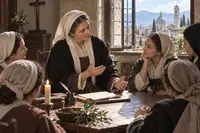
Many people think that to give your life to God you must walk through a convent door, put on a habit and live behind the grille of the cloister. Yet in the turbulent sixteenth century of the Italian Renaissance, Saint Angela Merici opened a new and daring path: consecrating her whole life to God while still living with her family, going about the crowded streets to care for poor girls and teach them the faith.
She founded the Company of Saint Ursula, the Ursulines, the first community in the Church’s history of consecrated women living in the world.
With gentleness, good sense and a mother’s love, she started a quiet revolution: she raised up the dignity of women and made the education of families the foundation for rebuilding the moral life of society.
Chapter 1 of 4
An orphan’s grief by Lake Garda
Angela Merici was born on March 21, 1474, in Desenzano del Garda, a small town on the shore of beautiful Lake Garda in northern Italy. It is the largest lake in Italy, and its mild climate, rare on the cold Po plain, lets olive groves and lemon trees scent the air all year. Her parents, Giovanni Merici and Caterina Biancosi, were simple, devout farmers who lived off their fields and animals. Every evening by the fire her father read the lives of the saints to his children, and young Angela grew to love holiness from her earliest years.
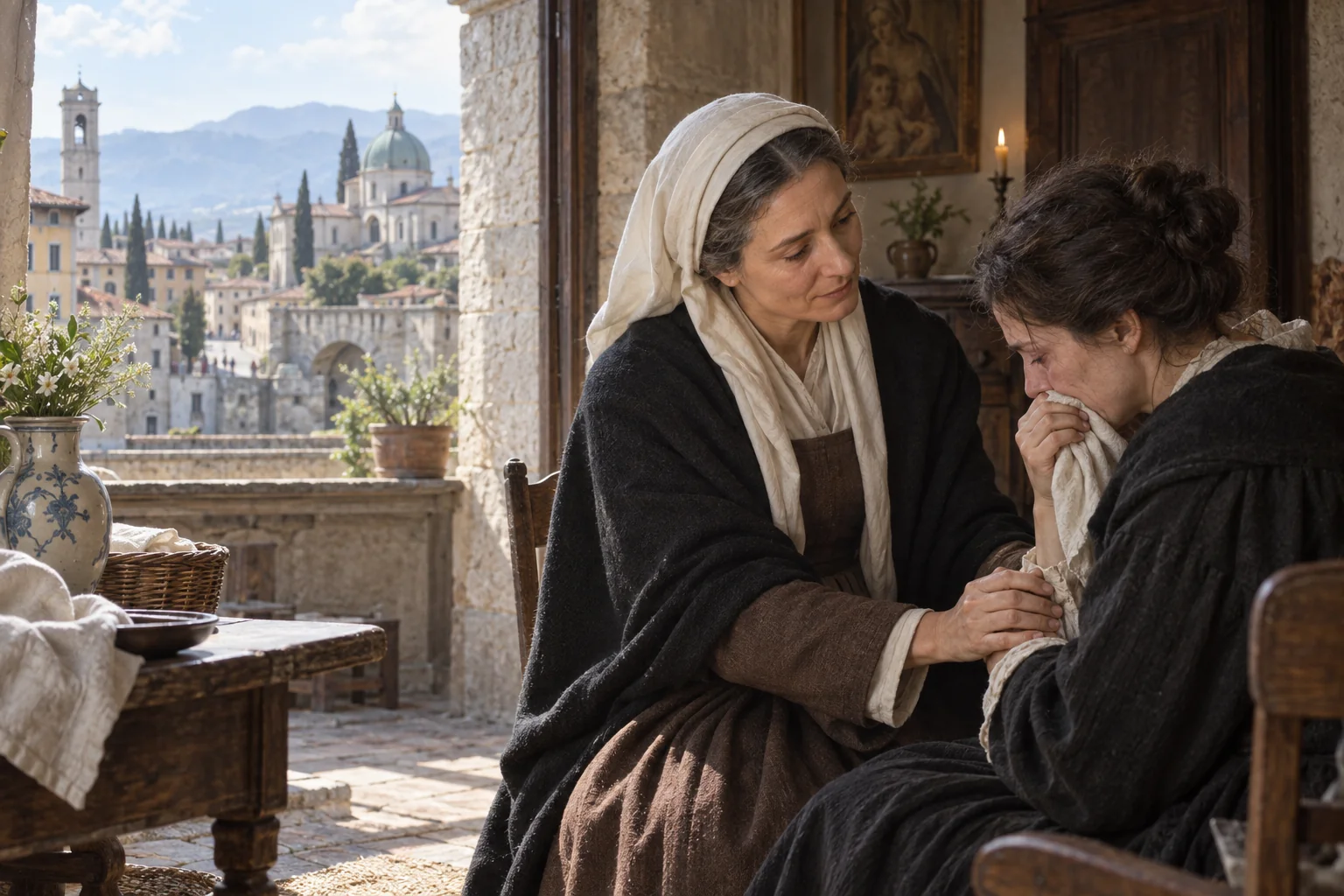
But that peaceful childhood was soon broken by one loss after another. When Angela was about fifteen, her dearest sister died suddenly without receiving the last sacraments, and Angela could not be consoled for fear of what had become of her sister’s soul.
Not long afterwards her father and mother both died. Orphaned in her teens, Angela and her younger brother were taken in by a wealthy uncle in the nearby town of Salò.
In her uncle’s comfortable house Angela turned her back on a life of empty parties. She asked to join the Franciscan Third Order so that she could live in poverty, wearing coarse cloth and fasting.
One day, while kneeling in prayer in a field, Angela was given a wonderful vision. She saw heaven open, a ladder of light reaching from earth to the heights, and bands of radiant young women climbing it, singing with the angels. Her sister appeared among them, smiling to comfort her, and a voice told her that before she died she would found a company of young women dedicated to holiness.
That vision did not erase all of Angela’s grief for her sister, but it turned that grief into a seed. Many years later, looking back, she understood that her tears for the sister who had died without the last sacraments had quietly planted a longing in her: that no soul should ever again have to leave this world so alone, without God.
Chapter 2 of 4
Brescia, and a room open to the young
In 1495, her uncle died and Angela returned home to Desenzano. Looking around the village, her heart ached to see so many girls from poor families with no schooling and no one to teach them the catechism, growing up in ignorance and easily led into sin.
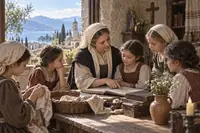
Angela gathered them in her own home, taught them their letters one by one, taught them to sew and patiently told them about the love of God.
She had no curriculum and no textbook, only a heart that could see that these country girls, left to themselves, would grow up without ever knowing they were children of God, worthy of respect and love. Every letter she wrote on her plain wooden board carried a silent message: you deserve to learn, even though you were born poor.
In 1516, recognizing her gifts and her kindness, the superiors of the Franciscan Third Order sent Angela to the city of Brescia to comfort a noble family who had just lost their beloved children. Brescia had just been ravaged by war, and Angela decided to stay there.
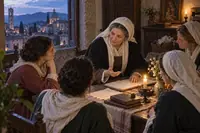
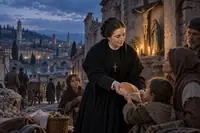
She rented a small, cramped room near the church of Saint Afra, an old church rebuilt in 1462 on the foundations of an abandoned Benedictine monastery, where an early bishop of Brescia had been buried in the crypt centuries before. Her simple room soon became a peaceful meeting place for every class of people. Wealthy nobles came to ask her advice in settling quarrels; scholars came to talk about the word of God; and above all, poor women and young women who had gone astray came to be welcomed with a gentle mother’s generosity.
In 1524, Angela made a grueling pilgrimage to the Holy Land. Then came a strange trial: as soon as the ship docked at Crete, she suddenly went blind in both eyes.
Her companions urged her to turn back, but Angela insisted on going on. She visited Bethlehem, Calvary and the Holy Sepulchre with the eyes of faith.
On the way home, when the ship stopped again at Crete, she was praying earnestly before a crucifix when her sight suddenly came back. The journey taught her a lesson she never forgot: the eyes of the body may go blind, but the eyes of faith must stay clear to see God’s will.
Chapter 3 of 4
The birth of the Company of Saint Ursula
In 1535, at sixty-one, an age most people then thought close to the end of life, Angela sensed that God’s hour had come and gathered the first twenty-eight devout young women in Brescia. She had not rushed to found a company in her stronger years. She had waited nearly forty years, letting life and prayer ripen in her, before laying the foundations of the work she was sure God had promised in the vision long ago. On November 25, 1535, at the church of Saint Afra, the women offered themselves to God, formally founding the “Company of Saint Ursula”, placed under the patronage of Saint Ursula, a patron of the young.
This was something new in the history of the Church: its members wore no special habit, took no public vows binding under the canon law of the time, and did not live apart behind convent walls.
They went on living with their families and earning their living in the world, but gave their hearts entirely to Christ by a promise of virginity. They were leaven and salt in society, teaching poor children, caring for the sick, visiting prisoners and showing what a pure, loving life looks like in the middle of the world.
In the “Counsels” and “Testament” she left her daughters, Mother Angela wrote words full of motherly love:
“I beg you to remember that you must treat others with gentle mercy and wise kindness, and never with harshness or force... Make people love you rather than fear you... Live in close unity with one another, and if something needs to be changed to suit the circumstances of the times, have the courage to do it after praying and taking careful counsel!”
Chapter 4 of 4
Her rest, and the growth of the order
Mother Angela Merici died peacefully on January 27, 1540, in Brescia, at the age of sixty-six. She had often gone to pray at the tombs of the martyrs of Brescia in the church of Saint Afra, and as she had wished, she was buried there, near the martyrs she had always loved. For thirty days her body stayed supple and gave off a strangely sweet fragrance while tens of thousands of people from the city came to pay their respects. Centuries later, on March 2, 1945, during the Second World War, bombs flattened the church; but the people of Brescia rebuilt it exactly as it had been, on its old foundations, so that the saint’s nearly intact remains could go on resting in the place she had chosen.
Pope Clement XIII beatified her in 1768, and on May 24, 1807, Pope Pius VII solemnly canonized Angela Merici. The Church celebrates her on January 27 each year.
After her death, in response to the reforms of the Council of Trent, the Ursulines became an enclosed order devoted to education. They spread throughout the world and were among the first orders to build schools for girls, in Europe, North America and on every continent.
Saint Angela Merici has something to teach Christians today: holiness does not ask us to flee the world. It means being in the world like a lamp, bringing God’s love to warm our families and neighborhoods.
She shows that a woman, with gentleness and steady faith, can become the pillar on which a whole society rebuilds its moral life.
The end of the story
You have walked with Saint Angela Merici to the end of the story.
A few details you want to look at again:
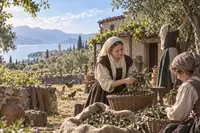
Her dearest sister died suddenly without the last sacraments, and Angela could not stop fearing for her sister’s soul.
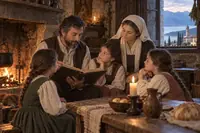
In a field, she saw a ladder of light joining earth and heaven, where her sister smiled at her and she was told she would found a company of young women.
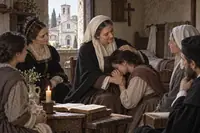
She gathered the first twenty-eight young women to found the "Company of Saint Ursula": women with no special habit and no public vows, still living with their families in the world.
Stay in silence
Thinking it over, you realize that becoming holy does not require shutting yourself behind convent grilles. Sometimes it only means staying in the midst of the world, gentle and steadfast.
Make people love you rather than fear you.
Let us pray
Saint Angela Merici,
you gathered young women who lived their faith in their own homes, without any special habit. You taught: "Make people love you rather than fear you."
Pray for the young women and girls of my parish, that they may grow up in faith and self-respect.
Teach me to become holy in the midst of the world, gentle yet steadfast, in my own family.
Amen.
Sources
- Feast dayAuthor’s edited profile
- Patron ofPatronages and symbols, version 1.1
- Often depicted withPatronages and symbols, version 1.1
- Reflectionursulines-roman-union.org
Meet the next one
 Journey 4