

Journey 4 · Hands That Stayed with the Suffering
Saint John Baptist de La Salle
Opening school doors to poor children
Feast day April 7
Tap to step inside
Saint John Baptist de La Salle
Opening school doors to poor children
Map of a life
This life told in 6 chapters
Begin the journey OpeningOpening1 min
 Chapter 1 of 6The eldest son of a noble family of Reims1 min
 Chapter 2 of 6A chance meeting at a convent door1 min
 Chapter 3 of 6Giving up everything to become poor among the poor1 min
 Chapter 4 of 6A teaching revolution that changed the world1 min
 Chapter 5 of 6Storms of trial and a silent retreat1 min
- Chapter 6 of 6Patron of educators1 min
Feast day
Saint John Baptist de La Salle
Some places may celebrate on a slightly different day.
April 7
Patron of
- Teachers (declared by Pius XII in 1950)
Often depicted with
- Surrounded by pupils
- A book
Opening
Opening
In the seventeenth century, under the splendid and lavish reign of Louis XIV, France prided itself on the magnificent palace of Versailles and the most brilliant culture in Europe. Yet behind that velvet curtain lay a painful reality: most children of poor workers and peasants never went to school and could not read, roaming the streets and growing up in ignorance and poverty, generation after generation. The schools of the time were reserved for the children of the nobility and the rich.
Into that injustice stepped a canon of Reims Cathedral, a man of noble birth, who dared to go against the tide of his time: he gave up his lucrative canonry, gave up his family’s fine mansion, gave away his vast fortune to the poor, and went to live with poor schoolmasters, opening a network of completely free schools for the children of struggling working people.
That pioneer was Saint John Baptist de La Salle (Jean-Baptiste de La Salle), founder of the Brothers of the Christian Schools, usually called the De La Salle Brothers or the Christian Brothers.
His revolution in education reshaped modern teaching, and the Church has always honored him as patron of all Christian educators.
Chapter 1 of 6
The eldest son of a noble family of Reims
Jean-Baptiste de La Salle was born on April 30, 1651, in the city of Reims, France, into one of the most distinguished noble and legal families of Champagne. His father, Louis de La Salle, was a powerful magistrate; his mother, Nicole Moët de Brouillet, was a devout noblewoman. The eldest of ten children, John Baptist grew up in luxury and received an excellent education.
At eleven he received the tonsure and clerical dress. At sixteen he was made a canon of the Cathedral of Reims, a highly honored position with a generous income, assuring him a brilliant future in the Church hierarchy. In 1670 he entered the famous seminary of Saint-Sulpice in Paris to study theology at the Sorbonne.
But the first great trial of his life struck suddenly: in 1671 his gentle mother died; and less than a year later, in 1672, his father also died unexpectedly.
At twenty-one, the young seminarian had to set aside his studies in Paris and return to Reims to take on the role of head of the family, managing the family property and raising six younger brothers and sisters. He fulfilled his family duties while persevering in his theological studies in Reims.
On April 9, 1678, Holy Saturday, John Baptist de La Salle was ordained a priest, and two years later he brilliantly defended his doctoral thesis in theology. Every honor, even a bishop’s miter or a cardinal’s hat, seemed within easy reach of the young priest, a nobleman with a doctorate.
Chapter 2 of 6
A chance meeting at a convent door
Yet God’s will led him onto a road he himself had never imagined.
In March 1679, at the door of the convent of the Sisters of the Child Jesus in Reims, Father de La Salle happened to meet Adrien Nyel, a zealous layman from the city of Rouen who wanted to open a free school for poor boys. The superior of the convent asked Father de La Salle to use the standing and the means of his noble family to help Mr. Nyel.
At first, Father de La Salle agreed to help only as an act of charity from the outside. He stood as guarantor, rented a small house and paid the teachers to open the school. Later, in his spiritual memoirs, he admitted honestly:
“If I had known then that the help I first gave would eventually lead me to spend my whole life with poor schoolmasters, I would have pulled back from the very start! For at that time I considered primary schoolmasters lower than the servants in my own house!”
Yet step by step, God led him deeper into the mission.
He saw with his own eyes the coarseness, lack of morals and ignorance of the schoolmasters of the time: they treated teaching as just a makeshift way to earn a living, had no teaching method, and were bad-tempered and beat their pupils. And the poor pupils were grubby and unruly, growing up like weeds in the street.
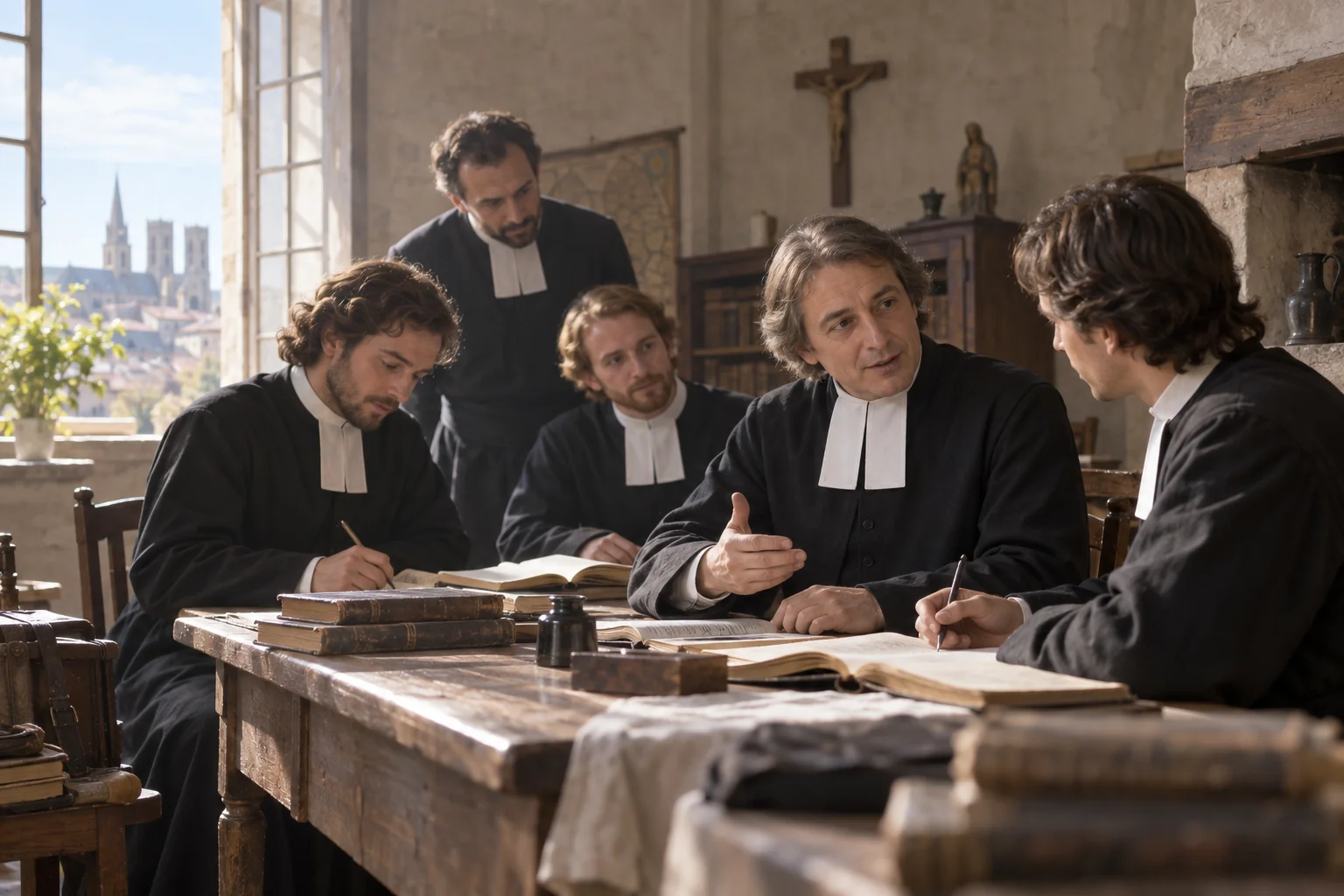
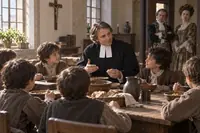
To remedy this, in 1680 Father de La Salle did something that shocked his whole noble family: he brought the poor schoolmasters to live and eat with him in his family’s fine mansion.
He sat at the same table with them, taught them good manners, guided them in prayer and passed on to them sound methods of teaching. His family, feeling their noble honor gravely insulted, fiercely objected and tried to drive the schoolmasters out of the house.
Chapter 3 of 6
Giving up everything to become poor among the poor
Torn in this bitter conflict, John Baptist de La Salle realized he could not live in silk as a noble canon while asking the schoolmasters to give themselves to poverty and sacrifice for poor pupils.
He made a radical choice, almost unheard of in his day. In 1683 he resigned as canon of the Cathedral of Reims, giving up a lucrative position he could have held for life. In the winter of 1684, amid a terrible famine raging in France, he sold off his whole enormous family inheritance and used the money to buy bread for the starving poor, down to the last coin.
The young nobleman of earlier days now had nothing at all. He moved out of the mansion and rented a shabby house on the rue Neuve to live in poverty with the schoolmasters.
On June 24, 1686, John Baptist de La Salle and the first twelve schoolmasters committed themselves to a consecrated life, formally founding the Brothers of the Christian Schools.
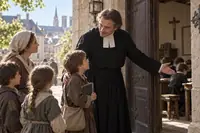
He made a revolutionary decision: members of the institute would never be ordained priests, but would always remain only “Brothers”, so that they could give their whole lives without reserve to the human and Christian education of poor children. Their simple black habit, with its white collar bands and short sleeveless mantle, became a familiar sight at school doors.
Chapter 4 of 6
A teaching revolution that changed the world
Saint John Baptist de La Salle laid the foundations of modern teaching with groundbreaking reforms.
First was teaching in the mother tongue: at that time, schools required pupils to learn to spell and read in Latin first, which made it very hard for poor children and led many to drop out. Father de La Salle was the first to insist on teaching pupils to read and write in their own French first, and only afterwards in Latin.
Next came the simultaneous method, teaching by class: before his time, a teacher taught pupils one at a time, while the others sat idle or made trouble. He pioneered dividing pupils of similar levels into separate classes, with the teacher explaining the lesson to the whole class, who listened and discussed together.
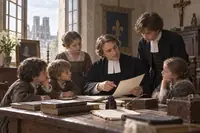
Seeing that the quality of education depends on the teacher, he founded “training schools for teachers” (forerunners of today’s teachers’ colleges) in Reims and Paris to form teachers in both skill and character.
He also opened technical and commercial schools for young men, Sunday evening classes for workers, and the first reform school in Rouen for young offenders sentenced by the courts. Most basic of all, every De La Salle school was completely free for the children of the poor, and open to all.
Chapter 5 of 6
Storms of trial and a silent retreat
Father de La Salle’s progressive reforms clashed with the interests of the private schoolmasters’ guilds of the time. They repeatedly took him to court and got the police to seize desks and benches and close the De La Salle schools in Paris. Many priests and bishops also misunderstood and opposed him, trying to remove him from his position as superior.
Matters came to a head in 1714. Worn down by unjust attacks, Father de La Salle quietly withdrew to live as a hermit at Parménie, on a remote mountainside in southern France. He lived in silence and prayer, bearing humiliation.
But while he was away, his faithful Brothers sent him a now-famous letter, calling on his vow of obedience and begging him to come back and lead the institute again. Obeying his brothers, the aging founder took up his walking stick and returned.
In his last years his health failed from asthma and chronic rheumatism. He moved to live at the house of Saint-Yon in the city of Rouen.
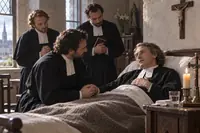
Early on the morning of April 7, 1719, Good Friday, he received the last sacraments with great fervor. When a brother at his side asked whether he fully accepted God’s will, John Baptist de La Salle answered with his last words:
“Yes, I adore in all things the will of God for me!”
Then he died peacefully, at the age of sixty-eight.
His body was buried in Rouen, but his remains later had a long and troubled journey, much like his life: during the French Revolution his tomb was violated, though fortunately his relics survived intact; in 1904, when the Brothers were expelled from France, the remains were taken to Belgium; and only in 1937 were they solemnly brought to rest permanently in the church bearing his name next to the institute’s headquarters in Rome, where pilgrims still come to venerate them today. Another part of his relics is kept at the main altar of the Cathedral of Reims, where he had once been a young canon before giving up everything.
Chapter 6 of 6
Patron of educators
Pope Leo XIII beatified him in 1888 and solemnly canonized him on May 24, 1900.
On May 15, 1950, Pope Pius XII solemnly proclaimed Saint John Baptist de La Salle “Principal Patron of all educators and teachers”. The Church celebrates him on April 7 each year; De La Salle schools celebrate on May 15.
In Vietnam, the De La Salle Brothers have been present since 1866, helping lay the foundations of modern education with well-known schools such as Taberd School in Saigon, Pellerin School in Huế and Bá Ninh School in Nha Trang, along with many free schools for poor children.
Saint John Baptist de La Salle leaves us a lesson: teaching is not simply a way to earn a living; teaching is a sacred vocation.
He told teachers:
“Touch the hearts of your pupils and transform them with love... Remember that you are their guardians, the guardian angels God has sent to lead these children into the light of knowledge and salvation!”
The end of the story
You have walked with Saint John Baptist de La Salle to the end of the story.
The story leaves a few scenes with you:
The noble canon bringing poor schoolmasters to live in his family’s own mansion, to the fury of his whole family.
In the midst of famine, he sold his entire inheritance to buy bread for the poor, down to the last coin.
He decided the Brothers would never be ordained priests, so they could give their whole lives to teaching poor children.
Stay in silence
It dawns on you: teaching is not simply a way to earn a living, but a sacred vocation.
Touch the hearts of your pupils and transform them with love.
Let us pray
Saint John Baptist de La Salle,
you sold your whole fortune to feed the hungry, and gave your whole life so that poor children could go to school.
Pray for teachers, that they may see teaching as a vocation, and love their pupils as their own children.
Pray for poor children who cannot go to school. May they have the chance to learn, and meet good teachers.
Amen.
Sources
- Feast dayAuthor’s edited profile
- Patron ofPatronages and symbols, version 1.1
- Often depicted withPatronages and symbols, version 1.1
- Reflectionlasalle.org
- Reflectionlasallefrance.fr
Meet the next one
 Journey 4