

Journey 4 · Hands That Stayed with the Suffering
Saint John Bosco
A father’s heart in the muddy streets
Feast day January 31
Tap to step inside
Saint John Bosco
A father’s heart in the muddy streets
Map of a life
This life told in 6 chapters
Begin the journey OpeningOpening1 min
 Chapter 1 of 6A dream at nine and a hard childhood at Becchi2 min
 Chapter 2 of 6Pain in the prisons of Turin1 min
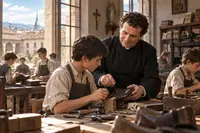 Chapter 3 of 6The Oratory of Valdocco and the “Preventive System”2 min
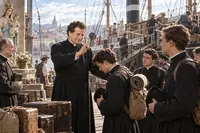 Chapter 4 of 6The birth of the Salesians and a worldwide reach1 min
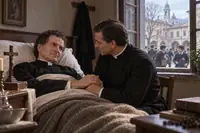 Chapter 5 of 6A last breath given wholly to the young1 min
- Chapter 6 of 6A saint of youth and of educators1 min
Feast day
Saint John Bosco
Some places may celebrate on a slightly different day.
January 31
Patron of
- Young people and students
- Educators
- Publishers
- Magicians
Often depicted with
- Surrounded by children
- The gray dog Grigio
Opening
Opening
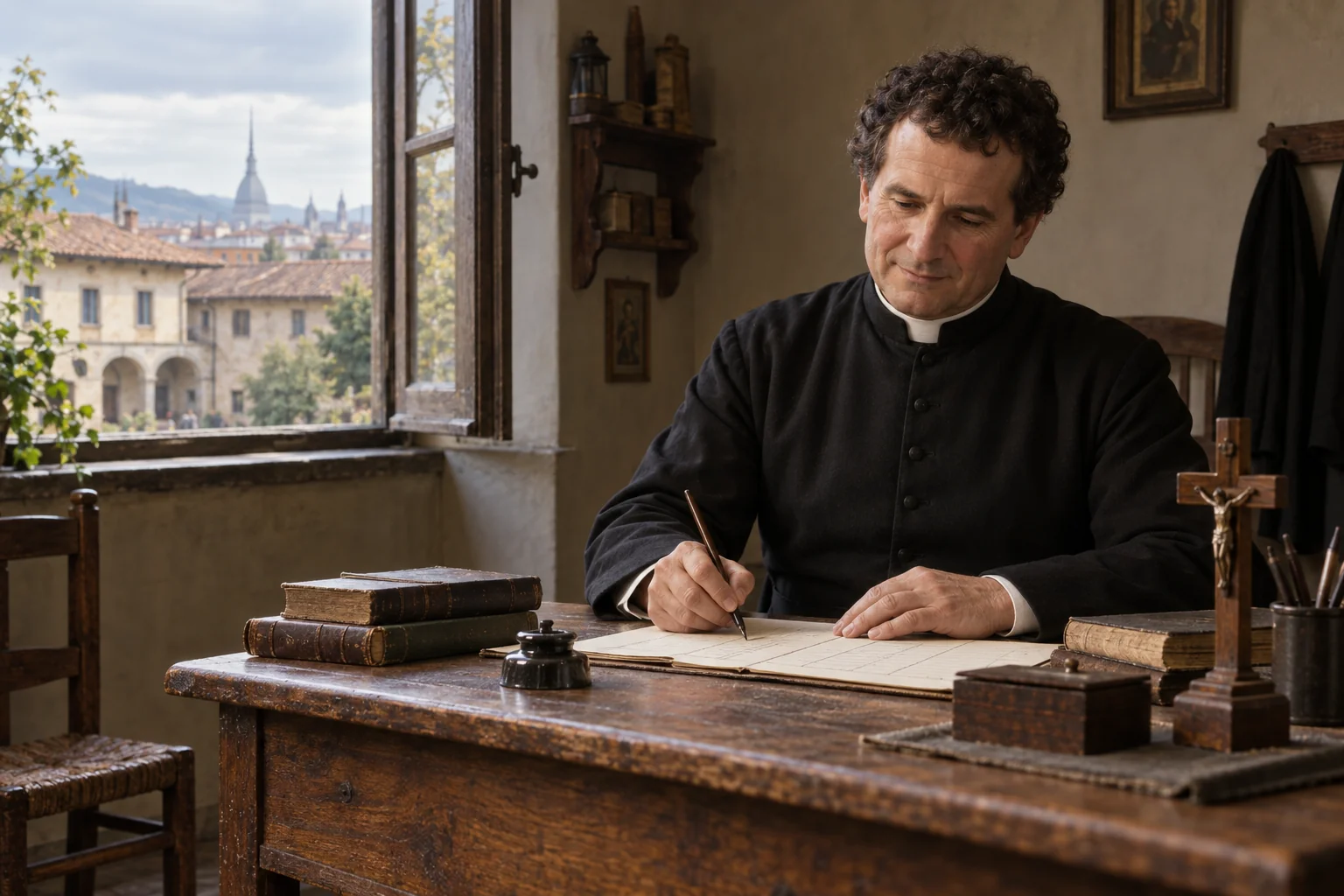
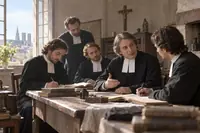
One early winter morning in 1841, in the sacristy of the church of Saint Francis of Assisi in the city of Turin, Italy, a young priest was vesting for Mass when he heard furious shouting. The sacristan was chasing a ragged street boy with a stick and beating him soundly because the boy did not know how to serve Mass.
The young priest ran out to stop him and sternly rebuked the sacristan:
“What are you doing? He is my friend!”
After Mass, he kept the boy back, gently sat him down, asked his name and learned that he was Bartolomeo Garelli, an orphan who had come from the countryside to scrape a living in the city. He could not read or write and did not even know how to make the Sign of the Cross. The young priest smiled warmly:
“Can you whistle?”
The boy smiled, bewildered. And that very morning, a first catechism lesson began with a Hail Mary and a warm hug.
That young priest was Don Bosco, Saint John Bosco, the man who gave his whole life to poor and abandoned young people. At a time when the Industrial Revolution was turning European society upside down, driving thousands of teenagers into exploited labor, crime and prison, he appeared as a father, a teacher and a friend.
With a method of education resting on three pillars (reason, religion and loving-kindness), he opened a new era that changed the lives of generations of young people around the world.
Chapter 1 of 6
A dream at nine and a hard childhood at Becchi
Giovanni Melchiorre Bosco was born on August 16, 1815, on the small farm of Becchi, in the village of Castelnuovo d’Asti in northern Italy. His father, Francesco Bosco, and his mother, Margherita Occhiena, were poor hired farmers.
When John was only two, a terrible drought followed by disease took his father’s life. His gentle mother, whom the whole Church would later lovingly call “Mamma Margherita”, had to support her elderly mother-in-law and three young children alone, in grinding poverty. Though the family was desperately poor, Mamma Margherita raised her children in a firm, devout way of life: honest, hardworking, and always opening the door to share a potato or a crust of bread with ragged beggars.
At nine, young John had a strange dream that shaped his whole life’s mission: in the dream he found himself in an open field full of children swearing and fighting. He rushed in, using his fists to restore order. Suddenly a majestic Man appeared and said:
“Not with blows, but with gentleness and love will you win these friends!”
The Man then pointed him to a beautiful Lady. She showed him the unruly children suddenly turning into roaring wild beasts, and then, in the blink of an eye, into gentle little lambs frisking around him. The Lady told him:
“Make yourself humble, strong and steadfast; what you see happening to these animals is what you will have to do for my children!”
Young John paid for that dream with much sweat and many tears. His rough half-brother Antonio forbade John to go to school, saying that reading books was laziness. At twelve, to keep peace in the family, John had to leave his beloved home in tears and work as a hired cowherd for the Moglia family for two whole years.
He taught himself acrobatics, tightrope walking, juggling and magic tricks. Every Sunday afternoon he put on a show that drew the children and adults of the village; but the price of admission was to pray a Rosary with him and listen while he repeated the parish priest’s sermon from morning Mass.
With the help of Father Calosso, the parish priest, and his mother’s hard work, John continued his studies. He studied while working at every kind of trade to support himself: carpenter, tailor, shoemaker, blacksmith, waiter. All those skills later became wonderful tools when he opened workshops to teach trades to young people.
Chapter 2 of 6
Pain in the prisons of Turin
On June 5, 1841, John Bosco was ordained a priest in Turin.
After his ordination, under the guidance of Saint Joseph Cafasso — a holy priest devoted to accompanying prisoners — Don Bosco began visiting the dark prisons of the city of Turin.
In those damp cells, he was deeply shaken at the sight of hundreds of boys between twelve and eighteen locked up together with hardened criminals. Their bodies were ragged and covered in sores, their souls hardened and full of hatred for society.
Don Bosco saw a painful truth: most of these boys had not committed crimes out of inborn wickedness, but because they had come from the countryside looking for work and been exploited, with no one to turn to, no one to teach them and no honest work. He made a vow with all his heart:
“I must do everything I can to keep these children from ever setting foot in this prison!”
And his meeting with young Bartolomeo Garelli on December 8, 1841, marked the birth of his great work, the Oratory.
Chapter 3 of 6
The Oratory of Valdocco and the “Preventive System”
Don Bosco’s early work went through countless hardships and uncertainties. The number of street boys and apprentices coming to him grew every day, reaching hundreds. Having no fixed premises, his band was driven from place to place: from churchyard to open field; people suspected he was gathering troublemakers to stir up revolt, and some priests even thought he had gone mad and tried to have him taken to an asylum.
Yet Don Bosco did not lose heart. On Sunday, April 12, 1846, he managed to rent Mr. Pinardi’s dilapidated shed in the slum of Valdocco on the outskirts of Turin. That poor shed was turned into the first chapel and became the cradle of the Oratory of Valdocco, which later grew into a whole complex including the Basilica of Mary Help of Christians, the church of Saint Francis de Sales, and secondary and vocational schools, still standing today.
Mamma Margherita, then nearly seventy, sold her little plot of land back home and came with her son to Valdocco to be the “Mamma” of hundreds of street boys: she washed and patched every torn shirt, cooked great pots of soup and brought the warmth of family to lonely hearts.
At Valdocco, Don Bosco perfected his famous “Preventive System”, the Sistema Preventivo: unlike the repressive method, which waits for students to do wrong and then punishes them as a warning to others, the preventive method places the educator beside the young person as a friend and father, to guide, advise and create a healthy environment in which they can hardly go wrong. Its three pillars are:
- Reason — explaining clearly through dialogue, without high-handed imposition;
- Religion — the Eucharist and the sacrament of Reconciliation received with free and willing love;
- and Loving-kindness — loving young people with such a concrete love that they feel they are truly loved.
He taught his assistants:
“Make these young people love us, and then they will do everything we wish... In every young person, even the most troublesome, there is always a point of goodness; the educator’s duty is to find that point and make it shine!”
He opened schools and workshops for printing, carpentry, tailoring and blacksmithing right on the grounds of the Oratory. He was the first in Italy to sign legally binding “apprenticeship contracts” with workshop owners to protect the rights, working hours and wages of young workers.
Chapter 4 of 6
The birth of the Salesians and a worldwide reach
To carry on his work for generations to come, in 1859 Don Bosco gathered his most trusted students, boys who had grown up in the Oratory such as Michael Rua and John Cagliero, to found the Society of Saint Francis de Sales, usually called the Salesians of Don Bosco. He chose Saint Francis de Sales as patron because he wanted his religious to be steeped in that saint’s gentleness and patient charity.
In 1872, with Saint Maria Domenica Mazzarello, he founded the Daughters of Mary Help of Christians for girls. In 1876, he founded the Salesian Cooperators for lay people in the world.
In 1875, Don Bosco took a bold step: he sent the first band of Salesian missionaries across the ocean to the wild lands of Patagonia in South America to evangelize and care for poor native youth. The dream of a nine-year-old boy had now spread across the globe.
He built the Basilica of Mary Help of Christians at Valdocco entirely from donations that came in day by day as if by miracle. Near the end of his life, at the request of Pope Leo XIII, though exhausted, he still traveled to France to raise funds to complete the Basilica of the Sacred Heart in Rome.
Chapter 5 of 6
A last breath given wholly to the young
Don Bosco’s whole life was a race without rest. He usually slept only a few hours a night and worked to exhaustion. A doctor who once examined him exclaimed in amazement:
“Don Bosco, the machine of your body is completely worn out; you are living and working entirely by a miracle!”
In the last days of January 1888, his body collapsed completely. He lay in his sickbed at Valdocco, in the very room where he had lived for nearly forty years (still preserved today on the upper floor of the building next to the basilica). As he heard the footsteps and laughter of the boys in the playground, his eyes filled with tears. He took Father Michael Rua’s hand and whispered his last words:
“Tell my young people that I am waiting for them all in heaven!”
At dawn on January 31, 1888, just as the bell of the church at Valdocco rang out, Don Bosco died peacefully and went home to God, at the age of seventy-two. More than forty thousand people of Turin came, many in tears, to pay their respects to their beloved father.
Chapter 6 of 6
A saint of youth and of educators
Pope Pius XI, who as a young priest had once visited Don Bosco at Valdocco, canonized him on April 1, 1934. His body now rests right beneath the main altar of the Basilica of Mary Help of Christians at Valdocco, near the tombs of Saint Maria Domenica Mazzarello and Saint Dominic Savio, once his own young pupil.
In 1988, for the 100th anniversary of his death, Pope John Paul II officially proclaimed Saint John Bosco “Father and Teacher of Youth”, Pater et Magister Iuventutis. The Church celebrates him on January 31 each year.
In Vietnam, the Salesian family of Don Bosco is widely present through technical schools, vocational schools, student hostels and parishes in many provinces, forming thousands of young people with skills and good character.
Saint John Bosco showed that to educate a person, we do not use the rod or fear; we must use all our love.
He tells every adult among us:
“To save the young, love what the young love, and then the young will love what we want them to love!”
Don Bosco’s schoolyard, full of laughter long ago, still stands for a Church that knows how to open its arms to young people and walk with them into the future.
The end of the story
You have walked with Saint John Bosco to the end of the story.
Later on, you will often think of:
The young priest stopping the sacristan from beating a street boy: "He is my friend!"
The dream at nine, where snarling wild beasts suddenly turned into gentle lambs frisking around his feet.
Mamma Margherita, nearly seventy, selling her land to cook pots of soup and mend torn shirts with her son for hundreds of street boys.
Stay in silence
What stirs you is this: to educate a person, we need neither the rod nor the imposition of fear, but a whole, patient love.
Love what the young love, and then the young will love what we want them to love.
Let us pray
Saint John Bosco,
you called a beaten street boy "my friend", and with your mother cooked every pot of soup and mended every shirt for hundreds of homeless boys.
Pray for children and young people who have lost their way. May they meet adults who know how to love and be patient.
Teach parents and teachers to raise children with love rather than the rod.
Amen.
Sources
- Feast dayAuthor’s edited profile
- Patron ofPatronages and symbols, version 1.1
- Often depicted withPatronages and symbols, version 1.1
- Reflectiondonbosco.jp
- Reflectiondiocesiravennacervia.it
Meet the next one
 Journey 4