

Journey 2 · Holiness Under One Roof
Saint Gerard Majella
A brother beside the little ones
Feast day October 16
Tap to step inside
Saint Gerard Majella
A brother beside the little ones
Map of a life
This life told in 6 chapters
Begin the journey OpeningOpening1 min
 Chapter 1 of 6The poor tailor of Muro Lucano1 min
 Chapter 2 of 6Running after the missionaries1 min
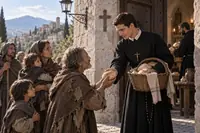 Chapter 3 of 6The convent door and the poor1 min
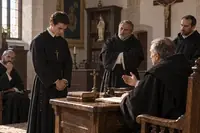 Chapter 4 of 6The storm of a cruel slander1 min
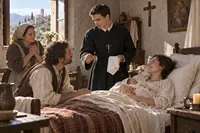 Chapter 5 of 6A dropped handkerchief, and a blessing for mothers1 min
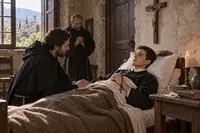 Chapter 6 of 6Twenty-nine years given wholly to God1 min
Feast day
Saint Gerard Majella
Some places may celebrate on a slightly different day.
October 16
Patron of
- Expectant mothers, for a safe childbirth
- Unborn children
Often depicted with
- A handkerchief
- A crucifix
Opening
Opening
Some ordinary people leave others feeling loved and valued wherever they go. They remember everyone’s troubles, stop when they hear a sigh, and always find a way to share what little bread they have.
That is how the poor of southern Italy remember Brother Gerard Majella, with warmth, as one of their own.
He did not live long: twenty-nine short years on this earth. Yet this thin, frail man found his way so deep into the hearts of families that, generation after generation, expectant mothers still call on him like a brother of their own, asking him to keep their unborn child safe.
Chapter 1 of 6
The poor tailor of Muro Lucano
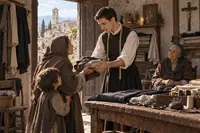
Gerard was born on April 6, 1726, in the town of Muro Lucano in Basilicata, a rugged, mountainous region of southern Italy where peasants toiled bent over the soil all year and stayed desperately poor. His father, Domenico Majella, was a poor tailor; his mother was Benedetta Galella. The family never had enough. From his devout mother, little Gerard received the gift of faith and a habit of fervent prayer that stayed with him all his life.
When Gerard was twelve, his father died, and the boy had to start earning a living far too early. He left school and learned tailoring to earn his bread.
During his years as an apprentice, and then as a servant in the household of the bishop of Lacedonia, he had to endure harsh, unjust treatment and terrible abuse. Gerard bore it all in silence, seeing it as a chance to share in the sufferings of Jesus.
In 1745, Gerard went home and opened a small tailor’s shop. He divided the little he earned into three parts: one to support his elderly mother and his sisters, one for the poor, and the rest to have Masses offered for the souls of the dead.
The young tailor did not wait to enter a religious house before he became generous. His generosity grew day by day in the middle of a craftsman’s hard struggle to make a living. The hands that measured cloth and threaded needles were the same hands that opened to give.
Gerard loved Jesus in the Eucharist deeply, and often spent whole nights kneeling before the tabernacle. He wanted to give his whole life to God in a religious order. He applied to the Franciscans but was turned down because he was too thin and frail. The closed door did not put out the fire in his heart.
Chapter 2 of 6
Running after the missionaries
In April 1749, priests of the Redemptorists came to preach a mission in Muro Lucano. Saint Alphonsus Liguori had founded the congregation not long before to go out to the remote country districts around Naples that no one bothered to visit, and preach to poor, forgotten peasants. This missionary spirit, turned toward the abandoned poor of the countryside, touched Gerard’s deepest longing. He begged to join them.
Seeing how pale and sickly the young man was, the missionaries shook their heads, afraid he would not be strong enough for religious life. His mother, out of love, even locked him in his room on the day they left town.
But Gerard tied his bedsheets into a rope and climbed down from the window, leaving a short note that brought a lump to his mother’s throat:
“Mother, forgive me, I am going to become a saint!”
He ran for many kilometers after the missionaries until they gave in and took him on trial at their house in Deliceto.
On July 16, 1752, Gerard made his profession in the Redemptorists as a lay brother. The young brother was given the hardest jobs: gardening, carrying water, cooking, sewing, keeping the door and looking after the chapel. The one they had thought too frail became the hardest-working, most cheerful and most useful member of the community.
Chapter 3 of 6
The convent door and the poor
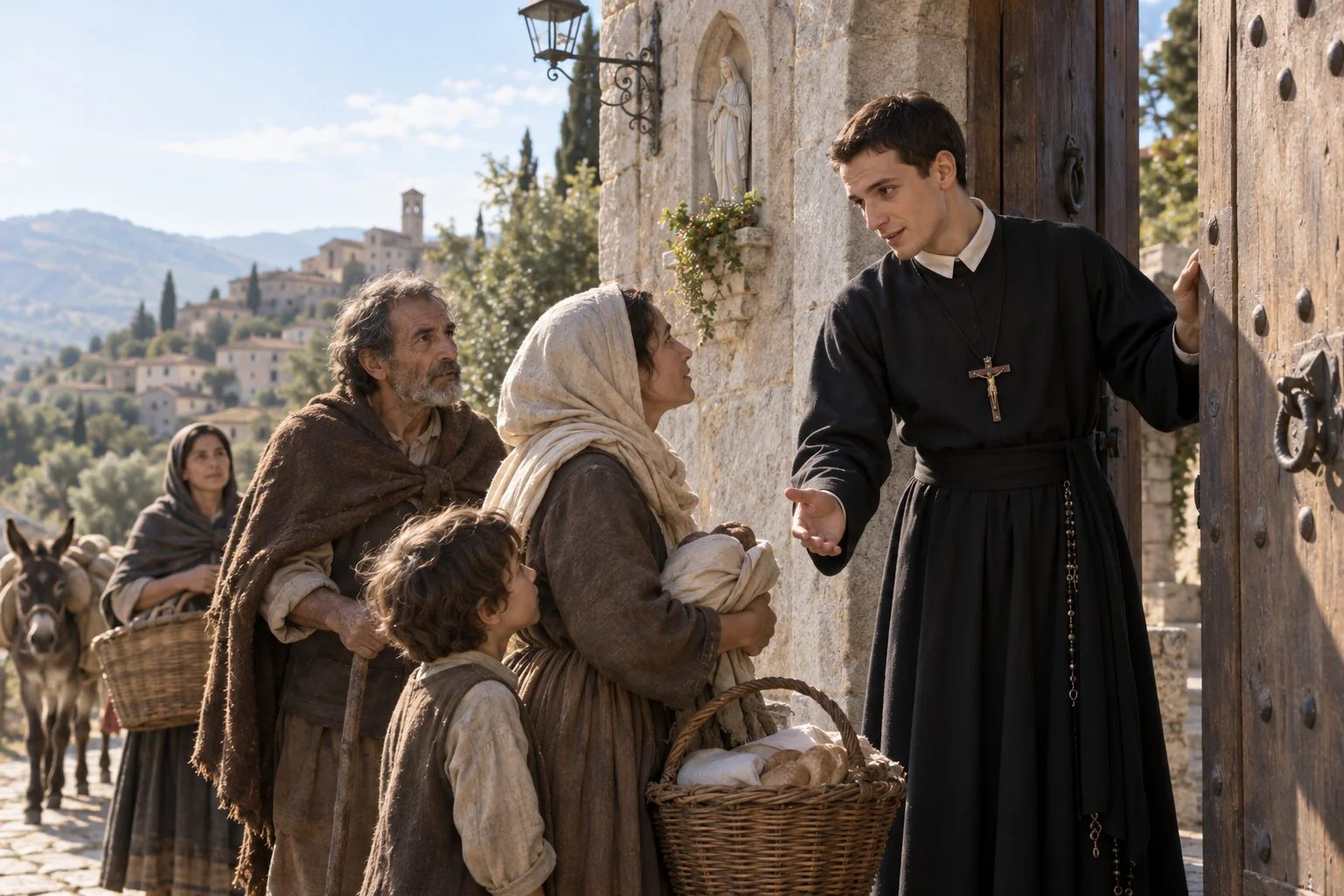
As porter, Gerard did more than open and bolt the door. His door became a place of peace for the poor. The hungry came begging for food, the despairing for comfort, the sick for prayer. He welcomed them with love and shared down to the last crust in the kitchen.
He traveled through the poor villages of southern Italy, meeting peasants hit by crop failure and hunger, and families in rags. He encouraged the despairing, strengthened the faith of poor young women and brought God into every thatched hut.
Prayer before the Eucharist never drew him away from the pain of others. It helped him see the face of the crucified Jesus in the ragged brothers and sisters standing in front of him.
Chapter 4 of 6
The storm of a cruel slander
In 1754, Gerard faced the most terrible trial of his life. A young woman named Neria Caggiano, whom he had once helped, had fallen into sin; egged on by others, she wrote to the founder, Saint Alphonsus, claiming that Brother Gerard had committed a sin of impurity with another young woman.
He was summoned before the Superior General. Faced with that monstrous, shameful charge, Gerard only bowed his head in silence and said not a word in his own defense. He followed the example of Jesus, silent before Pilate.
He was punished severely. He was forbidden all contact with outsiders and, most painful of all, forbidden to receive Holy Communion. At times his longing for the Eucharist burned so fiercely that he asked to be excused from serving Mass, for fear he could not hold himself back and would run up and seize the Host.
Not long afterwards the accuser fell gravely ill and, tormented by her conscience, wrote a letter admitting that she had made the whole thing up. Brother Gerard was fully cleared.
When Saint Alphonsus gently asked why he had not said a word to clear himself, Gerard humbly replied:
“Father, our Rule teaches us to bear correction patiently and not to defend ourselves. I trusted that God would arrange everything at His own right time.”
His good name was restored, and he calmly went back to sweeping and cooking as if nothing had happened. He bore no grudge against the woman who had harmed him.
Chapter 5 of 6
A dropped handkerchief, and a blessing for mothers
On one of his pastoral journeys, as he was leaving the home of an acquaintance in Oliveto Citra, Brother Gerard dropped his handkerchief. A young girl of the house picked it up and ran after him with it, but he smiled and said:
“Keep that handkerchief, my child, one day you will need it!”
Many years later, when the girl had married and was expecting her first child, she had a dangerous labor, and both mother and child were close to death. The doctor and the family could do nothing.
In that life-and-death struggle, she suddenly remembered Brother Gerard’s words. She asked her family to bring the handkerchief and lay it on her, and begged him to pray for her. The pain went away, the danger passed, and she gave birth to a healthy child. Mother and baby were both safe and well.
Ever since, the little handkerchief has been a beloved sign of a parent’s love. All over the world, millions of expectant mothers have turned to Saint Gerard for protection through pregnancy and childbirth.
Such prayer does not replace doctors, but it brings the mother deep peace and reminds the whole family to cherish the new life God has given.
Chapter 6 of 6
Twenty-nine years given wholly to God
In the summer of 1755, tuberculosis ravaged Brother Gerard’s body. He lay sick at the house of Materdomini in Caposele. On the door of his room he had a small sign hung that summed up his faith:
“Here the will of God is done, as God wills, and for as long as God wills.”
On the night of October 16, 1755, Brother Gerard Majella died peacefully and went home to God, only twenty-nine years old. The poor of the whole region poured in to mourn one of their own.
Pope Leo XIII beatified him on January 29, 1893, and Pope Saint Pius X canonized him on December 11, 1904. The Church celebrates him on October 16 each year.
For Vietnamese believers, especially in parishes closely connected with the Redemptorists, Saint Gerard is a beloved friend of the poor, of manual workers and of mothers.
His short life reminds us that you do not need a long life to do great things. If we put our whole love into each small task in front of us, open the door wide to those who are suffering and do God’s will faithfully each day, our ordinary lives too will spread the fragrance of holiness.
The end of the story
You have walked with Saint Gerard Majella to the end of the story.
You will hold on to these:
Climbing out of a window to run after the missionaries, leaving a note: "Mother, forgive me, I am going to become a saint!"
Falsely accused of a shameful sin, he only bowed his head in silence and said not a word in his own defense.
A handkerchief dropped by chance, which many years later saved a mother’s life in a moment of danger.
Stay in silence
One thing stays with you: you do not need a long life to do great things, only to put your whole love into each small task in front of you every day.
Even a short life has time to spread its fragrance, if each day is lived with a love that keeps nothing back.
Let us pray
Saint Gerard,
you climbed out of a window to follow the missionaries, leaving only a note: "I am going to become a saint!" When you were slandered, you bowed your head in silence.
You are the patron of expectant mothers. Pray for mothers waiting to give birth, that mother and child may both be safe and well.
Teach me to keep silent when I am misunderstood, and to put my whole love into each small task of the day.
Amen.
Sources
Meet the next one
 Journey 2