

Journey 2 · Holiness Under One Roof
Saint Helena
A mother who set out to find the Lord’s footsteps
Feast day August 18
Tap to step inside
Saint Helena
A mother who set out to find the Lord’s footsteps
Map of a life
This life told in 5 chapters
Begin the journey OpeningOpening1 min
 Chapter 1 of 5From a quiet corner of the empire1 min
 Chapter 2 of 5A son who came back for his mother1 min
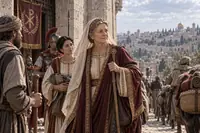 Chapter 3 of 5Darkness in the palace, and a journey to the Holy Land1 min
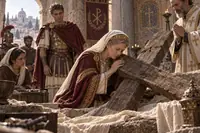 Chapter 4 of 5The Cross in the arms of memory1 min
 Chapter 5 of 5The last pilgrimage, home to the Father1 min
Feast day
Saint Helena
Some places may celebrate on a slightly different day.
August 18
Other feast days
- Honored together with Constantine in the Eastern tradition · May 21
Patron of
- Archaeologists
- Converts
- Those with difficult marriages
Often depicted with
- The Cross
- An empress’s crown
- Nails
Opening
Opening
When Helena decided to make her great pilgrimage to the Holy Land, her hair was already white with age. The woman who bore the title of Empress of Rome was long past the age of worldly dreams. Behind her lay a life full of upheaval: she had been cast aside in humiliation, pushed to the margins of power, then suddenly raised to the very height of imperial glory.
Yet the places this elderly woman longed to reach were not the battlefields where her son the emperor had won his victories.
- She went to the little village of Bethlehem, where the Son of God was born in the poverty of a manger;
- she went to Jerusalem, where He shed His blood on the Cross and rose in triumph;
- she went to the Mount of Olives, where the promise of peace was given to the Apostles.
A person can climb to the very summit of worldly glory with a heart still weighed down by worry, until their feet find the place where their soul can rest.
Chapter 1 of 5
From a quiet corner of the empire
Helena was born around the middle of the third century (about 248 to 250), possibly in Drepanum in Asia Minor, in present-day Turkey. Of her birth and early years, history says nothing. The ancient writers all agree that she came from a very humble background, far from the silks of the court. One historian even says she worked at a roadside inn before meeting the man who would become her husband, though that cannot be verified.
She shared her life with Constantius Chlorus, a gifted officer rising through the ranks of the Roman army. In the early 270s they had an only son, Constantine, whom history would call Constantine the Great.
At the end of the third century, when Constantius became one of the empire’s co-rulers, ambition led him to cast Helena aside without pity and marry Theodora, the stepdaughter of the emperor Maximian, to strengthen a political alliance.
For nearly twenty years after that, Helena lived in complete obscurity, out of sight at the edges of history. She had to swallow the pain of a wife discarded for political schemes in which she had no say. History has kept no letters to tell us how many nights she wept. But the fact that she was pushed aside is enough to remind us that behind the glittering names of great dynasties there are always families full of wounds and tears.
During all that time on the sidelines, no one knows how Helena lived, or how she raised her only son so that he did not grow up resentful and bitter toward the father who had abandoned his mother. We know only that when the time came, that son had not forgotten his mother, though they had been apart for nearly twenty years. Perhaps those silent, humiliating years had quietly rooted in Constantine a love for his mother that nothing could shake.
Chapter 2 of 5
A son who came back for his mother
In 306, Constantius died at York, in Britain. The army immediately proclaimed his son Constantine as ruler. As soon as power was in his hands, the new emperor’s first act was to bring his beloved mother back to the palace and restore her to full honor. In 324, Constantine formally gave his mother the highest title of all: Augusta, that is, Empress.
Gold coins bearing her portrait circulated throughout the empire. The woman once cast aside now stood at the very summit of rank.
It was also a turning point in the history of the Church. After bloody persecutions lasting nearly three centuries, the Edict of Milan in 313 opened an era of freedom for Christians. Churches were rebuilt, and prayers were raised openly in the streets.
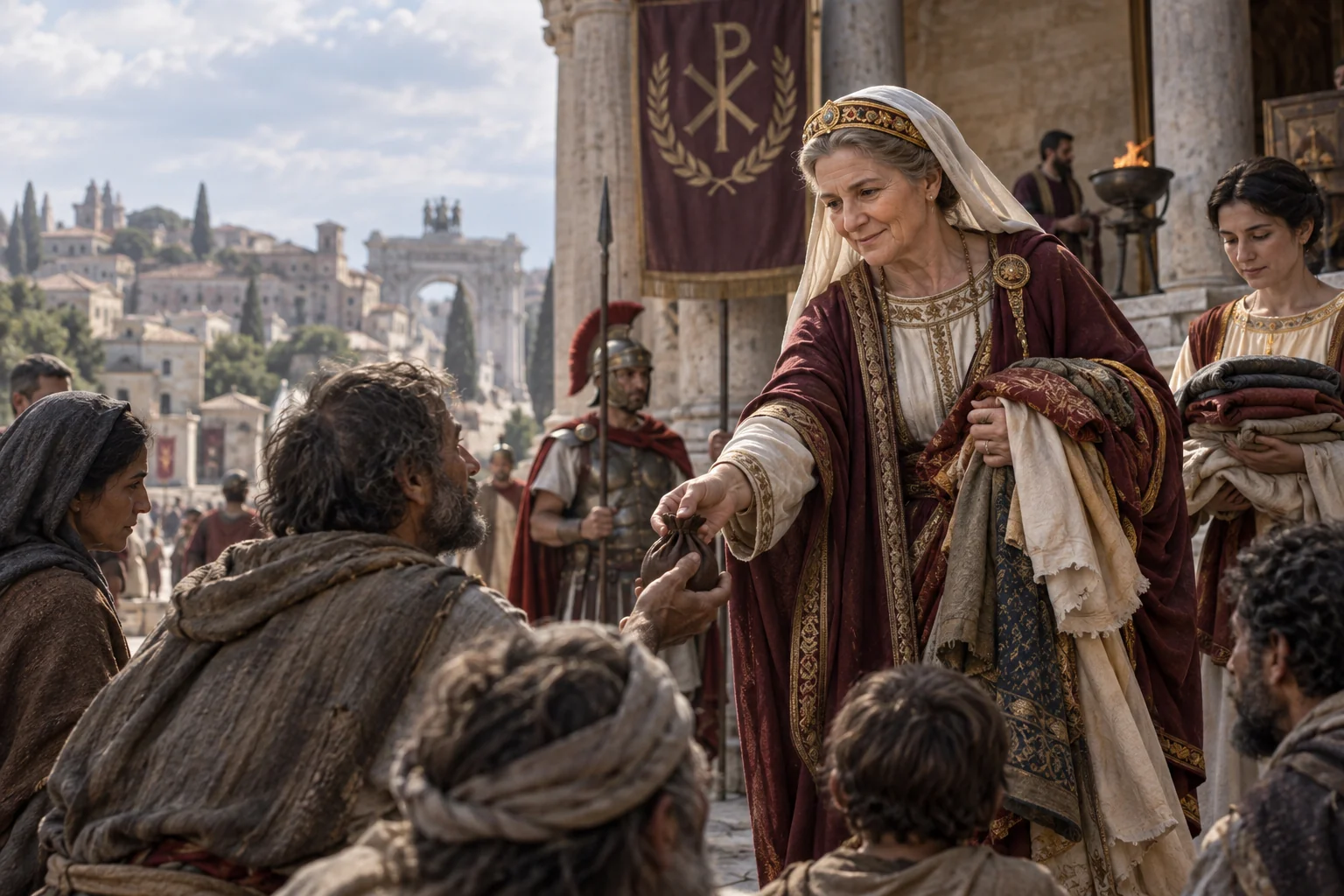
Helena embraced the Christian faith late in life. The historian Eusebius, her contemporary, praised her extraordinary fervor. Her faith quickly turned into action: she used all her income and influence to expand works of charity. She gave money and clothing to the poor and hungry; intervened to free prisoners held unjustly; supported slaves condemned to the mines; and welcomed exiles returning home.
She did not use her power to threaten people or to indulge herself. In her hands it became a way to ease the pain of the weak.
Chapter 3 of 5
Darkness in the palace, and a journey to the Holy Land
Yet no height of glory can keep tragedy away from a family. In 326, a bloody event broke out within the imperial family itself: Constantine, out of suspicion, ordered the execution of his own eldest son, Crispus, and not long afterwards, the empress Fausta also lost her life amid the dark twists of power.
The devout old mother saw those cruel rifts in the palace from close by. Around 326 to 328, when she was nearly eighty, Helena decided to make a long pilgrimage to the Holy Land.
She did not set out to go sightseeing. She carried the whole weight of her earthly life, the storms of her family and the little time she had left, to fall on her knees before the one true King: Jesus Christ.
In Palestine, she sponsored the building of great basilicas at the holiest sites: the Church of the Nativity in Bethlehem, the Church of the Ascension on the Mount of Olives, and the Church of the Holy Sepulchre in Jerusalem. Those churches gave every later generation of believers a real place to gather, to pray, and to stand where the events of salvation actually happened.
Historians of the time tell that she often joined the faithful at prayer in very plain clothes, mingling with the poor and praying beside them. Before God, the title of Empress meant nothing; she was simply a sinner in need of His mercy like everyone else.
Chapter 4 of 5
The Cross in the arms of memory
The ancient tradition of the Church has long linked Saint Helena’s name with finding the true Cross of Jesus on Calvary. The old accounts tell of a painstaking excavation beneath the foundations of a pagan temple, the finding of three crosses, and a healing that showed which was the wood on which the Lord had hung. Even today, pilgrims to Jerusalem are led down to an ancient cistern deep beneath the Church of the Holy Sepulchre, where tradition holds that she found that Cross.
In honesty, we should note that the “Life of Constantine” by the historian Eusebius — the earliest and most important source, written in that very era, about rediscovering the Lord’s tomb and building the first church there — makes no mention at all of finding the Cross. The detail first appears clearly in the sermons of Bishop Cyril of Jerusalem, around 350, nearly a quarter of a century after her pilgrimage. Even if devout storytelling gathered around the early accounts over time, the image of Saint Helena embracing the Cross has lived on in the heart of the Church and has lost none of its spiritual power.
It is an image that moves us deeply: the mother of the Roman emperor bending down to embrace what had been that empire’s most shameful instrument of death.
The Cross overturned every earthly measure of power. God’s true authority does not reign on a dazzling throne, but shines in love that gives itself to the last drop of blood. Whoever stands before the Cross must learn humility and service all over again.
Chapter 5 of 5
The last pilgrimage, home to the Father
Helena died around 329 or 330, at about eighty years of age. The historian Eusebius records that the emperor Constantine stayed constantly at her bedside, holding his mother’s thin hand tightly in her final hours.
After all the glory and wealth of the empire, the image that lingers at the end is still a warm family scene: an old mother about to go on her last journey, and her devoted son beside her. Every earthly throne is powerless before death; all that remains is a mother’s love and the hope of eternal life.
The Church celebrates Saint Helena on August 18 each year; the Eastern Churches honor her together with the emperor Constantine on May 21.
For Vietnamese believers, Saint Helena’s story brings a very real comfort: old age is never the end. Someone who has been abandoned, who has lived through the pain of a broken family, can still use the rest of their life to do good for God and for others. She traveled far to find the footsteps the Lord left long ago, and everywhere she went, her kindness left footprints of mercy of its own.
The end of the story
You have walked with Saint Helena to the end of the story.
A few images you will not easily forget:
Cast aside by her husband for political gain, she lived hidden for nearly twenty years, and history does not mention her once.
At nearly eighty, she set out on pilgrimage to the Holy Land, falling on her knees before the one King no empire could match.
It is told that she found the true Cross, then bent down to embrace the very instrument that had been the shame of the whole empire.
Stay in silence
Thinking it over, you see: a person can climb to the summit of worldly glory with a heart still heavy, until they find the place where their soul can truly rest.
Old age is not the end. It can be the moment a person sets out to seek what matters most.
Let us pray
Saint Helena,
you were abandoned and lived in obscurity for many years. Then, at nearly eighty, you still set out for the Holy Land and knelt before the Cross of the Lord.
Pray for those who have been abandoned and betrayed. May they find the place where their soul can rest in God.
May the elderly never think their time is over, for at any age we can set out to seek God.
Amen.
Sources
- Feast dayAuthor’s edited profile
- Patron ofPatronages and symbols, version 1.1
- Often depicted withPatronages and symbols, version 1.1
- Reflectionnewadvent.org
- Reflectionvaticannews.va
Meet the next one
 Journey 2