

Journey 2 · Holiness Under One Roof
Saint Nicholas of Myra
A gift that left no name
Feast day December 6
Tap to step inside
Saint Nicholas of Myra
A gift that left no name
Map of a life
This life told in 4 chapters
Begin the journey
Feast day
Saint Nicholas of Myra
Some places may celebrate on a slightly different day.
December 6
Patron of
- Children
- Sailors and seafarers
- Schoolchildren
- Russia and Greece
Often depicted with
- Three bags of gold (or three golden balls)
- A bishop’s miter and crozier
- An anchor
Opening
Opening
A gift can make the one who receives it overjoyed. But some gifts, given clumsily and with fanfare, make the receiver hang their head, as if their self-respect had been put on display to show off someone else’s kindness.
In the old stories of Saint Nicholas, what is most beautiful is the way he gave: slipping quietly through the night, so that a poor family could be rescued from destitution without ever having to lay its misery bare before the curious eyes of the whole neighborhood.
Behind the white-bearded figure of Santa Claus, who has traveled so far in today’s Christmas culture, stands a bishop of the early Church who spent his whole life on the side of the most fragile people.
Chapter 1 of 4
A shepherd on the Mediterranean shore
Saint Nicholas lived in the fourth century and was bishop of Myra, in the region of Lycia in Asia Minor, now Demre in Turkey’s Antalya province. That much is firm historical ground. His birth, his parents and even his youth have mostly come down to us through later pious legends rather than any record written in his own time.
Myra was then one of the six most important cities of the Lycian League, important enough to hold three votes in the league’s council — no small standing among the coastal city-states. The harbor serving the city was called Andriake, a few kilometers from the center of Myra toward the sea. A huge granary built under the emperor Hadrian still stands there today, along with towering heaps of murex shells — traces of a time when Andriake processed purple dye, one of the most precious goods of the ancient world, which colored the robes of kings and nobles. The busy port later silted up, and today, standing in a dry field, it is hard to imagine ships once crowding in and out.
Tradition says Nicholas was born in Patara, a prosperous port city nearby, into a well-off family. His parents died early, leaving him a large fortune. Instead of using that money to live in comfort, the young man quietly shared it with people in need.
People who live by a harbor know how precarious life is: ships come in bringing goods, news and wealth, but when they weigh anchor and sail away, they leave mothers and wives anxiously watching for them every day. Someone might do brisk business today, and after one storm at sea be penniless tomorrow. In so uncertain a world, a man ready to share his wealth brought real comfort to many a table and many a home.
Nicholas was chosen bishop of Myra. He lived through the last brutal years of persecution under the emperor Diocletian, and witnessed the Church’s turn to freedom under the emperor Constantine. The stories that he was imprisoned for his faith, or was present at the Council of Nicaea in 325, come from tradition, and there is not enough evidence to confirm every detail. But what the faithful have treasured for centuries is the image of a shepherd steadfast in a pure faith, who wholeheartedly defended the weak and the friendless.
Chapter 2 of 4
Three daughters, and a future rescued
Of all the old stories about Saint Nicholas, the one about the three poor daughters has been the most loved by ordinary people through the centuries.
The story goes that in the city there was a father who had once been well-off but had fallen into destitution. He had three daughters of marriageable age but not a coin for their dowries. In those days a girl without a dowry had almost no future, and the father, in his desperation, was thinking of selling his daughters into prostitution to put food on the table.
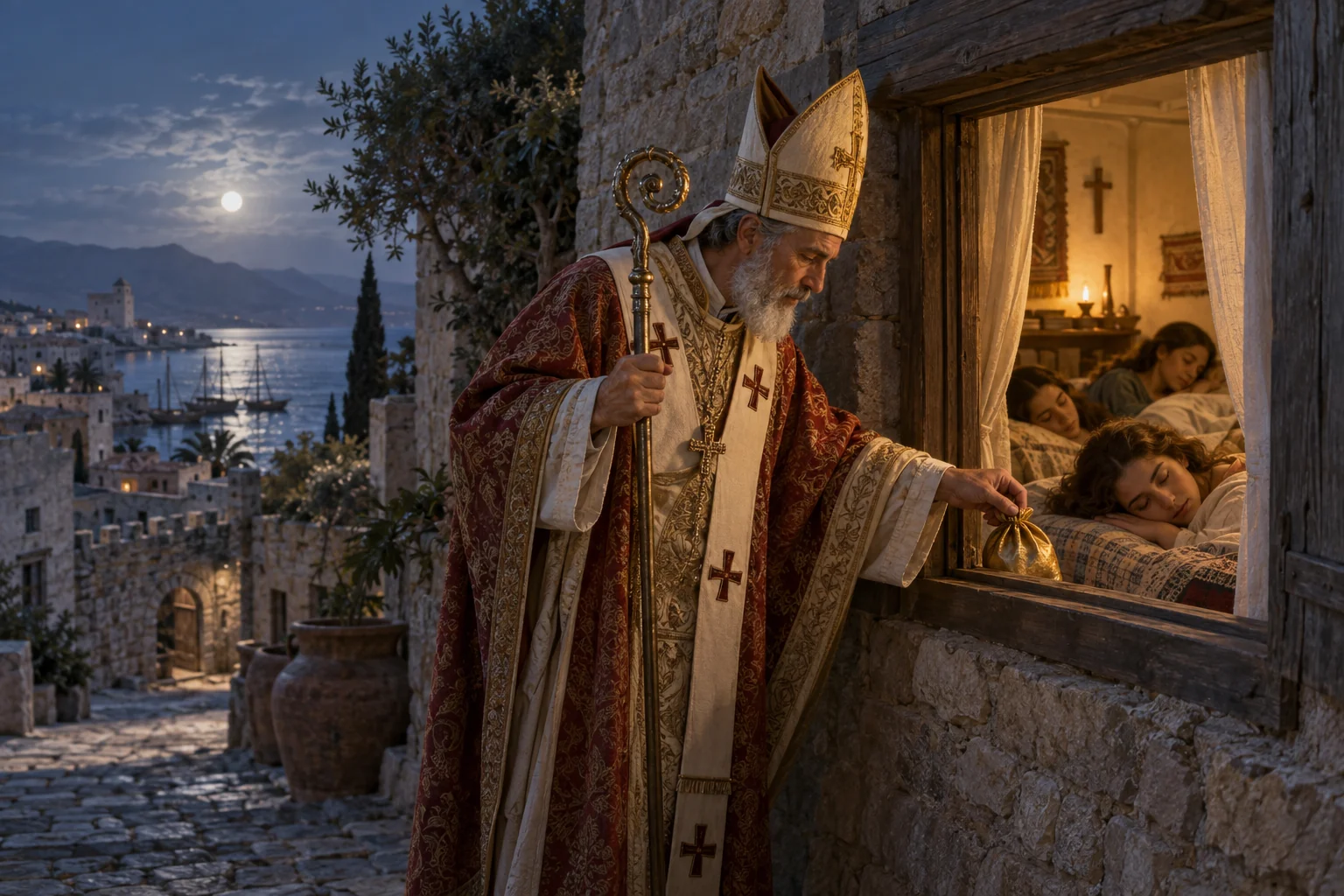
When he heard of it, late one quiet night Bishop Nicholas slipped up to the poor man’s window and tossed in a bag of gold, enough to provide a dowry for the eldest daughter. Some time later, he came again and tossed in a second bag of gold for the next daughter.
The third time, the father resolved to stay awake all night to see who his family’s benefactor was. As soon as the bag of gold fell through the window, he rushed outside and caught up with him. Recognizing the city’s kind bishop, the father fell at his feet weeping with gratitude. But Saint Nicholas firmly told him to keep it secret and never tell anyone as long as he lived.
That gesture reveals a heart that understands another’s pain, and helps in a way that leaves the dignity of the one being helped completely intact.
The three poor girls did not just receive a few gold coins. They were given back an honest future that had been teetering on the edge of the abyss. That anonymous gift became a firm bridge on which they could walk on through life with their heads held high.
In charity, sometimes the hardest thing is not how much money we give, but whether the giver is willing to step back and not make himself the center of everyone’s praise. Givers often want to be thanked, to have their names recorded, to have someone witness their good deed. Saint Nicholas teaches the opposite: step back into the shadows, so that the life of the one you help can step confidently into the light.
Later, the image of three bags of gold tossed through a window left an unexpected mark on Western folk culture: this detail is thought to have inspired the symbol of three golden balls — a sign still seen hanging outside pawnshops in Europe today, a distant reminder of the bishop who quietly rescued ruined families.
Chapter 3 of 4
A friend of seafarers
Devotion to Saint Nicholas spread especially deeply among sailors and those who make their living on the water. Many stories tell of him appearing to help ships through violent storms, intervening to save people unjustly condemned, and arranging grain relief for the people in years of famine.
For seafarers, the ocean is both the livelihood that feeds the whole family and the place where people realize most clearly how powerless they are. When the shore has disappeared far behind, with wind and waves roaring all around, a prayer asking Saint Nicholas to intercede brings peace and trust in God.
Families in the fishing villages along Vietnam’s coast know well the anxious wait for loved ones after every trip out to sea. Even if not every place has a particular devotion to him, the heart of people who depend on the sea is the same everywhere: out on the open water a loved one is facing danger, and in the little house there is always a lamp kept burning, waiting.
Saint Nicholas is remembered as defender of children, protector of the falsely accused, and father of the poor. They are very different people, yet they share one need: someone kind enough to stand up for them when they can no longer defend themselves.
Chapter 4 of 4
A long journey after his rest
He died peacefully around the middle of the fourth century in Myra. December 6 became his traditional feast day.
In 1087, amid the complex political and religious upheavals of the time — as Asia Minor was gradually falling into the hands of the Seljuk Turks — sailors from the city of Bari in southern Italy took most of his relics from Myra and brought them to be buried in their own city. The Basilica of Saint Nicholas in Bari, begun that very year to receive the relics, quickly became a bustling pilgrimage center, joining the devotion of both the Eastern and Western Churches — one of the few places in the world where Catholics and Orthodox come to pray together at the same altar.
Over many centuries in Europe, the custom of secretly giving presents to children on the eve of Saint Nicholas’s feast took firm hold, especially in the Netherlands, Germany and Central Europe. Much later, when the Dutch carried their image of “Sinterklaas” to the new lands of North America, the figure of Santa Claus at Christmas slowly took shape. Yet the bishop of Myra stands for something far deeper than gifts bought in a store: true generosity, which looks to those who have nothing to give back.
In 2004, forensic scientists at the University of Bari, working with facial reconstruction expert Caroline Wilkinson of the University of Manchester, rebuilt Saint Nicholas’s face from measurements of his skull kept for decades in the crypt of the basilica in Bari. The result showed a square face with high cheekbones, typical of the people of the eastern Mediterranean in the fourth century — and notably, a nose that had once been broken and had healed crooked. No one knows exactly where that injury came from: a beating in prison during the persecution, an everyday accident, or a mark of old age. But that small detail, lying quietly in his own remains for seventeen centuries, says something simple: we are used to picturing the saints with serene, gentle faces as in paintings, when in fact they were people of flesh and blood, bearing the marks of suffering and stumbles, just like any of us.
To give a gift in silence is to give the receiver the chance to stand up straight. Saint Nicholas shows us a rare kind of tact: coming close enough to others to understand their suffering, helping just enough to lift them to their feet, then quietly withdrawing so they keep their full dignity as children of God.
The end of the story
You have walked with Saint Nicholas of Myra to the end of the story.
Some details keep coming back to you:
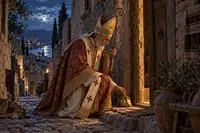
In the middle of the night, he quietly tossed a bag of gold through a poor father’s window, then asked that no one be told.
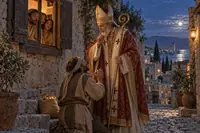
Caught by the watching father, he only sternly told him to keep the matter secret all his life.
Seventeen centuries later, his face was rebuilt from his skull — and it turned out he too had once had a broken nose, an everyday wound like anyone’s.
Stay in silence
You come to understand: giving in silence gives the receiver the chance to stand up straight — no one needs to know who gave.
The most beautiful gift is one that asks for no thank-you.
Let us pray
Saint Nicholas,
in the middle of the night you tossed bags of gold through the window of a poor father, then asked that no one be told.
Teach me to give in silence, without needing anyone’s thanks, without needing my name to be mentioned.
You are the patron of children. Watch over the little ones in my family and my parish. Pray for poor children and orphans, that they may be loved and have a home.
Amen.
Sources
- Feast dayAuthor’s edited profile
- Patron ofPatronages and symbols, version 1.1
- Often depicted withPatronages and symbols, version 1.1
- Reflectionnewadvent.org
Meet the next one
 Journey 2