

Journey 5 · Seeking God in Silence
Saint Clare of Assisi
Light in a room of silence
Feast day August 11
Tap to step inside
Saint Clare of Assisi
Light in a room of silence
Map of a life
This life told in 5 chapters
Begin the journey OpeningOpening1 min
 Chapter 1 of 5A noble flower of the Offreduccio family1 min
 Chapter 2 of 5That Palm Sunday night1 min
 Chapter 3 of 5The family’s fury and the refuge of San Damiano1 min
 Chapter 4 of 5“The privilege of poverty” and the miraculous Bread1 min
 Chapter 5 of 5A peaceful death and an enduring mirror2 min
Feast day
Saint Clare of Assisi
Some places may celebrate on a slightly different day.
August 11
Patron of
- Television (proclaimed by Pius XII in 1958)
- The Poor Clares
- Those with eye trouble
Often depicted with
- A monstrance
- A lamp
Opening
Opening
When people hear of Assisi, they usually think first of Francis, tramping the hillsides, preaching to the birds, kissing the leper. But beside that young man was a woman who gave herself to God in a different way: not wandering the roads, but staying behind the stone walls of the convent of San Damiano for more than forty years.
That woman was Clare. She was born into a wealthy noble family, with servants and a future already arranged through powerful alliances. Then one spring night she cut off her golden hair, took off her jewels and put on a rough habit.
From that small room, filled with the light of faith, she guarded a precious treasure for the Franciscan movement: the ideal of absolute poverty, which no earthly power could buy or water down.
Chapter 1 of 5
A noble flower of the Offreduccio family
Chiara Offreduccio, known in English as Clare, was born on July 16, 1194, in Assisi, Italy, into one of the most distinguished noble families of Umbria. Her father, Favarone di Offreduccio, was a powerful count from a family of knights; her mother, Ortolana, was a devout noblewoman who had made pilgrimages as far as Rome, Santiago de Compostela and the Holy Land.
Tradition tells that while Ortolana was pregnant and kneeling before a crucifix to pray for a safe delivery, she heard a voice say:
“Do not be afraid, for you will give birth to a brilliant light that will illumine the whole world!”
Because of that prophecy, the baby girl was named Chiara, Italian for “light” or “clear”.
Clare grew up in her family’s magnificent mansion near the cathedral of San Rufino. She learned embroidery, music, letters and the ways of court life. Yet the lavish amusements of her class never captured her heart. From her gentle mother she learned compassion early: she would often set aside the best portions of her food at banquets and secretly send them to the hungry poor outside the city gates.
When Clare came of age, her parents looked for a brilliant match among the wealthiest young nobles of the region. But however hard her family pressed, she refused. She felt a deeper call on her life.
Chapter 2 of 5
That Palm Sunday night
In Lent of 1212, Clare went to the cathedral of San Rufino to hear the young Francis of Assisi preach on repentance and the beauty of the poor Christ. His simple, fiery words went straight to the eighteen-year-old’s heart. She sought Francis out privately to ask his guidance about her vocation.
On Palm Sunday 1212, Clare put on her most splendid gown and went with her family to Mass at the cathedral. When the other young women went up one by one to receive palms from Bishop Guido, Clare, overcome with emotion, stayed where she was. Seeing this, the bishop came down the steps himself and placed the palm in her hand, as if to bless the step she was about to take.
That night, March 18, 1212, Clare and a close friend quietly slipped out of the mansion through an unused side door. She hurried through the dark down into the valley, to the little chapel of the Porziuncola, where Francis and the brothers were waiting with lighted torches.
Before the altar of Our Lady, Clare took off her gold, her jewels and her splendid gown. Francis himself cut off her long golden hair and gave her a rough ash-gray habit tied with a cord and a simple black veil. That night the young noblewoman became “the bride of the poor Christ”.
Chapter 3 of 5
The family’s fury and the refuge of San Damiano
When the Offreduccio family discovered the next morning that Clare had gone, they flew into a rage. Her uncles and kinsmen, knights armed with swords, stormed off to the Benedictine convent of San Paolo delle Abbadesse where she was staying. They tried coaxing her first, then threats and force, bursting in to drag her home.
But Clare ran into the chapel, gripped the altar cloth with both hands, and pulled off her veil to show everyone her shorn hair. She declared firmly:
“I will have no other bridegroom but Jesus Christ!”
Faced with such iron resolve, the noblemen withdrew, defeated.
Only sixteen days later, her fifteen-year-old sister Agnes ran away from home to join her. The family came again, beat Agnes cruelly and tried to drag her off, but through Clare’s prayers the girl suddenly became as heavy as stone. None of them could lift her, and in the end they let her go.
Not long afterwards, Francis brought Clare and her sisters to settle at the small chapel and poor convent of San Damiano outside Assisi, the same crumbling church Francis had restored with his own hands, where the old crucifix that had spoken to him hung. There the Order of Poor Ladies, later known as the Poor Clares or the Second Order of Saint Francis, was born. Later, even her own mother Ortolana and her youngest sister Beatrice asked to enter the convent and live under her guidance.
Chapter 4 of 5
“The privilege of poverty” and the miraculous Bread
In forty-one years at San Damiano, Mother Clare never left the convent. Yet behind those cloister walls was a life ablaze with love.
She fought to the end for what she called the “Privilege of Poverty” (Privilegium Paupertatis): the convent was to own no property and no land that brought in income, and the sisters were to live entirely by the work of their hands and by daily alms.
Out of concern for the sisters, several Popes, among them Gregory IX and Innocent IV, offered again and again to grant the order lands and income, but each time Clare knelt and pleaded:
“Holy Father, absolve me from all my sins, but never absolve me from following the poor Christ!”
She became the first woman in the history of the Church to write a Rule for religious women, and the Holy See approved it only two days before her death.
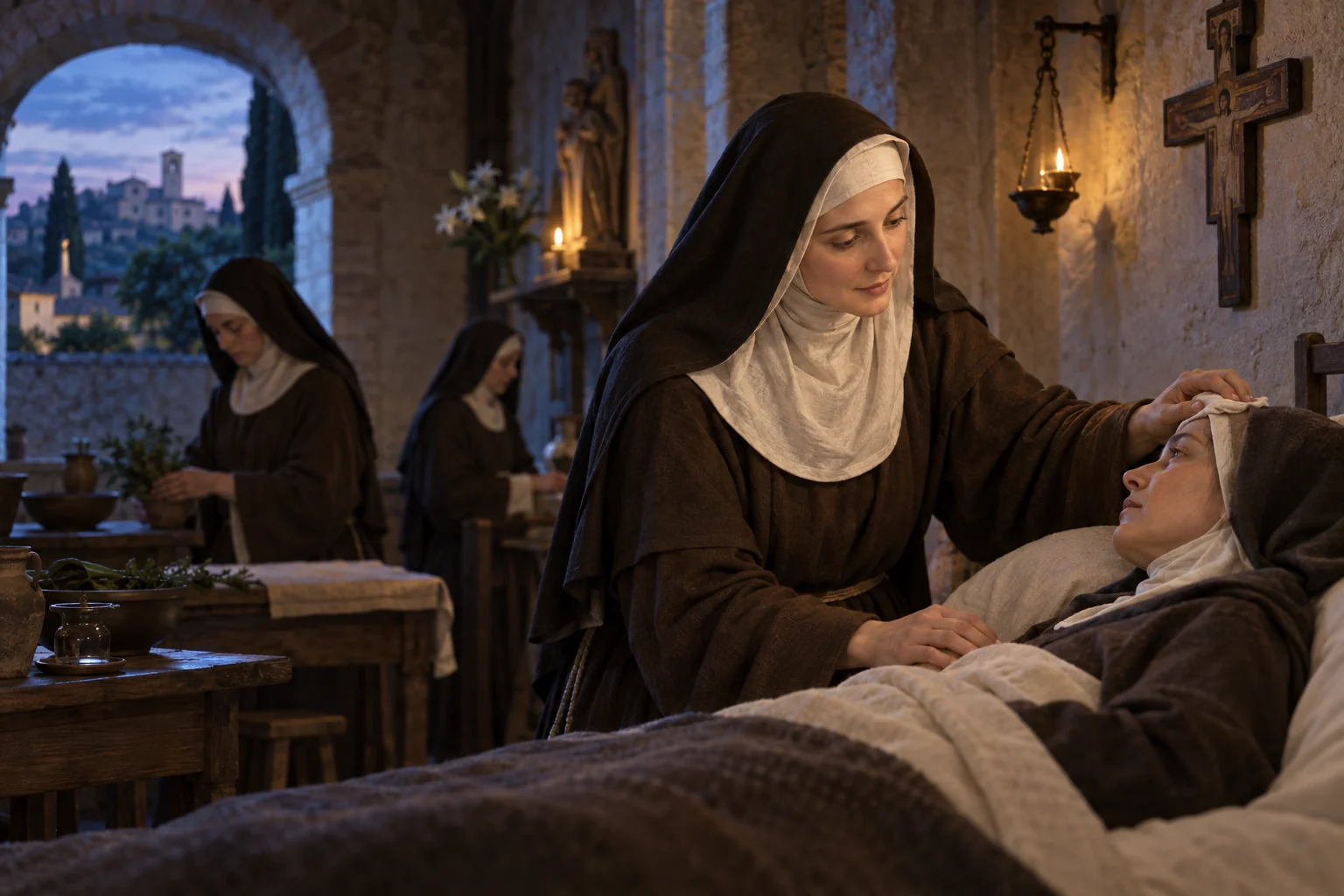
She took the lowliest jobs in the convent: nursing the sick sisters herself, washing linens and clothes, washing the feet of the sisters who came back from begging, and going around on freezing winter nights to tuck a blanket around each one.
In 1240, the brutal Saracen mercenaries of Emperor Frederick II swept through the Spoleto valley, plundering as they went, and set up ladders against the walls of San Damiano. The sisters wept in terror. At the time, Clare was gravely ill and bedridden.
She asked her sisters to help her up and to carry the monstrance with the Body of the Lord to the window facing the enemy. Then she bowed to the ground and prayed:
“Lord, do You wish to hand over these defenseless servants of Yours to the savage pagans? Protect the children who cannot protect themselves!”
A gentle voice spoke from the Host: “I will always protect you!”
Suddenly a dazzling light blazed out from the Eucharist. The terrified soldiers tumbled from their ladders and fled. San Damiano and the whole city of Assisi were saved at the last moment by the power of the Eucharist.
Chapter 5 of 5
A peaceful death and an enduring mirror
For the last twenty-eight years of her life, Mother Clare was almost constantly ill. Yet she always wore a peaceful smile, bright with the joy of the Resurrection.
On Christmas night 1252, too ill to go down to the chapel for Mass with her sisters, Clare lay in her sickbed weeping because she could not adore the Child Jesus. Then God gave her a wonderful vision: on the white wall of her room she saw the whole Midnight Mass being celebrated in the Basilica of Saint Francis, two kilometers away, and heard every note of the music.
Because of this event, in 1958 Pope Pius XII proclaimed Saint Clare patron of television and telecommunications.
At the beginning of August 1253, sensing that the hour had come to go home to the Father, Mother Clare lay in bed clutching the Rule the Holy See had just approved and sent to her.
As her sisters knelt around the bed sobbing, Mother Clare smiled and whispered her last words, spoken to her own soul:
“Go forth in peace, my soul, for you have had a good guide... Bless God, who created you, sanctified you, and loved you with a tender love like a mother for her little child!”
On August 11, 1253, Mother Clare died peacefully at the age of fifty-nine.
Only two years later, on September 26, 1255, Pope Alexander IV canonized Clare of Assisi. A new basilica was built in 1257 on the foundations of an older church to receive her body, but the exact location of the saint’s tomb was forgotten for nearly six centuries, just as had happened to her spiritual father Francis. Only in 1850 were her remains found again, intact, beneath the main altar. In 1987 her relics were placed in a glass coffin in the crypt beneath the basilica, her face covered with a thin layer of wax to preserve her features over the years. The ancient San Damiano crucifix, the one that spoke to Francis, was also brought to this basilica and is kept there, while a copy hangs in its original place in the church of San Damiano for pilgrims to see.
The Church celebrates her on August 11 each year.
Saint Clare teaches us that contemplation is not an escape from life. It means turning one’s soul into a clear mirror that reflects the face of Christ.
She reminds us that a believer’s real strength lies not in swords or money but in complete faith in the Eucharist and a glad, unburdened poverty that entrusts the whole of life to the hands of God.
The end of the story
You have walked with Saint Clare of Assisi to the end of the story.
A few scenes stay with you:
On Palm Sunday night 1212, Clare slipped out of the house, and Francis cut off her golden hair and gave her the rough habit of a "bride of the poor Christ".

When Popes offered her lands and income, she knelt and begged to keep the "Privilege of Poverty", willing to bear anything rather than give up absolute poverty.
When the Saracens attacked San Damiano, she carried the Body of the Lord to the window, and a dazzling light sent the enemy fleeing in panic.
Stay in silence
You come away knowing this: forty-one years without leaving a small enclosure can still be a life ablaze, strong enough to protect a whole city.
Never absolve me from following the poor Christ.
Let us pray
Saint Clare,
you left a mansion to live in poverty for the rest of your life at San Damiano. When the enemy attacked, you simply carried the Body of the Lord to the window, and the city was kept safe.
Teach me to find joy in a simple life, without chasing comfort.
Pray for cloistered nuns quietly praying for the world, and for those who work in communications.
Amen.
Sources
- Feast dayAuthor’s edited profile
- Patron ofPatronages and symbols, version 1.1
- Often depicted withPatronages and symbols, version 1.1
- Reflectionvatican.va
- Reflectionfranciscans.ie
Meet the next one
 Journey 5