

Journey 5 · Seeking God in Silence
Saint Teresa of Ávila
The interior castle, and a woman who weathered the storms
Feast day October 15
Tap to step inside
Saint Teresa of Ávila
The interior castle, and a woman who weathered the storms
Map of a life
This life told in 4 chapters
Begin the journey
Feast day
Saint Teresa of Ávila
Some places may celebrate on a slightly different day.
October 15
Patron of
- Spain
- Those suffering from headaches
- Writers
Often depicted with
- A quill and book
- A heart pierced by a fiery arrow
- The Carmelite habit
Opening
Opening
In the sixteenth century, Spain was one of the most powerful empires in the world, yet religious life had grown slack, compromised and lukewarm. Carmelite convents opened their doors wide to nobles who came for worldly conversation, the rooms were comfortable, even luxurious, and the strict austerity of the early days seemed long forgotten.
In a rigidly male-dominated society, at a time when the Inquisition was examining every word, a sickly, middle-aged nun of Jewish descent rose up and carried out a reform that shook the Church.
She restored the original spirit of poverty of the Carmelites, in what became the Reformed or Discalced Carmel, and she left some of the greatest works of mystical literature of all time: The Interior Castle, The Way of Perfection, and her Life.
That woman was Teresa of Ávila, Teresa of Jesus, the first woman ever named a Doctor of the Church.
Chapter 1 of 4
A dreamy childhood in the stone city of Ávila
Teresa Sánchez de Cepeda y Ahumada was born on March 28, 1515, in Ávila, an ancient city enclosed by massive stone walls in central Spain. Her father, Alonso Sánchez de Cepeda, was a wealthy merchant of noble standing; her mother, Beatriz de Ahumada, was a devout woman who died young when Teresa was only thirteen.
As a child, Teresa was bright, lively and full of imagination. She and her brother Rodrigo were so enthralled by the lives of the martyrs that at seven the two of them ran away from home to go to the land of the Moors and ask to be beheaded as martyrs for Jesus. Their uncle happened to catch the two children outside the city gate and brought them home.
As a teenager, after her mother’s death, Teresa was drawn to romantic tales of chivalry, fine clothes, jewelry and frivolous friends. Worried about his daughter’s future, her father sent her as a boarder to the convent of Our Lady of Grace in Ávila.
There, after fierce inner struggles and serious illnesses, Teresa recognized a call to religious life. Despite her father’s opposition, at twenty, in 1535, she ran away from home and entered the Carmelite Monastery of the Incarnation (the Monasterio de la Encarnación) in Ávila.
Chapter 2 of 4
Twenty years of struggle and a second conversion
The Monastery of the Incarnation at that time had more than one hundred and fifty nuns living under a very relaxed rule: noble nuns had private rooms and servants, and the monastery parlor was always busy with noble visitors coming to chat about worldly affairs.
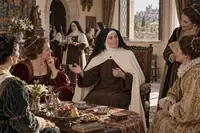
With her charm, intelligence and wit, Teresa quickly became the star of the parlor. She spent hours every day talking with visitors, and little by little neglected interior prayer.
At the same time, one serious illness after another struck her: a paralysis left her unable to move for nearly three years, at one point seemingly dead, with a grave already dug for her. Though her body was partly healed through the intercession of Saint Joseph, her soul was still torn for nearly twenty years between the love of God on one side and empty attachments to the world on the other.
In Lent 1554, at thirty-nine, the decisive turning point came: as she entered the convent chapel, Teresa’s eyes suddenly fell on a statue of Jesus scourged, covered in wounds, gazing at her.
That suffering gaze pierced her heart. Teresa fell to her knees, embraced the feet of the statue, beat her breast and sobbed, begging the Lord to give her the strength never to betray His love again.
It was her second conversion — radical and decisive. From then on she lived a deep mystical life of contemplation, receiving extraordinary graces from God: visions, raptures and above all the “piercing of the heart” (the transverberation), an angel piercing her heart with a fiery golden arrow of divine love.
Chapter 3 of 4
A journey of reform on muleback
Spurred on by the love of God, Teresa saw the urgent need to bring the Carmelites back to their roots of poverty and silence.
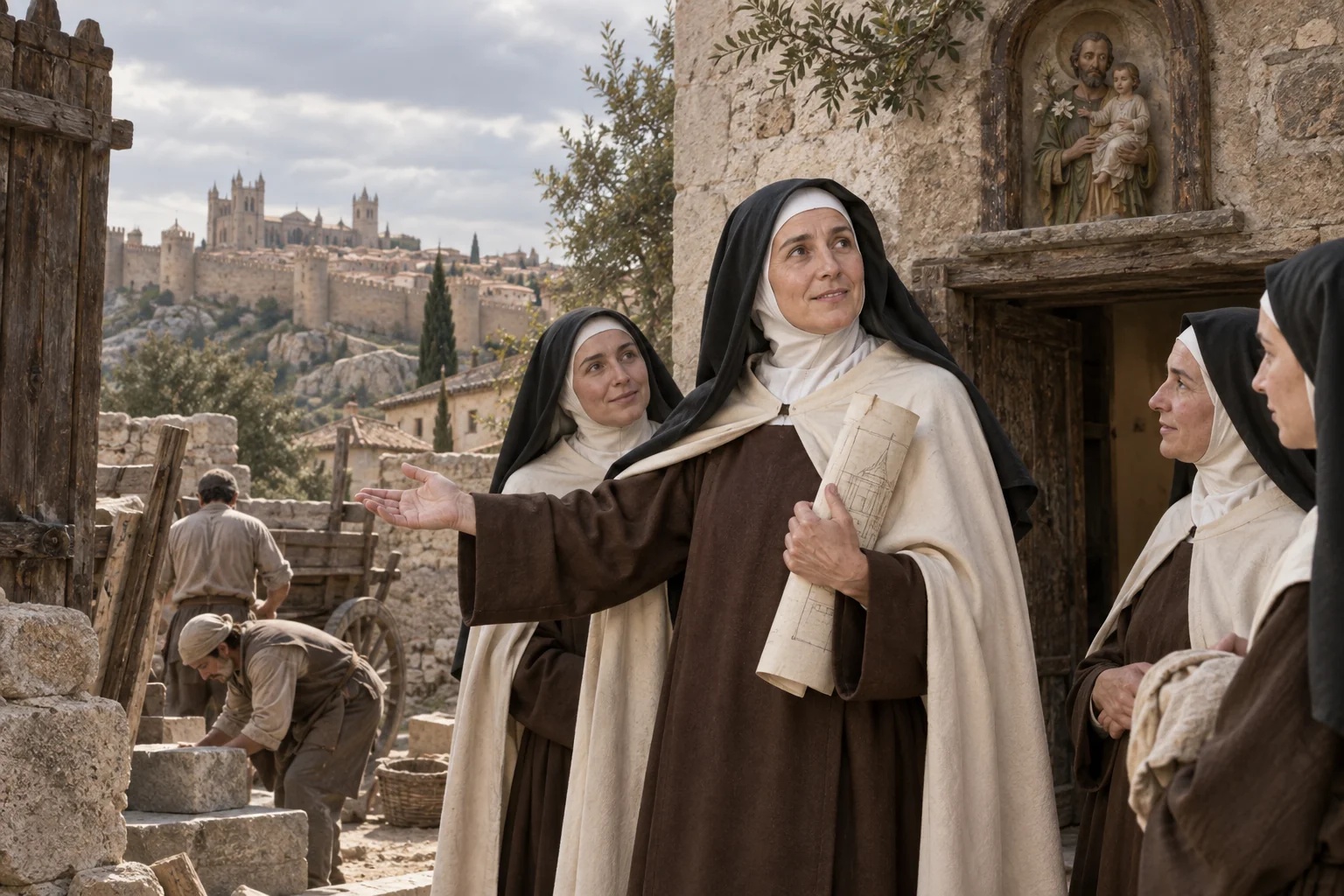
On August 24, 1562, overcoming fierce opposition from the nobility of Ávila and from the nuns of the old observance, Teresa founded the first reformed convent, Saint Joseph’s, in Ávila. There just thirteen nuns lived in absolute poverty: they wore coarse habits and rope sandals — hence the name Discalced Carmelites — fasted all year, kept complete silence and enclosure, and devoted most of their time to contemplative prayer.
In 1567, the Prior General of the Carmelites came on visitation, was deeply impressed by her work, and gave her authority to extend the reform throughout Spain, and permission to found houses for men as well.
It was during this period that she met a gifted young friar, Saint John of the Cross. She passed the fire of reform on to him, and he became her able partner in founding the men’s branch of the Reformed Carmel.
For the next twenty years, that sickly middle-aged woman became a “tireless traveler”. She rode in rattling mule carts all over Spain, through scorching summer sun and winter snow and ice, to found seventeen convents for women.
She faced countless storms: the suspicion of the Inquisition and the fierce opposition of the friars of the old observance — who had John of the Cross imprisoned in a dark cell in Toledo and ordered her confined under house arrest in Toledo.
Yet Teresa always kept her wit and her complete trust. Once, when her mule cart overturned in a muddy stream in a thunderstorm, she looked up to heaven and complained: “Lord, why do You let me suffer so many trials?”, and when she heard the Lord answer in her heart: “Teresa, that is how I treat My friends!”, she replied wittily:
“No wonder You have so few friends!”
She taught her nuns:
“Teresa alone is nothing but a useless zero; but Teresa plus God’s grace and a little money can do anything!”
Chapter 4 of 4
The masterpiece of The Interior Castle, and her hour of triumph
Amid exhausting journeys and tense disputes, in obedience to her confessors, Mother Teresa took up her pen and wrote classic works on the life of prayer.
In “The Interior Castle”, El Castillo Interior, she compares the human soul to a splendid castle made of clear diamond, with seven sets of rooms, seven mansions. The life of prayer is a journey from the outer rooms — full of distraction and sin — gradually toward the deepest center of the castle, the seventh mansion, where the Holy Trinity dwells in the highest mystical union.
She gave a famous definition of prayer:
“Interior prayer is not a matter of thinking much, but of loving much... It is an intimate conversation between friends, taking time frequently to be alone with Him who we know loves us!”
In the autumn of 1582, after a grueling journey to Burgos to found a new convent, Mother Teresa was completely exhausted. She made her way to the convent of the Annunciation at Alba de Tormes near Salamanca — the eighth of the seventeen convents she founded in her lifetime, established in 1571. Lying in her sickbed in a small, cramped room of that convent, she knew the day of meeting her Bridegroom had come.
On the evening of October 4, 1582, clutching her crucifix, Mother Teresa of Ávila spoke her last words:
“Lord, after all, I am a daughter of the Church... It is time, my Bridegroom, it is time for us to meet!”
Then she died peacefully.
That very night, Spain switched from the Julian to the Gregorian calendar, skipping ten days, so her feast was set for October 15 each year.
Pope Paul V beatified her in 1614, and on March 12, 1622, Pope Gregory XV solemnly canonized Teresa of Ávila, on the same day as Saint Ignatius of Loyola, Francis Xavier and Philip Neri.
On September 27, 1970, Pope Paul VI made history: he solemnly proclaimed Saint Teresa of Ávila the first woman Doctor of the Church. To this day her incorrupt body is kept in a reliquary above the main altar in the very room where she died at Alba de Tormes, along with her heart and left arm, venerated separately as treasured relics. In more than four hundred years, the tomb has been opened publicly for veneration only three times: in 1760, in 1914, and most recently in 2025 for the five hundred and tenth anniversary of her birth. In Ávila, on the very site of the house where she was born, a convent and small museum were built that keep her rosary, her rope sandals and the desk she used for writing.
Saint Teresa of Ávila left words that millions of believers know by heart:
“Let nothing disturb you, let nothing frighten you; all things are passing, God alone never changes. Patience obtains all things; whoever has God lacks nothing: God alone suffices!”
The end of the story
You have walked with Saint Teresa of Ávila to the end of the story.
You still keep these three scenes in mind:

At seven, she and her brother ran away from home intending to go to the land of the Moors to be beheaded as martyrs for Jesus, and luckily their uncle caught them in time.

In Lent 1554, her eyes fell on a statue of Jesus scourged and covered in wounds, and she fell to her knees, embracing its feet and sobbing — a second conversion, decisive and complete.
When her mule cart overturned in a muddy stream in a thunderstorm, she complained to the Lord and then answered Him wittily: "No wonder You have so few friends!"
Stay in silence
You smile as you realize: even the deepest mystical soul can love God fervently and still keep a sense of humor in the storm.
Let nothing disturb you, let nothing frighten you; God alone suffices!
Let us pray
Saint Teresa of Ávila,
you sobbed at the feet of the statue of the scourged Christ, and traveled everywhere founding convents amid countless storms. Once, when your cart overturned in a stream, you still teased the Lord: "No wonder You have so few friends!"
Teach me to pray as if talking with a close friend.
Help me keep my cheerfulness and sense of humor in hard times, and remember: God alone suffices.
Amen.
Sources
- Feast dayAuthor’s edited profile
- Patron ofPatronages and symbols, version 1.1
- Often depicted withPatronages and symbols, version 1.1
- Reflectioncarmel.asso.fr
- Reflectioncausesanti.va
Meet the next one
 Journey 5