

Journey 5 · Seeking God in Silence
Saint John of the Cross
The dark night of the senses and the flame of love
Feast day December 14
Tap to step inside
Saint John of the Cross
The dark night of the senses and the flame of love
Map of a life
This life told in 6 chapters
Begin the journey OpeningOpening1 min
 Chapter 1 of 6A poor child among the weavers of Fontiveros1 min
 Chapter 2 of 6A fateful meeting with Mother Teresa of Ávila1 min
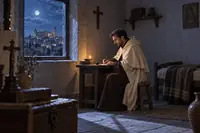 Chapter 3 of 6Nine months in the dark prison of Toledo1 min
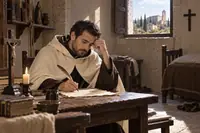 Chapter 4 of 6Mount Carmel and the way of “Nada”1 min
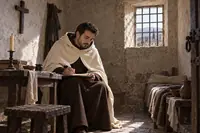 Chapter 5 of 6Rejected at the end, and a midnight song1 min
- Chapter 6 of 6The Mystical Doctor of the Church1 min
Feast day
Saint John of the Cross
Some places may celebrate on a slightly different day.
December 14
Patron of
- Spanish poets (proclaimed in 1952)
- Those who live a contemplative life
Often depicted with
- A cross
- A quill
- His drawing of Christ crucified seen from above
Opening
Opening
In a dark, damp prison cell barely big enough for one person to lie down, in a friary in Toledo, Spain, a young friar was held prisoner for nine long months.
His own brothers of the old Carmelite observance had kidnapped and locked him up because he had bravely sided with Mother Teresa of Ávila’s reform. He was starved on dry bread and water, and flogged till he bled in front of the community. His rotting habit crawled with lice, and there was no sunlight except through a small slit high up, just enough light to read his Office for a few minutes at midday.
Yet out of that humiliation, loneliness and utter darkness rose the most beautiful mystical poetry in the Spanish language and in all Catholic spirituality: the Spiritual Canticle, the Dark Night of the Soul, the Living Flame of Love.
That small prisoner was John of the Cross, Juan de la Cruz, the great “Mystical Doctor” of the Church.
He taught that the Cross is not a dead end; it is the one ladder that carries the soul through the “Night” into glorious union with God.
Chapter 1 of 6
A poor child among the weavers of Fontiveros
Juan de Yepes y Álvarez was born on June 24, 1542, in the town of Fontiveros, near Ávila, Spain. His father, Gonzalo de Yepes, came from a wealthy noble family of Toledo but had been disowned and disinherited for daring to marry Catalina Álvarez, a poor orphan girl who wove silk.
The family sank into extreme poverty. When John was only three, his father died of tuberculosis. His second brother, Luis, also died of hunger and malnutrition. His widowed mother had to trail from town to town with her two young sons, begging, before settling in Medina del Campo.
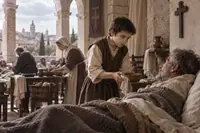
There, young John was taken into a charity school for poor orphans. He studied while also serving in a hospital for poor patients with venereal and incurable diseases. He washed bandages with his own hands and cared for foul-smelling, sore-covered bodies with rare tenderness.
At twenty-one, in 1563, John entered the Carmelites in Medina del Campo, taking the name John of Saint Matthias. He was then sent to the University of Salamanca, one of the most renowned in Europe, to study philosophy and theology.
In 1567 he was ordained a priest. But feeling that Carmelite life at the time was too lax and noisy, he was set on leaving the order to join the Carthusians, a strictly contemplative order, in search of complete silence.
Chapter 2 of 6
A fateful meeting with Mother Teresa of Ávila
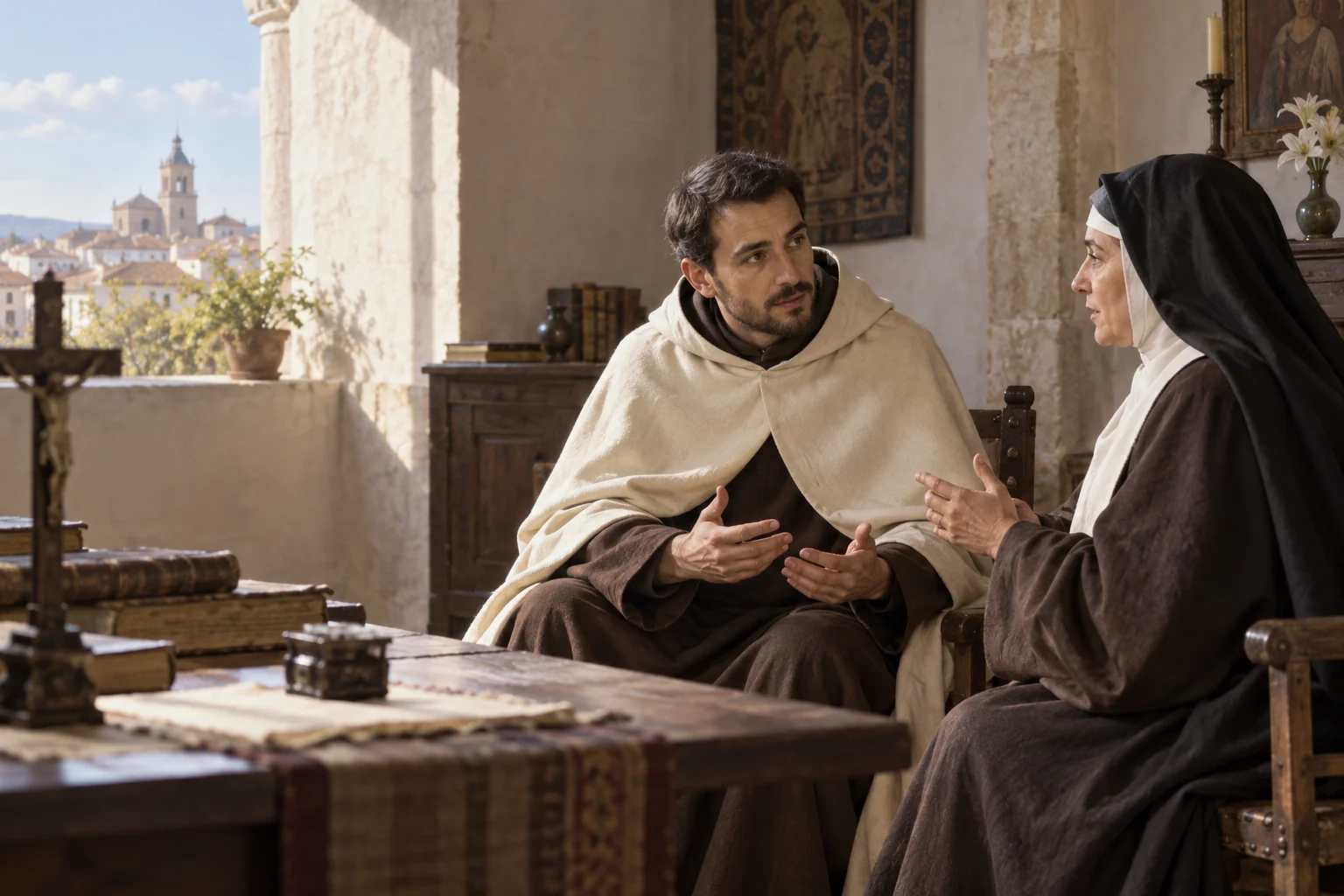
It was at that moment of inner struggle that a meeting that would change history took place in the autumn of 1567 in Medina del Campo: Mother Teresa of Ávila, then fifty-two, was looking for courageous priests to begin the reform of the men’s branch of the Carmelites. When she met John of Saint Matthias, a young priest of only twenty-five, small and thin but with eyes full of a deep inner light, Mother Teresa was overjoyed.
She persuaded him that he need not go far to look for another order:
“Stay, Father, and help me reform our own Carmelite family!”
John agreed on condition that the work begin at once.
On November 28, 1568, at Duruelo, in a poor, tumbledown farmhouse standing alone in the fields, John and his first two companions made their profession according to the Reformed Carmelite Rule. He changed his name to John of the Cross, Juan de la Cruz.
He wore a coarse habit, went barefoot, lived in a house with a ceiling so low he had to bow his head, and knelt in prayer every night on the freezing earth floor. He became the spiritual father and teacher of the first generations of Reformed Carmelite friars.
From 1572 to 1577, at Mother Teresa’s invitation, he became confessor and spiritual director to more than one hundred and thirty nuns at the Monastery of the Incarnation in Ávila, and his guidance brought a fresh spirit of conversion that changed the whole monastery.
Chapter 3 of 6
Nine months in the dark prison of Toledo
But the reform met fierce, blind opposition from the friars of the old observance. They regarded the reformers as rebels breaking the unity of the order.
On the night of December 2, 1577, a band of friars of the old observance with armed men burst into John of the Cross’s lodging in Ávila. They blindfolded him, tied him up and secretly took him to the Carmelite friary in Toledo.
There he was thrown into a dark, cramped cell, once a closet cut into the stone wall and only about three square meters, with no window except a tiny slit of light. For nine long months he was completely cut off from the outside world, not allowed to say Mass or read, enduring cruel floggings and humiliation.
Yet in the very depths of that misery, John of the Cross’s soul soared to the highest summit of union with God. With a stub of pencil he secretly wrote down the most beautiful mystical poems on scraps of paper, among them the first thirty-one stanzas of his masterpiece, the Spiritual Canticle, composed right in the darkness of prison:
“One dark night, fired with love’s urgent longings, oh, happy chance! I went out unseen, my house being now all stilled...”
On the night of August 15, 1578, the feast of the Assumption, guided by grace, he made a daring escape: he loosened the wooden bolts of a door in the next room, tied strips of torn blankets into a rope, let himself down through a window, then climbed over the friary’s high garden walls in the dead of night until he reached the streets of Toledo, groping his way to the central square, Zocodover.
Kept safe by Our Lady, he found refuge with the Reformed Carmelite nuns in Toledo. His escape sent shock waves through the order.
Chapter 4 of 6
Mount Carmel and the way of “Nada”
After his escape, he withdrew to the south of Spain, to Andalusia, serving as superior in several houses in Baeza, Granada and Segovia.
He wrote theological masterpieces that became the foundation of Christian mystical theology: “The Ascent of Mount Carmel” and “The Dark Night of the Soul”.
He set out a deep teaching on the purification of the soul: to reach complete union with God, the Absolute, the soul must pass through two “Nights”: the Night of the senses, purifying earthly passions, and the Night of the spirit, purifying the intellect, the will and the memory.
He summed up that path in a single word: “NADA”, Nothing, nothing at all:
“To come to enjoy everything, desire to enjoy nothing; to come to possess everything, desire to possess nothing; to come to know everything, desire to know nothing; to come to be everything, desire to be nothing!”
He taught that God surpasses every human idea, image and feeling. To meet Him, the soul must bravely let go of every earthly attachment and walk entirely in the darkness of pure faith, firm hope and ardent love.
Chapter 5 of 6
Rejected at the end, and a midnight song
Though he was a co-founder of the order, the last years of Saint John of the Cross were darkened by painful persecution from within the reform itself.
In 1591, a new superior with rigid views stripped him of all his offices and banished him to the remote friary of La Peñuela, deep in the mountains. Some even went about collecting slanders in an attempt to have him expelled from the order.
Yet John of the Cross accepted it all in gentle silence. He wrote to a spiritual daughter:
“Where there is no love, put love, and you will draw out love!”
In the autumn of 1591, he fell gravely ill from a gangrenous ulcer on his foot. He was moved to the friary at Úbeda. The prior at Úbeda, who held an old personal grudge against him, treated him very cruelly: he shut him in the smallest, shabbiest room, forbade visitors and denied him proper medicine. John of the Cross patiently bore all that pain as a final sacrifice.
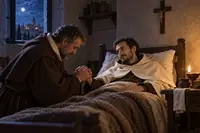
On the night of December 13, 1591, when the prior, filled with remorse, knelt by his bed weeping and asking forgiveness, John of the Cross smiled, took the prior’s hand and told him not to worry.
When he heard the friary bell ring at midnight for Matins, the forty-nine-year-old friar smiled radiantly and said:
“I am going to sing Matins in heaven!”
Clasping the crucifix, he spoke his last words:
“Lord, into Your hands I commend my spirit!”
Then he died peacefully, amid a brilliant light and a sweet fragrance that filled the room.
Chapter 6 of 6
The Mystical Doctor of the Church
Pope Clement X beatified him in 1675, and on December 27, 1726, Pope Benedict XIII solemnly canonized John of the Cross.
On August 24, 1926, Pope Pius XI declared him a Doctor of the Church with the title “Mystical Doctor”, Doctor Mysticus. In 1952 he was proclaimed patron of Spanish poets. The Church celebrates him on December 14 each year.
The cramped prison cell in Toledo, where he wrote his immortal poems in captivity, is now part of a carefully preserved historic site, reminding pilgrims that sometimes the most beautiful pages of the human soul are born in the darkest places.
Saint John of the Cross leaves a light for all who are going through their own dark nights of trial, illness and suffering: the night does not mean God is absent; it is the wondrous way God purifies the soul, burning away all the dross of the selfish ego to prepare it for a radiant meeting in eternal love.
He reminds each of us:
“In the evening of life, we will be judged on love!”
The end of the story
You have walked with Saint John of the Cross to the end of the story.
Some moments make you stop and catch your breath:
Imprisoned for nine months in a cell just three square meters in Toledo, starved and flogged, he still secretly wrote the first mystical stanzas of the Spiritual Canticle on scraps of paper.
On the night of the Assumption, he loosened the door bolts, tied torn blankets into a rope and climbed over the friary garden walls to escape in the dead of night.
In his last years, a prior with a personal grudge shut him in the shabbiest room, forbade visitors and denied him medicine, and still he patiently accepted it as an offering.
Stay in silence
You understand a paradox: the most beautiful poems about the light of God’s love were written from the deepest depths of darkness and humiliation.
In the evening of life, we will be judged on love.
Let us pray
Saint John of the Cross,
imprisoned in a cramped cell, starved and flogged, you still wrote the most beautiful poems about the love of God.
Pray for those going through the dark night of the soul: no longer feeling God, no longer seeing a way out. Let them know that God is still there in the darkness.
Teach me to accept the injustices and misunderstandings of life as an offering to God, and not to let my heart grow bitter.
Amen.
Sources
- Feast dayAuthor’s edited profile
- Patron ofPatronages and symbols, version 1.1
- Often depicted withPatronages and symbols, version 1.1
- Reflectioncarmelitaniscalzi.com
- Reflectionvatican.va
Meet the next one
 Journey 5