

Journey 5 · Seeking God in Silence
Saint Faustina Kowalska
The poor secretary of Divine Mercy
Feast day October 5
Tap to step inside
Saint Faustina Kowalska
The poor secretary of Divine Mercy
Map of a life
This life told in 6 chapters
Begin the journey OpeningOpening1 min
 Chapter 1 of 6A hard childhood in the village of Głogowiec1 min
 Chapter 2 of 6A turning point in a park in Łódź1 min
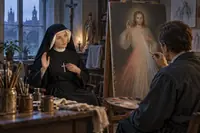 Chapter 3 of 6“Paint an image according to the pattern you see”1 min
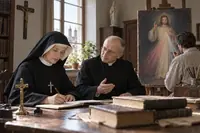 Chapter 4 of 6The pages of the Diary, and silent humiliation1 min
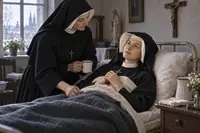 Chapter 5 of 6Her last drop of blood for the world1 min
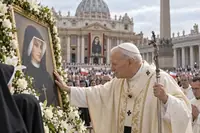 Chapter 6 of 6The triumph of Mercy1 min
Feast day
Saint Faustina Kowalska
Some places may celebrate on a slightly different day.
October 5
Often depicted with
- The image of Divine Mercy with white and red rays
- A religious habit
Opening
Opening
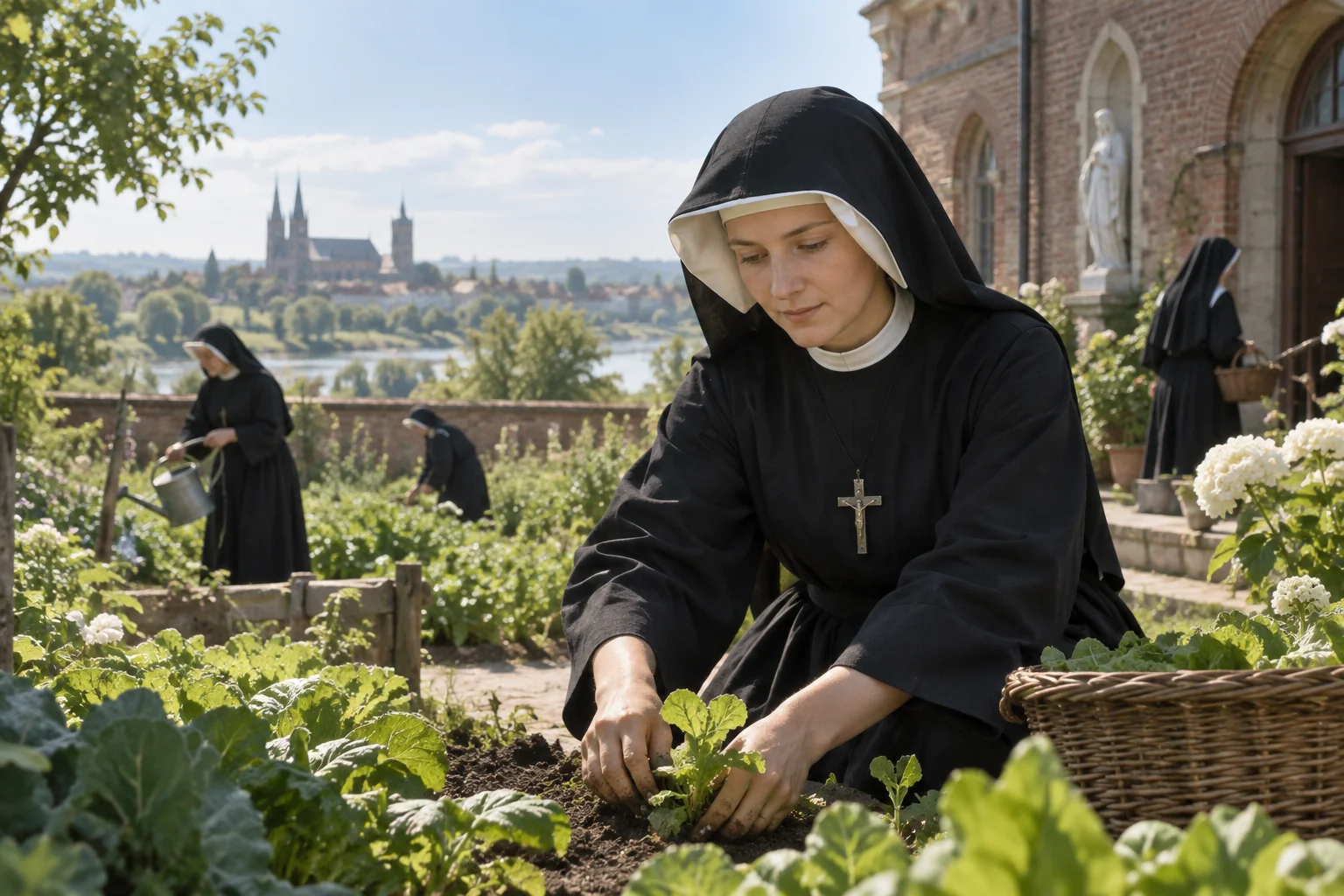
In the smoky kitchen of a convent on the outskirts of Kraków, Poland, in the 1930s, a slender young nun in an old black habit could be seen bent over big baskets of potatoes, peeling them. She did the heavy work without complaint, her hands chapped by the cold winter water, and some of the sisters looked down on her as uneducated and slow.
Yet it was to this poor nun, who had not even finished three years of primary school, that God entrusted a message for the whole world: the message of Divine Mercy.
Jesus appeared to her and gave her a tender name:
“Poor secretary of My Mercy!”
He asked her to have an image painted with two rays, red and white, streaming from His Heart, to work for a Feast of Divine Mercy, and to pass on the Chaplet of Mercy to a world on the brink of a devastating war.
Chapter 1 of 6
A hard childhood in the village of Głogowiec
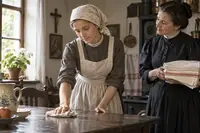
Helena Kowalska, as Saint Faustina was christened, was born on August 25, 1905, in the poor farming village of Głogowiec in central Poland. She was the third of ten children of Stanisław Kowalski and Marianna. The family was so poor that the ten children shared only a few decent outfits, taking turns wearing them to Sunday Mass.
From the age of seven, little Helena felt God calling her to give Him her life. She prayed faithfully, loved to help the poor and always obeyed her parents. Because the family was so poor, she had less than three years of school before she had to stop so that her younger brothers and sisters could have their turn.
At sixteen, Helena left her village to work as a maid for wealthy families in Aleksandrów and Łódź to earn money for her parents. She was a hardworking, honest servant.
But when she said she wanted to enter religious life, her parents firmly forbade it because the family was deep in debt and needed her wages. Helena swallowed her tears and obeyed, trying to silence the call in her heart and throwing herself into the fun of friends her age.
Chapter 2 of 6
A turning point in a park in Łódź
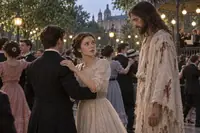
One summer evening in 1924, while Helena was at a crowded dance in a park in the city of Łódź, something happened that turned her life upside down. As she was dancing, she suddenly saw Jesus beside her, His body covered in bleeding wounds, His clothes in tatters.
He looked at her with infinite sorrow and said:
“How long shall I put up with you, and how long will you keep putting Me off?”
For Helena, the music stopped. Stunned, she slipped away from the party and ran straight to the nearby cathedral of Saint Stanislaus Kostka. She lay prostrate before the tabernacle, sobbing, begging God’s forgiveness and asking Him to show her what to do. A voice spoke in her soul:
“Go at once to Warsaw, and there you will enter a convent!”
Without delay, the nineteen-year-old went back to her room just long enough to pack an old dress, and with no money and no goodbye to her family, she boarded the night train for Warsaw.
In the unfamiliar capital she knocked on the doors of one convent after another, and everywhere she was turned away because she was poor and had no dowry. Finally, after a year of working to earn enough for a simple habit, on August 1, 1925, she was welcomed by the Sisters of Our Lady of Mercy. On April 30, 1926, she received the habit and the religious name Sister Maria Faustina of the Most Blessed Sacrament.
Chapter 3 of 6
“Paint an image according to the pattern you see”
Sister Faustina lived completely unnoticed in the convents of Kraków, Płock and Vilnius. She did the humblest jobs: cooking, gardening and keeping the door. Outwardly she was a simple, gentle nun, but in the depths of her soul Jesus was granting her extraordinary mystical visions.
The great moment came on the evening of February 22, 1931, in the convent at Płock. In her cell, Sister Faustina saw Jesus clothed in a white garment. One hand was raised in blessing, the other rested on His breast. From His Heart came forth two great rays: one red and one pale white.
Jesus told her:
“Paint an image according to the pattern you see, with the words: Jesus, I trust in You! I desire that this image be venerated first in your chapel, and then throughout the world... The two rays denote Blood and Water: the pale ray stands for the Water which makes souls righteous; the red ray stands for the Blood which is the life of souls. These two rays issued forth from the very depths of My tender mercy when My agonized Heart was opened by a lance on the Cross!”
The Lord also asked her to work for the Sunday after Easter to become the Feast of Divine Mercy. He promised that on that day all the floodgates of His mercy would be opened, and that those who go to confession and receive Holy Communion would obtain complete forgiveness of sins and punishment.
Chapter 4 of 6
The pages of the Diary, and silent humiliation
When she told her superiors and confessors about these visions, a painful time began for Sister Faustina. Many suspected she was mentally ill or hysterical. She was sent to psychiatric hospitals for examination and had to put up with the mocking whispers of some of the sisters. She bore all these humiliations in silence.
God sent her a wise and holy spiritual director, Blessed Michał Sopoćko, in Vilnius. Father Sopoćko recognized the hand of God in her soul. In 1934 he hired the painter Eugeniusz Kazimirowski to paint the first Divine Mercy image exactly as Faustina described it, and he told her to write down all her inner conversations with Jesus in notebooks.
And so this nun with so little schooling wrote “Divine Mercy in My Soul,” her Diary of more than six hundred pages.
In the Diary, Jesus gave humanity wonderful means of salvation:
- the Chaplet of Divine Mercy, prayed on ordinary rosary beads — “Eternal Father, I offer You the Body and Blood, Soul and Divinity of Your dearly beloved Son...” — to ask mercy for us and for the whole world;
- the Hour of Mercy at three in the afternoon, the hour Jesus breathed His last on the Cross, when grace pours out most abundantly on all who earnestly ask;
- and the attitude of Trust, placing complete confidence in God’s boundless mercy, because sin, however heavy, is only a drop of water falling into the vast ocean of God’s mercy.
Jesus said something that should make us tremble:
“Before I come as a just Judge, I first open wide the door of My Mercy. He who refuses to pass through the door of My Mercy must pass through the door of My Justice!”
Chapter 5 of 6
Her last drop of blood for the world
In her last years, tuberculosis of the lungs and intestines ravaged Sister Faustina’s body. She was treated at the Prądnik hospital on the outskirts of Kraków.
Long bouts of coughing up blood and wrenching intestinal pain left her unable to eat. Yet she always had a radiant, peaceful smile. She quietly joined her pain to the Passion of the Lord and offered it for dying sinners.
On the evening of October 5, 1938, at the convent of Łagiewniki in Kraków, Sister Maria Faustina Kowalska died peacefully and went home to God at thirty-three, the age of Jesus at His death. It was just one year before the Second World War broke out and devastated Poland.
Chapter 6 of 6
The triumph of Mercy
After her death, because of faulty early translations, the message of Divine Mercy was misunderstood and for years was even banned.
Yet God had prepared a great man from Poland itself. Archbishop Karol Wojtyła, later Pope John Paul II, opened a new and rigorous investigation, which fully vindicated Faustina’s Diary.
On April 18, 1993, Pope John Paul II beatified Faustina. And on April 30, 2000, the first Sunday after Easter in the new millennium, he canonized Faustina Kowalska, the first saint of the third millennium.
At the same time he established the Feast of Divine Mercy for the whole Church, on the Second Sunday of Easter each year. The Church celebrates her on October 5. In 1966 her remains were moved to the convent chapel at Łagiewniki; and since her beatification in 1993 they have rested on the altar, beneath the very first Divine Mercy image, painted by Kazimirowski from her description. From 1999 to 2002 a modern basilica shaped like a great ship, with a seventy-seven-meter tower for a mast, was built beside it to welcome the endless stream of pilgrims from all over the world.
In Vietnam, the Divine Mercy movement and the three o’clock chaplet have become part of the life of almost every parish and every Catholic family. The image of Jesus with the two shining rays has a place of honor on many altars.
Saint Faustina throws us a lifeline: never despair, whatever the sins and sufferings of your life.
Run to the merciful Heart of Jesus and cry out with all your faith:
“Jesus, I trust in You!”
The end of the story
You have walked with Saint Faustina Kowalska to the end of the story.
These scenes are hard to put out of your mind:
In the middle of a crowded dance in a park in Łódź, Jesus appeared beside her, His body covered in wounds, asking: "How long shall I put up with you?"
On the evening of February 22, 1931, she saw Jesus with two rays, red and white, streaming from His Heart, telling her to have the image of Mercy painted.
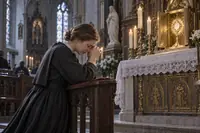
Many thought her deluded, and she was even sent to psychiatric hospitals for examination, yet she quietly wrote her Diary of more than six hundred pages.
Stay in silence
Your heart grows still: a girl with little schooling, looked down on by her own sisters, was chosen as the "poor secretary" of a message of salvation for the whole world.
Jesus, I trust in You!
Let us pray
Saint Faustina,
you were a nun with little schooling, doubted by many, yet chosen by God to tell the world about His Mercy: "Jesus, I trust in You."
Teach me to trust in God’s mercy, especially when my sins seem too great.
Help me show mercy to others as God has shown mercy to me, and pray for the dying who have no one to pray for them.
Amen.
Sources
- Feast dayAuthor’s edited profile
- Often depicted withPatronages and symbols, version 1.1
- Reflectionsaint-faustina.org
- Reflectionsaint-faustina.org
Meet the next one
 Journey 5