

Journey 5 · Seeking God in Silence
Saint Pio of Pietrelcina
The priest who bore the stigmata in the Gargano mountains
Feast day September 23
Tap to step inside
Saint Pio of Pietrelcina
The priest who bore the stigmata in the Gargano mountains
Map of a life
This life told in 7 chapters
Begin the journey OpeningOpening1 min
 Chapter 1 of 7Little Francesco in the village of Pietrelcina1 min
 Chapter 2 of 7Five bleeding wounds in the choir loft2 min
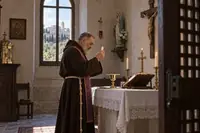 Chapter 3 of 7Storms of suspicion and two years of strict seclusion1 min
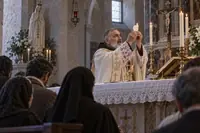 Chapter 4 of 7Mass on Calvary and a confessional that never slept1 min
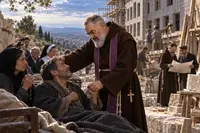 Chapter 5 of 7The hospital “Relief of Suffering”1 min
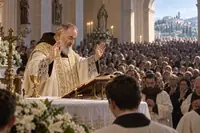 Chapter 6 of 7The wounds vanish, and his hour of triumph1 min
- Chapter 7 of 7A saint for a new age1 min
Feast day
Saint Pio of Pietrelcina
Some places may celebrate on a slightly different day.
September 23
Patron of
- Italy’s civil defense volunteers (2004)
- Young people
Often depicted with
- The five wounds
- Gloves covering the wounds
- A rosary
Opening
Opening
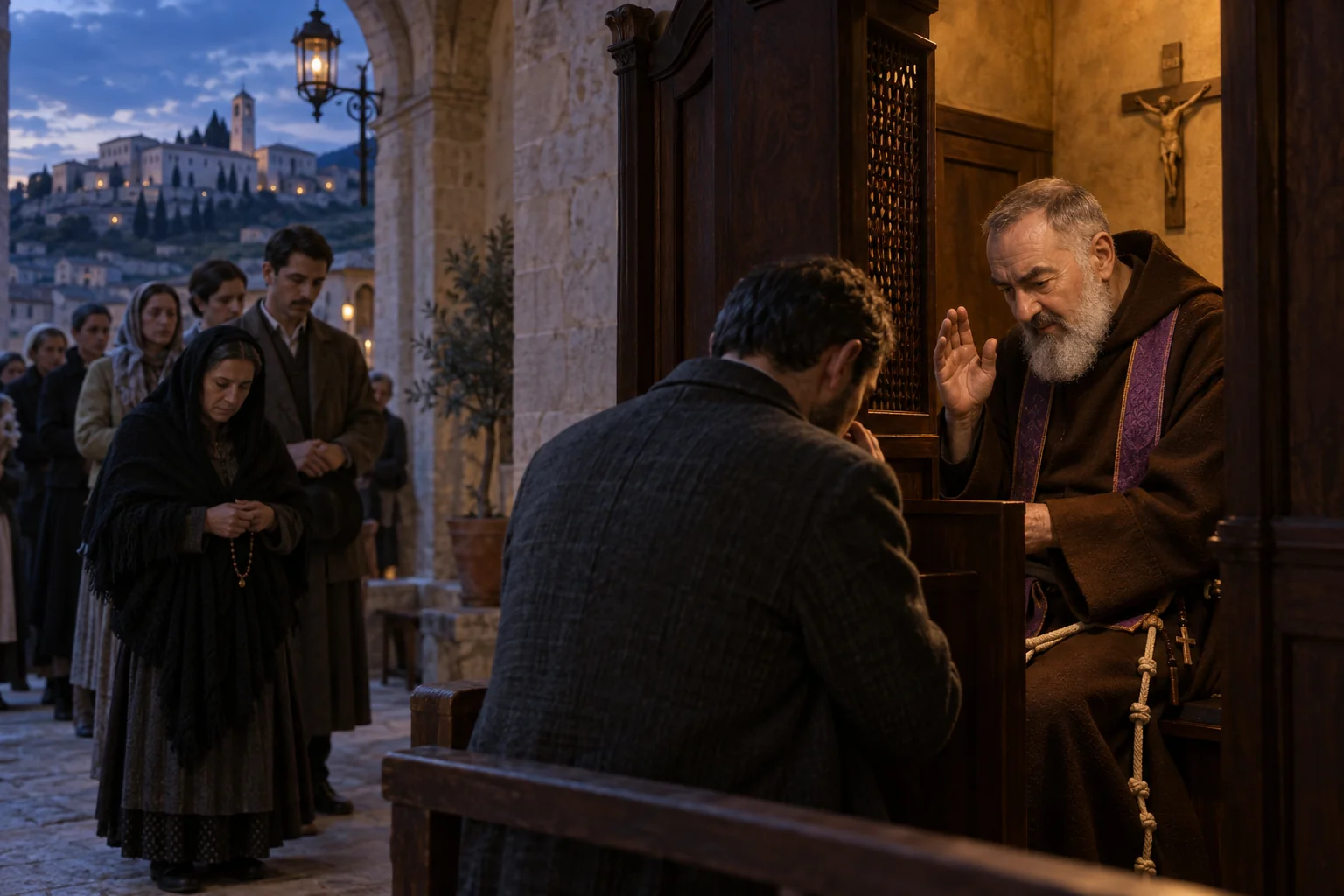
For more than fifty years of the turbulent twentieth century, in the small town of San Giovanni Rotondo perched on the rocky Gargano mountains of southern Italy, there flowed a stream of pilgrims like almost nothing else in history: millions of people from every continent — heads of state, scientists, famous artists and poor peasants in rags — waited in line through freezing winter nights just to kneel at the confessional of an old Capuchin friar.
That friar was Padre Pio of Pietrelcina, Padre Pio da Pietrelcina.
He was the first priest in the history of the Church to bear the five bleeding wounds of Jesus on his own body for half a century.
Yet what made Padre Pio great was not the painful nail wounds or the astonishing miracles. His greatness lay in this: he freely turned his whole life into a “living sacrifice”, shutting himself every day for sixteen to eighteen hours in the confessional to listen, to forgive and to heal the wounds of people’s souls.
Chapter 1 of 7
Little Francesco in the village of Pietrelcina
Francesco Forgione, Padre Pio’s childhood name, was born on May 25, 1887, in the poor farming village of Pietrelcina, in the province of Benevento in southern Italy. His father, Grazio Forgione, and his mother, Maria Giuseppa De Nunzio, were simple farmers bound all their lives to the plow and the cornfield. He was baptized the very next day in the ancient church of Saint Anne.
As a child, little Francesco was quiet and shy, and remarkably close to God. From the age of five, he saw Jesus, Mary and his guardian angel appear and talk with him as close friends. The boy assumed that everyone in the world saw such visions just as he did. He often slipped away to a corner behind the house, slept on the cold ground and used a stone for a pillow as penance.
Seeing that his fourth child had a special religious vocation, his poor father, Grazio Forgione, twice left his homeland and went all the way to America to work as a laborer, sending home every penny he earned for his son’s schooling.
At fifteen, on January 16, 1903, Francesco entered the Capuchin friary in Morcone, receiving the habit and the new name Brother Pio of Pietrelcina.
His years of novitiate and study were years of fierce struggle with illness: strange high fevers of more than 48 degrees Celsius that burst ordinary thermometers, and chest pains and violent coughing that led the doctors of the time to think he had terminal tuberculosis and could not survive. Yet he came through it all with extraordinary strength of spirit.
On August 10, 1910, in the cathedral of Benevento, he was ordained a priest at the age of twenty-three.
Chapter 2 of 7
Five bleeding wounds in the choir loft
Because of his poor health, in the early years after his ordination Padre Pio was allowed to live at home in Pietrelcina to recover. In September 1916, he was sent to the remote friary of San Giovanni Rotondo on the Gargano mountain, where the church of Our Lady of Grace had been begun in the 1530s by Capuchin friars before him. He stayed in that wild place until his last breath.
The event that would astonish the world took place on the morning of September 20, 1918: after saying Mass, Padre Pio was kneeling alone in thanksgiving before the large crucifix in the choir loft of the friary chapel. Suddenly, a majestic, radiant Figure appeared, whose hands, feet and side were bleeding.
Padre Pio later wrote in a letter to his spiritual director:
“I felt as if I were dying... When the vision disappeared, I opened my eyes and was stunned to see that my hands, my feet and my side had been pierced and were bleeding profusely! Utter pain tore through my body, but my soul was flooded with indescribable peace!”
The five wounds of Jesus were deeply imprinted on the body of the thirty-one-year-old priest:
- two wounds piercing through the palms and backs of his hands;
- two wounds piercing through his feet;
- and a wound in his side in the shape of an inverted cross, five centimeters deep, constantly oozing fresh blood and giving off a sweet fragrance of flowers, known as the odor of sanctity.
For fifty years afterwards, those wounds bled fresh every day, soaking the bandages. Out of humility, Padre Pio always wore fingerless brown woolen gloves to hide the nail marks on his hands.
One medical professor and leading pathologist after another, from Italy and across Europe, was sent by the Holy See to examine him rigorously. After months of observation and every kind of chemical treatment, the scientists had to sign a report confirming: these wounds belonged to no known pathological or psychological condition; they never became infected, never festered, and were entirely beyond the laws of nature.
Chapter 3 of 7
Storms of suspicion and two years of strict seclusion
News of a priest bearing the stigmata quickly set off waves of pilgrims to San Giovanni Rotondo. Yet alongside the people’s devotion came storms of suspicion, slander and bitter misunderstanding from some Church officials of the time.
People suspected him of using chemicals to produce the wounds himself, and of seeking financial gain.
From 1923 to 1933, the Holy See issued several decrees placing strict restrictions on Padre Pio. The climax came in 1931, when he was stripped of the faculty to hear confessions and forbidden to say Mass publicly before the faithful. He was allowed to celebrate Mass only alone in the private chapel.
Through two long years of unjust discipline, Padre Pio showed complete obedience and humility. He did not write a single letter of complaint, nor say a word of reproach against the Church or his superiors. He said:
“The will of my superiors is the will of God!”
In 1933, after the whole matter had been reexamined, Pope Pius XI lifted every prohibition and declared:
“I have not been against Padre Pio, but I was deceived!”
Padre Pio was free once more to serve his flock.
Chapter 4 of 7
Mass on Calvary and a confessional that never slept
For those who were blessed to attend the Mass Padre Pio celebrated at five every morning, it was a spiritual experience that changed their whole lives: his Mass often lasted two to three hours.
Standing at the altar, the priest who bore the stigmata did not simply read the liturgical texts; he relived every moment of the Passion on Calvary. Tears streamed down his cheeks, and his body trembled with fierce pain in the nail wounds as he spoke the words of consecration. The altar suddenly became a living Calvary.
After Mass, he went straight into the confessional. For more than fifty years, he sat there fourteen to eighteen hours a day.
God gave him an extraordinary gift of reading souls, kardiognosis: he saw into the depths of each penitent’s conscience. If someone deliberately hid a sin out of shame, he would gently or sternly name the exact date, place and circumstances in which that person had sinned.
He was stern with hypocrites and the hard-hearted, but endlessly tender with those who truly repented, embracing them with tears. Millions of hardened sinners and notorious atheists fell at his feet to ask forgiveness and begin their lives again.
Chapter 5 of 7
The hospital “Relief of Suffering”
Padre Pio’s charity did not stop at spiritual graces. Seeing the hardship of poor patients in southern Italy who had to travel hundreds of kilometers north for treatment, in 1940 he launched a great project: building a fully modern hospital right on the barren rocky mountain of San Giovanni Rotondo.
The work was completed entirely with voluntary donations from his spiritual children around the world.
On May 5, 1956, the hospital named “Casa Sollievo della Sofferenza”, the Home for the Relief of Suffering, was formally opened with its many beds and the most advanced equipment of the time. It is still regarded today as one of the most effective hospitals in Europe.
Padre Pio told the doctors:
“Here, the sick must be treated not only with the most advanced medicine, but with the very love of Christ... Remember that in every patient lying there, it is Jesus who is suffering!”
Along with the hospital, he founded the “Padre Pio Prayer Groups”, Gruppi di Preghiera, which spread worldwide, gathering millions of lay people to pray daily for the Pope’s intentions.
Chapter 6 of 7
The wounds vanish, and his hour of triumph
Exactly half a century after receiving the stigmata, something remarkable happened: from the beginning of 1968, the bleeding wounds on Padre Pio’s hands, feet and side gradually began to heal.
On September 20, 1968, the 50th anniversary of the stigmata, he celebrated a solemn Mass of thanksgiving. On September 22, he said the last Mass of his life before thousands of his spiritual children. When he raised his hands to give his final blessing, people were astonished to see that the scars of the nail wounds had completely vanished, the skin pink and smooth as a newborn’s, without a single trace of injury.
The mission of the faithful servant who bore the marks of the Passion was complete.
In the early hours of September 23, 1968, sitting in the armchair in his room, rosary in hand, whispering the two holy names over and over:
“Jesus... Mary... Jesus... Mary...”
, Padre Pio died peacefully, at the age of eighty-one.
More than a hundred thousand people came to his funeral.
Chapter 7 of 7
A saint for a new age
On May 2, 1999, Pope Saint John Paul II — who as a young priest had traveled to make his confession to Padre Pio in 1947 — beatified him.
On June 16, 2002, the Holy Father himself canonized Pio of Pietrelcina in Saint Peter’s Square before more than three hundred thousand faithful, one of the largest canonizations in the history of the Church. The Church celebrates him on September 23 each year.
In 2004, a huge pilgrimage church designed by the famous architect Renzo Piano was dedicated in San Giovanni Rotondo, with enormous stone arches — the largest spanning fifty meters — seating six thousand five hundred people inside and thirty thousand more in the square outside. In 2010, his body was moved to the crypt beneath the main altar of that new church, and today San Giovanni Rotondo has become one of the most visited Catholic pilgrimage centers in the world, second only to the Vatican itself.
Saint Pio of Pietrelcina leaves a simple message for every Christian amid life’s worries:
“Pray, hope and don’t worry! Worry is useless. God is merciful and will always hear your earnest prayer!”
The end of the story
You have walked with Saint Pio of Pietrelcina to the end of the story.
Three scenes remain with you:
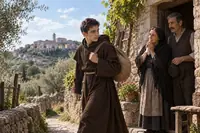
On the morning of September 20, 1918, after a majestic Figure appeared and vanished, Padre Pio was stunned to find his hands, feet and side bleeding with the five wounds.
For two years forbidden by the Holy See to hear confessions or say Mass publicly because of unjust misunderstandings, he wrote not a single letter of complaint, saying only: "The will of my superiors is the will of God!"
Every day he sat in the confessional fourteen to eighteen hours, able to name the exact day and hour a penitent had deliberately hidden a sin.
Stay in silence
You realize the heart of it: what made him great was not the strange wounds, but a whole life shut in the confessional to listen and forgive.
Pray, hope and don’t worry!
Let us pray
Saint Pio,
for two years you were forbidden to say Mass publicly because of misunderstandings, and you did not complain once. And every day you sat in the confessional for more than ten hours to listen and forgive.
Help me not to be afraid of the sacrament of Reconciliation, and to confess my sins sincerely.
Teach me to obey in peace when I am treated unjustly. And as you always said, help me to "pray, hope and don’t worry".
Amen.
Sources
- Feast dayAuthor’s edited profile
- Patron ofPatronages and symbols, version 1.1
- Often depicted withPatronages and symbols, version 1.1
- Reflectionpadrepio.it
- Reflectionpadrepio.it
Meet the next one
 Journey 5