

Journey 5 · Seeking God in Silence
Saint Catherine Labouré
The silent nun and the Miraculous Medal
Feast day November 28
Tap to step inside
Saint Catherine Labouré
The silent nun and the Miraculous Medal
Map of a life
This life told in 5 chapters
Begin the journey OpeningOpening1 min
 Chapter 1 of 5A child of the fields of Fain-lès-Moutiers1 min
 Chapter 2 of 5The apparitions in the chapel on the Rue du Bac1 min
 Chapter 3 of 5The Miraculous Medal goes around the world1 min
 Chapter 4 of 5Forty-six years hidden in a corner of a home for the elderly1 min
 Chapter 5 of 5A peaceful death and an incorrupt body1 min
Feast day
Saint Catherine Labouré
Some places may celebrate on a slightly different day.
November 28
Patron of
- The elderly
Often depicted with
- The Miraculous Medal
- The white winged cornette of the Daughters of Charity
Opening
Opening
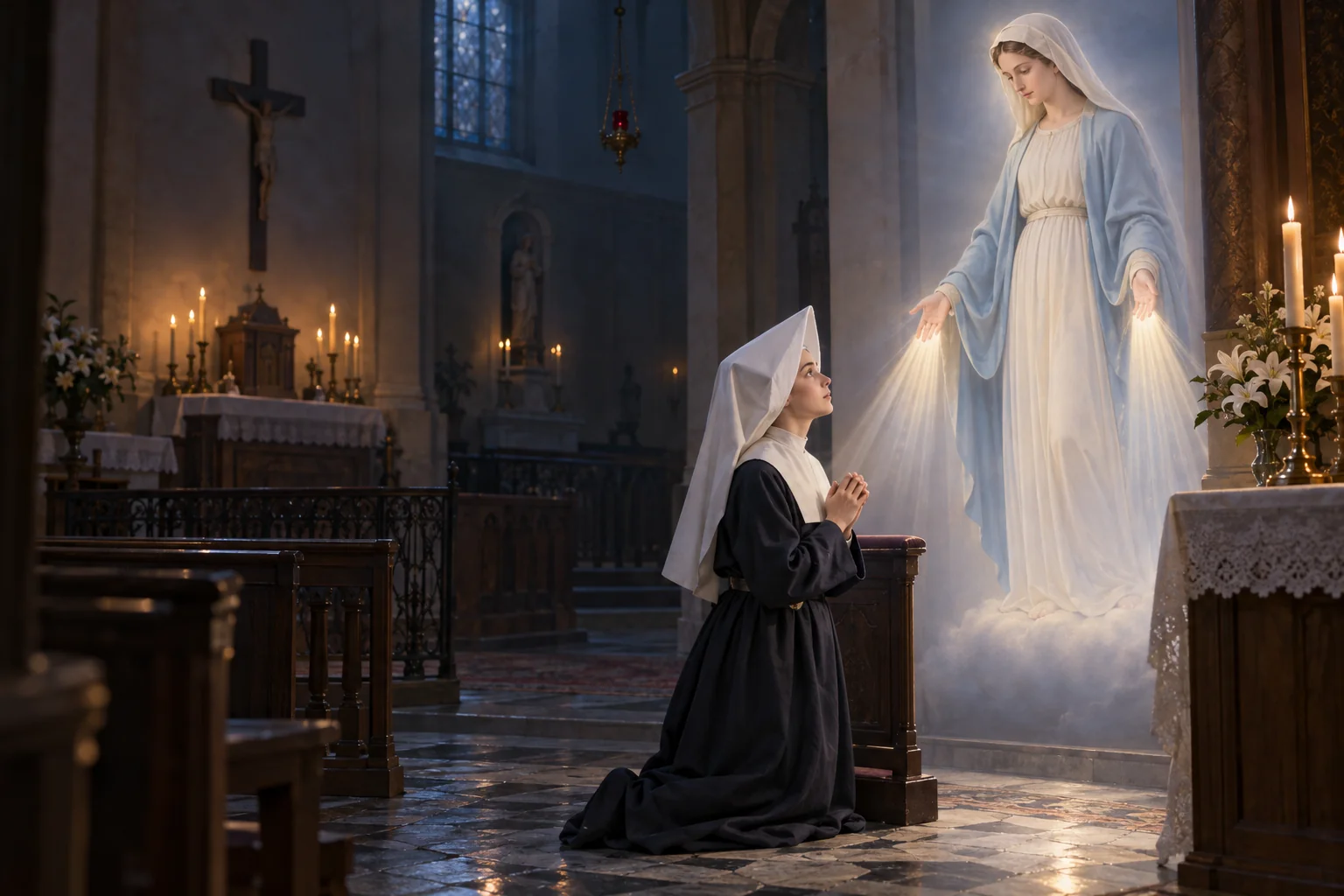
On a quiet summer night in 1830 in Paris, a young novice was sound asleep when she was awakened by the gentle voice of a shining child. The child led her through the long, dark corridors of the convent into the chapel. There every candle was blazing as on Christmas night, and the Virgin Mary herself appeared, seated in a chair in the sanctuary.
The novice ran forward, fell to her knees and rested her hands on the knees of the Mother of God, and for two hours they talked heart to heart.
That novice was Catherine Labouré, the one Our Lady chose to have the Miraculous Medal struck (known among Vietnamese Catholics as the Miraculous Image, or the Image of Our Lady of Graces).
Yet what would make the angels marvel was less her glorious visions than her heroic silence. For forty-six years, almost until the day she died, she told no one that she was the one who had seen Our Lady, content to be a sister who swept out the cowshed and peeled potatoes in a poor neighborhood.
Chapter 1 of 5
A child of the fields of Fain-lès-Moutiers
The saint was baptized Zoé Labouré. She was born on May 2, 1806, in the village of Fain-lès-Moutiers, in Burgundy, France, the ninth of eleven children in a prosperous farming family, the daughter of Pierre Labouré and Madeleine Gontard.
When Zoé was only nine, her gentle mother died. After the funeral, the little girl was seen climbing onto a chair in the bedroom, clasping the statue of Our Lady on the wall, pressing her face to it and saying through her tears:
“From now on, you will be my mother!”
And the Mother of God took that child at her word.
At twelve, when her eldest sister entered the convent, Zoé took charge of the family’s large farm: she got up at four in the morning, milked the cows, cooked for a dozen farmhands and looked after hundreds of pigeons. She never went to school, and all her life she could barely read or write.
One night Zoé had a strange dream: she saw herself in an old village church where an elderly white-haired priest was saying Mass. After Mass, the priest looked at her with great kindness and said:
“My child, today you run away from me, but one day you will be happy to come to me... God has chosen you for a special work!”
The girl woke with a start, not knowing what the dream meant.
Only at twenty-two, visiting the hospital of the Daughters of Charity in Châtillon-sur-Seine, did Zoé look up at a portrait on the wall and realize with a shock that the old priest of her dream was Saint Vincent de Paul, the founder of the congregation.
Her father fiercely opposed her and wanted her to marry, but she held firm, and on April 21, 1830, Zoé entered the novitiate of the Daughters of Charity of Saint Vincent de Paul on the Rue du Bac in Paris, taking the religious name Sister Catherine.
Chapter 2 of 5
The apparitions in the chapel on the Rue du Bac
In the chapel of the motherhouse on the Rue du Bac, within just nine months of entering the novitiate, Sister Catherine was granted three apparitions of Our Lady.
The first came on the night of July 18, in the early hours of July 19, 1830. Our Lady, seated in the sanctuary chair, foretold the bloody upheavals about to strike France (the July Revolution of 1830, which overthrew the king) and entrusted her with founding an association for young people, the Children of Mary.
The second and most important came at half past five on the evening of November 27, 1830, during the community’s evening prayer. Sister Catherine saw Our Lady standing on a half-globe, crushing the serpent’s head beneath her foot. In her hands, held at the level of her heart, was a small golden globe topped by a cross, standing for the whole world and for each soul, which she was offering to God.
Then the globe vanished, and her hands lowered and opened. From the jeweled rings on her fingers, brilliant rays of light poured down onto the globe at her feet. Our Lady explained:
“These rays are the symbol of the graces I shed on those who ask me for them... The gems that give no light are the graces people do not bother to ask for!”
Then an oval frame formed around Our Lady, bearing these words in French in letters of gold:
“O Mary, conceived without sin, pray for us who have recourse to thee!”
Then the image turned, and Sister Catherine saw the reverse side: a large letter M intertwined with a cross; beneath it two Hearts, the Heart of Jesus crowned with thorns and bleeding, and the Heart of Mary pierced by a sword; and around them twelve shining stars.
Our Lady told her:
“Have a medal struck according to this model! All who wear it around their neck with confidence will receive great graces; those who say this prayer will enjoy my special protection!”
Chapter 3 of 5
The Miraculous Medal goes around the world
Obeying Our Lady, Sister Catherine told the whole story to her confessor, Father Jean-Marie Aladel.
But the cautious priest did not believe her at first. He sternly told her she was imagining things and forbade her to give these visions another thought. Sister Catherine obeyed humbly, without a word of argument.
Only after nearly two years of watching the young sister’s quiet virtue and deep peace did Father Aladel take the matter to the Archbishop of Paris, Archbishop de Quélen. The archbishop at once saw God’s hand in it and authorized the striking of the first twenty thousand medals in June 1832.
As soon as the first medals were given out, while a terrible cholera epidemic was killing more than twenty thousand people in Paris, reports of healings and remarkable conversions began to pour in from everywhere. People called it the “Miraculous Medal”, the Médaille Miraculeuse.
Millions, then hundreds of millions of medals were struck and carried to every continent, a simple thing that brought peace to countless families.
Most famously, in 1842, Alphonse Ratisbonne, a wealthy Jewish lawyer and an outspoken unbeliever, saw Our Lady appear exactly as she is on the medal, in the church of Sant’Andrea delle Fratte in Rome. His sudden conversion shook all of Europe and spurred Pope Pius IX to proclaim the dogma of the Immaculate Conception in 1854.
Chapter 4 of 5
Forty-six years hidden in a corner of a home for the elderly
While the whole world was talking about the “Miraculous Medal” and wondering who the visionary could be, where was she?
In 1831, after completing her novitiate, Sister Catherine Labouré was sent to serve at the Enghien home for the elderly poor in Reuilly, a shabby working-class district on the outskirts of Paris. She spent the remaining forty-six years of her life there.
Sister Catherine did the hardest jobs: looking after the dairy cows, sweeping out the henhouse, cooking, mending clothes for the elderly and disabled residents and caring for wounded soldiers. For forty-six years, apart from her confessor Father Aladel, she never breathed a word to anyone, not even the sisters she shared a room with or her superiors, that she was the one who had seen Our Lady.
Whenever she heard people praising the Miraculous Medal, she only smiled quietly and went on praying her Rosary in a corner of the kitchen. She would gladly be forgotten by the whole world, as long as Mary was known and loved by all.
Only in 1876, a few months before her death, did Sister Catherine reveal her holy secret to her superior. Her old director had died, the statue of Our Lady of the Globe had still not been made, and she felt an inner urging to speak. Only then did the community learn the truth, and in astonishment they fell to their knees to thank God: they had lived beside a great saint for years without knowing it.
Chapter 5 of 5
A peaceful death and an incorrupt body
On the evening of December 31, 1876, Sister Catherine Labouré died peacefully at the home in Reuilly, at the age of seventy.
Fifty-seven years after her death, on March 21, 1933, in preparation for her beatification, her tomb was opened. The doctors, priests and sisters present were astonished: her body was intact. The eyes that had seen Our Lady were still a bright blue; the hands that had rested on Mary’s knees were still supple, the joints still flexible; and her body seemed to radiate a holy beauty.
Today her incorrupt body lies in a glass reliquary to the right of the main altar in the chapel on the Rue du Bac in Paris, the very chapel where she once knelt talking with Our Lady for two hours. Millions of pilgrims come every year, making it one of the most visited Marian shrines in the world.
Pope Pius XI beatified her in 1933, and on July 27, 1947, Pope Pius XII solemnly canonized Catherine Labouré. The Church celebrates her on November 28 each year.
In Vietnam, the Medal of Our Lady of Graces has become a constant companion for millions of believers: hung around a baby’s neck on the day of baptism, hung at the head of a sick person’s bed, clasped at the hour of death.
Saint Catherine Labouré has a lesson for us today: true greatness is not in being known and praised by others; it is in a soul that knows how to keep silent, hidden in God.
She reminds each of us to receive God’s gifts with humility, and to do each small duty of the day faithfully and with all our love.
The end of the story
You have walked with Saint Catherine Labouré to the end of the story.
Some moments stay with you:
On a summer night in 1830, the young novice knelt with her hands resting on Our Lady’s knees, and they talked heart to heart for two hours.
On November 27, 1830, she saw Our Lady standing on a globe, rays of light pouring from the rings on her hands down onto the world.

For forty-six years afterwards, she quietly swept the cowshed and peeled potatoes in a poor home for the elderly, never telling anyone that she was the one who had met Our Lady.
Stay in silence
And you see it now: from the day she clasped the statue of Our Lady at nine and whispered "you will be my mother", she was quietly preparing for a whole life hidden beside her Mother.
From now on, you will be my mother.
Let us pray
Saint Catherine Labouré,
you met Our Lady and received the Miraculous Medal. Yet for forty-six years afterwards you quietly swept the cowshed and peeled potatoes, telling no one.
Teach me to do the small things of each day with love, without needing anyone to know.
Pray for those who lost their mother young as you did, that they may know they have Mary as their Mother.
Amen.
Sources
- Feast dayAuthor’s edited profile
- Patron ofPatronages and symbols, version 1.1
- Often depicted withPatronages and symbols, version 1.1
- Reflectioncausesanti.va
- Reflectionchapellenotredamedelamedaillemiraculeuse.com
Meet the next one
 Journey 5