

Journey 5 · Seeking God in Silence
Saint Francis of Assisi
The poor man who glorified the Cross
Feast day October 4
Tap to step inside
Saint Francis of Assisi
The poor man who glorified the Cross
Map of a life
This life told in 8 chapters
Begin the journey OpeningOpening1 min
 Chapter 1 of 8The dashing young man of Assisi1 min
 Chapter 2 of 8A kiss for a leper1 min
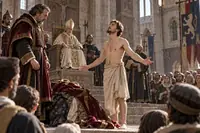 Chapter 3 of 8The break with his father before the bishop1 min
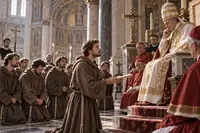 Chapter 4 of 8The birth of the Friars Minor1 min
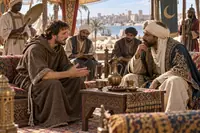 Chapter 5 of 8The crib at Greccio and a dialogue of peace with the Sultan1 min
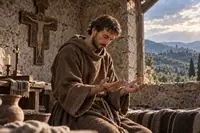 Chapter 6 of 8The five wounds on Mount La Verna1 min
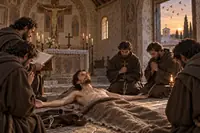 Chapter 7 of 8The Canticle of the Creatures and a smile for “Sister Death”2 min
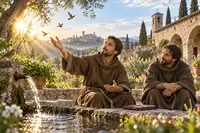 Chapter 8 of 8A saint of peace and of creation1 min
Feast day
Saint Francis of Assisi
Some places may celebrate on a slightly different day.
October 4
Patron of
- Those who protect the environment (proclaimed by John Paul II in 1979)
- Italy (1939)
- Animals
- Merchants
Often depicted with
- The five wounds
- Birds
- The wolf of Gubbio
- A brown habit with a three-knotted cord
Opening
Opening
On the flowering hillsides of Umbria in thirteenth-century Italy, people would see a man in a coarse gray-brown habit, patched all over, walking barefoot through the mud and singing God’s praises with a joy beyond words.
That man called the sun “brother”, the moon “sister”, fire “brother”, water “sister”, and even called bodily death “Sister Death.”
He gave up a rich cloth merchant’s fortune to take “Lady Poverty” as his bride. He embraced a leper, tamed a fierce wolf, and bore in his own flesh the five bleeding wounds of Christ.
He was Francis of Assisi, a saint loved by Catholics and non-Christians alike.
With the folly of the Gospel, he shook a medieval Church entangled in money and power, and led countless people back to the simplicity of the manger at Bethlehem and the Cross of Calvary.
Chapter 1 of 8
The dashing young man of Assisi
Francis was born around the end of 1181 or the beginning of 1182 in Assisi, Italy, and baptized Giovanni di Pietro di Bernardone. His father, Pietro di Bernardone, was a famously rich cloth merchant; his mother, Pica Bourlemont, was a devout noblewoman of French origin. When the boy was born, his father was away on business in France; when he returned, he renamed his son Francesco, “the little Frenchman,” out of his love for that country.
Raised in luxury, Francis was the ringleader of Assisi’s pleasure-loving young set: he spent money like water, wore splendid, outlandish clothes, and sang and played music in the streets all night. He dreamed of becoming a gallant knight and rising into the nobility.
In 1202, war broke out between the cities of Assisi and Perugia. Francis eagerly put on armor and went to battle, but Assisi was defeated and he spent more than a year as a prisoner in Perugia.
In the damp prison he was struck down by a high fever. Lying day after day on straw, the young dandy began to see how empty worldly glory is.
After his father ransomed him, in 1205 Francis again fitted himself out with a fine horse and gilded armor to join a military expedition in southern Italy.
But when he reached the town of Spoleto, he had a dream in which a majestic voice asked him: “Francis, who can do more for you: the master or the servant?” Francis answered: “Lord, the master, of course!” The voice said:
“Then why do you leave the master to follow the servant?”
When he woke, Francis turned his horse back toward Assisi and gave up his dream of knighthood for good.
Chapter 2 of 8
A kiss for a leper
The real turning point of his conversion took place on a path at the foot of the hill of Assisi.
Francis had always been terrified and disgusted by lepers: whenever he saw one in the distance, he would hold his nose and gallop off as fast as he could. But that day, when a leper with foul-smelling sores came toward him begging, Francis, moved by grace, leapt down from his horse.
He went up, placed a coin in the sick man’s fingerless hand, then embraced the leper and kissed his disfigured face.
Later, in his Testament, he wrote of that moment:
“What had seemed bitter to me was turned into sweetness of soul and body!”
He had overcome his greatest fear and recognized the face of Christ in the most wretched of men.
Not long afterwards, as he knelt praying before the old painted crucifix in the small, crumbling church of San Damiano, a gentle voice spoke from the Cross three times:
“Francis, do you not see that my house is falling into ruin? Go and repair my house!”
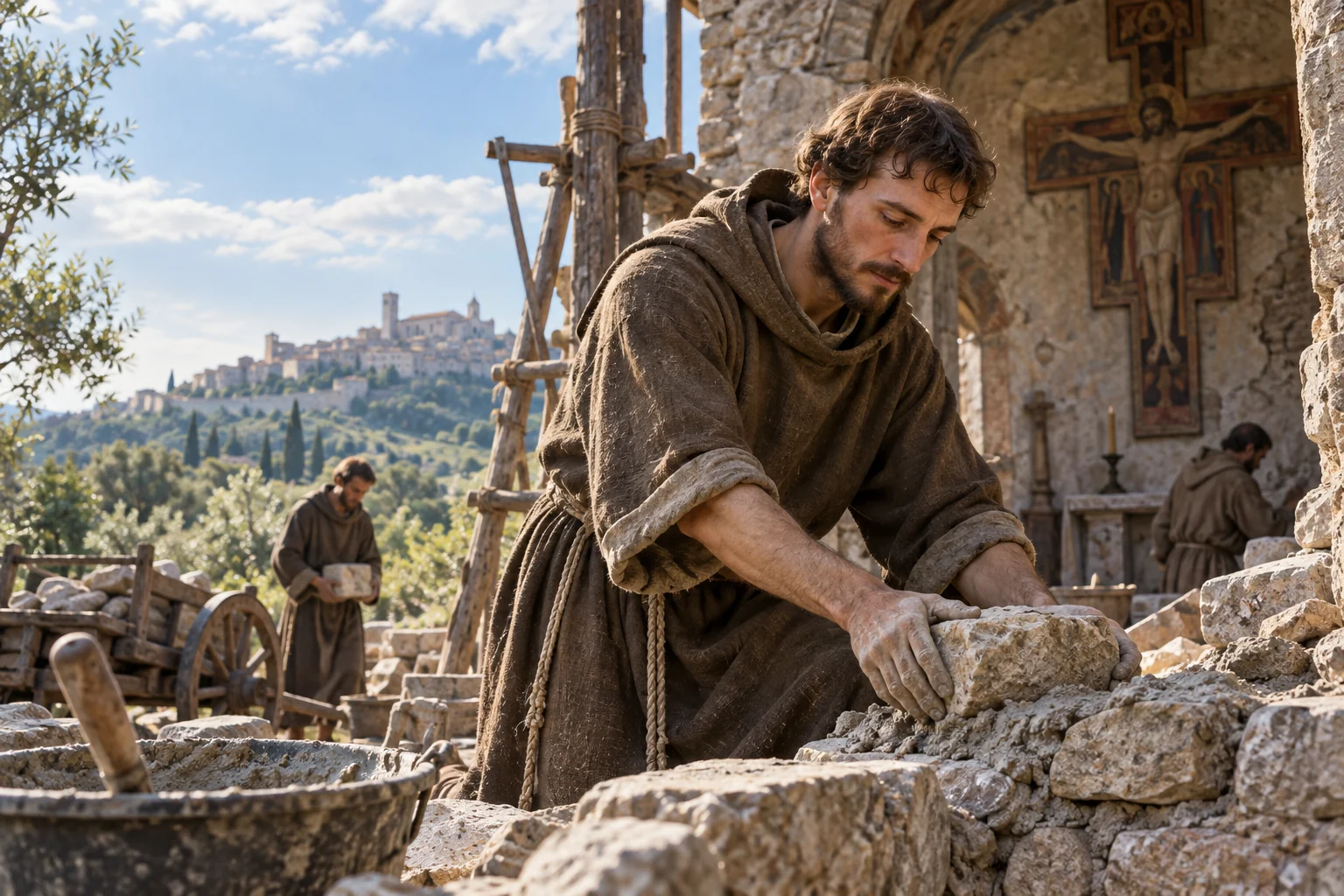
At first, Francis took those words literally. He went home, took many bolts of his father’s fine cloth, sold them, and bought stone to restore San Damiano with his own hands.
Chapter 3 of 8
The break with his father before the bishop
His father, Pietro Bernardone, was furious at his son’s “madness.” He tied him to a post, beat him, and finally dragged him before Bishop Guido of Assisi to make him renounce his inheritance and return all the money.
Before the eyes of the whole town, Francis did something astonishing: he returned the money, and then took off all the fine clothes he was wearing, laid them at his father’s feet and declared:
“Until today I have called Pietro Bernardone my father; but from now on I can say with peace of heart: Our Father who art in heaven!”
The bishop, in tears, wrapped his own cloak around Francis’s naked body.
From that moment, Francis belonged entirely to God. He put on the coarse tunic of the poorest local peasants, shaped like a cross and tied with a rope, and began the life of a wandering beggar.
Chapter 4 of 8
The birth of the Friars Minor
On February 24, 1208, in the little church of the Porziuncola, Our Lady of the Angels, Francis heard the Gospel in which Jesus sends His disciples out to preach, taking no gold or silver, no bag, no second tunic, no sandals, and cried out:
“This is what I have been longing for all this time!”
His holiness soon drew his first companions, well-born and educated men of Assisi: Bernard of Quintavalle, Peter Catani, Brother Giles... They sold all their possessions, gave the money to the poor and came to live with him in simple huts at Rivo Torto.
In 1209 Francis wrote a short rule made up almost entirely of Gospel passages, and led eleven brothers to Rome to ask Pope Innocent III to approve it.
At first the powerful Pope refused, finding their way of life too poor and too strange. But that night he had a dream: he saw the Basilica of Saint John Lateran, mother church of the whole world, tilting and about to collapse, until a small, poor friar put his shoulder to it and held it upright.
Recognizing the friar as Francis, the Pope called him in, approved their way of life and allowed the brothers to go everywhere preaching repentance. The Order of Friars Minor, the Franciscans, was born.
In 1212, he helped Saint Clare of Assisi found the Second Order, the Poor Ladies, or Poor Clares. In 1221, he founded the Third Order for lay people living in the world who wished to follow his spirit of poverty and peace.
Chapter 5 of 8
The crib at Greccio and a dialogue of peace with the Sultan
In 1219, in the middle of the bloody Fifth Crusade in Egypt, Francis did something extraordinary for peace: unarmed, with one companion, he crossed the battle lines at Damietta to meet the Sultan, Malek al-Kamil.
Seized and beaten by the Sultan’s soldiers, he asked to be taken to their master. Moved by Francis’s gentleness, courage and poverty, the Sultan received him with great respect, listened to him speak about Christ, and gave him an ivory horn as a keepsake before letting him return safely.
On Christmas night 1223, in the mountain village of Greccio, Francis had a beautiful idea that would change Christian custom: he asked a friend to prepare a real manger with straw and to bring a real ox and donkey to stand beside it, and Midnight Mass was celebrated there in a cave in the woods.
He wanted everyone to see with their own eyes the poverty and self-emptying love of the Son of God coming into the world. That is the origin of the Christmas crib set up all over the world every year.
Chapter 6 of 8
The five wounds on Mount La Verna
In the autumn of 1224, two years before his death, Francis climbed to the wild, rocky heights of La Verna, a mountain in the Casentino that Count Orlando of Chiusi had given him in 1213 as a place of retreat, to keep a forty-day fast in honor of Saint Michael the Archangel.
He prayed for two graces: to feel the pain Jesus suffered in His Passion, and to feel the fire of love that moved the Lord to give His life for us.
Around September 14, 1224, the feast of the Exaltation of the Cross, while he was deep in contemplation, a fiery six-winged Seraph came down from heaven. Between the angel’s wings was the image of a Man crucified on a Cross.
When the vision faded, Francis found his body marked with the five wounds of Jesus: in his hands and feet were marks like nails of black iron, and in his side a deep wound that often bled and soaked his habit.
He was the first person in the history of the Church known to bear the five wounds of the Lord.
Chapter 7 of 8
The Canticle of the Creatures and a smile for “Sister Death”
In his last years Francis was almost blind from an eye disease caught on his journey to Egypt, his body worn out by the stigmata and by illness.
Yet it was then, lying on a damp straw bed at San Damiano with mice scurrying about all night, that he composed his great poem, the “Canticle of the Creatures” (Cantico delle Creature).
It is a joyful song praising God for Brother Sun, Sister Moon, Brother Wind, Sister Water, Brother Fire and Mother Earth: the song of a soul at peace with God, with itself and with all creation.
On the evening of October 3, 1226, sensing that the hour of death had come, Francis asked his brothers to strip him and lay him on the bare earth at the Porziuncola, so that he could die in complete poverty like his Master.
He opened his arms and smiled:
“Welcome, my Sister Death!”
He asked his brothers to sing the Canticle of the Creatures again and to read the Passion from John’s Gospel.
As dusk fell, while a flock of larks swooped down onto the roof singing as if to say goodbye, Francis of Assisi died peacefully and went home to God. He was forty-five.
The foundation stone of a splendid basilica in his honor was laid only two days after his death, on a hill where criminals had been executed, which the people of Assisi called the “Hill of Hell”; from then on it was called the “Hill of Paradise.” Yet for nearly six hundred years the exact place of his tomb was a mystery: fearing the saint’s remains would be stolen, the friars had hidden the grave deep beneath the floor of the church. Only in 1818 did Pope Pius VII allow it to be excavated. After fifty-two days of digging, the tomb was found, enclosed by iron bars, and when the coffin was opened his body was found almost intact, his head still resting on a rough stone, as poor in death as he had been in life. A new crypt was built on that spot, where he is venerated to this day, and above it the magnificent two-level basilica, with Giotto’s famous frescoes of his life, is one of the great works of art of the Middle Ages.
Chapter 8 of 8
A saint of peace and of creation
Less than two years later, on July 16, 1228, Pope Gregory IX canonized Francis of Assisi.
In 1979, Pope Saint John Paul II proclaimed him patron of ecology. In 2013, the first Pope from Latin America took the name Francis as a sign of his commitment to the poor and to the care of creation. The Church celebrates him on October 4 each year.
The Peace Prayer,
“Lord, make me an instrument of Your peace...”
, captures his whole spirit, and millions of Vietnamese know it by heart.
Saint Francis of Assisi reminds us that true wealth lies not in what we gather and hold on to, but in what we dare to let go of and give away.
By his joyful poverty he showed the world that those who dare to give up everything for God find everything again in His love.
The end of the story
You have walked with Saint Francis of Assisi to the end of the story.
Still vivid in your memory:
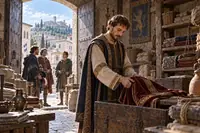
Once so repelled by lepers that he held his nose and galloped away, one day he leapt from his horse, embraced a sick man and kissed his disfigured face.
Before the bishop’s court, he took off all his fine clothes and laid them at his father’s feet, declaring that from now on he had only one Father in heaven.
On Mount La Verna, a Seraph appeared, and when the vision faded his body bore the five bleeding wounds of Jesus.
Stay in silence
Reaching the end, you understand: what once disgusted us most, embraced with love, can turn into sweetness.
What had seemed bitter to me was turned into boundless sweetness.
Let us pray
Saint Francis of Assisi,
you once shrank from lepers, then one day leapt from your horse to embrace and kiss one. You took off your fine clothes so that you had only one Father in heaven.
Teach me to live simply, to want fewer possessions, and to embrace what I once shrank from.
Help me love and care for God’s creation: the earth, the water, the plants and the animals.
Make me an instrument of God’s peace.
Amen.
Sources
- Feast dayAuthor’s edited profile
- Patron ofPatronages and symbols, version 1.1
- Often depicted withPatronages and symbols, version 1.1
- Reflectionvatican.va
- Reflectionofm.org
Meet the next one
 Journey 5