

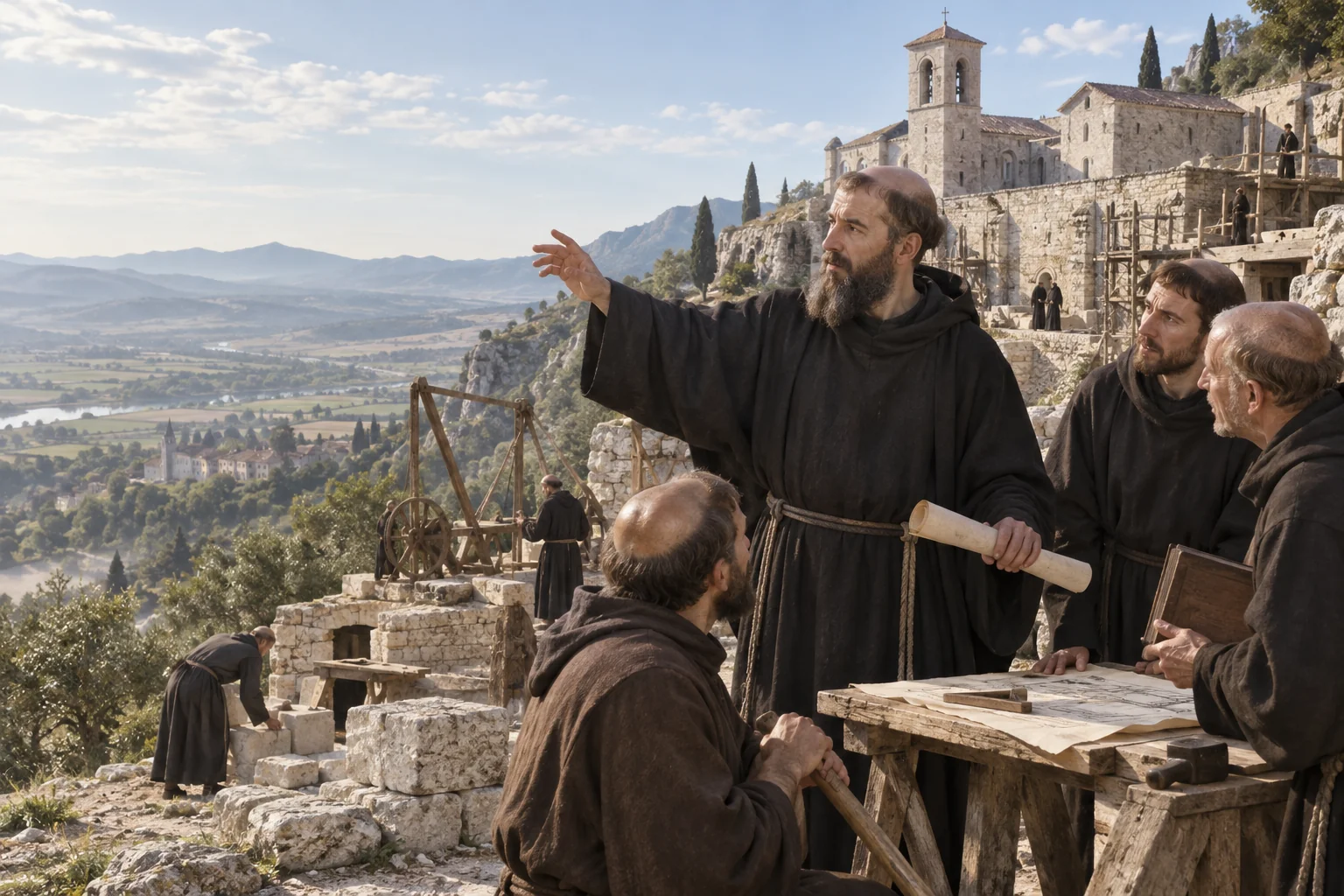
Journey 5 · Seeking God in Silence
Saint Benedict
Prayer and work that built a civilization
Feast day July 11
Tap to step inside
Saint Benedict
Prayer and work that built a civilization
Map of a life
This life told in 6 chapters
Begin the journey OpeningOpening1 min
 Chapter 1 of 6Leaving the splendid capital1 min
 Chapter 2 of 6Three years in the cave at Subiaco2 min
 Chapter 3 of 6The summit of Monte Cassino and the light of the Rule1 min
 Chapter 4 of 6An abbot who stood up to a tyrant1 min
 Chapter 5 of 6A last meeting, and dying upright2 min
- Chapter 6 of 6Patron of Europe1 min
Feast day
Saint Benedict
Some places may celebrate on a slightly different day.
July 11
Patron of
- Europe (proclaimed by Paul VI in 1964)
- Monks
- Farmers
- Against temptation and poisoning
Often depicted with
- The Saint Benedict medal
- A raven carrying a loaf of bread
- A broken cup of poison
Opening
Opening
In the sixth century, the Western Roman Empire lay in ruins after wave upon wave of barbarian invasion. Splendid cities were plundered and burned, schools closed, fields lay abandoned, law broke down, and a thousand-year-old civilization sank into a dark night of violence and poverty.
In the middle of that devastation, a young nobleman left corrupt Rome and withdrew to a cave high in the cliffs of Subiaco.
From that silent cave, he wrote a short Rule full of wisdom and balance. That Rule gave birth to a network of thousands of Benedictine monasteries stretching across Europe.
Wherever his monasteries rose, swamps were cleared into fields of grain, classical books were copied and preserved, the poor were fed, and justice and order were rebuilt.
That great father is Saint Benedict of Nursia (Benedetto da Norcia), honored through the ages as the “Father of Western monasticism” and the patron of all Europe.
Chapter 1 of 6
Leaving the splendid capital
Benedict was born around 480 in Nursia, now Norcia, a mountain town in the Umbria region of Italy, into a noble family with a strong tradition of faith. He had a devout twin sister, Saint Scholastica.
As a young man, he was sent by his parents to Rome to study law and classical literature. But as soon as he arrived, Benedict was shocked and disgusted by the dissolute lives of the young men his age.
He realized that if he kept on down this worldly road, he would lose his soul.
Around the year 500, at twenty, Benedict turned his back on a brilliant career. He quietly left Rome and withdrew with his faithful old nurse to the village of Enfide (now Affile).
There he worked a miracle, mending his nurse’s broken earthenware sieve, and people began flocking to praise him. So Benedict fled alone, deeper into the wild valley of Subiaco.
Chapter 2 of 6
Three years in the cave at Subiaco
At Subiaco, Benedict met a devout monk named Romanus. Romanus gave him a rough monk’s habit and showed him a natural cave on a sheer cliff, now called the Sacro Speco, the Holy Cave.
For three long years, Benedict lived completely alone in that cave, known to no one but the monk Romanus. From time to time Romanus would tie a piece of bread to a rope with a small bell on it and lower it from a ledge above.
In that silence, Benedict fought fierce inner battles. Once, the image of a woman he had known in Rome rose up in his mind and inflamed him with such desire that he thought of leaving the cave and going back to the world.
Recognizing the devil’s trap, Benedict stripped off his clothes and threw himself into a thick patch of thorns and nettles outside the cave. The thorns tore his body until it bled, and the fire of desire went out. From that day on, he was free and pure of heart.
Word of his holiness spread. Shepherds found him, and later the monks of the nearby monastery of Vicovaro, having just lost their superior, begged him to come and be their abbot. Benedict at first refused, knowing their way of life did not suit his, but at their insistence he agreed.
But when he began to tighten their lax discipline, the monks came to hate him and tried to poison him, offering him a cup of poisoned wine. When Benedict raised his hand and made the Sign of the Cross over it, the glass shattered as if struck by a stone.
He calmly rose and said to them:
“May God forgive you, brothers; I told you beforehand that my way of life did not suit you!”
Then he went quietly back to his cave at Subiaco.
At Subiaco, young men came from everywhere asking to follow him. Benedict organized them into twelve small monasteries, each of twelve monks under the guidance of an abbot.
But a jealous local priest named Florentius sent him poisoned bread and hired loose women to dance outside the monastery door to stir up trouble. For the sake of peace in the community, Benedict decided to leave.
Chapter 3 of 6
The summit of Monte Cassino and the light of the Rule
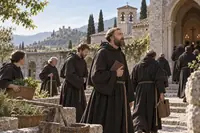
In 529, Benedict led a group of disciples up the mountain of Monte Cassino, between Rome and Naples, the site of an ancient fortress and a pagan temple to Apollo.
He smashed the pagan altar, cut down the sacred grove and built the Abbey of Monte Cassino, the great cradle of Western monasticism.
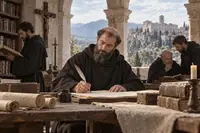
It was at Monte Cassino that Benedict wrote his great work, the Rule of Saint Benedict (Regula Benedicti), in seventy-three short chapters.
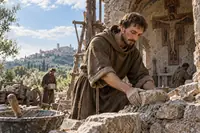
Unlike the very severe rules of the Eastern monks, the Rule of Saint Benedict is marked by wisdom, moderation and a deep sense of human balance. Monastic life is summed up in the famous motto “Ora et Labora”: Pray and Work. The monastery is seen as a “school of the Lord’s service” and a “family home”, where the abbot is a kind yet firm father who knows how to support the weak and correct the stubborn. The monks’ day is divided in a balanced rhythm: the Divine Office prayed in common, reading and meditating on God’s word, and work with hands or mind. He gave special care to the elderly, the sick and guests:
“All guests who come to the monastery are to be welcomed as Christ.”
That Rule went on to shape monastic life throughout Europe for over a thousand years.
Chapter 4 of 6
An abbot who stood up to a tyrant
Saint Benedict’s holiness and wisdom made even kings stand in awe.
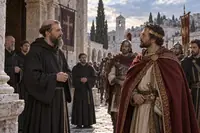
In 542 Totila, the brutal king of the Goths who was ravaging Italy, heard of his fame and came to Monte Cassino to test him. The king had one of his generals put on magnificent royal robes and lead his retinue into the monastery, pretending to be the king.
But Benedict, who was sitting and reading, saw the general from far off and called out:
“My son, take off those clothes, they are not yours!”
Astonished and afraid, King Totila came in person and fell at his feet. Benedict sternly rebuked the king:
“You have done much evil and caused so much grief! Stop your cruelty! You will enter Rome, you will cross the sea to Sicily, you will reign nine more years, and in the tenth year you will die!”
Every one of those prophecies came true, down to the last detail.
Chapter 5 of 6
A last meeting, and dying upright
His twin sister, Saint Scholastica, had founded a convent not far from Monte Cassino. Brother and sister met only once a year, at a small house belonging to the monastery, to talk together about the Kingdom of Heaven.
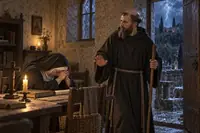
At their meeting early in 547, when night had fallen and Benedict got up to return to the monastery because the Rule forbade monks to spend the night outside, Scholastica begged him to stay. When he refused, she laid her head on the table and prayed, weeping.
At once a violent thunderstorm broke out, and Benedict could not set foot outside the door. Amazed, he cried:
“What have you done?”
Scholastica smiled and answered:
“I asked you and you refused; I asked God and He heard me at once!”
Saint Gregory the Great later remarked that the sister could do more than the brother, because she loved more.
Three days later, while praying in his room, Benedict saw his sister’s soul rising to heaven in the form of a white dove. He sent his brothers to bring her body back and buried her in the very tomb he had prepared for himself.
Not long afterwards, sensing that his own hour had come, Benedict had the tomb opened. For six days he burned with a high fever.
On March 21, 547, he asked his brothers to help him into the chapel of the Abbey of Monte Cassino. After receiving the Body and Blood of the Lord, the abbot stood upright, both arms raised to heaven in prayer, his disciples holding him up on either side, and died peacefully on his feet.
At that same moment, two monks in two places far apart both saw a road spread with shining carpets, reaching from Benedict’s room straight up to heaven.
For nearly fourteen hundred years afterwards, the shared tomb of brother and sister rested in the sanctuary of Monte Cassino, until one terrible day in the twentieth century. On February 15, 1944, in the middle of the Second World War, more than a hundred Allied bombers dropped over a thousand tons of bombs on the hill, reducing almost the entire abbey to rubble. Tragically, the Germans were not actually inside the monastery, as Allied intelligence had wrongly believed. Yet amid that terrible devastation, a shell that landed right by the tomb of Saint Benedict and Saint Scholastica did not explode. After the war, the monks found the relics of brother and sister intact among the ruins, and years of rebuilding raised Monte Cassino from the ashes.
Chapter 6 of 6
Patron of Europe
On October 24, 1964, Pope Paul VI proclaimed Saint Benedict “Principal Patron of all Europe”, in the same year that he went to Monte Cassino himself to consecrate the rebuilt abbey. It was a recognition of what the Benedictine monasteries had done to preserve learning, clear the land and rebuild the Christian civilization of the continent.
The Church celebrates him on July 11 each year in the revised liturgical calendar.
The Saint Benedict medal (Crux Sancti Patris Benedicti), bearing the initials of the famous prayer of exorcism “Vade retro Satana” (“Begone, Satan!”), is treasured and worn by believers everywhere as a sign of peace and protection against evil.
Saint Benedict teaches us that true peace does not lie in wealth or fame. It grows from an ordered life that puts God first, works hard with its hands and keeps the heart quiet in prayer.
“Ora et Labora”, Pray and Work: these are still the two strong wings that lift the soul above every storm of its time.
The end of the story
You have walked with Saint Benedict to the end of the story.
A few passages you will want to read again:
Fiercely tempted by desire in the cave at Subiaco, he took off his clothes and rolled in thorns and nettles to put out that fire.
The monks of Vicovaro put poison in a cup of wine for him; when he made the Sign of the Cross to bless it, the glass shattered.
On the day he died, he asked to be held up on his feet, arms raised in prayer, and died that way.
Stay in silence
And you notice something quietly: a simple, ordered life of prayer and manual work became the foundation for rebuilding a collapsing civilization.
Ora et Labora: Pray and Work.
Let us pray
Saint Benedict,
you taught monks to live by the rhythm of "pray and work", and from that simple way of life, all of Europe was rebuilt after its ruin.
Teach my family to live with order: a time to pray, a time to work, a time to sit together.
Protect me from all evil and temptation. And at the hour of my death, may I go forth in peace into God’s hands, as you did.
Amen.
Sources
- Feast dayAuthor’s edited profile
- Patron ofPatronages and symbols, version 1.1
- Often depicted withPatronages and symbols, version 1.1
- Reflectionvatican.va
Meet the next one
 Journey 5