

Journey 3 · Young Lives Freely Given
Saint Barbara
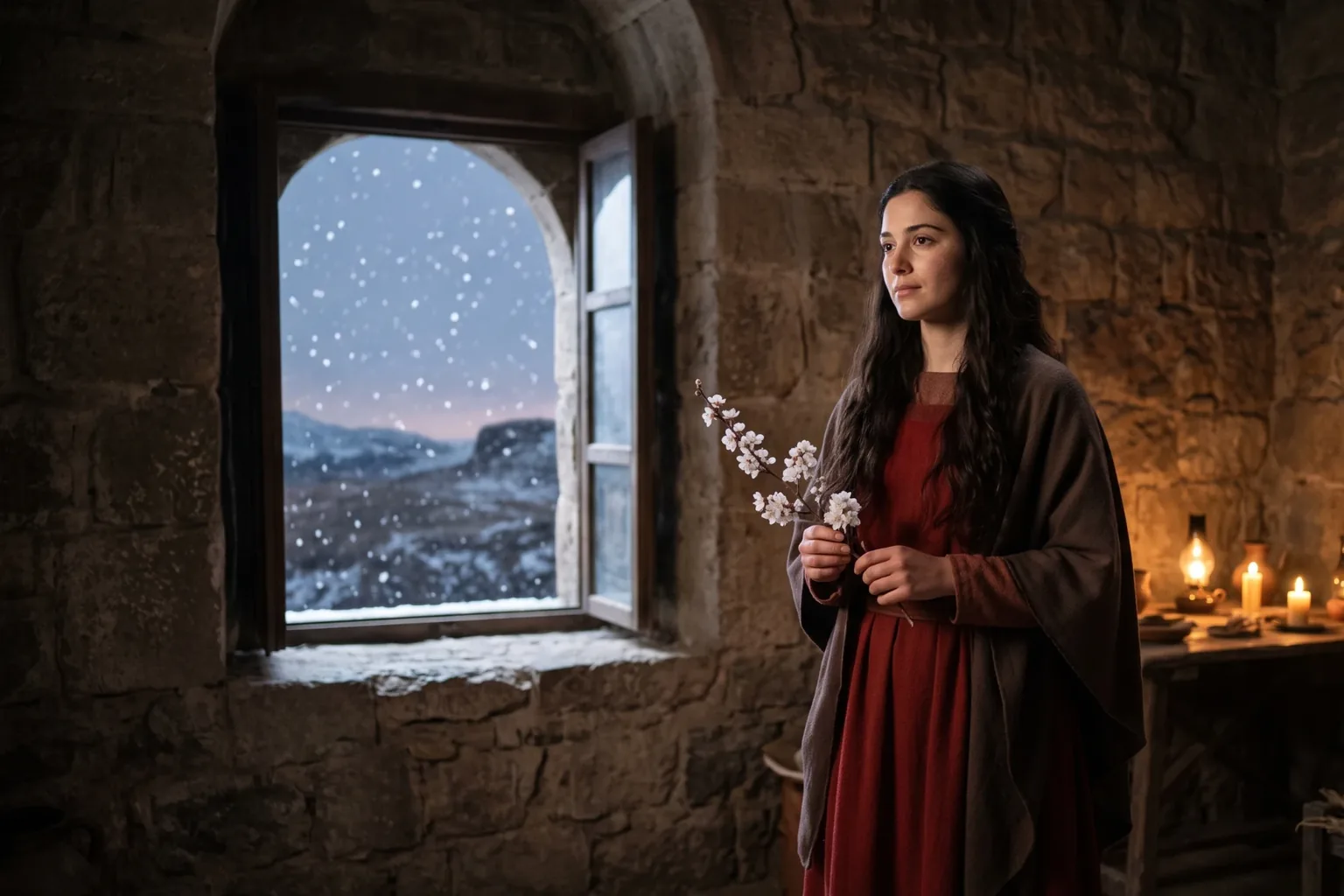
A cherry branch blooming in winter
Feast day December 4
Tap to step inside
Saint Barbara
A cherry branch blooming in winter
Map of a life
This life told in 9 chapters
Begin the journey OpeningOpening1 min
 Chapter 1 of 9A story with no records1 min
 Chapter 2 of 9The tower with three windows1 min
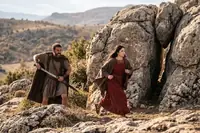 Chapter 3 of 9A father with a sword1 min
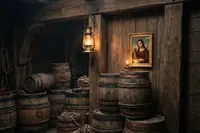 Chapter 4 of 9Lightning and a powder keg1 min
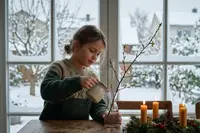 Chapter 5 of 9A cherry branch blooming in winter1 min
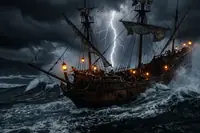 Chapter 6 of 9The city that bears her name1 min
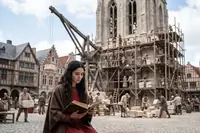 Chapter 7 of 9A tower still being built in a painting1 min
- Chapter 8 of 9Why the Church still keeps her name1 min
 Chapter 9 of 9Our own Barbara1 min
Feast day
Saint Barbara
Some places may celebrate on a slightly different day.
December 4
Patron of
- Artillerymen
- Miners
- Firefighters
- People in dangerous work, praying to be spared a sudden death
Often depicted with
- A tower with three windows
- A chalice
- A palm branch
- A cherry branch (tradition)
Opening
Opening
There are saints we know very well: the day they were born, the day they died, the letters they wrote, the people who met them. And there are saints about whom we know very little as real people, yet whose names are everywhere. Saint Barbara belongs to the second group.
Her name was given to a city on the shore of the Pacific Ocean. In Spanish and Italian, her name is also the word for the powder magazine on a warship. In Poland, coal miners march in dress uniform on her feast day. In Germany and Austria, on December 4, people cut a bare cherry branch and put it in a vase of water, waiting for it to bloom just in time for Christmas. And in Vietnam, countless Catholic girls bear the baptismal name Barbara.
Yet if you ask historians what year Barbara was born, where she lived and how she died, they will honestly tell you: we do not know for sure. Her story has been retold and embellished over many centuries, and that is how it is told here: as a story the Church has loved and handed down, not as a chronicle.
Chapter 1 of 9
A story with no records
The earliest accounts of Barbara appear around the seventh century, that is, three or four hundred years after the time she is thought to have lived. These texts do not even agree about her homeland: some say she lived in Nicomedia, a great city in Asia Minor near the Bosphorus; others say Heliopolis in Egypt, or Heliopolis in Syria. As for the date, she is thought to have been martyred around the third century, under one of the persecutions of the Roman emperors.
No document from that time mentions her. No ancient tomb has been identified with certainty. That is why in 1969, when the Church revised the whole liturgical calendar, the feast of Saint Barbara was removed from the general calendar of the universal Church, along with some other saints whose stories lack historical basis.
But we should be clear about this: the Church did not declare that Barbara did not exist. She was not “struck off the list of saints”, as many people think. Her name is still in the Roman Martyrology, the Catholic Church’s official list of saints, on December 4. Dioceses, parishes and those who bear her name may still celebrate her feast and honor her. It is simply that the Church does not require the whole world to keep one common feast when what we know of that saint is mainly tradition.
It is a little like many Vietnamese families, who honor an ancestor though no one remembers the year he was born or what he did, only a few stories handed down by the grandparents. Not knowing the details does not mean there was no one.
Chapter 2 of 9
The tower with three windows
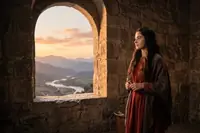
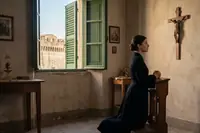
According to tradition, Barbara was the only daughter of a rich pagan man named Dioscorus. She was very beautiful, and her father, both loving her and wanting to keep her for himself, built a tall tower and shut her up in it, so that no one would see her and she would not be influenced by the outside world.
But it was in that very tower that the young woman began to think. Looking out of the window at the sky and earth, the mountains and rivers, she wondered: how could the statues of gods made of stone and wood that her father worshiped have created all these wonders? The story tells that she found a way to reach some Christians, heard about the one God, and was baptized in secret.
Once, while her father was away, workmen were building a bathhouse in the tower that he had ordered with two windows. Barbara told the workmen to make a third window. When her father came back and asked why, she answered: the three windows stand for the Father, the Son and the Holy Spirit, the light of the Trinity shining on the human soul.
Because of that detail, almost all old paintings and statues show Saint Barbara beside a tower with three windows. If you go into an old church in Europe and see a statue of a young woman holding a small tower in her hand, that is Barbara.
Chapter 3 of 9
A father with a sword
When he learned that his daughter had become a Christian, Dioscorus was so furious that he drew his sword to kill her. Tradition says Barbara fled, and a rock split open for her to hide in. But a shepherd saw where she was hiding and showed her father.
The father dragged his daughter home, beat her, and then handed her over himself to the governor. The governor used every kind of torture to make her deny the faith: flogging, burning with torches, parading her through the streets in shame. The story says that every night in prison the Lord healed Barbara’s wounds, and the next morning she stood before the court again, still at peace. A woman named Juliana, seeing her courage, also professed her faith and was martyred with her.
In the end she was sentenced to be beheaded. And the most terrible part of the story is this: her own father demanded to carry out the sentence with his own hand. He took his daughter up a mountain and beheaded her.
As soon as he came down the mountain, from a clear sky a bolt of lightning struck, and Dioscorus died on the spot.
This story, though it has no historical records, has made listeners shudder through the centuries, because it speaks of something true in life: sometimes the one who hurts us most is the one who should love us most. And there are young people who, to keep their faith, have had to pay for it by losing their own families. In Vietnam, too, in times of persecution, there were sons and daughters denounced or abandoned by non-Christian parents and siblings. So Barbara’s story is not as distant as it seems.
Chapter 4 of 9
Lightning and a powder keg
It was the lightning in the story that gave Saint Barbara a most unusual place in popular devotion.
In the Middle Ages, people prayed to her for protection from lightning and storms. Then, when gunpowder came to Europe and the first cannons appeared, their roar and flash reminded people of lightning. Artillerymen and those who worked with explosives, always at risk of sudden death, chose Saint Barbara as their patron.
On Spanish and Italian warships, people often placed a picture of Saint Barbara in the powder magazine, asking her to keep the ship safe from fire and explosion. Over time, that very magazine came to be called by her name. To this day the Spanish dictionary has the word “santabárbara”, meaning “a ship’s powder magazine”. A young woman saint gave her name to the most dangerous place on a warship.
Then came the miners, who work deep underground amid poisonous gas and explosions, who go down into the pit each morning not knowing whether they will come up again in the evening. They too chose Saint Barbara. In Poland, December 4 is fondly called “Barbórka”, the miners’ festival. Miners in black dress uniforms with plumed caps go to Mass and then celebrate together. In many mines in Germany, Austria and Poland, a small statue of Saint Barbara still stands at the entrance to the tunnel.
Firefighters, foundry workers, architects, people in dangerous trades, and all who fear a sudden death, turn to her. In old paintings, Saint Barbara often holds a chalice with the Host above it. That is because people believed she intercedes so that those who honor her will not die before receiving the last sacraments. For people of old, dying suddenly, without time for confession or Holy Communion, was the most frightening thing of all.
Chapter 5 of 9
A cherry branch blooming in winter
There is a very beautiful custom tied to Saint Barbara’s day, still kept in Germany, Austria and much of Central Europe.
On December 4, when winter has set in and the trees are bare, people go into the garden and cut a cherry branch, sometimes an apple or peach branch, bring it indoors and put it in a vase of water in a warm place. They change the water every day, and wait. If the branch blooms right on Christmas night, it is taken as a sign of good fortune in the new year. These branches are called “Barbara branches”.
A legend explains the custom: while imprisoned, Barbara found a dry cherry twig caught on her clothes. She put it in her cup of drinking water, saving a few drops each day to water it. And on the very day she was taken to her execution, the dry twig burst into bloom.
Whether or not the legend is true, the image of a dry branch blooming in midwinter is a very Christian one: life springing from what seemed dead, like Advent waiting for the Lord to come, like the hope of those in dark prisons. Catholic families in Europe use Barbara branches as a way of teaching children to wait for Christmas: changing the water each day, looking each day to see whether the buds have appeared, just as we prepare our hearts day by day for the Lord’s coming.
Chapter 6 of 9
The city that bears her name
On December 3, 1602, the Spanish explorer Sebastián Vizcaíno and his fleet, sailing along the coast of California, was caught at night in a fierce storm. The fleet came through. The next day was the feast of Saint Barbara, protector against storms and sudden death. In thanksgiving, he named the bay where they had found safety Santa Barbara.
Two hundred years later, the Franciscans founded a mission there, and little by little the place became a city. Today hundreds of thousands of people live in the city of Santa Barbara on the California coast, and most do not know that their city’s name comes from a stormy night at sea and a prayer of thanks to a young woman saint.
On the other side of the world, in Kyiv, the capital of Ukraine, there is a relic venerated as the arm of Saint Barbara. According to tradition, in 1108 a Byzantine princess, coming to marry a grand prince of Kyiv, brought that relic with her from Constantinople. For many centuries it was kept in Saint Michael’s Golden-Domed Monastery, and brides in Kyiv would come to pray before it for a happy marriage. The authenticity of this relic, like that of many other ancient relics, cannot be verified; but it shows how devotion to Saint Barbara spread from East to West.
In the Middle Ages, Saint Barbara was also counted among the “Fourteen Holy Helpers”, fourteen saints whom the German people believed were especially quick to help in times of trouble, above all during the terrible plagues of the fourteenth century.
Chapter 7 of 9
A tower still being built in a painting
In 1437 the Dutch painter Jan van Eyck, one of the great masters of European painting, painted a small picture of Saint Barbara, now kept in the Royal Museum of Fine Arts in Antwerp, Belgium. The painting has one special feature: it was never finished. There are only fine pen strokes on a white ground, with a few patches of sky where the color had been started.
In the painting, Saint Barbara sits in the foreground, reading. Behind her rises a huge Gothic tower, and what makes the painting so alive is that the tower is being built: there is scaffolding, there are workmen carrying stones and chiseling, there is a crane hoisting materials up high, there are people standing at the top of the tower. Van Eyck turned the tower of imprisonment in the legend into a busy building site in a fifteenth-century European city.
Art historians still debate whether it is an unfinished painting or a sketch deliberately left as it was. Either way, it shows how closely people of that time lived with Barbara’s story. Her tower was not something far off in an old tale; it was like the church towers going up in their own cities.
Builders, stonemasons and architects of that time chose Saint Barbara as their patron precisely because of that tower. And whenever a bell tower was finished, many places set a small statue of Saint Barbara inside it, asking her to protect it from lightning, the greatest fear for the tallest buildings in the city.
Chapter 8 of 9
Why the Church still keeps her name
One might ask: if we do not know for sure that the story of Barbara is true, why honor her?
The Church answers by distinguishing two things. One is what we know for certain about history, and the Church never wants the faithful to confuse legend with fact. It was precisely out of respect for the truth that in 1969 the feast of Saint Barbara was removed from the general calendar. The other is the devotion of a thousand years, the prayers, the people who were comforted, the miners who went down into the pit with a prayer on their lips. That too is real.
Many scholars think that behind that embellished story there may have been a real young woman martyred in a persecution, whose name the community remembered, telling and retelling her story and adding to it over many generations. In the first centuries thousands of Christians died whose names no one recorded. Barbara may be the face that stands for them.
And whichever details are true and which are not, the story still speaks of very true things about faith: finding God through the beauty of creation; keeping faith even when it costs one’s closest bonds; peace in the midst of suffering; and hope, like a dry branch that can still bloom.
Chapter 9 of 9
Our own Barbara
In Vietnam, Barbara is one of the baptismal names most often given to girls, especially in long-established Catholic regions. Many grandmothers and mothers named Barbara still celebrate their patron on December 4, even though her feast is no longer in the general calendar. That is entirely proper: she is still a saint of the Church.
If your name is Barbara, you need not worry that your patron “did not exist”. You need only know that what we know of her comes from the Church’s telling over many centuries, not from history books. And that telling has helped countless people live more courageously.
Perhaps the most beautiful image by which to remember Saint Barbara is not the tower, nor the sword or the lightning, but the dry cherry twig in a cup of water. A few drops of water each day, in a dark prison. No one knew it would bloom. But the young woman kept watering it.
Every life has winters like that: a long illness, a loved one far away, a prayer that seems never to be answered. Barbara reminds us to keep giving our own little drops of water each day: a prayer, a good deed, a little patience. Some branches bloom only on Christmas night.
The end of the story
You have walked with Saint Barbara to the end of the story.
Images that will stay with you:
A young woman in a tower telling the workmen to make a third window, so that the light of the Trinity could shine in.
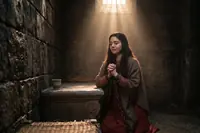
A father demanding to carry out the sentence with his own hand, and lightning from a clear sky.
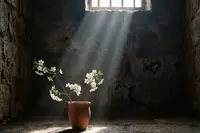
A dry cherry twig in a cup of water, given a few drops each day, blooming on the very day the young woman went to her death.
Stay in silence
As the story ends, you realize that even without knowing every detail for sure, the story still says something true: a dry branch can still bloom.
If there is a "winter" in your life right now, keep giving your own little drops of water each day.
Let us pray
Saint Barbara,
it is told that you kept your faith even when your own father turned his back on you. Pray for young people who must choose between faith and peace at home, that they may have courage while still honoring their parents.
Protect those who work amid danger: miners, soldiers, firefighters, seafarers. May I and my loved ones not be taken suddenly before we have made peace with God and with one another.
And in the winters of my life, teach me patience like a dry branch waiting to bloom.
Amen.
Sources
- Feast dayArticle, version 1.1
- Patron ofPatronages and symbols, version 1.1
- Often depicted withPatronages and symbols, version 1.1
Meet the next one
 Journey 3