

Journey 3 · Young Lives Freely Given
Saint Mary Domenica Mazzarello
A lamp lit in a poor corner of the village
Feast day May 13
Tap to step inside
Saint Mary Domenica Mazzarello
A lamp lit in a poor corner of the village
Map of a life
This life told in 7 chapters
Begin the journey OpeningOpening1 min
 Chapter 1 of 7A hardworking daughter of the hills of Mornese1 min
 Chapter 2 of 7A typhoid epidemic, and strength lost1 min
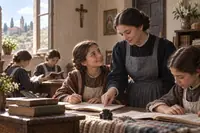 Chapter 3 of 7A vision on Borgo Alto, and a sewing room for the poor1 min
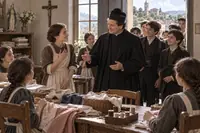 Chapter 4 of 7A providential meeting with Don Bosco1 min
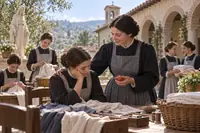 Chapter 5 of 7A mother’s love, and a lamp burning all night1 min
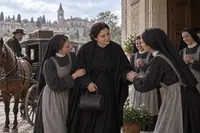 Chapter 6 of 7Her last breath at Nizza Monferrato1 min
- Chapter 7 of 7A flame that still burns1 min
Feast day
Saint Mary Domenica Mazzarello
Some places may celebrate on a slightly different day.
May 13
Patron of
- The Daughters of Mary Help of Christians (Salesian Sisters)
Often depicted with
- The window of Valponasca
- A black habit
Opening
Opening
In the remote village of Mornese, clinging to the barren hillsides of northern Italy, people were used to seeing a sunburned peasant girl with hands calloused from hoeing, harvesting and carrying water. She had little schooling, had never been beyond her village, and knew nothing but the rows of vines and the cornfields, year in, year out.
Yet from the small sewing room this girl opened in a poor corner of the village to teach a trade to abandoned girls grew a great congregation of women whose branches now spread across every continent: the Institute of the Daughters of Mary Help of Christians, the Salesian Sisters of Don Bosco.
That ordinary woman was Maria Domenica Mazzarello.
With Saint John Bosco she co-founded a vast family devoted to education. Don Bosco warmed thousands of street boys in the great city of Turin with a father’s heart; Mother Mazzarello sheltered countless poor, abandoned country girls with a mother’s gentle, holy love.
Her life sings of the power of God, who does not need the great means of this world, only a soul humble and empty enough to leave His hands free to build works that save many.
Chapter 1 of 7
A hardworking daughter of the hills of Mornese
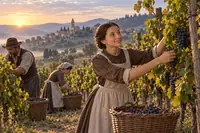
Maria Domenica Mazzarello, affectionately called Main, was born on May 9, 1837, on a small farm in the village of Mornese, in Piedmont, Italy, in the hilly wine country of the Lemme valley, whose green slopes still have the simplicity of a nineteenth-century village. Her parents, Giuseppe Mazzarello and Maria Calcagno, were simple farmers who worked the land all their lives and kept a faith as solid as rock. She was the eldest of many children and was baptized on the day she was born.
Main grew up in the sun and wind, physically strong, cheerful and straightforward. Even as a teenager she could work in the fields as nimbly as any strapping young man in the area: hoeing, pruning the vines, carrying heavy sacks of grain.
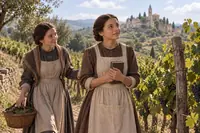
Yet the hands that held a hoe also learned early to fold in prayer. Every morning before sunrise, Main got up and walked several kilometers along steep, stony paths to the village church to go to Mass and receive Holy Communion.
The Valponasca farmhouse where her family lived had a little attic window facing straight toward the parish church, and it is still preserved today. At night the young woman would stand there looking toward the distant bell tower of the village church, then kneel and speak heart to heart with Jesus in the tabernacle.
In 1854, under the spiritual guidance of the parish priest, Father Domenico Pestarino, Main and some devout young women of the village founded the “Daughters of Mary Immaculate”. The young women promised to live chaste lives in the world, quietly helping poor families and caring for the sick of the parish.
Chapter 2 of 7
A typhoid epidemic, and strength lost
In 1860 a terrible typhoid epidemic broke out in Mornese. Her uncle’s whole family fell gravely ill with no one to look after them, and they faced a slow death from hunger and disease.
The parish priest came and asked Main to go and help. Main knew how deadly the disease was. She told him:
“Father, I am willing to go; but I know for certain that I will catch the disease and die!”
Even so, out of Christian charity, the twenty-three-year-old did not refuse. She went and nursed her uncle’s whole family, cooking and washing for them until they were well again.
And just as she had foreseen, Main caught the disease, and badly. A high, delirious fever lasting many weeks brought her to the very edge of death. She received the last sacraments and prepared to die.
But God had other plans: against all expectation, Main pulled through.
The price was very high: her robust health was gone for good. The illness left her thin and weak, unsteady on her feet, with no strength to hold a hoe or do heavy farm work.
Sometimes God takes away everything a person leans on in order to open a completely new road. Looking at the fields she no longer had the strength to work, Main did not despair. She knelt and said to the Lord:
“Lord, my strength for the fields is gone; now teach me what I must do to serve You!”
Chapter 3 of 7
A vision on Borgo Alto, and a sewing room for the poor
One afternoon, walking alone on the steep road of Borgo Alto on the outskirts of Mornese, Main suddenly had a vision: she saw a large building with a wide courtyard full of laughter, and many little girls playing and running about. A kind, gentle voice spoke in her ear:
“I entrust these children to you!”
The vision showed Main clearly which way to go. She realized that in the poor countryside, girls always had the hardest lot: they did not go to school, and they were easily exploited and led astray.
She wasted no time. Main talked it over with her close friend Petronilla, and the two young women decided to learn dressmaking and embroidery, not to get rich, but to open a free sewing room for the poor girls of the village.
Main told her friend:
“We will teach them every stitch so they have an honest trade to support themselves; and while we sew, we will teach them to love God, to pray the Rosary and to keep their souls pure!”
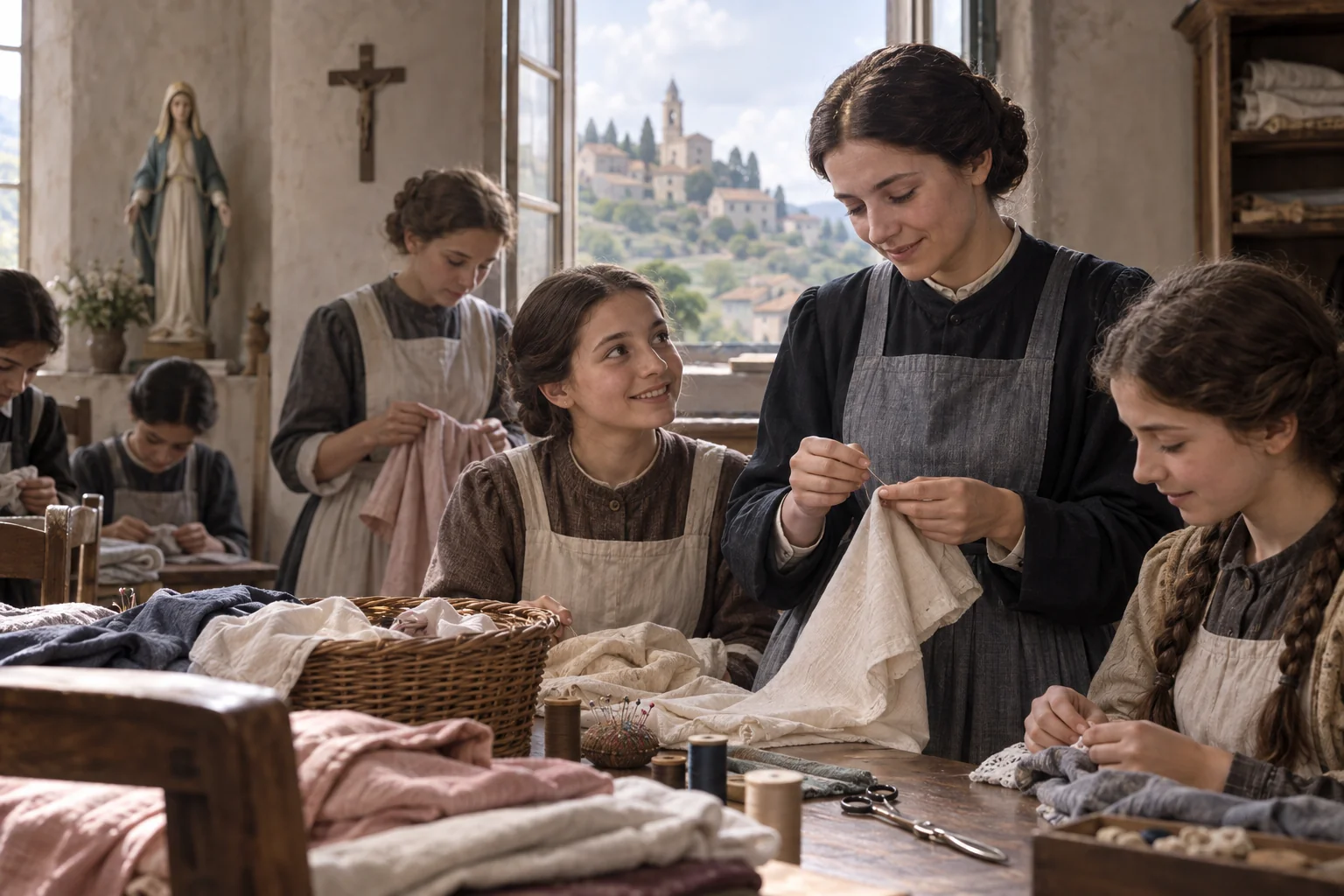
So a small, poor sewing room opened in a corner of the village. Main took in orphans and abandoned girls who had nowhere to go and raised them, sharing every potato and crust of bread. The sewing room was always full of hymns and children’s happy laughter. Main’s motherly love turned a poor workshop into a real home.
Chapter 4 of 7
A providential meeting with Don Bosco
In 1864, Don Bosco brought a group of Salesian boys from Turin to visit Mornese.
It was a meeting of two great souls. Seeing Don Bosco walking among his boys for the first time, Main exclaimed with emotion:
“Don Bosco is truly a saint, I feel it clearly in my soul!”
For his part, Don Bosco recognized in the sewing room of this poor apostle of Mornese the answer to his long-held dream: founding a congregation of sisters devoted to educating poor girls, alongside the work he was doing for boys.
In 1872, with the approval of Pope Pius IX, Don Bosco formally founded the Institute of the Daughters of Mary Help of Christians.
On August 5, 1872, in the poor chapel at Mornese, Maria Domenica Mazzarello and the first fourteen young women solemnly made their vows, receiving the habit from Don Bosco’s hands.
The large building on the hill of Borgo Alto, which Don Bosco had first meant to be a boys’ school, became the sisters’ first convent, exactly as in the vision Main had seen on the village road years before.
The sisters unanimously elected Mother Mazzarello as the first superior of the congregation. At the head of a new congregation born in utter poverty, she became the soul of the community through her humility, her great motherly love and Don Bosco’s “Preventive System”: education through reason, religion and loving kindness.
Chapter 5 of 7
A mother’s love, and a lamp burning all night
Mother Mazzarello never sat at a desk giving orders. She was always the first to rise and the last to go to bed in the convent. She rolled up her sleeves and carried water, did laundry, cooked and sewed for the girls alongside her sisters.
She taught the young sisters the heart of religious life:
“Do everything for the love of God, never to seek the praise of others. Every stitch we sew must be an act of love offered to God!”
She had a wonderful gift for reading hearts and understood each sister and each child. When she saw a sister looking sad and tired, she would come close, pat her shoulder in comfort, and slip an apple or a little cake into her pocket.
She wanted her sisters always serene and joyful:
“Sadness is the devil’s ally. A Salesian sister must always be cheerful!”
Under her leadership, the Daughters of Mary Help of Christians grew at an astonishing pace. Convents, schools and vocational workshops quickly sprang up all over Italy and spread into France.
Most remarkable of all, in 1877, only five years after the founding, Mother Mazzarello boldly sent the first missionary sisters across the ocean to the wild lands of Patagonia in South America to bring the Gospel to the native peoples. The heart of the peasant woman from Mornese reached to the ends of the earth.
Chapter 6 of 7
Her last breath at Nizza Monferrato
In 1879, Mother Mazzarello moved the congregation’s motherhouse to the convent at Nizza Monferrato.
Journeys to visit distant communities, constant concern for her sisters’ future and a life of austere sacrifice wore down her strength. At the beginning of 1881, on a visit to the convents in France, she contracted severe pleurisy.
Knowing her end was near, she gathered her strength to return to Nizza Monferrato, to be among her beloved daughters.
From her sickbed, her voice choked with emotion, she gave the sisters her last words:
“Love one another with all your hearts... Always keep humility and poverty... Love Mary Help of Christians and be faithful to Don Bosco... I forgive everyone, and I ask everyone to forgive me!”
At dawn on May 14, 1881, after whispering the hymn to Mary she loved most,
“Mother, I greet you...”
, Mother Maria Domenica Mazzarello died peacefully in the arms of her sisters, at the age of forty-four.
When she died, the congregation was only nine years old, but already had nearly three hundred sisters and thousands of girls being cared for in thirty convents.
Chapter 7 of 7
A flame that still burns
Pope Pius XI beatified her in 1938, and Pope Pius XII solemnly canonized her on June 24, 1951. The Church celebrates her on May 13 each year.
Today Mother Mazzarello is known and dearly loved in hundreds of communities of the Daughters of Mary Help of Christians in Vietnam and on every continent.
She is a model for all who give themselves to educating the young: education is not about imposing authority or passing on dry facts; it is a work of love that comes from the heart.
The attic window at Valponasca still reminds us that even if our life is as small as a grain of sand in some remote countryside, if we lift our eyes to God and open our hands to serve others with love, God can light a fire in that quiet, hidden corner that warms the whole world.
The end of the story
You have walked with Saint Mary Domenica Mazzarello to the end of the story.
Three things you will keep coming back to:
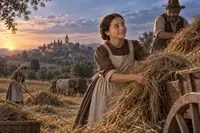
After typhoid took away her strength for the fields, she knelt and said: "Lord, my strength for the fields is gone; now teach me what I must do to serve You!"
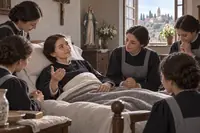
On the hill of Borgo Alto, she heard a gentle voice: "I entrust these children to you!"
The little sewing room in a poor corner of the village always rang with hymns and the laughter of the orphans she took in.
Stay in silence
And you are left with this: God does not need great means, only a soul humble and empty enough for Him to build in.
Every stitch we sew must be an act of love offered to God.
Let us pray
Saint Maria Mazzarello,
after the illness that took away your strength, you knelt and said: "Lord, teach me what I must do to serve You." And God entrusted poor children to you.
Teach me to accept the changes in my life, when my health or work is no longer what it was, and still find a way to serve.
Pray for poor and orphaned girls, that they may go to school and have a joyful home.
Amen.
Sources
- Feast dayAuthor’s edited profile
- Patron ofPatronages and symbols, version 1.1
- Often depicted withPatronages and symbols, version 1.1
- Reflectioncgfmanet.org
Meet the next one
 Journey 3