

Journey 1 · Those Who Met the Lord
Saint Andrew
The one who brought others to the Lord
Feast day November 30
Tap to step inside
Saint Andrew
The one who brought others to the Lord
Map of a life
This life told in 5 chapters
Begin the journey
Feast day
Saint Andrew
Some places may celebrate on a slightly different day.
November 30
Patron of
- Scotland, Russia, Greece
- The Patriarchate of Constantinople
- Fishermen
Often depicted with
- An X-shaped cross
- A fishing net
Opening
Opening
Open the Gospels and look for Andrew, and almost every time you find him doing exactly one thing: standing in the middle, connecting one person to another. Sometimes pulling his brother by the hand to come and meet the Master. Sometimes noticing a small boy lost in the crowd, clutching a few little loaves. Sometimes acting as an unexpected go-between for strangers from far away who wanted to meet Jesus but did not know whom to ask.
No one remembers him saying anything stirring. No miracle is attached to his name. Not a single sermon of his own was written down. But try taking him out of those Gospel pages: Simon would have had no one to bring him to the Master, the boy with five loaves would have stayed lost in the crowd unnoticed, the Greeks would have gone home empty-handed for lack of a way in. Some people are not the heroes of the great story. They simply stand at the right bend in the story, and because they stand there, others take the right turn.
Chapter 1 of 5
An afternoon he could never forget
Andrew came from Bethsaida, whose name in Aramaic means “house of fishing”: a fishing village right where the Jordan flows into the Sea of Galilee, home to him, to his brother Simon, and later to Philip as well. Archaeologists excavating the foundations of this ancient village — today the site of El-Araj on the northeastern shore of the lake — have found thousands of lead net weights in the soil, along with traces of a Roman-style bathhouse and stone vessels used in Jewish daily life. Here was a community that had lived by fishing for generations. Andrew must have grown up amid the strong smell of fish, waves slapping against the boats, and the clatter of net weights as people picked fish from the mesh at dawn.
Before he knew Jesus, he was already the disciple of another man: John the Baptist. He must have left home and boat for a while and gone down to the Jordan to live by that prophet’s austere way — no small decision for a young fisherman used to a settled life with his family.
Then one afternoon, standing by the river, he heard his teacher point to a man walking past: “This is the Lamb of God.” Andrew said nothing, only quietly turned and, together with a friend, followed the stranger — probably a little nervous, not quite knowing what he was doing, simply following the instinct of someone who has just heard something important.
Jesus sensed he was being followed, turned and asked: “What are you looking for?” The question flustered them; not knowing how to answer properly, they answered with a question of their own: “Teacher, where are you staying?” Jesus answered, so simply it was almost casual:
“Come and see.”
They went, saw where he was staying, and stayed with him the whole of that afternoon. The Gospel writer — who must have heard Andrew tell this story countless times — remembered every small detail: it was about four o’clock in the afternoon. A lifetime holds thousands of afternoons that no one bothers to remember. But sometimes a single afternoon is enough to redraw the whole path of a life.
Coming out of that house, the first thing Andrew did was not to sit alone and ponder it, but to run as fast as he could to find his brother.
“We have found the Messiah!”
He did not keep that joy to himself for a single moment; he gave it straight away to the person closest to him. He could not have imagined that his simple, hot-tempered, often tongue-tied brother would become the rock on which the Church was built. Andrew simply did something very ordinary between brothers: when you find something precious, you share it first with the one you love, without weighing it up.
Chapter 2 of 5
Leaving the nets to set out
The Synoptic Gospels tell another story, perhaps a little later: one morning on the shore of the Sea of Galilee, Andrew and Simon were casting their nets into the water — the familiar work they had done thousands of times, nothing new about it. Jesus passed by and called them. Their nets were still in the water, but they left them there at once, stepped ashore and followed him without the slightest hesitation.
We do not know how the two stories — the meeting by the Jordan and the farewell to the nets by the Sea of Galilee — fit together, or how far apart they were. Perhaps in between, Andrew went home for a while, back to the family boat, and only when the call came again did he leave for good. The life of faith is sometimes like that: a first encounter does not always draw us away at once and completely; we need to be called by name once more, to be looked in the eye once more, before we truly let go of everything and set out.
Andrew was counted among the Twelve. When the disciples sat on the Mount of Olives looking down at the magnificent Temple, and heard their Master say that one day it would be thrown down, with not one stone left upon another, Andrew was one of the four — with Peter, James and John — who came quietly to ask him privately when it would happen. It was the question of someone who did not understand everything yet, but wanted to. Following the Master has never meant understanding everything from the start.
What is worth noticing is that of the four who asked that private question, Andrew was the only one not among the three closest disciples — Peter, James and John, whom the Master often singled out for great moments. Andrew stood in an odd position: close enough to be trusted, but not prominent enough always to be named first. Perhaps that in-between place is the one closest to most of us — not everyone who follows the Lord is in the “inner three,” but everyone can find their place right beside them, close enough to listen, trusted enough to be asked.
Chapter 3 of 5
Five loaves in a wild meadow
Evening fell over a deserted meadow; thousands of people had followed to listen since early morning, and now all of them were faint with hunger. Jesus turned to Philip and asked whether there was any way to buy bread for everyone to eat. Philip did the sums and shook his head in dismay: two hundred denarii worth of bread would not go far among so many people.
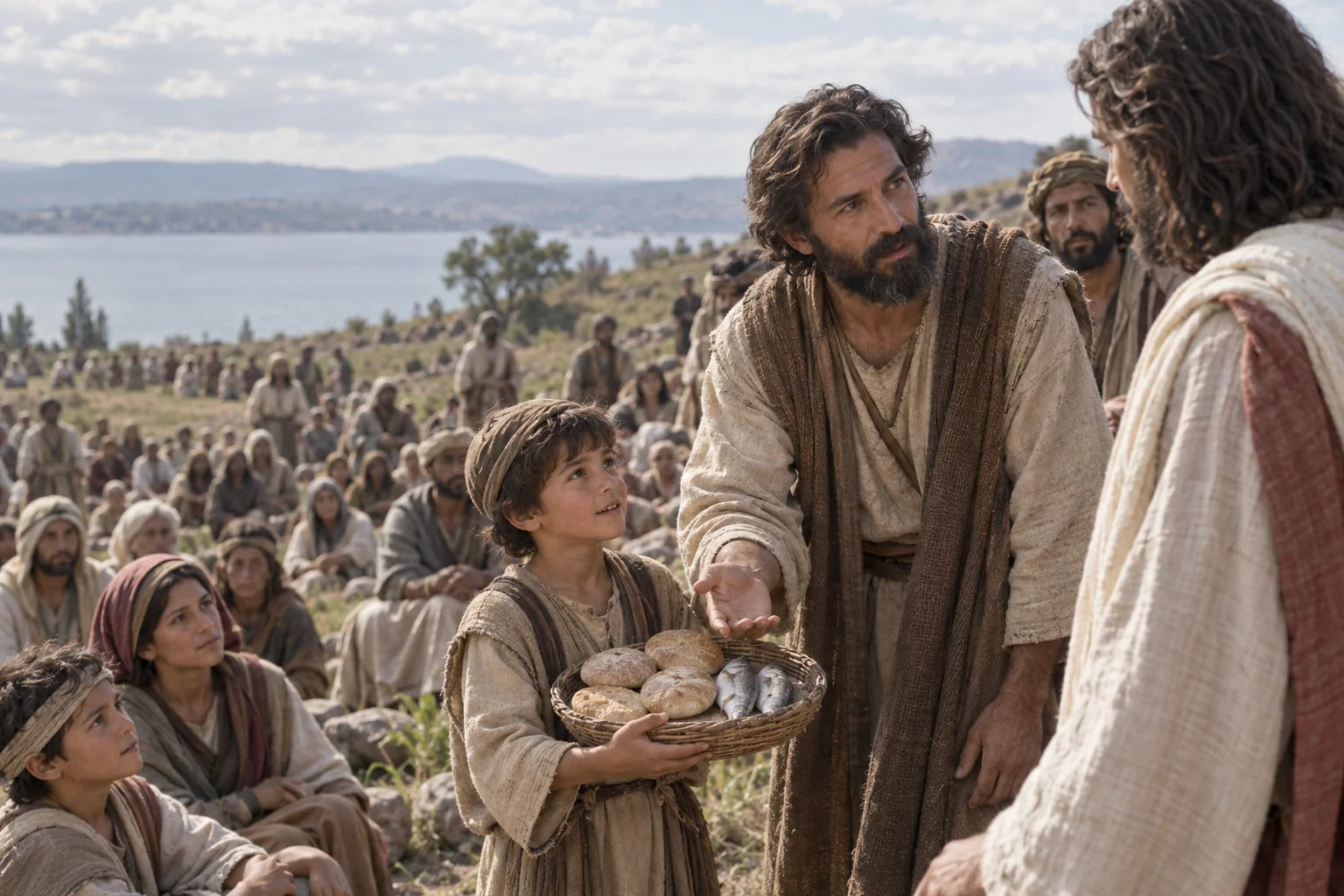
While the others stood there helpless, not knowing what to do, Andrew did something quite different: he quietly made his way around the crowd, looking to see if anyone had brought anything to eat. And he found it — a small boy with five loaves of the cheapest barley bread and two small fish.
He brought the boy before the Master, yet his own words were full of doubt, almost taking back what he had just done:
“But what are these among so many people?”
He did not believe in advance that any miracle would happen. He simply did the smallest thing within his power: noticed something others had overlooked, and brought it to the right place, to the right person.
Jesus took those five loaves and two fish, looked up to heaven and gave thanks, then broke them. The bread kept multiplying in the disciples’ hands, enough for a whole sea of people to eat their fill, with twelve baskets left over, full to the brim.
Andrew did not work the miracle. He simply could not bring himself to overlook a boy holding a few small loaves in a hungry crowd. So many good works in life begin like that: someone takes the trouble to notice, a tiny contribution is recognized at the right moment, even though the one bringing it does not know where it will go or what fruit it will bear.
And notice this too: it was the boy who truly gave. He could have held tight to his food in a crowd of hungry strangers — no one could have blamed him. But he handed it over. Andrew’s role was only to be the go-between, standing between a small generous heart and a boundless power. Sometimes serving the Kingdom does not require us to be the ones who give, only to be the ones who show other generous hearts the way to where they are needed.
Chapter 4 of 5
A bridge for those from far away
In the last days before the Passion, among the crowds streaming into Jerusalem for the Passover, some Greeks — perhaps foreigners devoted to the Jewish faith who had come from far away — shyly approached Philip:
“Sir, we wish to see Jesus.”
Philip could not decide by himself, so he went to find Andrew to talk it over. And once again, Andrew stood in his familiar place: linking those who were searching with the One who could fill their longing. The two of them went together to tell the Master.
From that seemingly small meeting, Jesus spoke of the grain of wheat that falls into the ground and must die to bear much fruit — foretelling his own death, now close at hand. A meeting Andrew arranged opened the way to one of the deepest teachings in the whole Gospel.
After the Resurrection and the Ascension, Andrew’s name is still mentioned among the Apostles gathered in prayer in the upper room in Jerusalem. After that, the New Testament says nothing more about him in particular; he quietly steps out of the written record.
Chapter 5 of 5
The long road of tradition
What happened next is kept only in the oral memory of the early Christian communities; it no longer belongs to Scripture, but to tradition. An ancient letter, said to have been written by the elders and deacons of Achaia — who claimed to have witnessed his death with their own eyes — tells that Andrew traveled to the distant lands around the Black Sea, then down into Greece, and finally came to rest in the city of Patras.
There the Roman governor, named Aegeas, was determined to force the people of the city back to the worship of idols. Andrew stood up against him, saying that a judge of men must sooner or later recognize his own true Judge in heaven. He was arrested, flogged, and then bound — not nailed with iron nails — to a cross set up by the seashore. Tradition says he kept teaching the people gathered around him for three whole days, until he breathed his last.
To be honest, the image of the X-shaped cross people usually associate with Saint Andrew in paintings and on flags appeared much later, in the Middle Ages — very possibly influenced by the story of Peter asking to be crucified upside down. The Acts of the Apostles does not tell of this martyrdom, and no witness from the first or early second century confirms that he was in Patras. But though history leaves many gaps, devotion to him has taken deep root over two thousand years, especially in the Eastern Churches.
The Church celebrates Saint Andrew the Apostle on November 30 each year. For Vietnamese Catholics, the name Andrew carries a very special warmth: it is the baptismal name of Blessed Andrew of Phú Yên, the first martyr of the Church in Vietnam, and of the martyr priest Andrew Trần An Dũng Lạc — both of whom appear elsewhere in this app.
Looking back over his whole life, we do not need to dream of distant journeys to the Black Sea or Greece to live like Andrew. Sometimes love for the Lord simply takes the shape of someone who dares to bring a family member to church, who notices a child standing lost in a corner of the parish courtyard, who steps in to help a stranger standing hesitant, not knowing whom to ask. Not everyone is called to preach great, resounding sermons. But everyone can do exactly what Andrew did: bring another person closer to the good they have been blessed to find.
The end of the story
You have walked with Saint Andrew to the end of the story.
What stays with you, perhaps, is:
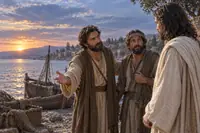
An afternoon by the Jordan, hearing his teacher point to a stranger, then quietly following without yet knowing why.
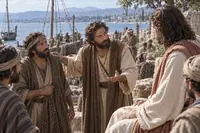
Running to find his brother the moment he met the Master: "We have found the Messiah!"
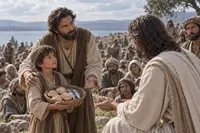
In a hungry crowd, noticing a boy holding five loaves, then bringing him before the Master.
Stay in silence
Look a little closer and you see: Andrew never preached a great sermon, never worked a miracle. He always stood in exactly the right place, linking those who search with the One who can fill that longing.
Not everyone is called to stand center stage — but everyone can be the one who brings another person closer to what is good.
Let us pray
Saint Andrew,
as soon as you met the Master, you ran to find your brother: "We have found the Messiah!" In a hungry crowd, you noticed a boy holding five loaves and brought him to the Master.
Teach me to bring others closer to the Lord through very small things: an invitation, taking someone to Mass, a shared meal.
Do not let me look down on what I have in my hands, even if it is only five loaves, for the Lord can make it enough for many.
Amen.
Sources
- Feast dayAuthor’s edited profile
- Patron ofPatronages and symbols, version 1.1
- Often depicted withPatronages and symbols, version 1.1
- Reflectionvatican.va
- Reflectiongutenberg.org
Meet the next one
 Journey 1