

Journey 8 · Faith with a Vietnamese Face
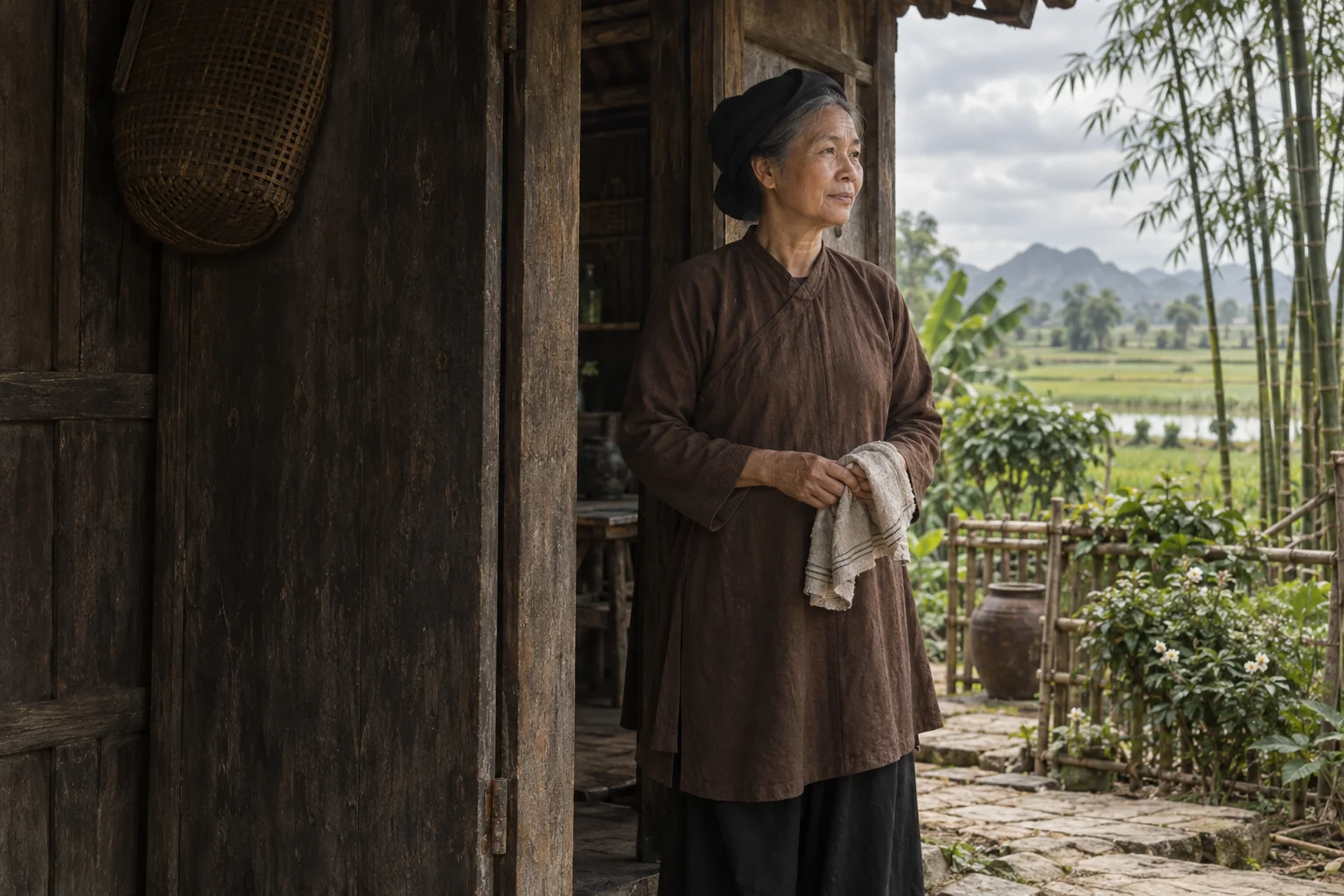
Saint Agnes Lê Thị Thành
A mother’s blood reddening the cloth that wrapped her
Feast day July 12
Tap to step inside
Saint Agnes Lê Thị Thành
A mother’s blood reddening the cloth that wrapped her
Map of a life
This life told in 6 chapters
Begin the journey OpeningOpening1 min
 Chapter 1 of 6A capable mother in the Catholic village of Phúc Nhạc1 min
 Chapter 2 of 6A home sheltering the footsteps of shepherds1 min
 Chapter 3 of 6The day the storm struck Phúc Nhạc1 min
 Chapter 4 of 6Tearing lashes and venomous snakes in the courtroom2 min
 Chapter 5 of 6A bloodstained cloth and her last breath1 min
 Chapter 6 of 6The holy mother of Vietnam1 min
Feast day
Saint Agnes Lê Thị Thành
Some places may celebrate on a slightly different day.
July 12
Patron of
- The Catholic Mothers’ Associations in Vietnam
Often depicted with
- A palm branch
- A rosary
Opening
Opening
In the provincial prison of Ninh Bình, in the summer of 1841, during the persecution under Emperor Thiệu Trị, there was a scene to break any heart: a sixty-year-old peasant woman, her hair streaked with gray, her skin lined by a lifetime of sun and weather in the rice fields, half lay, half knelt on the damp, moldy earth floor of the dark cell.
Her rough black tunic hung in tatters, stuck to her skin with the blood that had flowed from the brutal floggings of the mandarin’s soldiers. When her youngest daughter, Lucia Nụ, came to visit and saw the torn welts on her old mother’s body, she burst into sobs. But the mother gathered her strength, held her daughter’s hand tightly and comforted her with a gentle smile:
“Don’t cry, my child! Look: these marks of blood are no disgrace; they are fresh red roses that Jesus has given me... I suffer these pains out of love for God; go home and thank God, and pray that I may persevere to the end!”
That woman with a mother’s heart was Saint Agnes Lê Thị Thành, fondly known as Saint Đê, the only woman among the one hundred seventeen Vietnamese Martyrs canonized by the Church. She was not a nun or a scholar; she was a simple country mother of six and a kindly grandmother to many little ones. By her heroic sacrifice and steadfast faith in prison, she showed the world how far a Vietnamese woman could go, through a mother’s love and her love of God, and she brought glory to her whole people.
Chapter 1 of 6
A capable mother in the Catholic village of Phúc Nhạc
Agnes Lê Thị Thành was born around 1781 in the village of Gia Miếu (also called Bái Điền), in the district of Yên Định, Thanh Hóa province now in the commune of Hà Long, Hà Trung district, in the diocese of Thanh Hóa. To make a living, the family later moved to her mother’s home village of Phúc Nhạc, now in the commune of Khánh Nhạc, Yên Khánh district, Ninh Bình province, in today’s diocese of Phát Diệm.
As a girl, Thành was obedient, hardworking in the fields, modest and gentle, and known for her love of prayer; she went to church morning and evening. At nineteen (seventeen, according to some sources), at her parents’ wish, she married a devout young man of the village, Nguyễn Văn Nhất, whom the villagers called Mr. Đê, and so she too came to be called Mrs. Đê. Their marriage was a model of harmony and mutual respect. They had six children: two sons, named Đê and Trân, and four daughters, named Thu, Năm, Nhiên and Nụ.
Mrs. Đê was a wonderfully capable mother: she rose at dawn to cook and worked the fields alongside her husband. However hard the farm work, she always made time to teach her children their first prayers and hymns. Every evening after supper she gathered the children before the family altar to pray the Rosary. She often told them:
“Food and clothing are needs of this world, but keeping our souls free of sin and loving God is the eternal treasure of our family!”
Her heart was generous without limit: in her house there was always a separate jar of rice for wandering beggars. Whenever anyone in the village was sick or in trouble, she went of her own accord to visit, spoon-feed them rice porridge, wash their clothes and help with medicine. Two of her daughters later gave their lives to God in the Congregation of the Lovers of the Holy Cross, the natural fruit of the faith she had sown for so many years in that small house.
Chapter 2 of 6
A home sheltering the footsteps of shepherds
In 1840, Emperor Minh Mạng issued his harshest edict of persecution against the faith. The mandarins offered huge rewards in silver and gold to anyone who denounced or captured Western missionaries or Vietnamese priests. Priests had to flee into the forests or hide in the homes of brave Catholic families.
The simple thatched house of Mr. and Mrs. Đê in Phúc Nhạc became a safe refuge for the Church. Mrs. Đê dug a secret cellar right beneath her own bedroom to hide priests. Father Berneux (later the saintly Bishop Nhân), Father Galy (called Saint Lý) and Father John the Baptist Thành all hid there for months on end. Every day Mrs. Đê cooked for them, carried food and water down to them with her own hands, washed the vestments, and kept a careful watch whenever the priests said Mass secretly at night. She told her children:
“To hide and serve God’s priests is a great blessing for our family; even if I have to die for it, I am ready!”
Chapter 3 of 6
The day the storm struck Phúc Nhạc
Early on Easter morning, April 14, 1841, the governor Trịnh Quang Khanh, greedy for the reward and eager to win favor at court, led five hundred royal soldiers himself to surround the village of Phúc Nhạc. They blocked every road and forced all the villagers into the courtyard of the communal house while they searched every home.
The soldiers burst into Mrs. Đê’s house and searched everywhere. Thanks to her calm, two missionary priests managed to escape into the marshes. But after hours of digging, the soldiers found the secret cellar and caught Father John the Baptist Thành hiding there. They tied him up, smashed the furniture, and arrested and bound Mrs. Đê and her husband.
The soldiers shoved the sixty-year-old mother about, tied her arms behind her back, put a heavy iron chain around her neck and marched her with the priests to the provincial prison of Nam Định, and later to Ninh Bình. On the way they beat her and mocked her as a “foolish old woman,” but Mrs. Đê walked on in silence, whispering the Hail Mary over and over.
Chapter 4 of 6
Tearing lashes and venomous snakes in the courtroom
At the provincial court of Ninh Bình, the high mandarins tried every trick, subtle and cruel, to break the peasant woman. At first the judge tried coaxing:
“Old woman, you are over sixty, old and weak — go home and enjoy your children and grandchildren... Do you know that the crime of harboring Western priests is punished by wiping out three generations of your family? Just step over that cross once, and I will spare your life and let you go home today!”
Agnes Đê knelt with her back straight, looked the judge in the eye and answered boldly:
“Your Excellencies, I am only an ignorant country woman, but I know right from wrong! The Cross is where my Lord died to redeem me; I honor and worship Him all my life — how could I dare trample on Him? If you cut off my head, I will accept it, but I will never deny my Lord!”
Enraged by her steadfastness, the judge had her outer garment stripped off, had her tied to a post, and ordered four soldiers to lash her again and again with thorny rattan whips. The blows tore her flesh, and her blood soaked the earthen floor of the courtroom. But the sixty-year-old mother clenched her teeth and endured it without a single cry for mercy, only softly calling on the holy names:
“Jesus... Mother Mary... help me!”
When the lash could not break her, the mandarins devised a scheme vicious enough to make anyone shudder. Knowing how women dread venomous snakes, they had soldiers catch two live poisonous snakes, rolled up the legs of Mrs. Đê’s trousers, pushed the snakes inside and tied the hems shut. Then they stood around laughing, waiting for the woman to panic, leap about screaming, and trample on the cross to escape.
But before the eyes of all the officials, something strange happened. Agnes Đê stood as still as a statue, hands joined at her breast, eyes lifted to heaven in prayer. The two snakes crawled around her legs for a while, then lay still, without biting her or leaving so much as a scratch. The soldiers and the judge were terrified; they hurriedly had the snakes pulled out with tongs and threw her back into the dark prison.
Chapter 5 of 6
A bloodstained cloth and her last breath
Flogging after flogging, the damp, filthy prison, hunger and thirst, and a severe bout of dysentery drained the old mother’s last strength. She lay unable to move on the moldy earth floor of the Ninh Bình prison, her body covered in festering sores, blood and pus soaking her torn mat.
Yet her soul was filled with a strange joy. Whenever her children or other Christians slipped in to visit, she urged them to hold fast to the faith, to live in love and harmony, and to obey their superiors wholeheartedly. One morning in early July 1841, sensing that the hour had come to go home to the Father, she asked her fellow prisoners to help her sit up, and she prayed the Rosary one last time.
On the morning of July 12, 1841, Agnes Lê Thị Thành died peacefully in the dark prison of Ninh Bình, at the age of sixty. Her martyrdom came not under the executioner’s sword but through faithful self-giving, day after day in prison, for the name of Christ.
After her death, the soldiers pressed a red-hot iron bar to her feet to make sure she was dead before letting her family take the body. The faithful of Phúc Nhạc soaked up the blood that seeped from her wounds with pieces of white cloth, wrapped her body, and carried it home to Phúc Nhạc for an honorable burial.
Chapter 6 of 6
The holy mother of Vietnam
On May 2, 1909, Pope Saint Pius X beatified Agnes Lê Thị Thành. On June 19, 1988, in Saint Peter’s Square, Pope Saint John Paul II canonized her together with one hundred sixteen other Vietnamese Martyrs.
She has gone down in history as the only mother among the canonized martyrs of Vietnam. The Church celebrates her on July 12 each year, and on the common feast of November 24. In Vietnam, millions of mothers and grandmothers in the Catholic Mothers’ Associations take Saint Agnes Lê Thị Thành as their model and patroness.
Saint Agnes Lê Thị Thành has a lesson for every family today:
“The firmest foundation of a people’s faith is nurtured in the kitchens and family prayers of poor mothers!”
A peasant woman who dug a cellar beneath her own bedroom to shelter priests, she stood motionless in the courtroom with two venomous snakes coiled around her legs. She teaches mothers and wives to love their families through quiet sacrifice every day, to keep a home where children and grandchildren learn to pray, and never to fear life’s hardships, because love that comes from God is strong enough to weather every storm.
The end of the story
You have walked with Saint Agnes Lê Thị Thành to the end of the story.
Three scenes that move you to tears:
Seeing her daughter weep at the torn marks of the lash on her body, she comforted her: "These marks of blood are no disgrace; they are fresh red roses that Jesus has given me."
For years she kept a cellar dug right beneath her own bedroom to hide priests who were being hunted.

When the mandarins pushed two venomous snakes into her trousers to force her to step over the cross, she stood motionless in prayer, and the two snakes simply lay still without biting her.
Stay in silence
You understand the strength of a mother: the firmest foundation of a people’s faith is sometimes nurtured only in the kitchens and family prayers of poor mothers.
These marks of blood are no disgrace; they are fresh red roses that Jesus has given me.
Let us pray
Saint Agnes Lê Thị Thành,
you dug a cellar right beneath your own bedroom to hide the priests. And when your daughter wept at the marks of the lash on your body, you comforted her, saying they were roses Jesus had given you.
Pray for Vietnamese Catholic mothers, who keep the flame of faith alive in the kitchen and in evening prayers.
Teach me to shelter those in danger, and to speak to my children about God through my own life.
Amen.
Light a candle for Saint Agnes Lê Thị Thành
Sources
- Feast dayAuthor’s edited profile
- Patron ofPatronages and symbols, version 1.1
- Often depicted withPatronages and symbols, version 1.1
- Reflectionhdgmvietnam.com
- Reflectionhdgmvietnam.com
Meet the next one
 Journey 8