

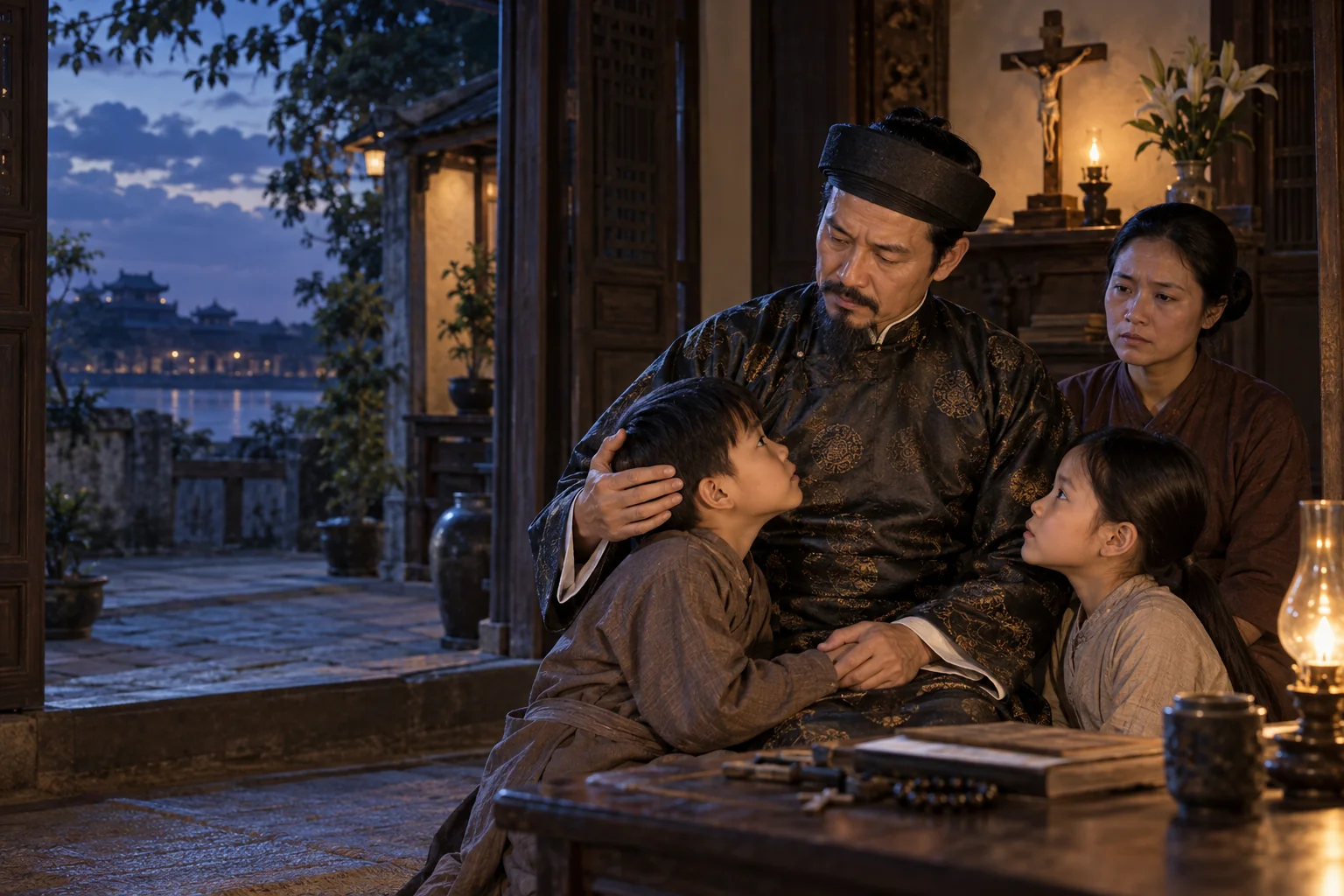
Journey 8 · Faith with a Vietnamese Face
Saint Michael Hồ Đình Hy
A high mandarin kneeling before the Cross
Feast day May 22
Tap to step inside
Saint Michael Hồ Đình Hy
A high mandarin kneeling before the Cross
Map of a life
This life told in 5 chapters
Begin the journey OpeningOpening1 min
 Chapter 1 of 5A gifted young man of Như Kinh1 min
 Chapter 2 of 5An inner struggle and the office of head of the Phủ Cam community1 min
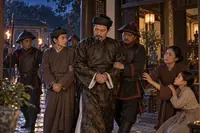 Chapter 3 of 5Betrayal and floggings in prison1 min
 Chapter 4 of 5An example of integrity before the hour of execution2 min
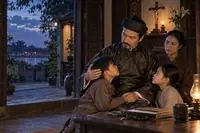 Chapter 5 of 5The high mandarin among the saints of Vietnam1 min
Feast day
Saint Michael Hồ Đình Hy
Some places may celebrate on a slightly different day.
May 22
Often depicted with
- A palm branch
- The robes and hat of a Nguyễn court mandarin
Opening
Opening
One sweltering summer afternoon in 1857, under the fierce persecution of Emperor Tự Đức, on the long road leading to the execution ground of An Hòa outside the imperial capital of Huế, a procession both tragic and heroic shook the whole court.
A leading court official, forty-nine years old, who had held the post of Thái Bộc Tự Khanh (minister in charge of the royal finances and ceremonies) and had enjoyed the warm favor of two emperors, Minh Mạng and Thiệu Trị, had now been stripped of his court robes. His arms were tied behind his back, a heavy cangue was around his neck, and iron chains were on his legs. In front of him walked soldiers carrying a wooden board bearing the death sentence; behind him came a train of war elephants and hundreds of armed soldiers with drawn swords and spears. The escort left through the Hiển Nhân Gate of the Imperial City and passed along the great streets of the capital to the An Hòa bridge.
The people of Huế packed both sides of the road, many of them weeping for the honest, kindly high official who for so long had helped so many in need. But the official walked with an unusually calm and dignified bearing. His face shone with peace. He looked at his children and the faithful weeping by the roadside, nodded slightly and smiled to comfort them.
The steadfast high official who went up to the scaffold was Michael Hồ Đình Hy, the highest-ranking court official among the one hundred seventeen Vietnamese Martyr Saints. He showed the whole court and people that a Christian can be a mandarin of integrity, serving his king and helping his country with all his heart, while at the same time keeping complete loyalty to God, the King above all kings.
Chapter 1 of 5
A gifted young man of Như Kinh
Michael Hồ Đình Hy was born in 1808 in the village of Như Kinh, Phú Vang district, Thừa Thiên province, near the capital of Huế, into a distinguished noble family that had been Catholic for generations. His father was also a high official at court. Hy was the youngest child and from childhood showed outstanding intelligence, an honest, upright character and a kind heart.
Growing up, he mastered Chinese classical literature, passed the examinations and entered the service of the Nguyễn court. It was no easy path for someone from a Catholic family: the examinations under the Nguyễn required mastery of the Confucian classics, and many scholars of the time still looked on Catholic families with suspicion. With outstanding administrative talent and absolute integrity, he quickly won the trust of Emperor Minh Mạng and rose through many important posts: he was put in charge of the royal silk-weaving works, served as a financial inspector, and gradually rose to the post of Thái Bộc Tự Khanh, a mandarin of the third rank, on a par with a deputy minister or minister of the time. He was one of very few high officials free to enter the inner palace to discuss great affairs of state with the emperor.
He married a devout Catholic woman named Maria Teresa Đoàn Thị Nguyện, from the village of Phủ Cam, and they had five children: three sons and two daughters. The family of the high official Hồ Đình Hy was a model home: though they lived in a splendid capital rife with bribery, he always kept his household simple and honest and never touched a dishonest coin. Whenever drought or flood struck, he used his salary to open his granaries to the poor, Christian or not. People throughout the capital region respectfully called him “the honest mandarin”.
Chapter 2 of 5
An inner struggle and the office of head of the Phủ Cam community
Though he had kept the Catholic faith from birth, in his first years as an official under Emperor Minh Mạng, when the edicts against the faith broke out, he kept his faith quietly for the sake of his family’s safety and his standing at court. For a time he even drifted morally: he neglected the sacraments, lost himself in the banquets and receptions of court life, and at one point fell into sin in matters of the heart. It is a very human truth that the Church’s records do not hide, and it shows that his road to holiness was no easy straight line.
But God’s grace awakened his soul. Around 1845, after a deep retreat under the guidance of the missionaries, the mandarin Hồ Đình Hy made a complete conversion. He knelt and confessed in tears, firmly gave up all his worldly habits and began to live with great devotion. He formally took on the office of Trùm, head of the parish council, of the Phủ Cam community, the largest parish in Huế.
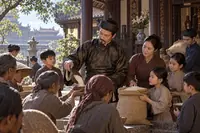
It took great courage: here was a high official of the third rank who rode each day in a decorated palanquin under a purple parasol into the imperial palace to discuss affairs of state, yet in the evening knelt in the parish church, humbly teaching catechism to poor children, settling quarrels in the Catholic neighborhood and running its works of charity. He used his own official residence as a secret refuge for the Paris missionaries, priests and seminarians. He used his influence and his own money to stand surety for and free hundreds of poor faithful who had been arrested and imprisoned. Bishop Pellerin (Đức cha Huy) and the missionary priests regarded him as the strongest pillar of the Church in the capital.
Chapter 3 of 5
Betrayal and floggings in prison
At the beginning of 1857, Emperor Tự Đức’s court issued its harshest edict against the faith, ordering every Catholic establishment rooted out. Then came a painful betrayal: someone hungry for the reward and bent on personal revenge secretly informed the court that the mandarin Hồ Đình Hy had long been the leader of the “perverse religion of Jesus” in the capital and was secretly harboring Western priests in his home. Emperor Tự Đức was stunned and flew into a violent rage, feeling deceived by his most trusted high official.
On February 10, 1857, the emperor ordered soldiers to burst into his residence without warning and arrest the mandarin Hồ Đình Hy together with his eldest son. He was stripped of all his ranks, all his property was confiscated, and he was thrown into the Trấn Phủ, the most notoriously brutal military prison in the capital. In the Trấn Phủ prison the judges — many of them former colleagues at court who envied his integrity — tormented him with the cruelest punishments: he was flogged with thorny bamboo rods that tore his flesh; forced to kneel on piles of sharp thorns; and they even clamped red-hot iron pincers onto his flesh until it smoked and burned.
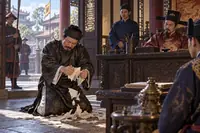
But more painful than the physical blows were the judges’ vicious schemes: they drugged him and asked cunning questions while he was dazed, to force him to sign confessions revealing the hiding places of the bishops and priests. When he came to and realized how he had been tricked, he beat his breast, wept bitterly, fell to his knees, tore up the confessions and declared before the mandarins:
“I admit only that I myself follow the Religion and will die for the Religion! I will never denounce anyone to harm my innocent brothers and sisters!”
Faced with such firmness, the mandarins could only petition Emperor Tự Đức to carry out the death sentence. Emperor Tự Đức approved the sentence of beheading with his own brush.
Chapter 4 of 5
An example of integrity before the hour of execution
Knowing that martyrdom was near, the mandarin Michael Hồ Đình Hy kept complete peace. From his dark prison he secretly sent a letter out to Bishop Pellerin to make his confession and ask to receive Viaticum one last time. He told his wife and children:
“Look at me, my children: the fame, rank and earthly wealth I have held for so long have all vanished like smoke and clouds... Only faith in Jesus and an upright conscience last forever! Never hold a grudge against those who slandered and harmed me; forgive them and pray for them! Always keep your duty as children and live worthily as God’s children!”
On the afternoon of May 22, 1857, the death sentence was carried out. The escort passed through the main streets of Huế. When they reached the An Hòa market, where the execution ground had been set up by the bridge, the supervising mandarin came up once more and urged him:
“Your Excellency, just say one word renouncing the religion, and I will at once petition the emperor to spare your life and restore your rank!”
The mandarin Michael Hồ Đình Hy smiled, shook his head and answered firmly:
“Thank you for your kindness, sir... But I have served the earthly king all my life; now I want only to serve the King of heaven to the last drop of my blood! Please carry out your duty!”
He asked permission to put on a clean white long tunic. He spread a patterned mat on the ground, knelt facing the church of Phủ Cam, and with his hands joined before his chest prayed fervently.
Three strokes of the gong rang out, the executioner’s sword came down, and the honest forty-nine-year-old official fell, ending a heroic life of self-giving. In the crowd standing silent by the An Hòa bridge that day, there must have been many who owed him much from his years in office — families he had fed from his granaries in times of flood, poor faithful he had freed from prison with his own money — who now could only stand and watch, tears falling silently, not daring to say a word. The faithful and his family reverently carried his body back for an honorable burial at his beloved parish church of Phủ Cam, the very place where for many years he had knelt every evening to teach catechism to poor children. It became his final resting place.
Chapter 5 of 5
The high mandarin among the saints of Vietnam
On May 2, 1909, Pope Pius X beatified the mandarin Michael Hồ Đình Hy. And on June 19, 1988, Pope John Paul II canonized him together with one hundred sixteen other Vietnamese Martyrs in Saint Peter’s Square. The Church celebrates him on May 22 each year, and on the common feast of November 24.
Saint Michael Hồ Đình Hy leaves a lesson for Christians in public life today:
“A Catholic can fully enter political life and hold the highest offices of power, while keeping clean hands, an honest heart and an iron faith!”
From an official who had years of wavering, living carelessly amid the honors of the court, to the high mandarin kneeling toward the church of Phủ Cam before the executioner’s sword, he teaches each of us: never use power to seek personal gain or to crush the weak. Use the very position and talents God has given you to serve your homeland with justice, and always keep complete loyalty to God in every hardship of life.
The end of the story
You have walked with Saint Michael Hồ Đình Hy to the end of the story.
A few glimpses of his life stay with you:
He had years as an official living carelessly, caught up in court banquets, before a retreat brought him to a complete conversion and he took on the office of head of the Phủ Cam community.
Coming to after being made to sign a confession while drugged, he beat his breast and wept, tearing up the paper right in front of the mandarins.
Before his execution, he told his wife and children: "Never hold a grudge against those who slandered and harmed me; forgive them and pray for them!"
Stay in silence
You see the far from straight road of a saint: a man who truly stumbled amid the honors of the court could still become one of the most upright witnesses of the faith.
The fame, rank and earthly wealth I have held for so long have all vanished like smoke and clouds; only faith in Jesus and an upright conscience last forever!
Let us pray
Saint Michael Hồ Đình Hy,
you served as a mandarin amid the banquets of the court, you stumbled, and God drew you back. Before your death you told your wife and children not to hold a grudge against those who had slandered you.
Help me not to lose hope when I look back on my past falls, for God can still make something new.
Pray for those in public service, that they may live with integrity. And teach me to forgive, and to pray for those who have harmed me.
Amen.
Light a candle for Saint Michael Hồ Đình Hy
Sources
- Feast dayAuthor’s edited profile
- Often depicted withPatronages and symbols, version 1.1
- Reflectiontonggiaophanhanoi.org
- Reflectiondongcong.net
Meet the next one
 Journey 8