

Journey 1 · Those Who Met the Lord
Saint Veronica
A cloth that wiped a face
Feast day July 12
Tap to step inside
Saint Veronica
A cloth that wiped a face
Map of a life
This life told in 9 chapters
Begin the journey OpeningOpening1 min
 Chapter 1 of 9Someone who is not in the Gospels1 min
 Chapter 2 of 9The woman who touched the hem of His cloak2 min
 Chapter 3 of 9The women on the way of the Passion1 min
 Chapter 4 of 9The true image1 min
 Chapter 5 of 9The cloth in Rome2 min
 Chapter 6 of 9The Sixth Station1 min
 Chapter 7 of 9The bullfighter and the photographer1 min
- Chapter 8 of 9Why a story that is not in the Bible is still worth keeping1 min
 Chapter 9 of 9Our own cloth1 min
Feast day
Saint Veronica
Some places may celebrate on a slightly different day.
July 12
Patron of
- Photographers
- Laundry workers (by popular devotion)
Often depicted with
- A cloth bearing the Holy Face
Opening
Opening
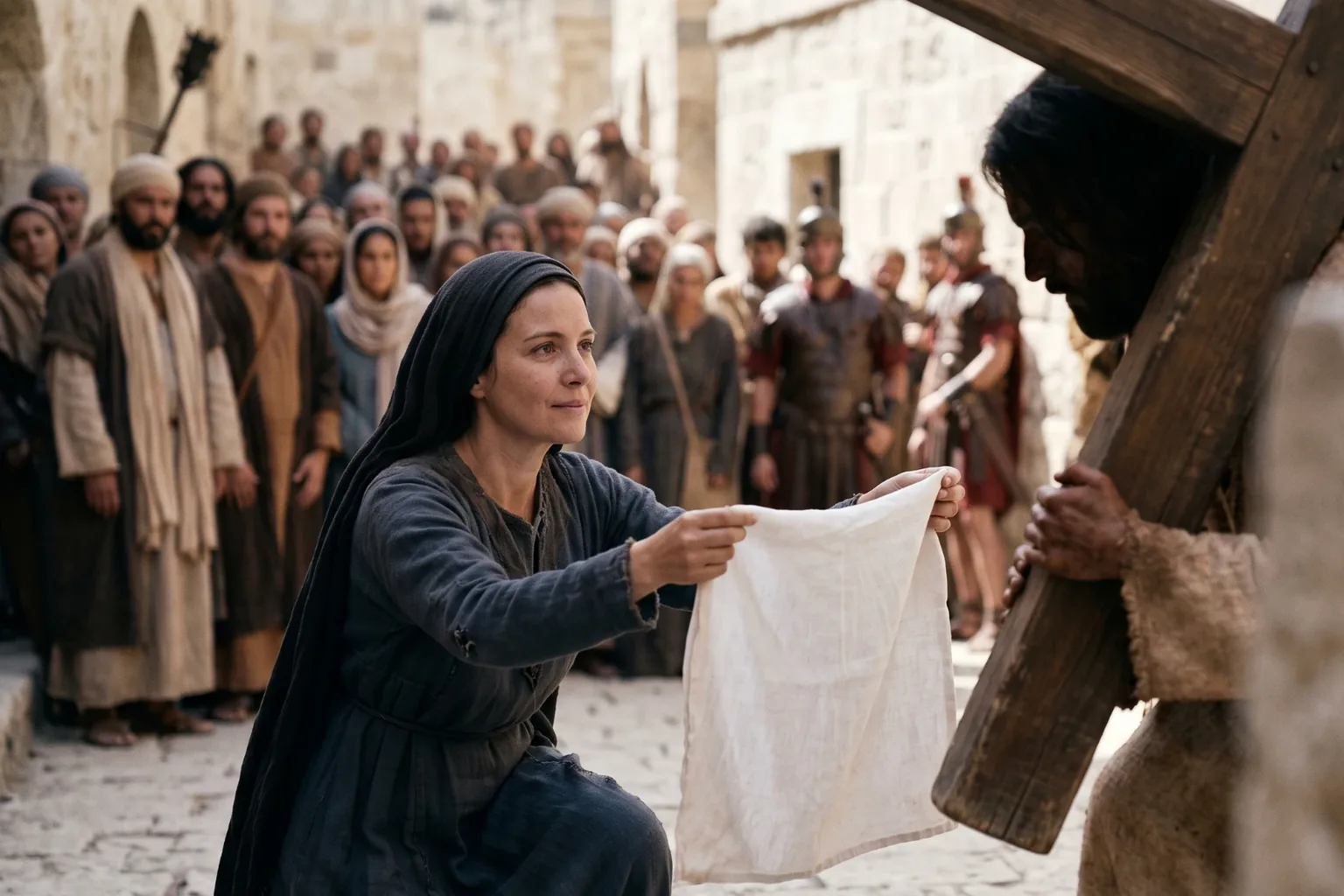
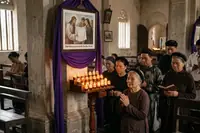
Every Lent, in the churches of Vietnam, people make the Way of the Cross: fourteen stations, fourteen pictures along the walls, fourteen times on our knees. At the sixth station the whole church prays together: “Saint Veronica wipes the face of Jesus.” And in the picture hung at that station, a woman kneels by the road, holding out a white cloth toward the One carrying the cross, His face covered in blood and sweat.
It is perhaps the most moving scene on the way of the Passion. Amid the mocking crowd, the rough soldiers, the disciples who had fled, one woman steps forward, unafraid, to do something so small it seems almost useless: to wipe the face of a man about to die.
But many who make the Way of the Cross all their lives never notice that this story is not in the Gospels. Not one Gospel mentions the name Veronica. That makes her one of the most unusual of saints: loved everywhere, with a statue in Saint Peter’s Basilica, a place in Dante’s great poem, even a move in Spanish bullfighting named after her, yet almost nothing we know about her is certain.
Chapter 1 of 9
Someone who is not in the Gospels
The Gospels describe in some detail the road Jesus walked with His cross up to Golgotha. There is Simon of Cyrene, pressed by the soldiers to help carry it. There are the women of Jerusalem beating their breasts and weeping, and Jesus turns and says to them: “Do not weep for Me; weep instead for yourselves and for your children” (Lk 23:28). But there is no woman who wipes His face.
The story of Veronica comes from tradition, and it came a long way before taking the shape we know today.
In a text from around the fourth century that is not part of the Bible, the “Acts of Pilate”, there is an account of the trial of Jesus. There, a woman stands up to testify for Him. She says: “I had a flow of blood for twelve years; I touched the hem of His garment, and at once the bleeding stopped.” That is the very woman the Gospel tells of, who slipped through the crowd to touch the Lord’s cloak (Mk 5:25–34). The Gospel does not give her name. The “Acts of Pilate” calls her Berenice.
Berenice is a Greek name meaning “bearer of victory”. Carried over into Latin, it became Veronica.
Chapter 2 of 9
The woman who touched the hem of His cloak
If the tradition identifying Veronica with the woman with the flow of blood is right, then she has a real story in the Gospels, and it is a very moving one.
The Gospel of Mark tells of a woman who had suffered from a flow of blood for twelve years. She had gone to many doctors, “had suffered greatly at the hands of many doctors and had spent all that she had. Yet she was not helped but only grew worse” (Mk 5:26). Under the Law of Moses, a woman with a flow of blood was considered unclean. Anyone who touched her became unclean too. She could not enter the Temple or go near others. For twelve years she lived on the margins, someone no one dared to touch.
When she heard about Jesus, she slipped into the crowd pressing around Him, and from behind touched His cloak. She thought: “If I but touch His clothes, I shall be cured.” At that moment the bleeding stopped. She felt in her body that she was healed.
Jesus stopped, turned to the crowd and asked: “Who has touched My clothes?” The disciples were surprised: with the crowd pressing like this, who had not touched the Master? But He kept looking around to find her. The woman, frightened and trembling, came forward, fell at His feet and told the whole truth in front of everyone.
It was perhaps the hardest moment of her life: an “unclean” woman having to admit publicly that she had touched a teacher of religion in the middle of a crowd. But Jesus did not reproach her. He called her by a word that perhaps no one had called her for twelve years: “Daughter, your faith has saved you. Go in peace and be cured of your affliction” (Mk 5:34).
If that woman later stood by the road of the cross with a cloth in her hand, her gesture makes perfect sense. Jesus had touched her when no one dared. Now, when He was rejected by the whole city, she stepped forward, and touched Him.
Chapter 3 of 9
The women on the way of the Passion
Though the Gospels do not name Veronica, they give the women of the Passion a prominence that readers of the time must have found surprising.
On the way up to Golgotha, the Gospel of Luke tells that “a large crowd of people followed Jesus, including many women who mourned and lamented Him” (Lk 23:27). At the foot of the cross, when the male disciples, except John, had fled, there were women standing there: Mary, Mary Magdalene, Mary the mother of James, Salome, and “many other women who had come up with Him from Galilee”. And on the morning of the first day of the week, it was women again who were the first to go to the tomb and the first to hear of the Resurrection.
In a society where the testimony of women was not accepted in court, the Gospels record that those most faithful in the darkest hour were the women. Veronica, though she comes from tradition, belongs to that company. She stands for all the nameless women who did not run away.
Chapter 4 of 9
The true image
Later, people explained the name Veronica another way, more beautiful but probably wrong: combining the Latin word “vera”, meaning “true”, with the Greek word “eikōn”, meaning “image”. “Vera icon”, the true image. Linguists think this was a popular explanation that grew up after the story of the cloth with the Lord’s face already existed, and is not the real origin of the name. But that understanding has become part of the story: the woman named “true image”.
In the Middle Ages, the story grew many more details. One tale says Veronica had a cloth bearing the image of the Lord’s face, and that Emperor Tiberius in Rome, gravely ill, was healed on seeing it. Then little by little the story was placed on the very road of the Passion: as Jesus passed by carrying the cross, she stepped out to wipe His face, and when she opened the cloth, the Lord’s face was imprinted on it.
These details cannot be verified. But they show that people of old longed for something very human: to see the face of Jesus. Not a concept, not a doctrine, but a face, with eyes, a forehead, drops of blood and sweat.
Chapter 5 of 9
The cloth in Rome
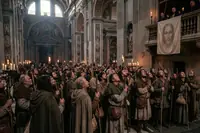
From around the twelfth century, in Old Saint Peter’s in Rome, people venerated a cloth believed to be Veronica’s, called “the Veronica” or “the Holy Face”. In Holy Years, tens of thousands of pilgrims from all over Europe poured into Rome, and the moment the cloth was shown was the high point of their pilgrimage.
The poet Dante, who probably came to Rome in the Holy Year of 1300, mentions that scene in the “Paradise” of his Divine Comedy. He compares himself, gazing at a saint in heaven, to a pilgrim who has come all the way from Croatia to see “our Veronica” and stands there, never tiring of it, thinking: “My Lord Jesus Christ, true God, was this then what Your face looked like?”
When Saint Peter’s Basilica was rebuilt in the sixteenth and seventeenth centuries, one of the four huge piers supporting the dome was set aside to hold the cloth. In the niche of that pier stands a marble statue of Saint Veronica more than four meters tall, carved by the sculptor Francesco Mochi around the years 1629 to 1632. The statue is famous for its movement: her garments billow as if in a gust of wind and her trembling hands hold out the cloth, as if she had just rushed out of the niche to show us the Lord’s face. Above the statue is a small balcony from which, by tradition, the cloth is still shown to the faithful on the Fifth Sunday of Lent.
Is the cloth in Rome really the cloth Veronica used? No one can prove it. Over the centuries, several different cloths in Europe have been venerated as “the Veronica”. A famous one has been kept since around 1620 in Manoppello, a small mountain town in central Italy. On September 1, 2006, Pope Benedict XVI went to pray before that cloth, the first Pope to go there in nearly four hundred years. He said nothing about its authenticity, but spoke of “the radiance of the face of Christ” and invited the faithful to seek that face in their own lives.
Chapter 6 of 9
The Sixth Station
The Way of the Cross as we know it today, with fourteen stations, took shape gradually over many centuries. Pilgrims to Jerusalem in the Middle Ages wanted to walk again the road the Lord had walked, stopping at each place to pray. Those who could not go to Jerusalem re-created that road at home, in churches and on hillsides. At first the number of stations varied from place to place. Only in the seventeenth and eighteenth centuries did the fourteen stations become standard, thanks to the Franciscans, above all Saint Leonard of Port Maurice, who set up more than five hundred Ways of the Cross across Italy.
Among those fourteen stations, some are not in the Gospels: the three falls of the Lord, the Lord meeting His Mother, and Veronica wiping the face of Jesus. They come from tradition and the devotion of pilgrims.
In 1991, at the Good Friday Way of the Cross at the Colosseum, Pope Saint John Paul II introduced a “Scriptural Way of the Cross”, with fourteen stations all taken from the Gospels, beginning in the Garden of Olives. In that version there is no Veronica station. But that does not mean the Church has abandoned the traditional Way of the Cross. Both forms are used, and in most parishes, including those of Vietnam, the Sixth Station with the image of Veronica is still there, every Lent.
Chapter 7 of 9
The bullfighter and the photographer
The name Veronica lives on in a very unexpected place: the bullring in Spain.
In bullfighting, the most basic and classic pass, in which the matador uses the large cape to lead the bull charging past him, is called a “verónica”. That is because the matador holds the cape out in front of him with both hands, just as Saint Veronica is shown holding out the cloth in old paintings and statues. The Spanish were so used to that image in their churches that they named a move in the bullring after it.
Because of the story of the Lord’s face imprinted on the cloth, Veronica is also regarded as patron of photographers, those who “print” human faces on paper. She is also regarded as patron of laundry workers and those who work with cloth. These titles come from popular devotion, not from any official Church document, but they show how the woman with the cloth has entered everyday life.
Chapter 8 of 9
Why a story that is not in the Bible is still worth keeping
One might ask: if the story of Veronica is not in the Gospels, should we believe it?
The Church has never required the faithful to believe the story as dogma. It is a devotional tradition, not an article of faith. But the Church still keeps it, because it expresses a deep truth of the Gospel.
Jesus said: “Whatever you did for one of these least brothers of Mine, you did for Me.” Veronica is an image of those words. She could not save the Lord from the cross. She could not make the soldiers stop. She could only do one small thing: wipe a face. And in that very small thing, she received the face of the Lord.
Here is something worth pondering: the story says the Lord’s face was imprinted on the cloth after she wiped His face, not before. She did not wipe the Lord’s face because she wanted a relic. She wiped it out of love. The Lord’s face was a gift that came afterward, to the one who dared step out of the crowd.
Chapter 9 of 9
Our own cloth
In Vietnam, Veronica is a fairly common baptismal name for girls and mothers. Many celebrate their patron during Lent, or on July 12, as is the custom in many places. If your name is Veronica, you may know that your patron is not in the Bible or the general liturgical calendar, and that history has left no record of her. But she is present in every church, every Lent, at the Sixth Station of the Way of the Cross, and in the prayers of millions of people.
Perhaps no saint is closer to everyday life than that woman. For each of us has times when we meet someone carrying their own cross: a mother caring for a sick child, a friend who has just lost a job, a stranger crying in a corner of a hospital. We cannot lift the cross from their shoulders. But we can step out of the crowd and wipe away a drop of sweat for them: a word of concern, a glass of water, a hand to hold.
And who knows, like Veronica’s cloth, when we open our hearts, we may find the face of the Lord imprinted there.
The end of the story
You have walked with Saint Veronica to the end of the story.
Images that will stay with you:
Amid a mocking crowd, a woman stepping forward with a white cloth.
The pilgrim from Croatia standing on and on before the cloth in Rome, silently asking: "Was this then what Your face looked like?"
The marble statue in Saint Peter’s Basilica, her garments billowing as if she were running forward.
Stay in silence
At the end of her story, you realize she did not wipe the Lord’s face to obtain a relic; she wiped it out of love, and the Lord’s face was a gift that came afterward.
Today, step out of the crowd and wipe away a drop of sweat for someone carrying their own cross.
Let us pray
Saint Veronica,
amid a crowd that only stood and watched, you stepped forward to wipe the face of the Lord. Help me not to stand and watch when I see someone suffering, but to dare to step forward, even if all I can do is something small.
Teach me to recognize the face of the Lord in the faces of the old, the sick, the poor and the despised.
And when I make the Way of the Cross this Lent, help me not only to weep for the Lord, but to wipe away the tears of those around me.
Amen.
Sources
- Feast dayArticle, version 1.1
- Patron ofPatronages and symbols, version 1.1
- Often depicted withPatronages and symbols, version 1.1