

Journey 6 · Keepers of the Lamp of Faith
Saint Thomas Aquinas
The Angelic Doctor and silence before the Mystery
Feast day January 28
Tap to step inside
Saint Thomas Aquinas
The Angelic Doctor and silence before the Mystery
Map of a life
This life told in 6 chapters
Begin the journey OpeningOpening1 min
 Chapter 1 of 6The “Dumb Ox” of Roccasecca3 min
 Chapter 2 of 6The school of Cologne and the prophecy of Albert the Great2 min
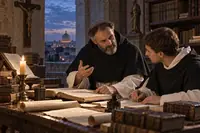 Chapter 3 of 6The cathedral of the Summa Theologiae2 min
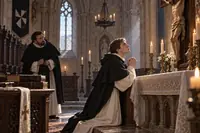 Chapter 4 of 6The poet of the Eucharist1 min
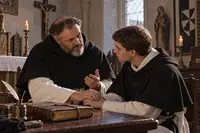 Chapter 5 of 6“It is all straw!”2 min
- Chapter 6 of 6A lighthouse of Truth2 min
Feast day
Saint Thomas Aquinas
Some places may celebrate on a slightly different day.
January 28
Patron of
- All Catholic schools, colleges and universities (proclaimed in 1880)
- Students
- Theologians
Often depicted with
- A sun on his chest
- A dove
- A book
Opening
Opening
One afternoon at the end of 1273, in the small chapel of the friary of Saint Nicholas in Naples, a big, heavy man knelt before a crucifix, as still as stone. He had been kneeling like that for hours. A friar passing by peeked through the crack of the door and drew back, hardly daring to breathe: the man at prayer was no longer touching the ground.
That man was Thomas Aquinas, the greatest mind Christian theology has ever produced, author of the massive Summa Theologiae, which theology faculties around the world still pore over page by page more than seven hundred years later. He is called Doctor Angelicus, the Angelic Doctor, because his mind seemed to reach heights ordinary people cannot attain. Yet at the end of his life this extraordinary man laid down his pen and said something that stunned learned Europe: everything he had written was only straw.
How does someone who built the greatest cathedral of thought in history come to call it straw? Not by rejecting it, but because for one moment he touched what no book, however learned, can fully express: God Himself. To understand that turning point we must go back to the beginning, to a silent boy from a noble family of southern Italy, whom his classmates thought slow and called the “dumb ox.”
Chapter 1 of 6
The “Dumb Ox” of Roccasecca
At the end of 1224 or the beginning of 1225, a boy was born into the nobility at the castle of Roccasecca, a gray limestone fortress on a steep rocky spur above the valley of the Melfa, near the town of Aquino in the Terra di Lavoro region of southern Italy. His father, Count Landolfo d’Aquino, was a vassal of Emperor Frederick II; his mother, Countess Theodora Caracciolo, was distantly related to the Norman royal house and the Hohenstaufen court. He was the youngest of a large family, and they named him Thomas.
Today the castle of Roccasecca is only crumbling walls clinging to the hillside and bare watchtowers against the sky, but in the thirteenth century it was one of the strongest fortresses on the border between the Kingdom of Sicily and the Papal States, a position that kept the d’Aquino family wary of both the rival powers, Emperor and Pope. Amid these power struggles, Thomas’s parents had a very worldly ambition for their youngest son: they wanted him to become abbot of the nearby Benedictine Abbey of Monte Cassino, a post that would bring honor in the Church and strengthen the family’s standing in the region.
At five, little Thomas was sent to the Abbey of Monte Cassino to begin his education under the Benedictine monks. The accounts of his childhood keep a charming detail: the quiet boy used to go to his teachers with one question, asked over and over:
“What is God?”
That innocent question from a five- or six-year-old mapped out a whole life. For the next forty-nine years, all the enormous intellectual work of Thomas Aquinas would revolve around answering it, ever more deeply and ever more humbly before the boundlessness of the One he was seeking.
In 1239, when Emperor Frederick II expelled the monks from Monte Cassino in his conflict with the Pope, the fourteen-year-old went to study at the University of Naples, one of the liveliest centers of learning in Europe, where the newest Latin translations of Aristotle were causing a stir. There the big, quiet student who always sat silently in a corner of the classroom met the Dominican friars, the newly founded “Order of Preachers,” who lived in poverty and walked barefoot from city to city, preaching and studying. Their poverty and their hunger for truth stirred the young man deeply.
In 1244, at nineteen, Thomas secretly joined the Dominicans, wrecking all his family’s plans. For Count Landolfo and Countess Theodora, a son who threw away a prestigious future as abbot to follow a band of poor friars begging for their bread was an unbearable disgrace. Two of Thomas’s brothers, soldiers in the Emperor’s army, ambushed him on his way to Paris, kidnapped him and locked him up for more than a year in Roccasecca, the castle where he had been born.
During his captivity the family tried everything to break his resolve, even the cruelest temptation: they sent a prostitute into his room, hoping that a sin of the flesh would end his vocation. The moment Thomas saw the woman come in, he seized a burning brand from the fireplace and drove her out, then used its charred end to draw a cross on the stone wall. That night, according to the Dominican tradition recorded in the canonization process, two angels came and girded him with a white cord, a sign that God had given him the grace of lifelong chastity. From then on no temptation could shake it.
In the summer of 1245, after more than a year as a prisoner, Thomas escaped. It is said that his sister, who loved him, secretly brought him a rope, and that he let himself down from a high window of the tower in the dark of night to the Dominican brothers waiting below. In the end his family had to give in. The silent young man had chosen his path, and it would take him farther than anyone in that castle could have imagined.
Chapter 2 of 6
The school of Cologne and the prophecy of Albert the Great
His Dominican superiors saw the extraordinary mind behind Thomas’s quiet manner and sent him to Paris, then to Cologne, to study with one of the most brilliant men of the Middle Ages: Saint Albert the Great (Albertus Magnus), a walking encyclopedia, expert in everything from theology to minerals, from philosophy to botany.
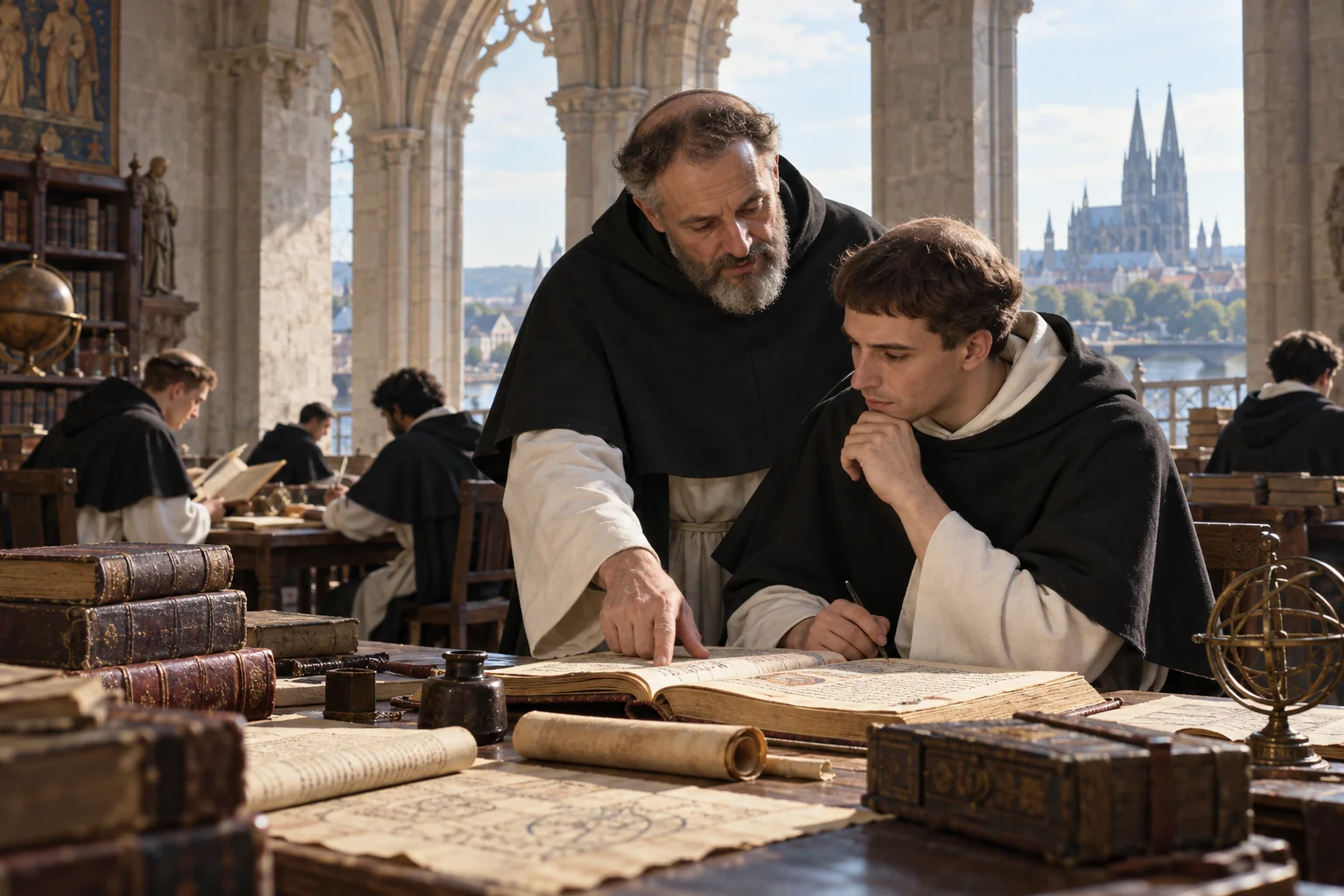
In the lecture halls of Cologne, the tall, slow, quiet young Italian who sat at the back and almost never spoke became a laughingstock. His classmates nicknamed him “the Dumb Ox of Sicily” (Bos Mutus Siciliae), because of his massive build and his puzzling silence, which they took for dullness.
But Saint Albert the Great, with the keen eye of a true teacher, soon saw something else. A story often told in the Dominican Order relates that one day some mischievous classmates decided to tease Thomas. Seeing him walking deep in thought in the friary grounds, they ran up and told him an ox was flying across the sky, just to see what the “dumb ox” would do. Thomas looked up in honest surprise. When they burst out laughing, he replied calmly:
“I would rather believe that an ox could fly than that my brothers in religion would lie to one another.”
That answer, funny and wise at once, silenced the mockers.
The real turning point came at a public disputation, the most important exercise in a medieval university, where a student had to answer hard questions from masters and classmates on the spot. Asked to present and defend a difficult theological thesis, the “dumb ox” finally spoke, and what poured out was not the stammering of a dullard but reasoning so clear and deep that it went far beyond any student his age, and even beyond what Master Albert himself had taught.
The whole hall fell silent in amazement. When he had finished, Saint Albert the Great turned to the other students and made a prophecy the Church still remembers: “You call him a dumb ox, but I tell you: the bellowing of this Ox will one day resound throughout the whole world!” Coming from one of the greatest scholars of the age, it was no exaggeration: seven hundred years later, that
“bellowing”
still echoes in every faculty of theology and philosophy in the world.
Chapter 3 of 6
The cathedral of the Summa Theologiae
In 1252, Thomas returned to the University of Paris to continue teaching, and in 1256, at thirty-one, he was made a Master of Theology, an honor few attained, let alone a young mendicant friar whose family had held him prisoner only a few years before. From then on he taught in Paris, Rome, Viterbo and Naples, and became a trusted theological adviser to several Popes and to the saintly king of France, Louis IX.
Thomas lived in an age of great intellectual upheaval. Translations of the ancient Greek philosopher Aristotle, handed down through Arab and Jewish scholars and especially through the commentator Averroes, were flooding into Europe’s universities. They brought a powerful system of rational thought that seemed to contradict many Christian beliefs about creation, the immortality of the individual soul and God’s providence. The radical Averroists in Paris even taught the dangerous doctrine of “two truths,” one of philosophy and one of faith, which might contradict each other, as if a person could believe two opposite things depending on whether he stood in a lecture hall or in a church.
Faced with this crisis, many conservative theologians took the safe road and wanted to forbid the study of Aristotle altogether as a danger to the faith. Thomas Aquinas chose a far bolder road, and it became the great work of his life. Instead of running from reason, he stepped into the middle of the storm and showed that faith and reason are not enemies but companions, both leading to the one Truth, because both come from the same God. He summed up this principle in a famous maxim: Gratia non tollit naturam, sed perficit — Grace does not destroy nature, but perfects it.
On that foundation Thomas built a work so massive that people compare it to a cathedral of thought: the Summa Theologiae. It has three great parts, divided into hundreds of questions, each laid out with astonishing rigor: the question is stated, the objections are listed, the answer is given, and then each objection is answered in turn. In the first part he presents the “Five Ways” (Quinque Viae) of showing by reason alone that God exists: from motion, from causation, from necessity, from degrees of perfection and from the order of the universe. He discusses creation, human nature as the union of soul and body, the moral and theological virtues, the mystery of the Incarnation of the Word, and the seven Sacraments as the means God uses to pour out grace on humanity.
This was not the work of a scholar in an ivory tower. Those who worked closely with him tell us that when he met a hard theological problem, when even his powerful mind had to give up before a deep mystery, Thomas never tried to force an answer by his own strength. He would get up from his desk, go straight to the chapel, kneel before the tabernacle and weep. Some nights his brothers heard him sobbing in the dark church, begging God to enlighten his small mind before mysteries beyond human reach. The greatest mind of the Middle Ages, it turns out, was fed not only by books but by the tears of a man on his knees.
Chapter 4 of 6
The poet of the Eucharist
Thomas’s special devotion to the Eucharist did not stop at quiet hours of prayer in the chapel. In 1264 Pope Urban IV established a new solemnity for the whole Church, the Feast of the Body and Blood of Christ, Corpus Christi, to honor Jesus truly present under the appearances of bread and wine. The Pope, who knew Thomas’s deep love for the Eucharist and his sharp theological mind, asked him to compose the texts and, above all, the hymns for the new feast.
From the great theologian’s pen poured hymns of astonishing beauty that are still sung in Catholic churches all over the world: the Pange Lingua, with its majestic closing verses, the Tantum Ergo, sung at Benediction; the gentle, heartfelt Panis Angelicus, about the Bread of Angels become food for pilgrims on earth; the short O Salutaris Hostia; and the Adoro Te Devote, Thomas’s own deeply moving profession of faith before a mystery reason cannot fathom, which begins: “I adore You in silence, O Lord truly hidden beneath these appearances of bread...”
It is astonishing that the man who wrote the rigorous, dry reasoning of the Summa Theologiae down to the last detail also wrote poetry so lyrical and so full of devotion. But in Thomas these were not two different people. A sharp mind and an ardent heart were simply two ways of expressing one longing: to know God and to be wholly united with Him. The Dominicans sum up his spirituality, and that of the whole order, in a famous motto: Contemplari et contemplata aliis tradere — To contemplate, and to hand on to others the fruits of contemplation. Thomas prayed before the Eucharist, and out of that prayer he wrote theology; he pondered the mystery, and out of that he wrote poetry.
Chapter 5 of 6
“It is all straw!”
In 1273, at the friary of Saint Nicholas in Naples, something happened that changed what little remained of Thomas Aquinas’s life. On the morning of December 6, the feast of Saint Nicholas, after Thomas had celebrated Mass, his companion and trusted secretary, Brother Reginald of Piperno, saw that he had gone through something extraordinary, too deep for words.
Not long before, Brother Dominic of Caserta had seen Thomas praying before the crucifix in the chapel, lifted from the ground, while a voice spoke from the cross: “You have written well of Me, Thomas. What reward would you have from Me for your labor?” Without the slightest hesitation, Thomas answered with a few words that held the longing of his whole life: “Non aliam nisi Te, Domine!” —
“Lord, I want no other reward but You!”
But what happened on December 6, 1273, went further still. After Mass that day, something happened to Thomas; historians and theologians still debate whether it was a mystical vision or a direct, overwhelming encounter with God’s presence. From that moment, the man who had written thousands of the sharpest pages in the history of Christian theology laid down his pen and never wrote another line.
Brother Reginald, worried and puzzled, begged him again and again to finish his work, for the Summa Theologiae still lacked its final part. At last, giving in to his friend’s pleading, Thomas said what the Church remembers as one of the humblest things ever said by a great scholar:
“Reginald, I cannot go on. All that I have written now seems to me like straw, compared with what I have seen and what has been revealed to me.”
He was not rejecting a lifetime’s work, and he was not despising himself or losing heart. Here was a man who had spent his whole life using human language and the most rigorous logic ever devised to try to speak about God, and who then, in one moment, was allowed to taste directly the One he had so long spoken of from afar. In the blinding light of that reality, all words, however subtle and deep, became like straw: not because they were wrong, but because they were so small beside the One they tried to describe. That was the Angelic Doctor’s last lesson, and perhaps his deepest: all theology, all knowledge, must in the end bow before the Mystery.
Chapter 6 of 6
A lighthouse of Truth
Early in 1274, though his health had clearly declined since that experience, Thomas set out at the command of Pope Gregory X for the Second Council of Lyon in France, an important council seeking unity between the Eastern and Western Churches. On the way he struck his head on a low-hanging branch and fell gravely ill.
His companions brought him to the Cistercian Abbey of Fossanova, near Terracina in Lazio, the first Cistercian abbey built on Italian soil, famous for its graceful early Gothic architecture, plain to the point of austerity in the Cistercian spirit of poverty. The monks gave their honored guest a small, simple room on the upper floor of the guesthouse, whose narrow window looked out on the vaulted roof of the abbey church and the dark green hills beyond. It is said that when they offered him the soft bed kept for noble guests, Thomas, faithful to his vow of poverty to the end, asked to lie on a simple mat on the floor like any other friar.
Knowing he would soon go home to the Father, Thomas asked for Viaticum. In the presence of the Body of the Lord, on which he had meditated all his life and for which he had written such hymns, he spoke his moving last words:
“I receive You, ransom of my soul. For love of You I have studied, kept vigil, toiled, preached and written...”
It was the humble summing-up of a life that had given its whole extraordinary mind to one purpose: serving the God he loved.
Thomas Aquinas died on the morning of March 7, 1274, at the Abbey of Fossanova, only forty-nine years old. In those forty-nine short years he left so much that generations of scholars have since spent whole careers studying, commenting on and debating every word he wrote.
On July 18, 1323, in Avignon, Pope John XXII canonized Thomas Aquinas. In 1567 Pope Saint Pius V, recognizing his unrivaled stature as a theologian, declared him a Doctor of the Church, a title given to very few. In 1879, in the encyclical Aeterni Patris, Pope Leo XIII made the thought of Thomas the foundation for teaching philosophy and theology throughout the Catholic Church. The “dumb ox” had become a lighthouse for generations of Catholic scholars. In 1880 he was proclaimed patron of all Catholic schools and universities throughout the world.
His body, moved several times over the centuries, rests today in the Church of the Jacobins in Toulouse, France, where the Dominican Order, to which he gave his whole life, made one of its first foundations. The Church celebrates him on January 28 each year, the day his remains were translated to Toulouse.
The prophecy Saint Albert the Great made in that lecture hall in Cologne came true far beyond anything he could have imagined. The bellowing of the “Dumb Ox” resounded throughout the world in his own time and has echoed for seven centuries since. It reminds each generation that human reason, enlightened by faith and fed by humble prayer, can reach extraordinary heights, but must always know how to bow, as Thomas did in his last hours, before a Mystery greater than any page can hold.
The end of the story
You have walked with Saint Thomas Aquinas to the end of the story.
These three scenes stay with you:
Locked in the castle by his own family to break his vocation, he seized a burning brand to drive a prostitute out of the room, then drew a cross on the wall.
Mocked by his classmates as the "dumb ox," he finally spoke in a disputation, and Master Albert the Great prophesied: "The bellowing of this Ox will one day resound throughout the whole world!"
After a vision in 1273, the man who had written the massive Summa Theologiae laid down his pen, calling all he had written mere "straw" compared with what had been revealed.
Stay in silence
You see what is most precious in a great mind: however high reason may reach, it still knows how to bow before a Mystery greater than itself.
Lord, I want no other reward but You!
Let us pray
Saint Thomas Aquinas,
your classmates called you the "dumb ox", and you became one of the greatest minds of the Church. Yet at the end of your life, you counted all you had written as straw compared with the Mystery of God.
Pray for students and teachers, that their learning may bring them closer to God.
Help me use my mind to serve the truth, and humbly bow my head before what is beyond my understanding.
Amen.
Sources
- Feast dayAuthor’s edited profile
- Patron ofPatronages and symbols, version 1.1
- Often depicted withPatronages and symbols, version 1.1
- Reflectionop.org
- Reflectionenglish.op.org
Meet the next one
 Journey 6