

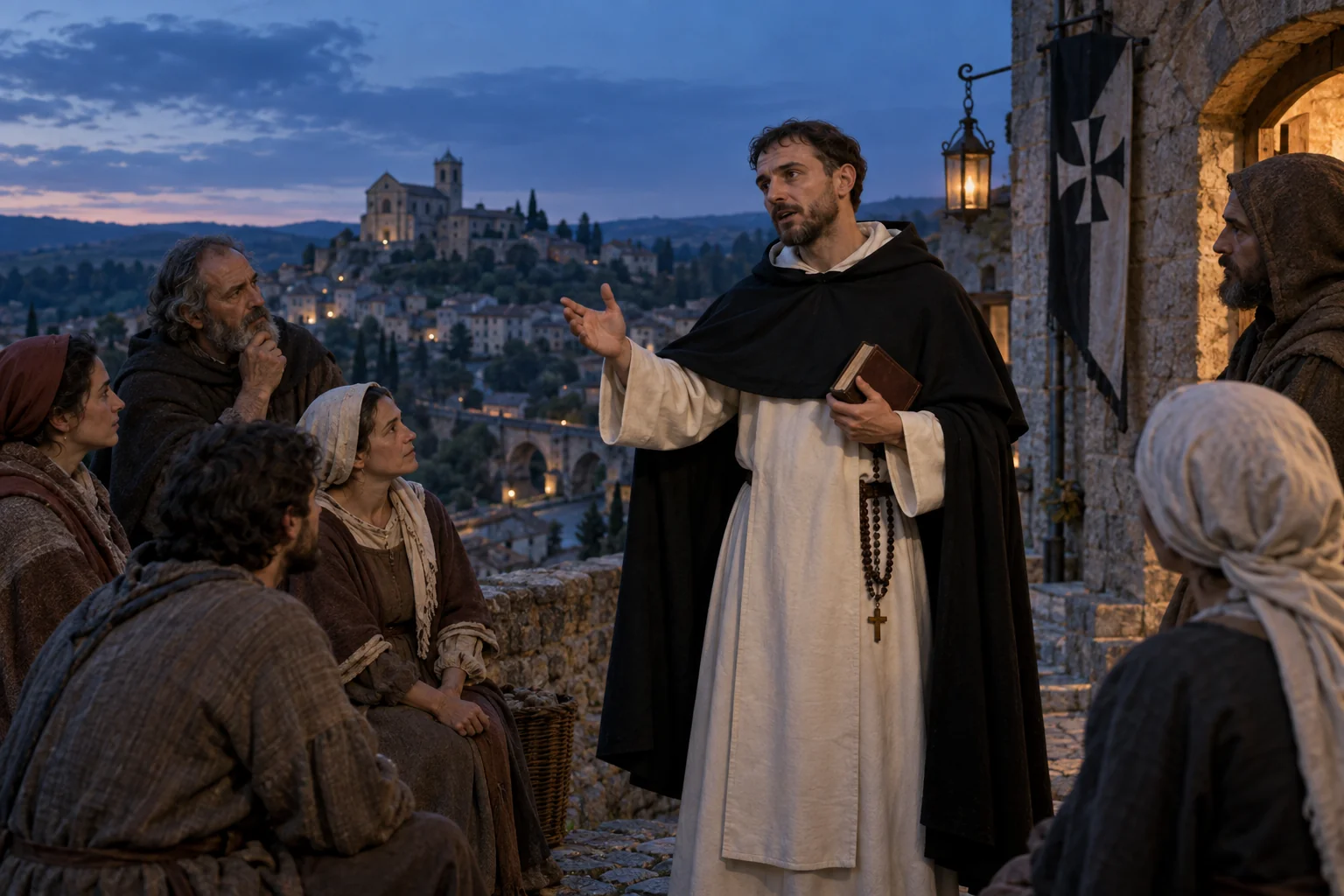
Journey 6 · Keepers of the Lamp of Faith
Saint Dominic de Guzmán
Sowing the seed of the Gospel on tireless feet
Feast day August 8
Tap to step inside
Saint Dominic de Guzmán
Sowing the seed of the Gospel on tireless feet
Map of a life
This life told in 7 chapters
Begin the journey OpeningOpening2 min
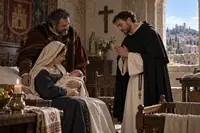 Chapter 1 of 7A boy from Caleruega who sold his books3 min
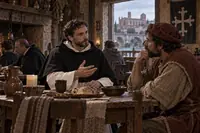 Chapter 2 of 7The night of debate at the inn in Toulouse2 min
 Chapter 3 of 7The birth of the Order of Preachers2 min
 Chapter 4 of 7Scattering the brothers to the universities1 min
 Chapter 5 of 7Nine ways of prayer, and nights of compassion1 min
 Chapter 6 of 7Resting beneath his brothers’ feet2 min
- Chapter 7 of 7A torch that never goes out2 min
Feast day
Saint Dominic de Guzmán
Some places may celebrate on a slightly different day.
August 8
Patron of
- The Dominican Order
- Astronomers
- The Dominican Republic
Often depicted with
- A dog carrying a torch
- A star on his forehead
- The Rosary
Opening
Opening
In the thirteenth century, in the south of France, amid the sun-drenched, windswept land of Languedoc, a heretical movement called the Albigensians (Albigenses, or Cathars) was spreading like wildfire, drawing hundreds of thousands of believers away from the faith. They held an extreme dualism: they regarded all visible things and the human body as created by the devil, rejected marriage, and denied the mystery of the Incarnation and the sacraments of the Church. In their eyes, the material world was itself a prison, and only the total renunciation of every earthly pleasure — even having children — could free the soul from that prison.
To counter it, the Holy See sent legates and powerful Cistercian abbots. They rode magnificent horses, wore lavish vestments, and were escorted by noisy retinues, hoping to overwhelm their opponents with worldly authority. Yet the harder they tried, the worse they fared against the Albigensian leaders, the “perfect ones” (perfecti), who outwardly lived lives of great austerity: they fasted constantly, wore plain black robes and went barefoot preaching through the villages. Their hard way of life won over the poor, and the splendid legates, for all their orthodoxy, looked like hypocrites living in luxury off the people.
Right in the middle of that deadlock, a Spanish priest with a refined bearing, a broad, shining forehead and eyes burning with charity stepped up beside the legates. His advice turned the Church’s whole approach upside down:
“My lords, pride cannot be extinguished by a show of power; to defeat the hypocrisy of heresy, we must use the true poverty of the Gospel itself, feet that walk, humility and sincere prayer!”
That priest was Dominic de Guzmán (Domingo de Guzmán) — founder of the Order of Preachers, usually called the Dominicans. With the fire of Truth (Veritas) and the Rosary, he opened a new chapter in the Church’s mission, joining contemplative silence to the preaching of God’s Word, so that the light of the Gospel might reach the darkest corners of the human heart. But before he changed the way the Church went about its mission, Dominic was a boy growing up on the dry highlands of Castile, carrying in his heart a dream that his own mother had seen even before he was born.
Chapter 1 of 7
A boy from Caleruega who sold his books
Dominic was born around 1170 at Caleruega, a small town between the cities of Osma and Aranda de Duero, in the region of Old Castile in Spain — a dry, windswept upland, where limestone hills stretch to the horizon and ancient monasteries rise like quiet oases in a border region that for centuries had been a battlefield between the Christian kingdoms and the Moorish Muslim states. His father was Félix de Guzmán, a nobleman of an old local family; his mother was Juana de Aza, a woman known throughout the region for her piety and her generosity to the poor. The Church later beatified her too, a rare sign of the holiness in which the whole family was raised.
Tradition tells that before he was born, his mother dreamed that she gave birth to a little dog carrying a blazing torch in its mouth, running everywhere and setting the whole world alight. The dream was taken to foretell her son’s mission: to carry the torch of truth against the darkness of error and kindle the fire of God’s love all over the earth. Later, when the Dominican Order grew strong, medieval painters took that image — the dog carrying a torch — as a familiar symbol of the founder. There is also a famous Latin pun the Dominicans still fondly repeat: Domini canes — “the dogs of the Lord”, which sounds close to the name Dominicanes (Dominicans) and also evokes faithful guardians of the flock, ready to bark the alarm whenever the wolves of heresy creep in among the sheep.
At fourteen, Dominic was sent to the city of Palencia to study the liberal arts and theology at its renowned school — one of the oldest centers of learning on the Iberian Peninsula, which would later become the forerunner of the University of Valladolid. He studied there diligently for ten years, with an extraordinary memory and a deep love for the Word of God. He always carried with him the Gospel of Saint Matthew and the letters of Saint Paul, reading them until the parchment pages were worn thin from turning, and it is said that he knew almost all of both by heart.
In 1191, a terrible drought brought a devastating famine to the region of Palencia. No rain fell, season after season; the earth cracked, the barley withered in the fields, and the poor died of hunger in the streets. Faced with such suffering, the twenty-one-year-old student Dominic did something that astonished the whole university. He sold all his valuable possessions, even his priceless parchment books with notes he had carefully written in his own hand. Books were a scholar’s most precious possession; a poor student of the time might save for years to buy just one. Dominic sold them all to buy food for the starving poor.
When his classmates reproached him in surprise, thinking he had foolishly traded away his whole academic future, Dominic gave an answer that has never been forgotten:
“How can I sit still and study these dead skins, while the living pages of Christ, my poor brothers and sisters, are dying of hunger in the streets?”
His compassion so moved the professors and students that they took up a collection of their own, which saved thousands of lives. A young man ready to sell the very tools of his study to save others was no dry scholar who knew only words. It was the first sign that in Dominic, knowledge and love would never be separated.
In 1196, he was ordained a priest and joined the cathedral chapter of Osma, living under the Rule of Saint Augustine — a community of priests living together, keeping strict religious discipline, devoted to the liturgy and the study of Scripture. He lived a contemplative life, keeping vigil in prayer all night while the other canons slept, and before long his brothers trusted him enough to elect him subprior of the chapter. If his life had gone on like that, Dominic might have become a holy but hidden priest, spending his whole life within the four walls of the cathedral of Osma. But God had another path for him, and that path began with what looked like a simple diplomatic errand.
Chapter 2 of 7
The night of debate at the inn in Toulouse
In 1203, Dominic and Bishop Diego de Acebo — the Bishop of Osma whom he deeply admired — were sent by the king of Castile on an embassy to Denmark to negotiate a royal marriage for the prince. That journey took the two men across the south of France, right through the land of Languedoc, where the Albigensian heresy was raging most fiercely.
Stopping for the night at an inn in the city of Toulouse — a busy center of trade and also one of the main strongholds of the Cathar movement — Father Dominic noticed that the innkeeper was a fervent follower of the heresy. Instead of going to bed after a long, tiring day in the saddle, he sat down at the table with the innkeeper, by the flickering candlelight of a winter night in the south of France.
With rare gentleness, a deep knowledge of Scripture and complete respect for the other man, and with none of the heavy-handed authority the legates relied on, he sat talking and debating with him all night until morning. One by one the false arguments of the heresy gave way, not to heavy accusations, but to patient explanation, step by step: the true meaning of creation, of the human body as a temple of the Holy Spirit and not a prison of the devil, and of the Savior’s merciful love, shown in verse after verse of Scripture that Father Dominic quoted without a book, from a memory steeped in it for years.
When dawn broke through the small window of the inn, the innkeeper burst into tears and fell on his knees at Father Dominic’s feet, renouncing the heresy and asking to return to the Catholic faith. One night and one patient conversation had done what all the splendid legations, with their force and authority, could not.
That night changed the course of Dominic’s life. He saw that his calling was not to settle into a canon’s comfortable stall at Osma, holy and peaceful as that life was. He was to sow the seed of Truth through the dialogue of love: not with swords, not with worldly power, but with feet that walked through the villages, with a chosen poverty that made him one with the people he hoped to persuade, and with a mind trained well enough to answer any argument of those who had gone astray.
Chapter 3 of 7
The birth of the Order of Preachers
From 1206, with the permission of Pope Innocent III, Father Dominic and Bishop Diego began itinerant preaching in Languedoc. They gave up fine horses and carriages, walked barefoot from village to village under the harsh sun of the south of France, and lived entirely on alms from day to day. It was the very opposite of the earlier legates’ luxury, and it began to win the trust of people sick of hypocrisy.
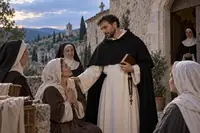
In 1206, at Prouille — a small village not far from Toulouse — Father Dominic founded the first convent of nuns, for women who had just left the Albigensian heresy and returned to the Church. Many of them came from poor backgrounds and had been raised and educated for free by the Cathar “perfect women” — one of the reasons the heresy spread so quickly among the poor. Prouille became the praying heart of the mission: there the sisters quietly upheld the hard work of the preachers outside.
In 1215, in Toulouse — the very city where he had spent that fateful night of debate twelve years earlier — Father Dominic and his first six followers formally founded a new community devoted to preaching. At that time, under the old canon law, public preaching was reserved to bishops; priests were usually permitted only to celebrate the sacraments, not to teach widely. An order of traveling priests trained especially to preach was something entirely new in the medieval Church.
Pope Honorius III solemnly approved the Order of Preachers, the Dominican Order, by a bull dated December 22, 1216, and called its friars “champions of the faith and true lights of the world”. Dominican spirituality is summed up in a phrase of Saint Thomas Aquinas — who would join the order less than thirty years later: Contemplari et contemplata aliis tradere, meaning to contemplate, and to hand on to others the fruits of contemplation.
He taught his friars that before opening their mouths to preach to others, the preacher himself must spend many hours in silence before the Eucharist so that the Word of God would soak into him and not remain dry arguments learned by heart. He gave them a rule still repeated in Dominican houses all over the world:
“A Dominican speaks only with God, or about God!”
Chapter 4 of 7
Scattering the brothers to the universities
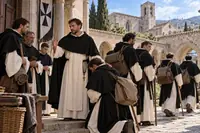
In 1217, when the Dominican community in Toulouse had only sixteen friars — far too small a number to dream of evangelizing all of Europe — Father Dominic made a bold decision that astonished them all: he would scatter the whole little group across Europe.
His companions begged him to keep them together, fearing that the fragile young community would fall apart. Father Dominic answered firmly with a simple farming image:
“Grain piled up in one heap will rot; but scattered far and wide, it will bring forth a rich harvest!”
He sent them to the two greatest universities of the Western world at the time: Paris, home to the sharpest theological minds in Europe, and Bologna, the cradle of law and also the place where he himself would later breathe his last. He wanted his friars in the lecture halls, mastering the best philosophy and science of the age, so they could put that learning at the service of the faith rather than preaching with zeal alone. That bold move made the Dominicans the greatest intellectual and theological force of the medieval Church, producing giants like Albert the Great and Thomas Aquinas, who carried on along the road Dominic had opened.
Church tradition has also long linked Saint Dominic with the origin of the Rosary. Tradition tells that during the hard years of struggle against the Albigensian heresy, when reasoned debate was sometimes not strong enough to move hearts that had grown too hard, Our Lady appeared and gave him the Rosary as a powerful spiritual weapon — a simple way of prayer that even poorly educated country people could use, quite different from complex theological debates meant only for scholars.
He used those simple beads to teach the mysteries of the Incarnation, Passion and Resurrection of Jesus, making the Rosary a popular prayer that nourished the faith of millions of poor people through the centuries. A tiny seed sown in the hard days in Languedoc grew into one of the most widespread prayers in the whole Catholic Church.
Chapter 5 of 7
Nine ways of prayer, and nights of compassion
Behind the sharp debates in the public squares, behind the eloquence that brought so many heretics to submit, lay a hidden life of prayer, wet with tears, which few people knew about except the brothers who lived with him.
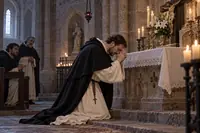
By day he walked tirelessly preaching under scorching sun or steady rain, never counting his weariness; by night he almost never slept in a bed. He spent whole sleepless nights in the church, lying prostrate before the altar, beating his breast and weeping bitterly. His brothers often heard him crying out in the depths of the night, when he thought no one was listening:
“Lord, what will become of sinners? Where is Your mercy for them?”
That was not the lament of a theologian reasoning about sin in the abstract, but the cry of a true shepherd carrying in his heart the burden of every lost soul he had met on the road.
An ancient work called “The Nine Ways of Prayer of Saint Dominic”, written down by disciples who had watched him pray, describes how he prayed with his whole body: sometimes kneeling with his head bowed to the ground in repentance, sometimes lying prostrate on the cold stone floor of the church, sometimes standing motionless for hours with his arms outstretched in the shape of a cross, sometimes standing upright with both hands raised high to heaven as if begging for an urgent favor. For him prayer was not just a matter of the mind or the lips; it was the whole person, body and soul, turned toward God.
Hard on himself, he was gentle, cheerful and full of compassion toward others, a contrast that surprised everyone who met him. The witnesses at his canonization process, people who had lived beside him for many years, all agreed:
“No one ever saw him sad or angry; his face was always radiant with the joy of the Holy Spirit!”
That combination, strict with himself and always smiling with others, became a hallmark of Dominican life, handed down through generations of friars.
Chapter 6 of 7
Resting beneath his brothers’ feet
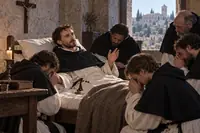
In the summer of 1221, after a long pastoral journey in northern Italy under the burning summer sun, Father Dominic collapsed, exhausted and burning with fever. Twenty years of endless walking, meager meals and sleepless nights of prayer had probably worn him down. He was brought to the friary of Saint Nicholas in Bologna, where the Dominican community had taken firm root since the brothers were first sent out.
Knowing he would soon go home to the Father, he asked his brothers to take off the good habit he was wearing and dress him in the old, threadbare habit of another brother — even in his dying hour, he did not want to be treated differently or better than the poorest friars of the order. Since his cell had no bed, in keeping with the spirit of poverty he had lived all his life, he lay on a torn mat spread on the floor, surrounded by his brothers.
To the sons kneeling and weeping around him he left a last testament that summed up everything he had lived for:
“My dear sons, this is the inheritance I leave you as my faithful children:
Have charity;
Keep humility;
And live voluntary poverty!”
When the brothers, weeping, asked who would guide the young order once he was gone, he smiled and comforted them:
“Do not weep, my sons! I shall be more useful to you after my death; I shall intercede for you before God more effectively than when I was still living on this earth!”
He asked his brothers to say the prayers for the commendation of the soul. At noon on August 6, 1221, when the brothers reached the words,
“Come to his aid, saints of God, come to meet this soul...”
, Saint Dominic peacefully breathed his last and went home to God, at the age of fifty-one, surrounded by the sons he had spent fifteen years forming.
In keeping with his humble wish, he was buried right beneath the floor of the chapel, beneath the feet of his brothers, so that everyone would walk over him whenever they came in or went out. He stayed humble in death, as he had been all his life.
Chapter 7 of 7
A torch that never goes out
Less than thirteen years later, on July 13, 1234, Pope Gregory IX — who had been his close friend since the years when he was Cardinal Ugolino, and a steady supporter of the young order — solemnly canonized Dominic de Guzmán. The Pope declared:
“I have no more doubt of this man’s holiness than I have of the holiness of the Apostles Peter and Paul!”
The Church celebrates him on August 8 each year.
His body is kept today in a magnificent tomb called the Arca di San Domenico — the Shrine of Saint Dominic — placed in its own chapel inside the Basilica of San Domenico in Bologna. The tomb itself shows how Dominic’s work went on bearing fruit through the centuries: begun by the sculptor Nicola Pisano in 1264, then continued by generation after generation of craftsmen, including carvings from the hand of a very young Michelangelo at the end of the fifteenth century — a work that took nearly five hundred years to complete, as if European art itself wanted a share in honoring the humble saint who died on a torn mat.
In Vietnam, the Dominican Order has deep roots: Spanish Dominican missionaries laid firm foundations for the dioceses of the North, the former Eastern and Central Vicariates, and among the one hundred seventeen Vietnamese Martyr Saints, thirty-eight belong to the Dominican family, including bishops, priests, brothers and lay Third Order members. Saint Dominic’s Rosary — the spiritual gift he received amid the hard years of struggle against heresy in Languedoc — has nourished the faith of Vietnamese Catholics for generations, from old people praying the Rosary on their porches to families gathering for evening prayers.
Saint Dominic’s life, from the night of debate at the inn in Toulouse to his last hour on a torn mat in Bologna, teaches one thing above all: Truth must never be imposed by violence or proud oppression. It can only be proclaimed through poverty freely chosen, through the patient dialogue of love, and through a life deeply united with God in the silence of prayer. That road seems slow and humble, yet it lasts longer than any army or worldly power, because it reaches the very heart of the human person.
The end of the story
You have walked with Saint Dominic de Guzmán to the end of the story.
These scenes are not easy to pass over:
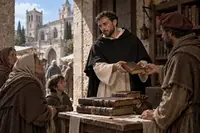
In the terrible famine at Palencia, the twenty-one-year-old student sold all his precious parchment books to buy food for the starving poor.
One night at an inn in Toulouse, with gentleness and a memory steeped in Scripture, he won over the Albigensian innkeeper by the time dawn broke.
When the Dominican community was still tiny, he decided to scatter his sixteen brothers across Europe, saying: "Grain piled up in one heap will rot!"
Stay in silence
You see why he dared to go against all expectations: a seed of truth, sown widely in poverty and dialogue, bears fruit more strongly than any imposed authority.
Grain piled up in one heap will rot; but scattered far and wide, it will bring forth a rich harvest!
Let us pray
Saint Dominic,
in a time of famine, you sold even your most precious books to save the poor. You used gentleness and the Word of God to win back those who had gone astray, and sent your brothers to sow the Gospel everywhere.
Teach me to share what I treasure most with those in need.
Help me speak with people of other beliefs gently, not with harsh words.
May my family be faithful in praying the Rosary.
Amen.
Sources
Meet the next one
 Journey 6