

Journey 6 · Keepers of the Lamp of Faith
Saint Catherine of Siena
The young woman who dyed the world red with the fire of love
Feast day April 29
Tap to step inside
Saint Catherine of Siena
The young woman who dyed the world red with the fire of love
Map of a life
This life told in 6 chapters
Begin the journey OpeningOpening1 min
 Chapter 1 of 6The twenty-fourth child of a dyer of Siena5 min
 Chapter 2 of 6Three years in a closed room and the mystical wedding ring2 min
 Chapter 3 of 6A kiss on the neck of the condemned Niccolò2 min
 Chapter 4 of 6A letter to the Pope and the rescue from Avignon2 min
 Chapter 5 of 6The masterpiece “Dialogue” and the last drops of blood2 min
 Chapter 6 of 6Doctor of the Church and Patroness of Europe1 min
Feast day
Saint Catherine of Siena
Some places may celebrate on a slightly different day.
April 29
Patron of
- Europe (1999)
- Italy (1939)
- Nurses
- Protection against fire
Often depicted with
- A crown of thorns
- A lily
- A ring
- A book
Opening
Opening
In the summer of 1376, a twenty-nine-year-old woman knelt before the throne of Gregory XI in the great hall of the papal palace at Avignon. The palace was a huge stone fortress on a rocky cliff above the Rhône, its walls up to four meters thick to withstand any siege. She came with no retinue and no title of any kind, only the black mantle of the Dominican Third Order. It is said that her voice did not tremble at all:
“In the name of Christ crucified, I beg you, Holy Father, be a real man. Have the courage to return to Rome.”
Words like those could have cost anyone else their head. But that woman was no queen, no princess, and did not own a single inch of land to take refuge in if the court at Avignon grew angry. She was the daughter of a cloth dyer in Siena, a town in Tuscany, and had grown up in the Fontebranda quarter, home to an ancient fountain that flowed all year round and that the whole neighborhood of dyers depended on. She could not write. All her life, the letters bearing her name were written down by others as she dictated.
And yet only a few months after that meeting, a Pope left his safe palace, boarded a ship at Marseille, spent two long months at sea, and returned to a ruined Rome full of political danger. We know her as Catherine of Siena, whom the Church would later make a Doctor and a patroness of all Europe. But before all those titles, she was only a child in a cramped house that smelled of dye, one of twenty-five brothers and sisters.
Chapter 1 of 6
The twenty-fourth child of a dyer of Siena
The Benincasa family home stood on the small sloping lane called Vicolo del Tiratoio, right beside the Fontebranda quarter. The lane still bears that name, and the house still stands, bought by the people of Siena only a few decades after her death as a place of pilgrimage. The house was laid out on three floors in the manner of a workshop: the ground floor was for soaking cloth and dyeing, crammed with wooden vats reeking of alum and tree bark; the upper floors were home to a whole large, crowded family. Giacomo di Benincasa, her father, was a member of the dyers’ guild — a trade that paid enough to live on and never more, because the price of woolen cloth depended on the weather, on war, on whether the water from the Fontebranda well flowed steadily or not.
Caterina Benincasa was born on March 25, 1347, on the very feast of the Annunciation — a coincidence people never stopped mentioning later, as if a sign had been given before she even opened her eyes. She and her twin sister Giovanna were the last two of the twenty-five children of Giacomo and Lapa Benincasa. The number sounds hard to believe today, but in a fourteenth-century craftsman’s family, where one child in every few did not survive the first years of life, having many children was the only way to make sure the family had heirs and someone to carry on the trade. Giovanna, Catherine’s twin, died in her first months.
We often imagine that the saints were unusual right from the cradle. With Catherine, the surviving records, mostly from her confessor Raymond of Capua, who later wrote her life, show a cheerful, lively child, pampered by the whole family for her sweet nature, often laughing and loving to play with her brothers and sisters. Nothing gloomy, nothing forced. That very ordinary foundation makes what happened when she was six all the harder to explain.
That day, Catherine and her brother Stefano were walking home after visiting their married sister, crossing the little valley called Vallepiatta, from where the dome of the church of Saint Dominic could be seen towering on the hill. The little girl suddenly stopped, her eyes fixed on the sky above the roof of the church. Her brother called her several times with no answer; when he came back and pulled her by the hand, she started as if waking, her face wet with tears, and said that if she had been allowed to see that sight longer, she would no longer have known what hunger or thirst were. She told them: in that patch of sky, Jesus had appeared, dressed in papal vestments, seated on a throne, raising His hand to bless her.
A year later, at seven — the age that the canon law of the time considered the age of reason, when moral responsibility begins — Catherine knelt by herself in a corner of a room and silently vowed to live in lifelong virginity, given to Christ. No one witnessed it, no one told her to do it. It was the decision of a seven-year-old, made by herself and kept by herself for the next twenty-six years, through every family pressure.
That pressure came when she was twelve — the age when medieval craftsmen’s daughters usually began to have marriages arranged by their parents. Lapa, her mother, began grooming her daughter as a future bride: curling her hair, dressing her well, teaching her to walk gracefully so as to catch the eye of some well-off family. Catherine flatly refused. And to put a complete end to every marriage proposal, she took scissors and cut off her golden hair with her own hand. Her hair was a girl’s greatest beauty in those days, the thing any mother would proudly show off to the neighbors.
It was not a childish whim. It was a declaration, and her parents understood its meaning at once. They answered not with understanding but with a long, simmering anger. They dismissed the maid who helped in the house and gave all the heaviest work — washing, cooking and cleaning for a family of nearly thirty mouths — to Catherine, as if hard labor could break their stubborn daughter’s will. They allowed her no private corner to pray, not even the little attic room she used to slip away to.
This is a part her biographies often pass over quickly, but it is one of the details that most clearly shows who Catherine was. With nowhere left to retreat to, she did not resist, did not run away from home, and did not pretend to give in. She thought of another way: to build a room no one could see, right inside herself. She told herself that her father was the image of Jesus, her mother was Our Lady, the brothers and sisters around her were the Apostles — and each time she bent to scrub pots or carry water, she saw it as serving the Holy Family itself. A child of twelve or thirteen, in the middle of unjust punishment, found a way to turn humiliation into a form of wordless prayer. Few adults could do as much.
The tug-of-war lasted almost a year. Then one evening, her father, after quietly watching his daughter bent over her work without a trace of resentment on her face, walked into the room and saw — as was told later — a white dove resting on Catherine’s head as she prayed. He said nothing about that vision; he simply gathered the whole family and declared that he would no longer force his daughter to marry, leaving her free to follow the path she had chosen.
At sixteen, Catherine asked to join the group of women in black mantles of the Dominican Third Order, popularly called the Mantellate — literally “the mantled ones”. It had originally been a group for older widows, who lived on their own and did works of charity in the city without taking lifelong vows like nuns in a convent. An unmarried young girl asking to join was unheard of. At first the women of the group flatly refused. But Lapa, her mother — once the fiercest opponent — now stepped in herself to persuade the Mantellate to change their minds, on the grounds that her daughter was sickly and frail and needed a devout life to heal her soul. In the end, the women agreed to interview her. Catherine came to that meeting with her face still marked by the smallpox she had just recovered from. Perhaps it was precisely her lost good looks that convinced the women that this girl was sincere, and not trying to use the habit to escape an unwanted marriage.
Chapter 2 of 6
Three years in a closed room and the mystical wedding ring
Once she had put on the black mantle, Catherine did something no one in the family expected: she asked to withdraw completely into a small room in the basement of the house — a place probably once used to store dyed cloth — and almost vanished from family life for three years, from 1364 to 1367.
It was no comfortable retreat. The room had no window worth the name, only enough light coming through a narrow slit. She slept on a wooden plank, with no mattress, no warm blanket in Siena’s bitterly cold winters. Her daily food was reduced to dry bread dipped in water and a few raw vegetables. As an adult, her body could hardly digest ordinary food at all, and modern researchers still debate whether this was a sign of a serious eating disorder or simply the result of extreme penance kept up since adolescence.
It was during those years that she went through what she herself described as terrible battles with temptation. Not abstract temptations, but — as she told her confessor — violent sensual hallucinations and voices sowing despair, so that many nights she did not dare close her eyes. When that inner storm finally passed and Catherine felt peace return, she burst into tears and cried out into the silence: “Lord, where were You when my heart had to endure such horrible filth?” And the answer she received, as she told it, was not a rebuke for having doubted, but a surprisingly gentle reply:
“Catherine, I was right in the middle of your heart. It was I who gave you the strength never to consent to those temptations.”
This answer is worth pausing over: God did not promise to take the temptation away, but showed that He had been there all along, even in the moment when she felt most abandoned.
On the night before Ash Wednesday in 1367, amid a harsh Lent of penance and fasting, Catherine, by her own account, had a vision greater than any before: Jesus appeared with Our Lady and the saints and took her as His bride in a mystical marriage. He placed on her finger a gold ring set with a brilliant precious stone and four small pearls around it, a sign of whole and unshakable faith. She said that human eyes could not see the ring, but she herself, for the rest of her life, always felt it there on her finger, even in the middle of a busy crowd.
What is striking is not the mystical detail of that vision, but what happened right afterward. By the ordinary logic of a “spiritual marriage”, one might expect Catherine to become even more withdrawn, sinking deeper into the life of a recluse. But what she described was exactly the opposite: the Lord told her to leave that closed room, step outside, live in the midst of society, and serve the people around her.
“Love for Me and love for one’s neighbor are one. You cannot do Me any good, for I need nothing from you. But you can help your poor brothers and sisters, in My name.”
The three years behind a closed door turned out to be not a destination but a time of preparation, before a life flung out into the noisiest marketplace in the world.
Chapter 3 of 6
A kiss on the neck of the condemned Niccolò
Stepping out of that little room, Catherine threw herself into work that few could imagine a slender young woman, who ate almost nothing, would have the strength to do.
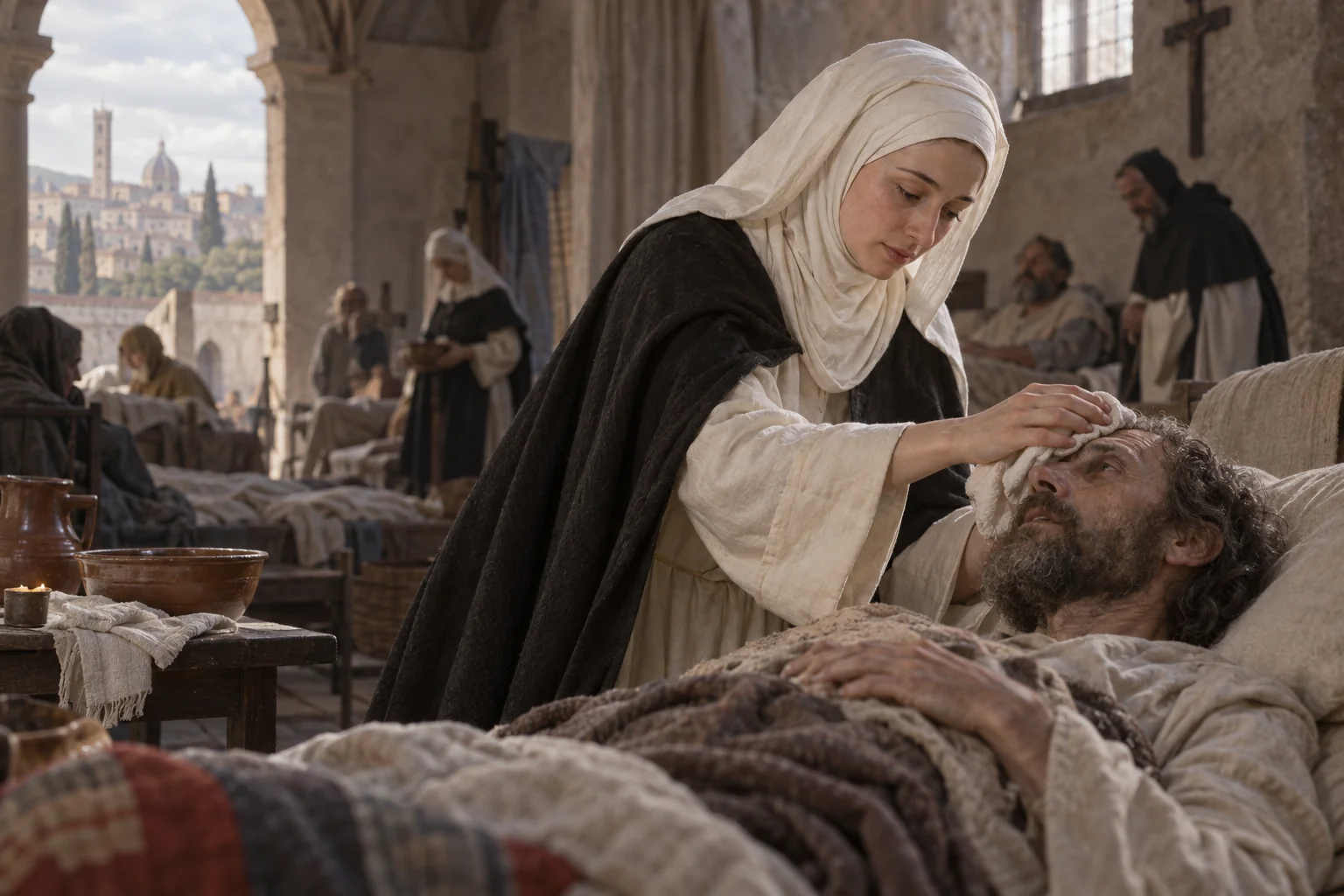
In 1374, the Black Death — the bubonic plague that had swept across Europe from the middle of the century, taking nearly a third of the continent’s population — broke out again in Siena. The city had had as many as fifty thousand people before the plague; after the first outbreak in 1348, fewer than half remained. By the time it returned in 1374, the terrible memory was still so fresh that people panicked, abandoned the sick and shut their doors, not daring to go out. Catherine and the little group of disciples who followed her — later called the “Bella Brigata”, the beautiful company — went straight into the isolation quarters, where the sick, covered in sores and stinking, had been abandoned by their own families for fear of infection. She washed their wounds with her own hands and buried the bodies no one dared touch, even when the smell of death had spread through the whole quarter.
Beyond nursing the sick, Catherine threw herself into far more dangerous work: reconciling the age-old feuds between the noble families of Tuscany — bloody Montague-and-Capulet-style conflicts, where one wrong word could make her a target for both sides. She went in person, sat among men whose hands were still stained with the blood of the other side’s relatives, and with an authority that came not from the sword but from her own uncompromising frankness, she made them sit down and talk.
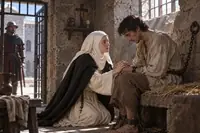
But perhaps no story about Catherine is told and retold as often as the afternoon she accompanied Niccolò di Toldo, a young nobleman from Perugia whom Siena had sentenced to beheading for plotting rebellion. Niccolò was in a towering rage. He believed the sentence was unjust, and in his fury he cursed God Himself, refused all the sacraments, even refused to confess before dying, which at the time meant losing one’s soul forever.
Catherine asked to visit him in prison. She did not preach, did not condemn. She simply sat down beside him, spoke to him like an older sister, asked about him and listened to his anger until it calmed down. It was that patient gentleness — not any threat of hell — that made Niccolò break down in tears, ask to confess, and walk out to the place of execution with a calm that astonished even the executioner.
In the letter Catherine later wrote to her confessor Raymond of Capua — one of the most vivid and haunting letters among the nearly four hundred of hers that survive — she told how she knelt beside the block and held Niccolò’s head in her lap as the axe came down, so that the drops of warm blood spattered her mantle, and in that moment she “saw” his soul received, like a dove flying up into the arms of the Redeemer. That was not a detail she added to make the story more beautiful. It was how a twenty-seven-year-old woman faced the most violent death she had ever witnessed with her own eyes — by staying, without turning to run, until the very last moment.
Chapter 4 of 6
A letter to the Pope and the rescue from Avignon
Someone who had never properly learned to read and write — for in those days craftsmen’s daughters rarely went to school — should never have become one of the most politically influential voices in fourteenth-century Europe. But Catherine did it, by dictating every word to the secretaries among her disciples. Nearly four hundred letters survive to this day — to cardinals, to the kings of France, England and Hungary, to prostitutes in Siena, to prisoners in jail, to the Pope himself — all in an unmistakable voice: reverent to the point of utter humility, and frank to the point of being uncompromising.
She called the Pope “Dolce Cristo in terra” — sweet Christ on earth — a form of address expressing absolute reverence for the chair of Peter. Yet right after that greeting, she could write questions that would make any courtier break into a sweat. What made those letters so urgent was the crisis of the “Avignon exile” — for nearly seventy years, from 1309, the Popes had left Rome to live at Avignon, in the south of France, under the ever heavier influence of the French court. Rome, meanwhile, fell into chaos: noble families fought for power, Saint Peter’s Basilica fell into disrepair, and sheep even grazed in the courtyard in front of it.
In 1376, Catherine — then twenty-nine — made the long journey from Siena to Avignon, crossing the Alps to meet Gregory XI face to face. The papal palace at Avignon, which she entered, was one of the most heavily fortified buildings in Europe at the time — towering stone walls, built when the Popes feared attack in a region still swarming with unemployed mercenaries after the wars. Amid that luxurious, fortified setting, a small woman with no title and no retinue stood before the papal throne and said what no one else dared say: be a real man, have the courage to return to where you belong.
Gregory XI had already made a private vow, kept secret from almost everyone, that if he were chosen Pope, he would bring the Holy See back to Rome. When Catherine — who could not have known about that secret vow by any ordinary means — mentioned that very thing during their meeting, the Pope was stunned. For three long months she stayed in Avignon, continuing to persuade, continuing to write letters, until on September 13, 1376, Gregory XI formally set out from Avignon. He boarded a ship at Marseille on October 2, sailed by way of Genoa, and landed at Corneto on December 6, before continuing on to Rome — ending nearly seventy years of exile for the chair of Peter. No one can say for certain that the decision came only from the words of a dyer’s daughter. But historians, even the most cautious, agree that Catherine’s voice was one of the decisive factors, at a moment when the scales were still wavering.
Chapter 5 of 6
The masterpiece “Dialogue” and the last drops of blood
The joy of the return to Rome did not last long. Only two years later, in 1378, the Great Western Schism broke out — one of the worst rifts in the history of the Church, when two men both claimed to be the lawful Pope, one in Rome and one back in Avignon, tearing apart the unity Catherine had given all her strength to restore. Urban VI, the Pope in Rome, called Catherine to his side, not to hold any office, but simply to have her spiritual support amid the political storm tearing Catholic Europe apart.
Catherine’s last months in Rome were one long stretch of exhaustion and pain. She felt the schism like a wound tearing her own body, and in the deep faith of one who had been “betrothed” to Christ, she believed she could offer her very life, the very sufferings gnawing at her body, as a sacrifice for the Church’s unity.
It was during that time, surrounded by pain, that she dictated to her secretaries her great work: “The Dialogue of Divine Providence” — an imagined conversation between her soul and God the Father. In it is an image that became one of the most beautiful theological images ever written by someone with no formal schooling in theology: Christ as a golden bridge spanning the abyss between heaven and earth, with three steps — the nailed feet, the pierced side, and the lips that give the kiss of peace — to lead people across the raging river of sin below and into eternal life.
In 1375, a little earlier, in the city of Pisa, she had received the stigmata, the Five Wounds of Jesus: wounds that could not be seen with the naked eye, but which she described as intense pain in the palms of her hands, her feet and her side, recurring for the rest of her life.
In her last weeks in Rome, Catherine could hardly take anything but the Eucharist. Every morning she dragged herself, step by trembling step, to Old Saint Peter’s — a building that then still kept its shape from the time of Constantine, before it was torn down and rebuilt into the magnificent Saint Peter’s Basilica known today — to kneel for hours before Giotto’s mosaic “Navicella”, the image of the ship of the Church tossing amid the storm, with the Apostles in panic while Jesus walks on the water. She said she felt the whole weight of that ship — of the whole divided Church — pressing down on her thin shoulders, now only skin and bone.
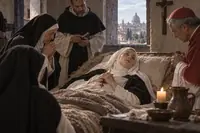
On April 29, 1380, on a simple straw-covered bed in Rome, after whispering her last words:
“Lord, if I must die, remember that I have died for Your Church”
, Catherine of Siena died. She died at thirty-three, the same age as the One she had called her Bridegroom all her life.
Chapter 6 of 6
Doctor of the Church and Patroness of Europe
Eighty-one years later, on June 29, 1461, Pius II — another son of Siena itself — canonized Catherine, and the girl from the dyers’ quarter of Fontebranda became the pride of the very city that had eyed her with suspicion in her youth.
Six centuries later, on October 4, 1970, Paul VI made an unprecedented decision: he proclaimed Catherine of Siena a Doctor of the Church — in the same year as Teresa of Ávila — the first time in history that two women were given the title previously reserved for scholars, bishops and formally trained masters of theology. A young woman who had never gone to school now stood in the same rank as Thomas Aquinas, Augustine and Bernard of Clairvaux — the greatest minds of Christian theology.
In 1999, Pope Saint John Paul II proclaimed her one of the principal co-patrons of all Europe — together with Benedict, Cyril and Methodius, Bridget of Sweden and Edith Stein. The Church celebrates her on April 29 each year, the day of her death.
What the story of Catherine of Siena leaves us goes beyond the visions and miracles so often told: a young woman who had nothing in her hands by the world’s usual measures of power — no education, no wealth, no position, not even the ability to write her own name — yet who dared to tell a Pope to his face that he had to be braver, and that Pope listened. Before she died, she had dictated a short saying that was later carved on countless statues of her all over Italy:
“If you are what you should be, you will set the whole world on fire.”
She did not say it as a rousing slogan. She lived exactly like that, and that fire, which started on a small street corner in Siena that smelled of dye, really did spread as far as Avignon, to the chair of Peter, and it is still burning today.
The end of the story
You have walked with Saint Catherine of Siena to the end of the story.
A few moments leave you silent:
At six, crossing the valley of Vallepiatta, the little girl suddenly saw Jesus appear in the sky, dressed in papal vestments, raising His hand in blessing.
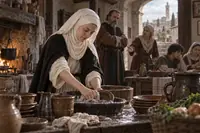
To put an end to every marriage proposal, she cut off her golden hair with her own hand, then quietly turned washing and cooking for her family into a form of wordless prayer.
She knelt beside the block and held the head of the condemned Niccolò in her lap as the axe came down, so that the drops of warm blood spattered her mantle.
Stay in silence
You feel the strength of something simple: a dyer’s daughter who could not write and never went to school was the one who dared tell a Pope to be braver — and he listened.
If you are what you should be, you will set the whole world on fire.
Let us pray
Saint Catherine of Siena,
you were a dyer’s daughter who never went to school, yet you dared to speak the truth even to the Pope. You also knelt beside a condemned man, holding him in his last hour.
Pray for the Church and her leaders, that they may be brave and holy.
Teach me to turn washing and cooking into prayer, and to stay beside those who are afraid of death.
Amen.
Sources
- Feast dayAuthor’s edited profile
- Patron ofPatronages and symbols, version 1.1
- Often depicted withPatronages and symbols, version 1.1
- Reflectionvatican.va
- Reflectionvaticanstate.va
Meet the next one
 Journey 6