

Journey 6 · Keepers of the Lamp of Faith
Saint Francis de Sales
Sweetness that wins over hardened hearts
Feast day January 24
Tap to step inside
Saint Francis de Sales
Sweetness that wins over hardened hearts
Map of a life
This life told in 5 chapters
Begin the journey OpeningOpening1 min
 Chapter 1 of 5A young nobleman of Savoy4 min
 Chapter 2 of 5Winning the fortress of the Chablais with leaflets3 min
 Chapter 3 of 5A bishop of gentleness and the masterpiece “Introduction to the Devout Life”2 min
 Chapter 4 of 5His last rest in Lyon1 min
 Chapter 5 of 5Patron of writers and journalists1 min
Feast day
Saint Francis de Sales
Some places may celebrate on a slightly different day.
January 24
Patron of
- Writers and journalists (proclaimed by Pius XI in 1923)
- The deaf
Often depicted with
- A heart
- A book
Opening
Opening
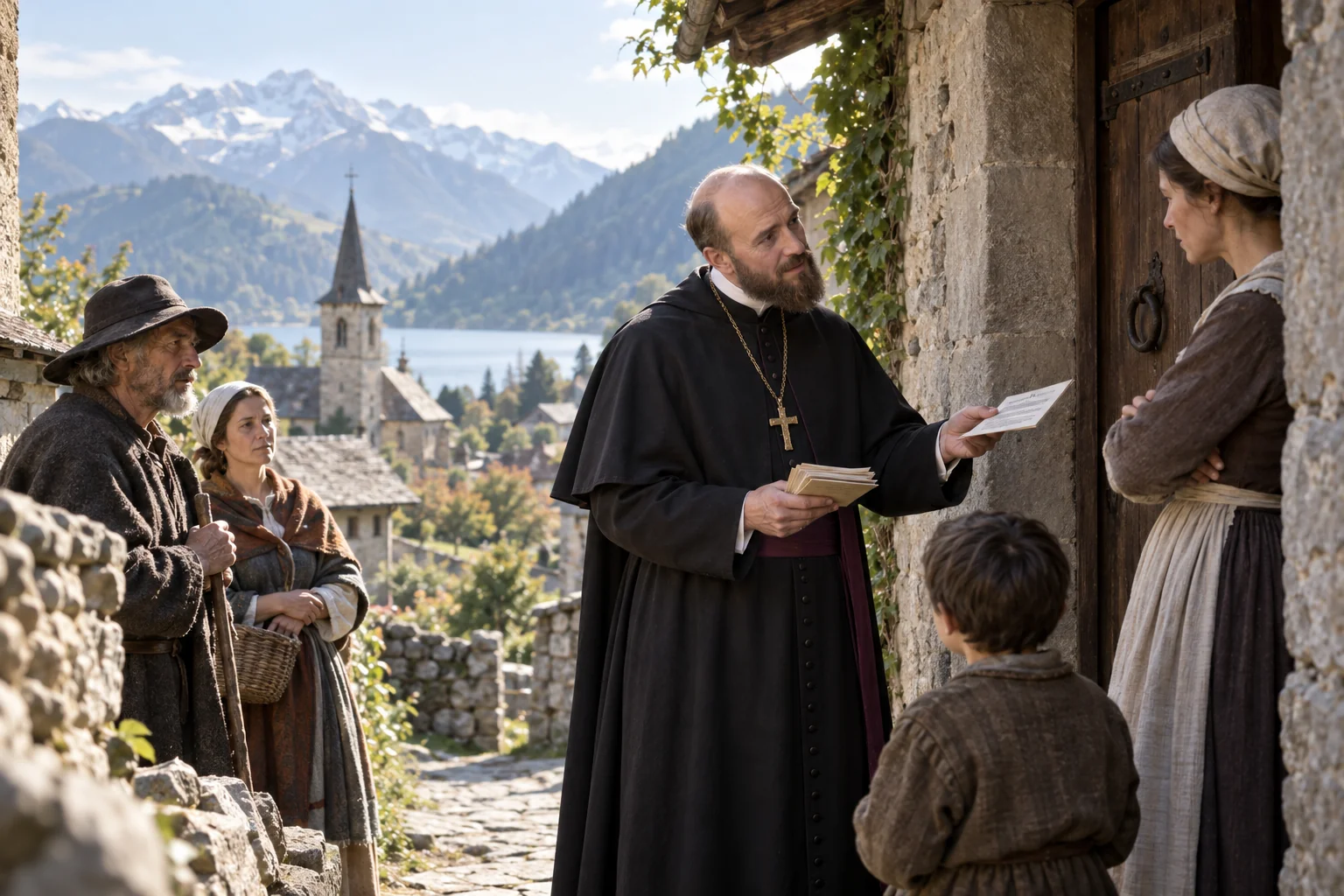
In the autumn of 1594, a thirty-year-old man left the town of Annecy and set out for the southern shore of Lake Léman (the French name for Lake Geneva), carrying a Bible, a breviary, and almost nothing else. His destination was the Chablais, a fertile strip of land along the lakeshore which Catholics of the time regarded as lost: more than twenty-five thousand inhabitants had gone over to Calvinism, every Catholic priest had been expelled, and the churches had been closed or turned into Protestant meeting houses.
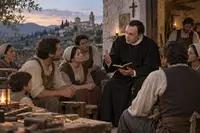
He had no armed escort. Only his cousin, the priest Louis de Sales, went with him. They lodged at the fortress of Allinges, a cluster of old castles on a high hill above the town of Thonon, which had guarded the way into Savoy since the Middle Ages. From there he walked down to Thonon every day to preach to a town that had shut its doors on him and forbidden anyone to listen to him or sell him so much as a loaf of bread.
Four years later, when he left that land, all twenty-five thousand people who had followed the Reformation had returned to the Catholic Church, without a drop of blood shed and without any persecution. That man was Francis de Sales — François de Sales — later Bishop of Geneva, Doctor of the Church, patron of writers and of those who work in communications. The story of how he won over a whole hostile region, not with the sword but with patience and small sheets of paper slipped under doors, is still one of the most remarkable lessons in the power of gentleness.
Chapter 1 of 5
A young nobleman of Savoy
Nothing in François de Sales’s background pointed to a life like that. He was born on August 21, 1567, at the castle of Thorens, its pointed towers rising among the hills of Savoy, then an independent duchy, not yet part of France, wedged between the Alps and Lake Geneva. His father, François de Boisy, was a powerful nobleman at the court of Savoy. His mother, Françoise de Sionnaz, gave birth to him when she was only fifteen. Hers was an arranged marriage, as was usual among the nobility of the time, but she became a deeply devout mother, and it was she who first planted in her eldest son the devotion to Our Lady that he kept all his life.
As the eldest of thirteen children, François had his path laid out from childhood: to inherit the title and carry on his father’s political career, perhaps go further still. He was sent to the best schools Europe could offer. In 1578, at only eleven, he left home for Paris to study at the Collège de Clermont, one of the most prestigious schools of the day, run by the Jesuits, where Latin grammar, rhetoric and scholastic philosophy were taught by the strictest methods of the late Renaissance.
It was in Paris, at nineteen, while attending the lively theological debates that were a regular part of student life at the time, that François fell into a violent crisis of faith, not over whether God existed, but over one particular doctrine: the Calvinist doctrine of Predestination, which held that God had decided from all eternity that some people would be saved and some would go to hell, and that a person had no way of changing their fate by their own merits or good will.
For a sensitive perfectionist like François, that idea became a terrible trap. He became convinced, with nothing to go on but his own obsession, that he was destined for hell, and that however hard he tried to live well, it would be no use. The crisis lasted six weeks without a break. He could not eat or sleep; his slender body wasted away until his friends feared he might die of sheer exhaustion.
The crisis reached its peak one evening in January 1587. François went into the church of Saint-Étienne-des-Grès, a small church in the Latin Quarter of Paris that kept an old statue known as “Our Lady of Good Deliverance,” where Paris students often came to pray before an exam or in any crisis. He fell to his knees and, choking with sobs, prayed the Memorare, the prayer that reminds Our Lady that no one who ever fled to her protection was left unaided. Then he spoke a prayer that has been quoted ever since:
“Lord, even if I am destined to be separated from You forever in hell, at least in the days I am still allowed to live on this earth, let me love You with all my heart.”
It was a strange prayer, almost a paradox: not asking to be saved, only asking to love, whether he was lost or not. But that moment of letting go completely, instead of trying to argue himself into reassurance, was the turning point. He later said that as soon as he finished the prayer, the despair crushing his soul melted away, and a sweet peace he had never known took its place. Those six weeks of inner torment, painful as they were, became the foundation of everything he would later teach: God is not to be feared but loved, and love is the only cure for every anxiety.
In 1588, obeying his father, François left Paris for the University of Padua in northern Italy to study law — entirely in keeping with the career his family had planned. In 1591 he earned a doctorate in both civil and canon law at once, an achievement rare even among the best students of the time.
When he returned to Savoy with a doctorate in law in hand, his father had everything ready for his son’s future: a seat in the Senate of Chambéry — the most powerful body in the duchy — and an arranged marriage with a rich, beautiful heiress. For any young nobleman of the time, it was a dream: power, wealth and fame, all neatly wrapped up, his for a nod.
François turned it all down. He asked his father to let him become a priest. The struggle between father and son was long and tense: a nobleman did not easily accept that his eldest son and heir would give up everything to put on a priest’s cassock. But in the end, faced with his son’s unshakable resolve, he gave in. On December 18, 1593, François de Sales was ordained a priest, and soon afterward was appointed Provost of the cathedral chapter of Geneva, although the city of Geneva itself was under Calvinist control and the bishop had in practice moved his seat to Annecy, about forty kilometers away.
Chapter 2 of 5
Winning the fortress of the Chablais with leaflets
Less than a year after his ordination came the greatest opportunity, or rather the greatest trial, of François’s priestly life. The Chablais, the land south of Lake Geneva, had just been returned to the Duchy of Savoy after years of military conflict with Reformed Geneva. But returning the land did not mean returning the faith: during decades under Geneva’s influence, almost all of the twenty-five thousand inhabitants had become Calvinists. The Bishop of Geneva appealed for volunteer priests to go and re-evangelize the region. None of the diocesan clergy dared to go, for a very practical reason: priests who ventured into that region had been beaten, and some even murdered.
Only François came forward. He said simply to the Bishop:
“If Your Excellency thinks I can do anything, I am ready to go.”
He knew the danger well, but he went anyway, with only his cousin Louis de Sales.
In the winter of 1594 the two priests settled at the fortress of Allinges, a medieval stronghold on a hill commanding the whole southern shore of Lake Léman, fought over for centuries by Savoy and Geneva. From there François walked down every day to Thonon, the chief town of the region, looking for ways to reach the people.
But the Calvinist ministers had told the people of Thonon never to listen to the Catholic priest, never to sell him food, never to give him shelter. On some freezing winter nights, walking back to Allinges, François was chased through the forest by dogs and even wolves, and had to climb a tall tree and huddle there all night in the bitter cold. Afterward his feet were so frozen that they had to be soaked in warm water for hours to save his toes from gangrene. At least three times assassins hired to get rid of that “troublesome priest” lay in wait for him on the road, and each time he escaped by a hair’s breadth.
After many long months with almost nothing to show for it, doors still shut and ears still closed, François had an idea no missionary had tried before. If people would not open their doors to hear him preach, he would write, and let the pages find their own way into each home. Beginning on January 25, the feast of the Conversion of Saint Paul, he sat night after night by candlelight writing short leaflets in French. In a clear, courteous and sometimes witty style, they set out the Catholic teaching on the authority of the Pope, the Sacraments and the Eucharist, the very points the Calvinist ministers attacked hardest. He and his few helpers quietly slipped those sheets of paper under the doors of houses at night, and pasted them on tree trunks and on walls in the streets.
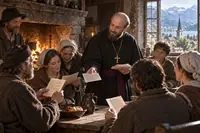
At first there was only silence; some people tore the leaflets up as soon as they saw they came from “the papist priest.” But curiosity, especially about something forbidden that turns up at your own door, slowly won out. People began to pick them up and read them, then passed them around by the fire on winter nights, careful not to let the neighbors know. One by one, the knots of prejudice tied over decades began to loosen.
The real turning point came in 1596 and 1597, when François was finally able to organize public debates with the Calvinist ministers — especially after an influential figure in the region, Antoine de Saint-Michel, lord of Avully, publicly returned to the Catholic faith. From there the movement spread like oil on cloth. In 1597, thousands of the people of Thonon came asking to return to the Church. By 1598 the number had reached a full twenty-five thousand: almost the entire population of the Chablais had been reconciled with the Church, without any armed force and without a drop of blood shed.
Later, when asked the secret of that remarkable return, François answered with a simple comparison still quoted today in books on persuasion:
“A spoonful of fragrant honey catches more flies than a whole barrel of sour vinegar. You cannot convert people’s hearts with anger.”
Chapter 3 of 5
A bishop of gentleness and the masterpiece “Introduction to the Devout Life”
Word of the mission in the Chablais spread far, and in 1602 François de Sales was consecrated Bishop of Geneva, though in practice he still had to govern from Annecy, since Geneva never came back under a Catholic bishop in his lifetime.
Becoming a bishop did not change François’s way of life. He sold what valuables were left in the bishop’s house and gave the money to the poor, went on wearing his faded black cassock, and still walked, sometimes dozens of kilometers over rough mountain roads, to reach the most remote parishes, places that had not seen a bishop in years. He taught catechism to poor children himself, and sat for hours in the confessional hearing beggars whom many priests of the time avoided.
One of the most important encounters of his life came in 1604, when he met Jeanne-Françoise de Chantal — a young noble widow of deep piety, looking for a spiritual companion after her husband died in a hunting accident. A rare spiritual friendship grew between them, with no other aim than to help each other, and others, become holy. In 1610 they founded the Order of the Visitation together, for women, including the frail and the elderly, who wanted to live a consecrated life but lacked the strength for the strict penances of the older orders.
But Francis de Sales’s greatest gift to the Church, the one that carried his name far beyond little Savoy, was the book he published in 1609: “Introduction to the Devout Life,” often called Philothea (“lover of God”). It grew out of private letters of spiritual direction to a relative, later reworked into a handbook for anyone in any walk of life.
The book was a quiet revolution because of an idea that many at the time found almost shocking. Before François, the common view in the Church, even among educated clergy, was that to become truly holy you had to give up life in the world, enter a monastery, and leave behind family, trade and soldiering. François put it bluntly:
“It is a deadly error, even a heresy, to wish to banish the devout life from the soldier’s barracks, the craftsman’s workshop, the court of princes, or the home of married people.”
He compared holiness to the different flowers of one garden, each with its own beauty and its own way of blooming: the soldier becomes holy as a soldier, keeping discipline and upright courage; the mother becomes holy amid caring for her children and the work of the kitchen; the merchant becomes holy through honesty in every transaction.
Seven years later, in 1616, he published the “Treatise on the Love of God” (Theotimus), going still deeper into the theology of love he had lived and taught all his life, with a philosophical and theological depth rare in his day.
Chapter 4 of 5
His last rest in Lyon
Decades of tireless work, thousands of kilometers on foot through mountain parishes, sleepless nights writing, teaching and hearing confessions, slowly wore down the bishop’s health. By the end of 1622, when he was fifty-five, his strength was clearly failing.
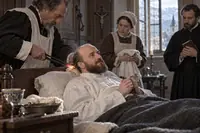
At the end of that year he had to accompany the Duke of Savoy’s party on an official journey to Avignon and then Lyon. In the harsh cold of a French winter, he suffered a sudden stroke. He was put to bed in a small, shabby room, once the gatekeeper’s lodge, at the Visitation convent in Lyon, a house of the very order he had founded with Saint Jane Frances de Chantal twelve years before.
Following the brutal treatment common at the time for stroke, the doctors pressed red-hot irons onto the back of his neck, hoping the shock of pain would bring him round. Those present said that in that agony François did not groan or resist at all, but only smiled faintly and whispered:
“Lord, do with me whatever pleases You.”
On the afternoon of December 28, 1622, the feast of the Holy Innocents, Francis de Sales died. When the doctors performed an autopsy, as was customary for important figures, they found something astonishing: his gallbladder had hardened and shrunk into small stones. It was taken as a sign that behind his famously calm, gentle manner lay decades of hard inner struggle to master a fiery temper. The man who had written that “a spoonful of honey catches more flies than a barrel of vinegar” was not born gentle. He had to forge that gentleness, day after day, until it became his second nature.
Chapter 5 of 5
Patron of writers and journalists
Only thirty-nine years after his death, in 1661, Pope Alexander VII beatified François de Sales, and on April 19, 1665, formally canonized him — remarkably quick by the standards of the time, a sign of how widely his writings and his example had touched people.
In 1877, Pius IX proclaimed Francis de Sales a Doctor of the Church, in recognition of the theological worth of his writings, especially the “Introduction to the Devout Life,” a book still in print today, translated into dozens of languages, and more widely read than most religious works of its age.
In 1923, through the encyclical Rerum Omnium Perturbationem, Pius XI named Francis de Sales patron of Catholic writers, journalists and all who work in communications: a fitting choice for a bishop who used handwritten leaflets to open closed hearts long before anyone had heard of “mass media.” The Church celebrates him on January 24 each year.
Of all the sayings of Francis de Sales, perhaps the most quoted, and the one that best sums up his life, is this:
“Do not wish to be anything but what you are, and try to be that perfectly.”
It is not abstract advice. It comes from a man who was nearly crushed by despair at nineteen, who had to master his temper so hard that it left its mark on his body, and who spent his whole life trying to love in a world full of division and hostility. In his age as in ours, full of harsh words and doors shut tight in suspicion, his example still holds: sometimes the strongest force of all is a gentleness that never gives up.
The end of the story
You have walked with Saint Francis de Sales to the end of the story.
Some passages you keep turning over:
In the middle of a six-week crisis of faith over predestination, he knelt before a statue of Our Lady and prayed: "Even if I am destined to be separated from You forever, let me love You with all my heart."
When a whole region shut its doors to his preaching, he wrote leaflets and quietly slipped them under the door of each house in the dead of night.
After four years of perseverance, all twenty-five thousand people of the Chablais had returned to the Church without a single drop of blood being shed.
Stay in silence
You learn the secret of winning hearts from his own words: a spoonful of honey catches more flies than a barrel of vinegar.
A spoonful of fragrant honey catches more flies than a whole barrel of sour vinegar.
Let us pray
Saint Francis de Sales,
you won over a whole region with nothing but gentleness and sheets of paper slipped under doors, without a drop of blood being shed.
Teach me to speak gently, for "a spoonful of honey catches more flies than a barrel of vinegar".
Pray for those who write for newspapers, write books and work in communications, that they may use words to bring people closer to truth and peace.
Amen.
Sources
- Feast dayAuthor’s edited profile
- Patron ofPatronages and symbols, version 1.1
- Often depicted withPatronages and symbols, version 1.1
- Reflectionvatican.va
- Reflectionvatican.va
Meet the next one
 Journey 6